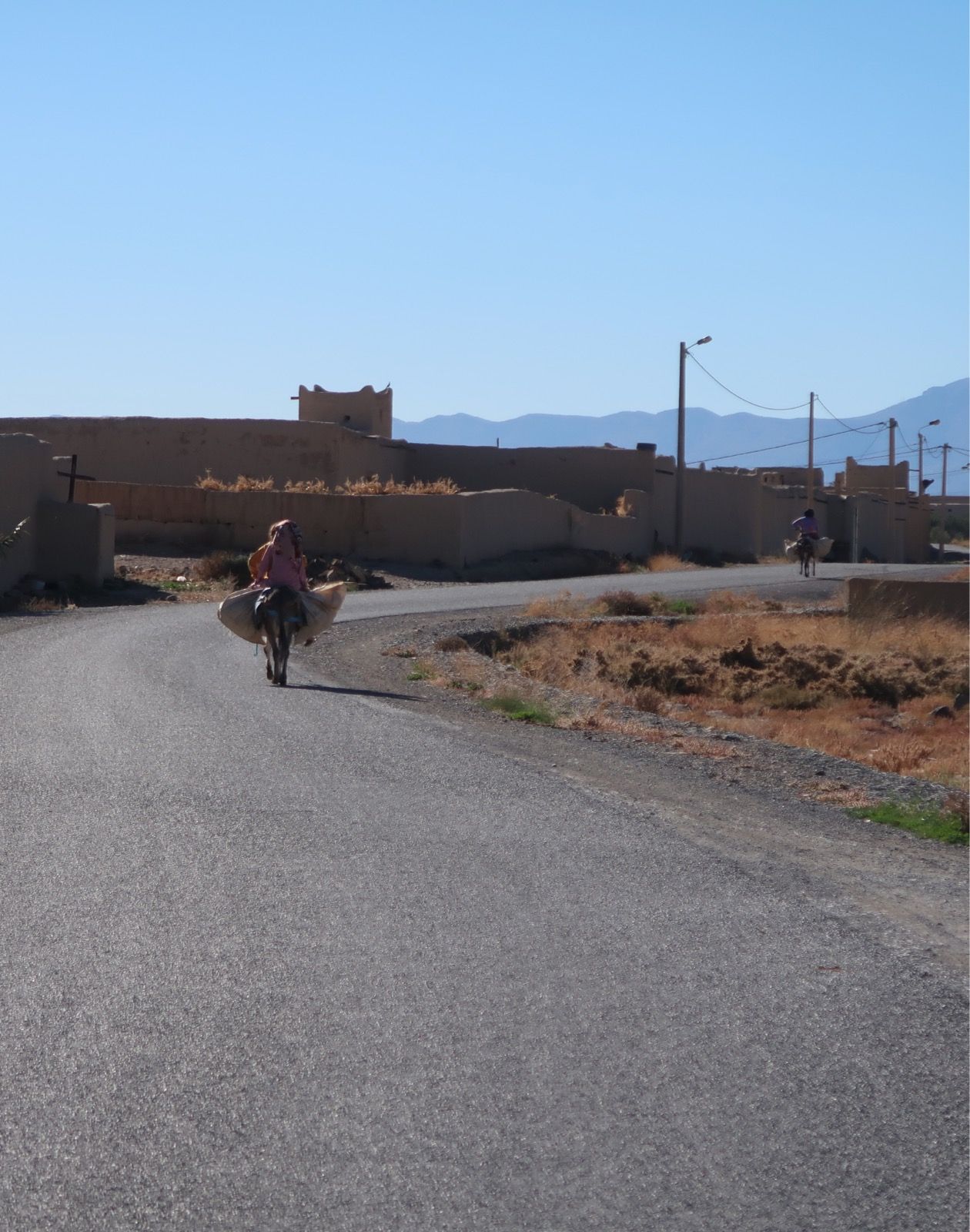
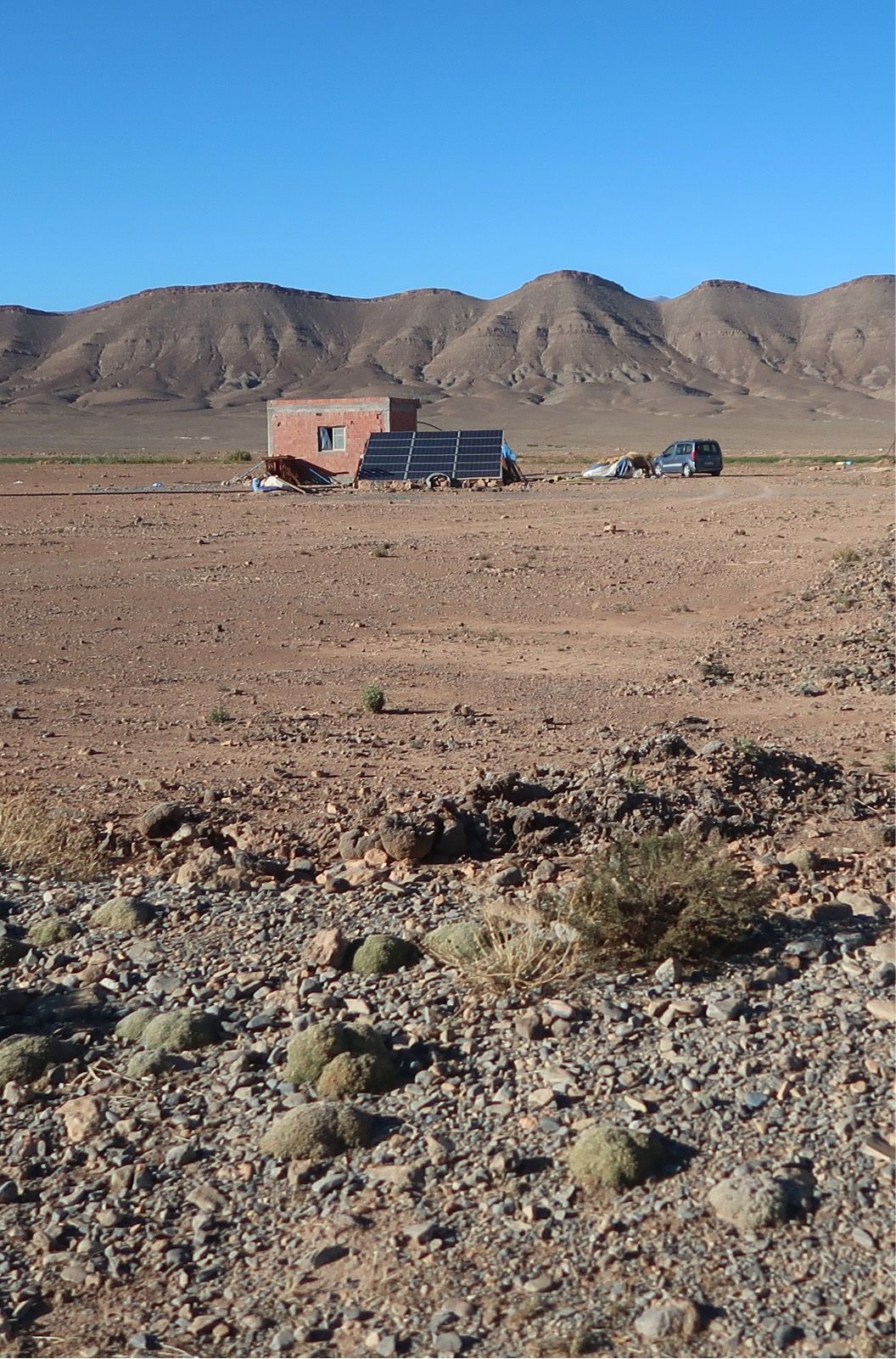
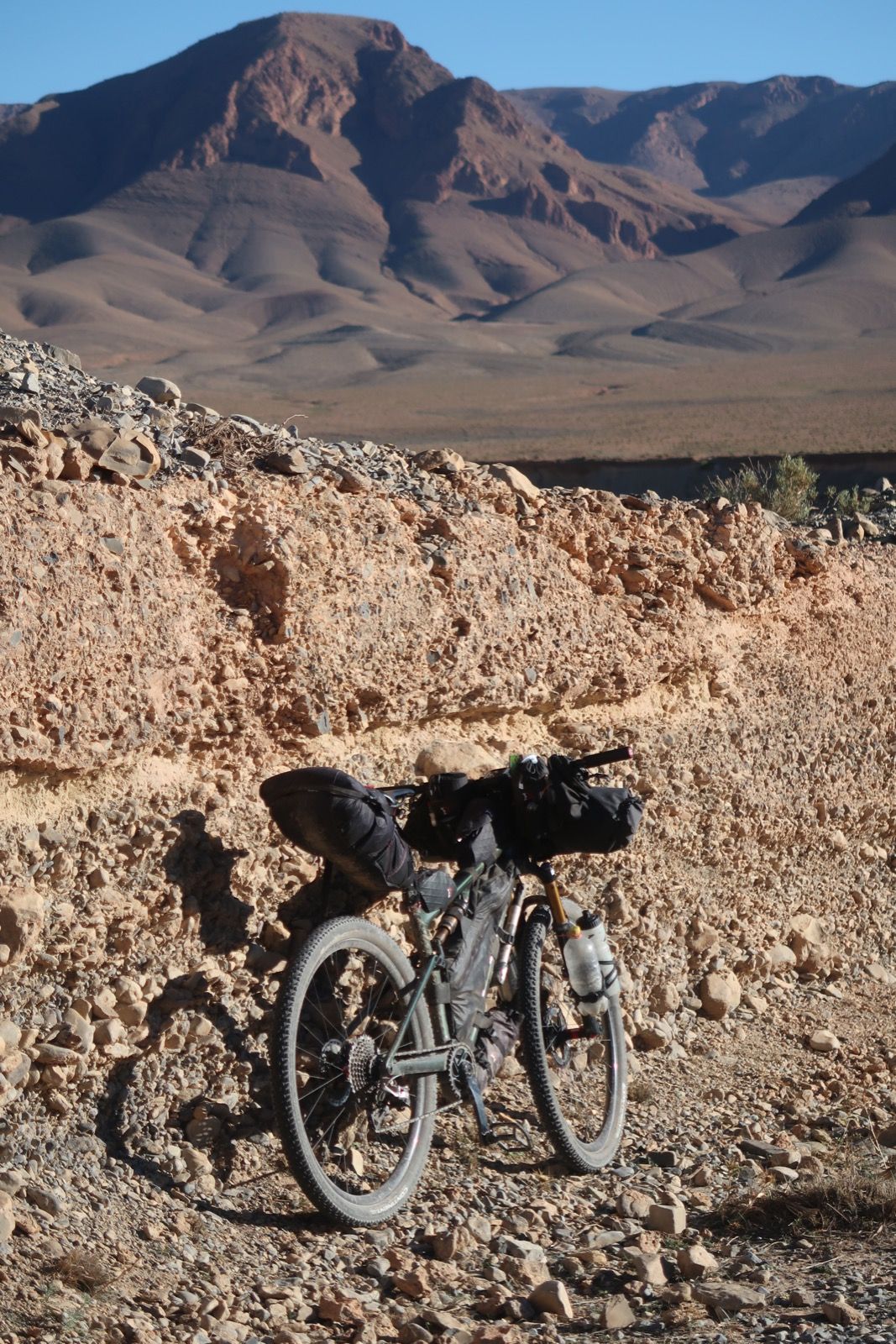
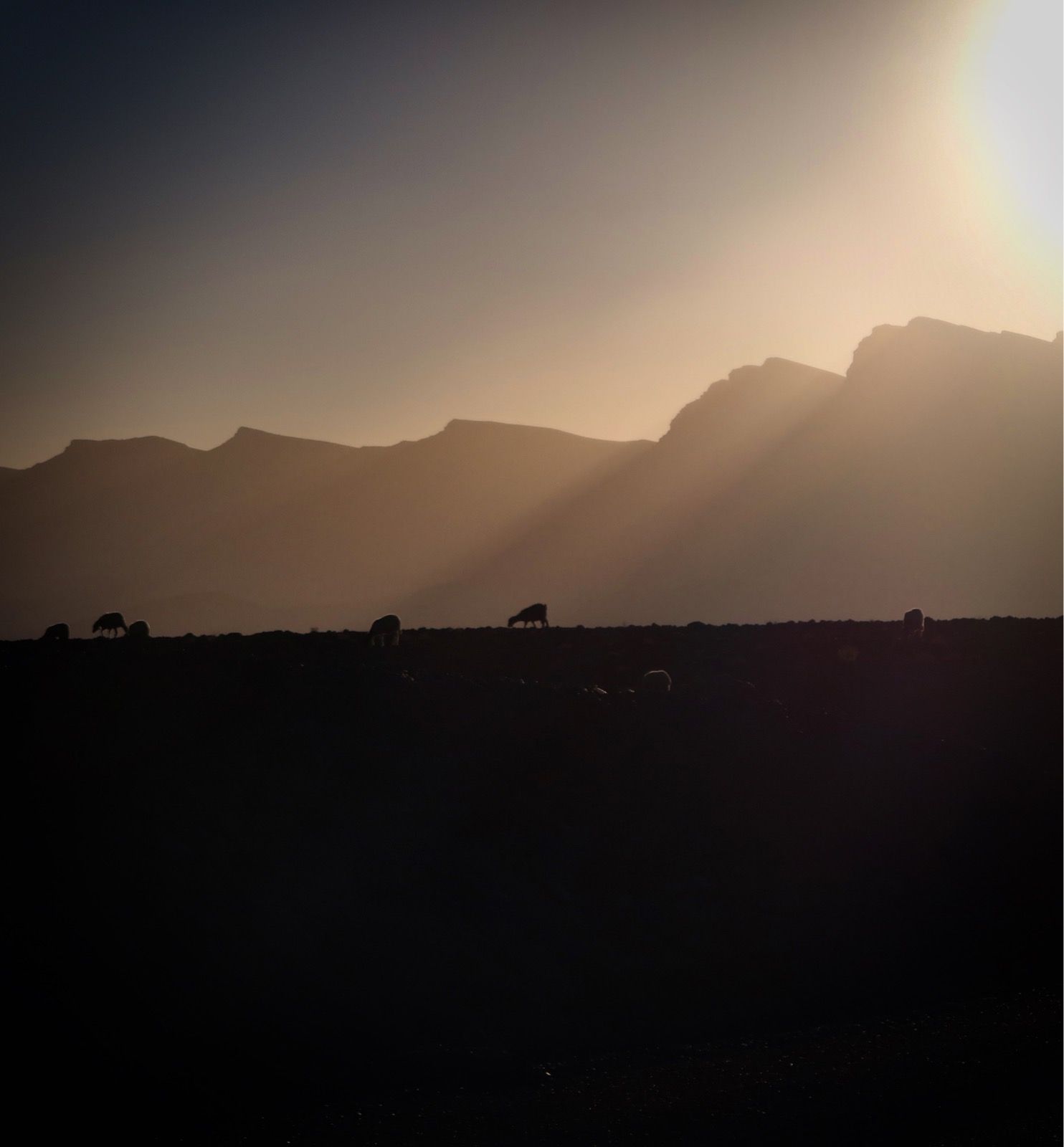
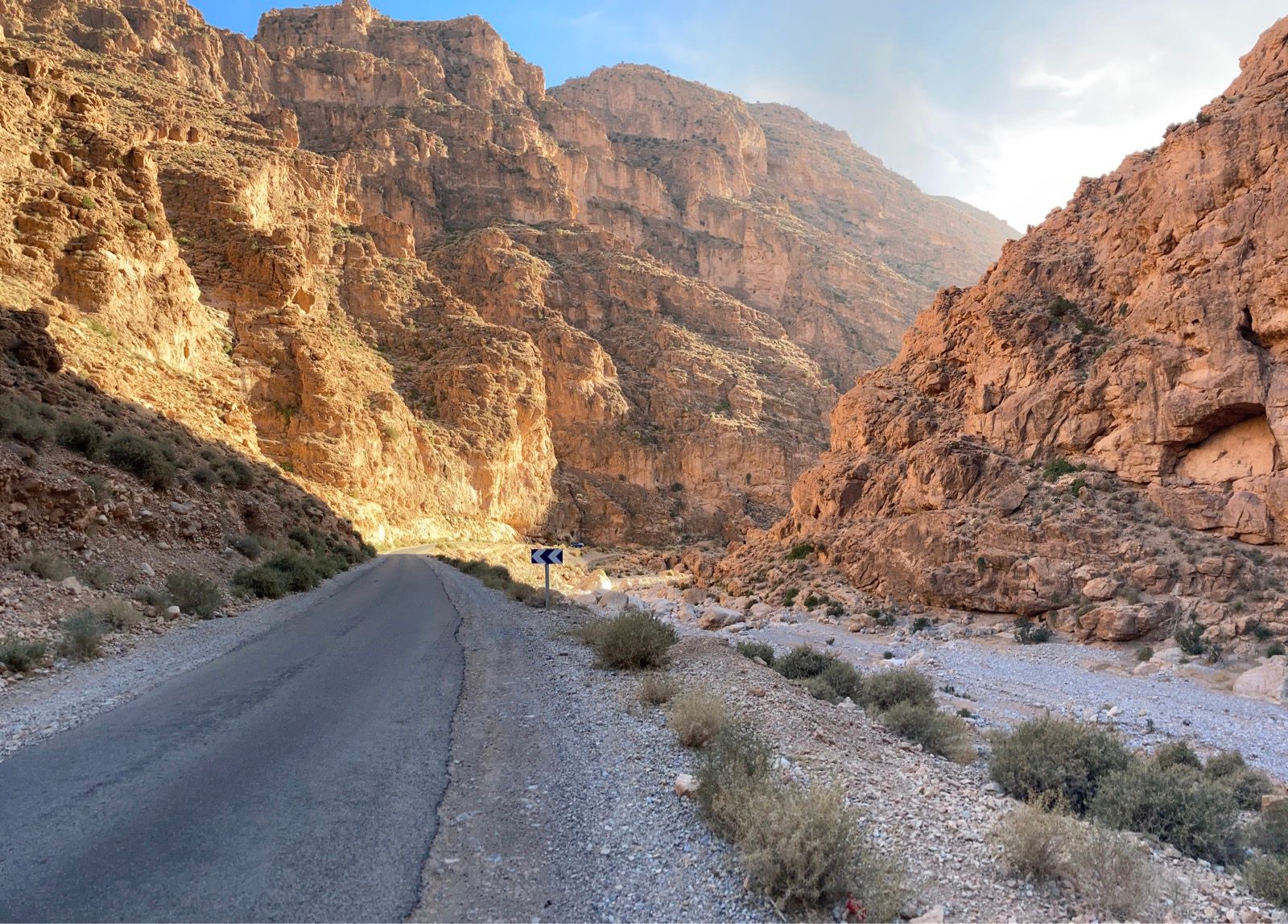
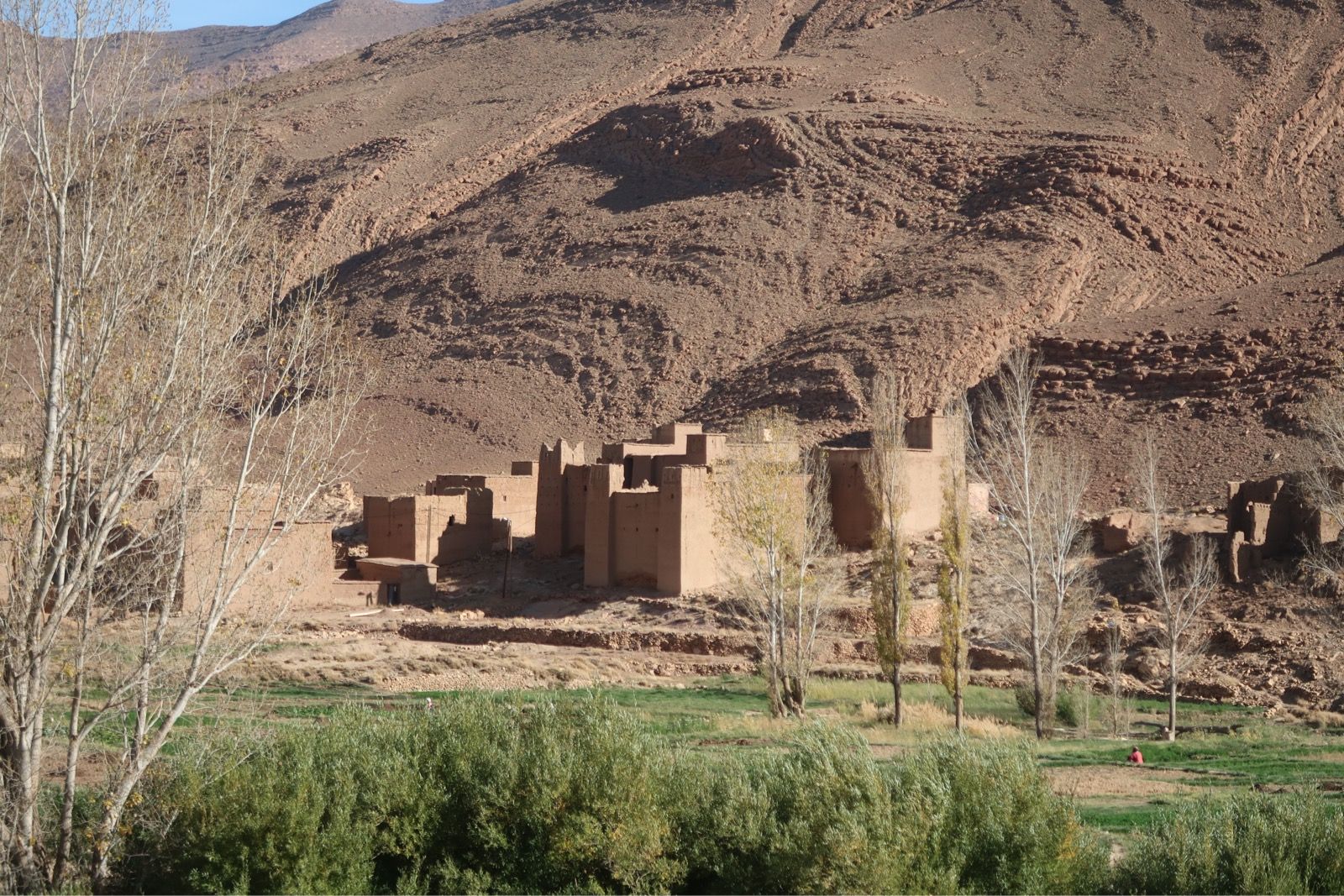
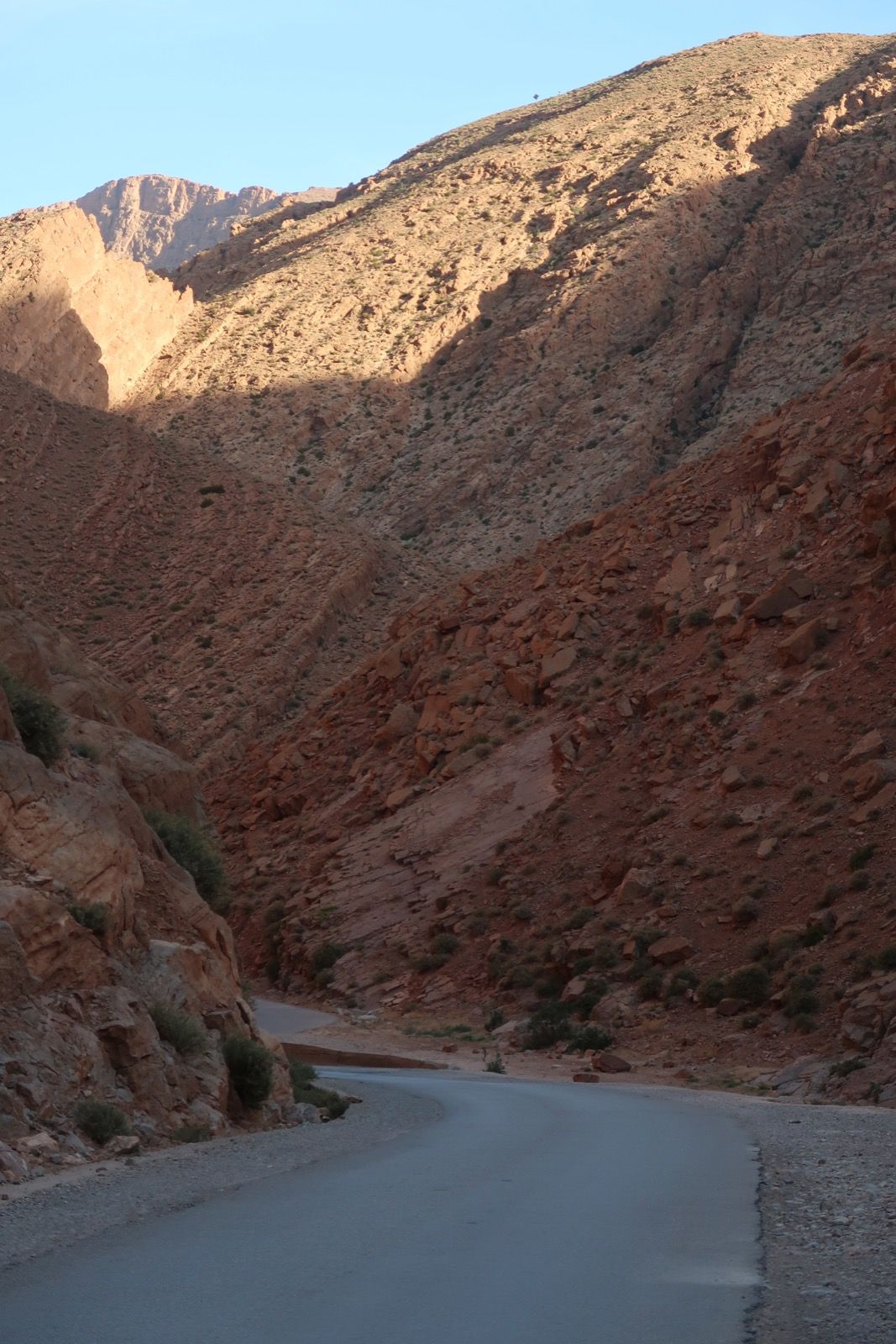
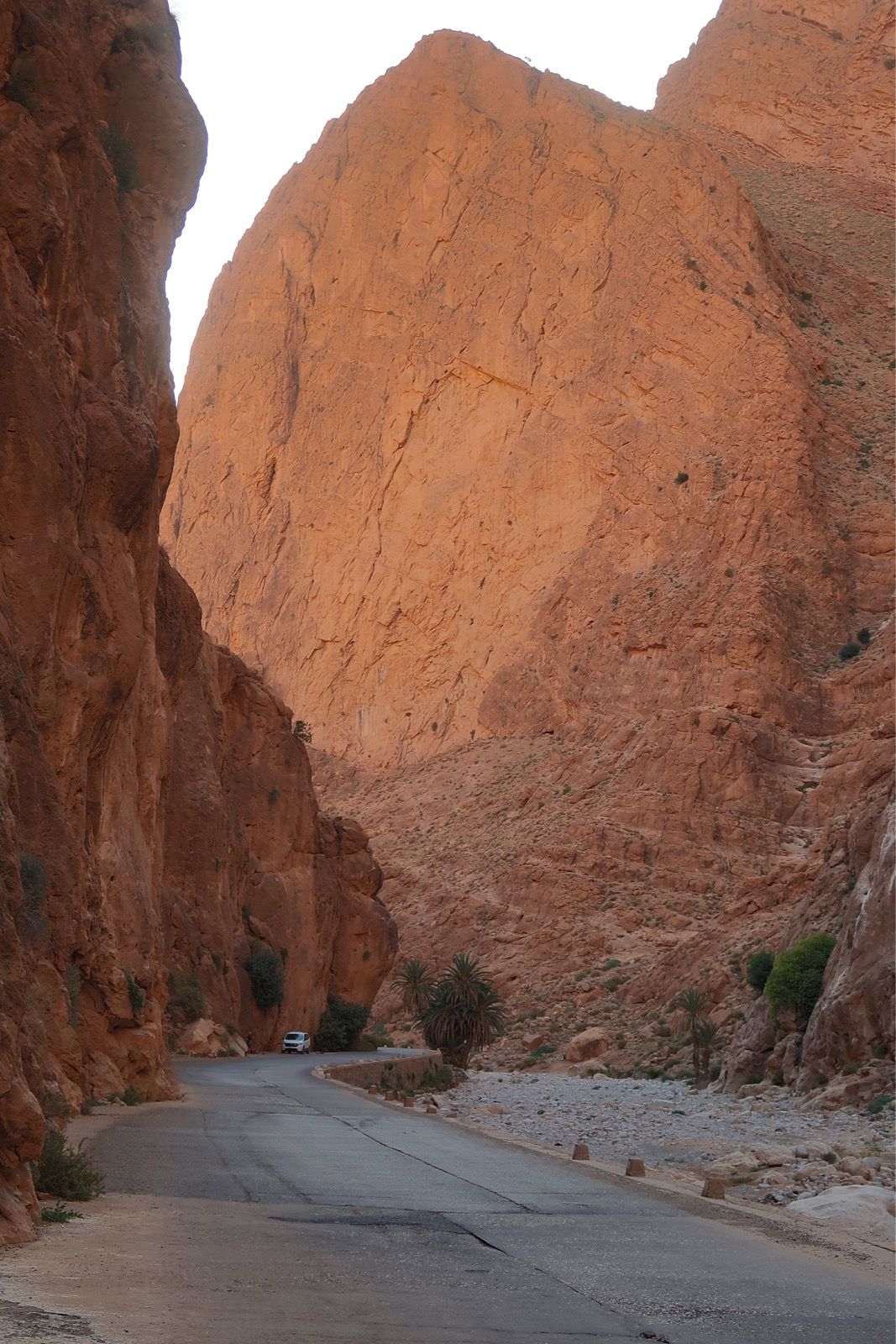
Bikepacking Western Africa

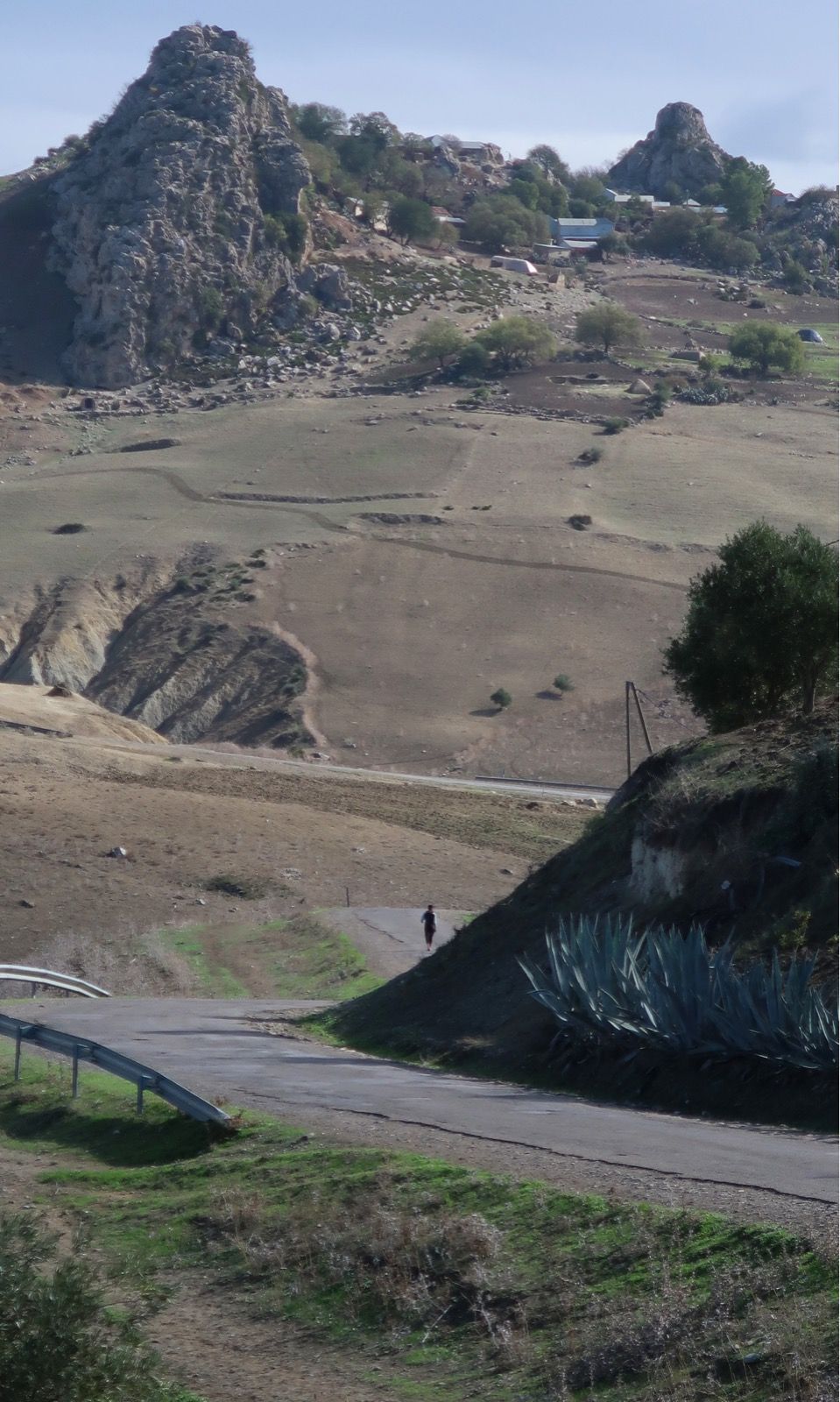
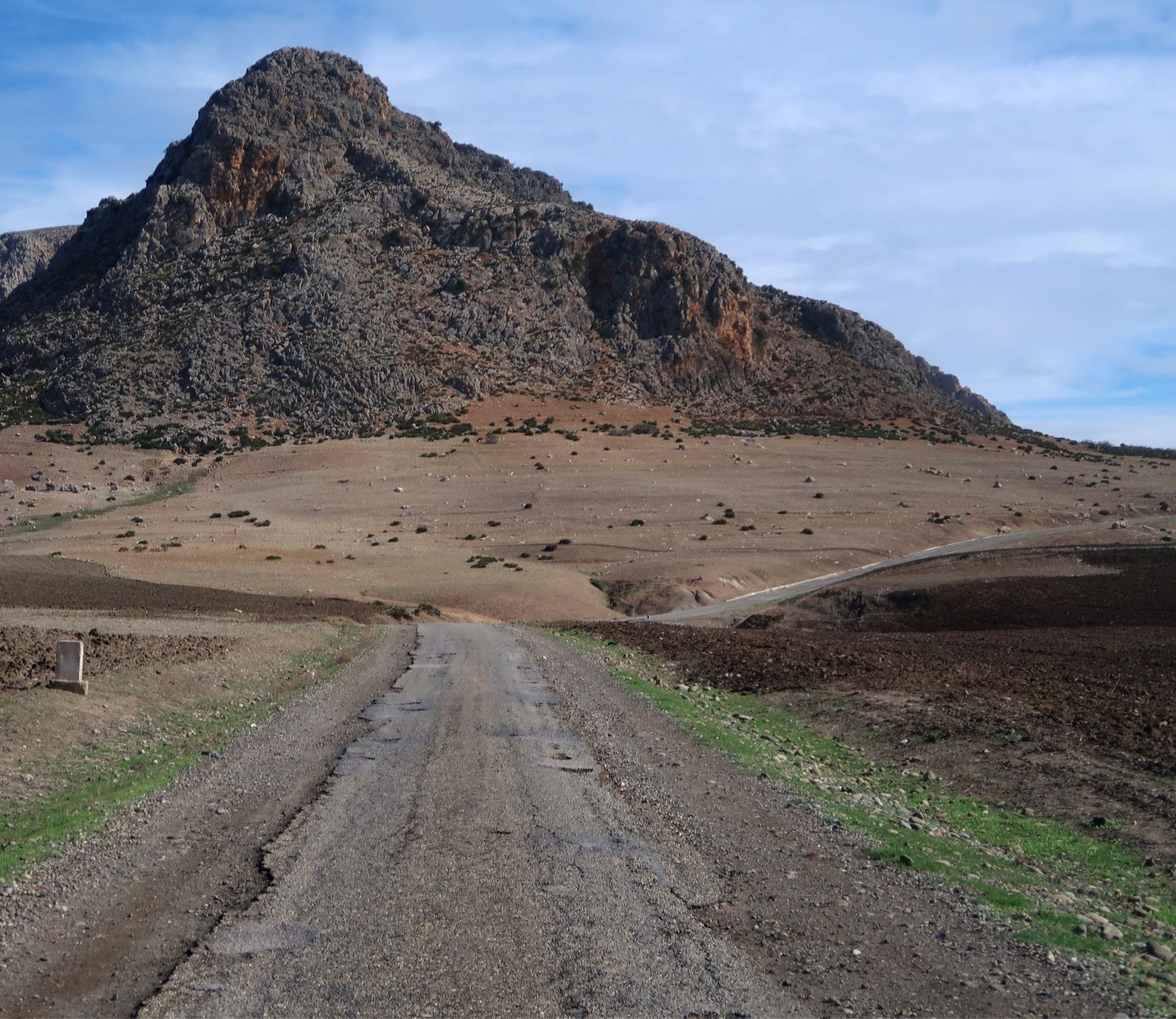
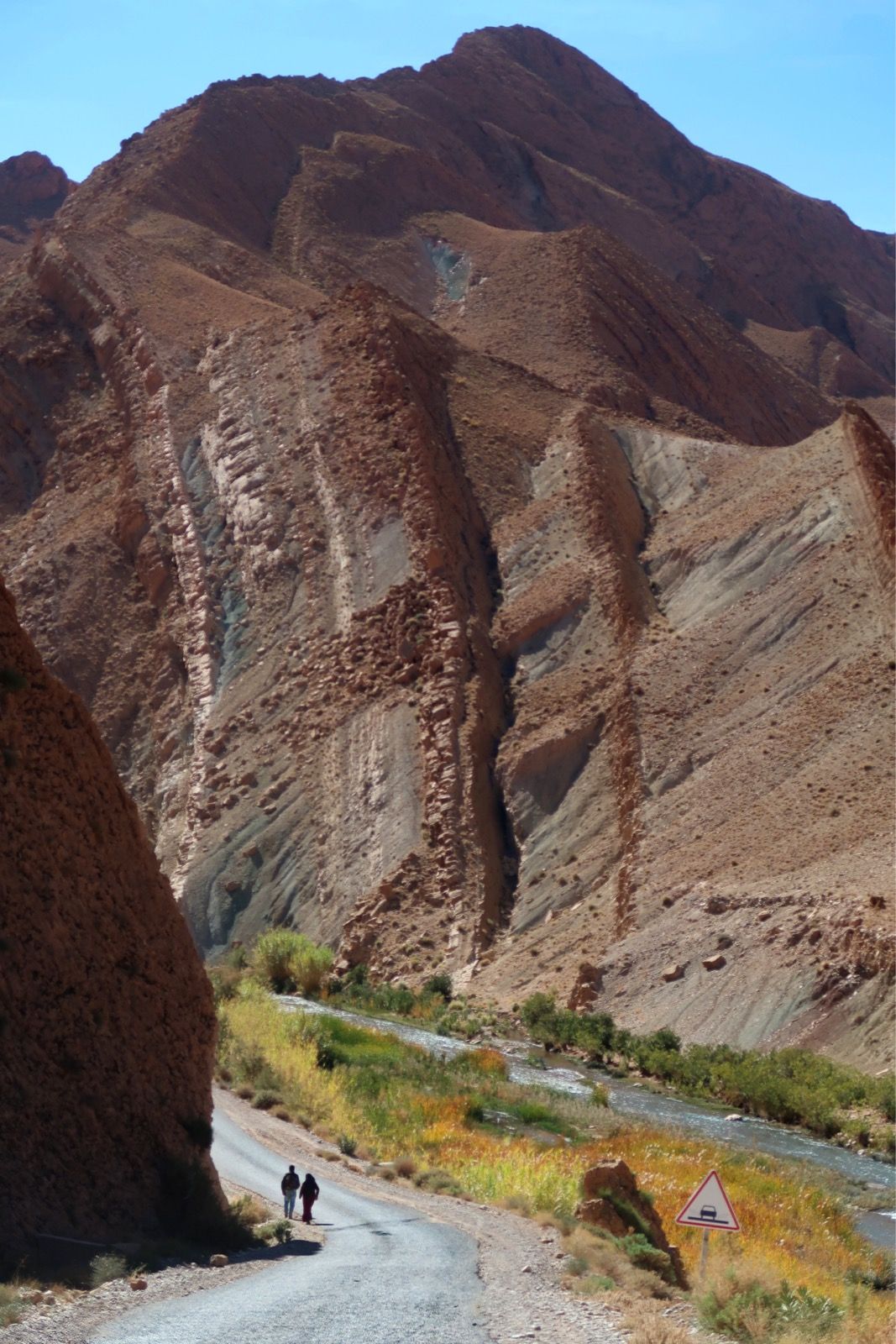
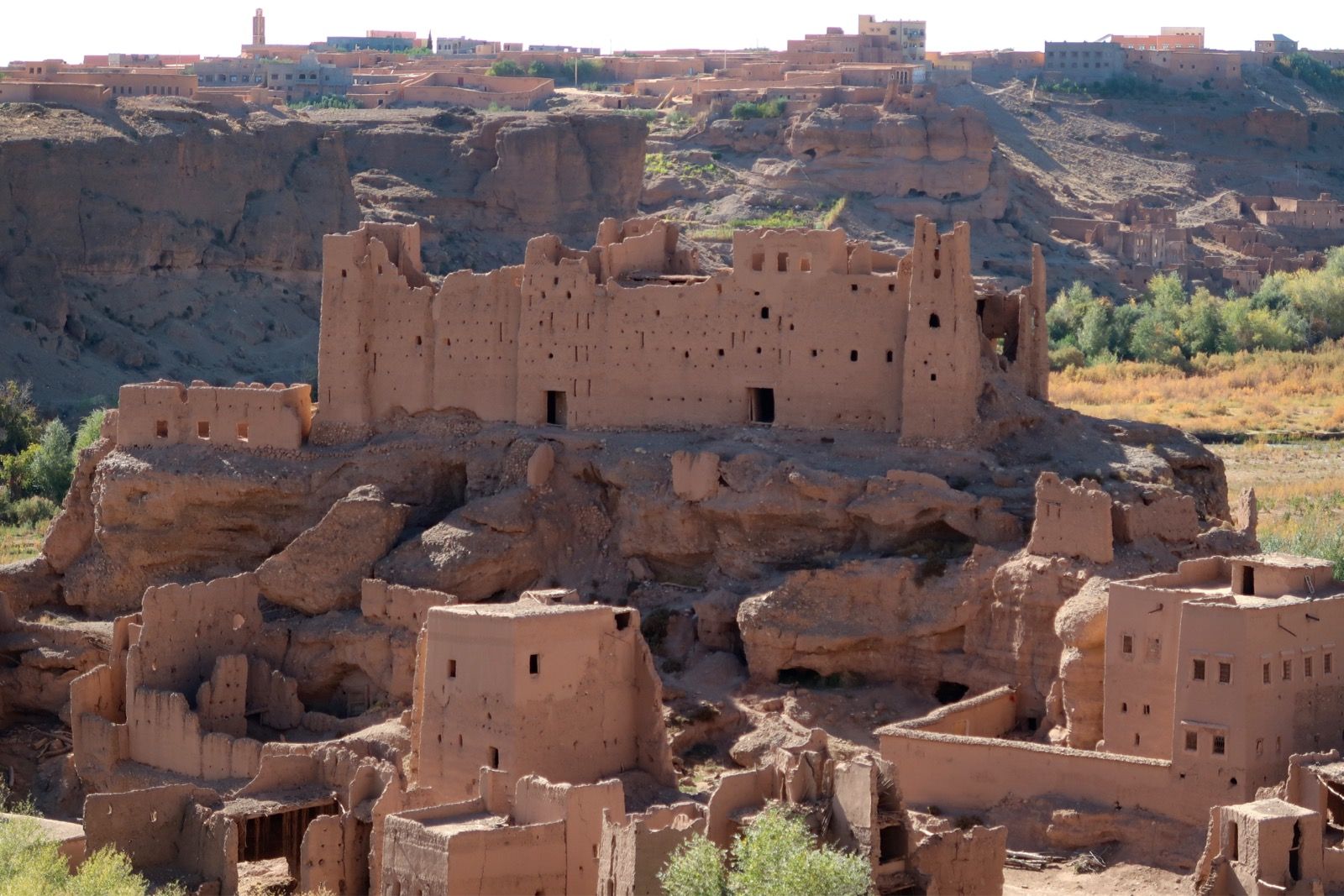
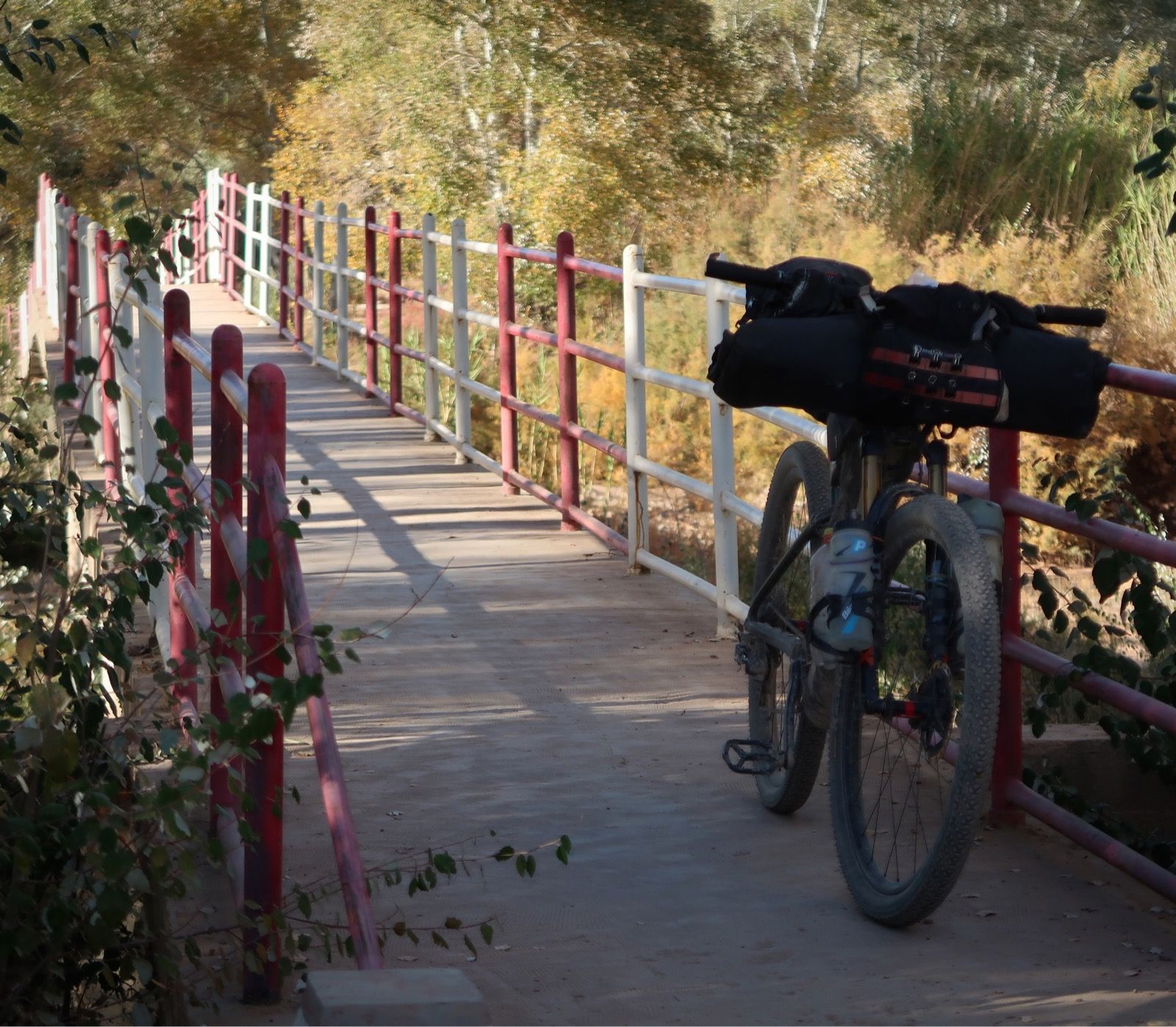
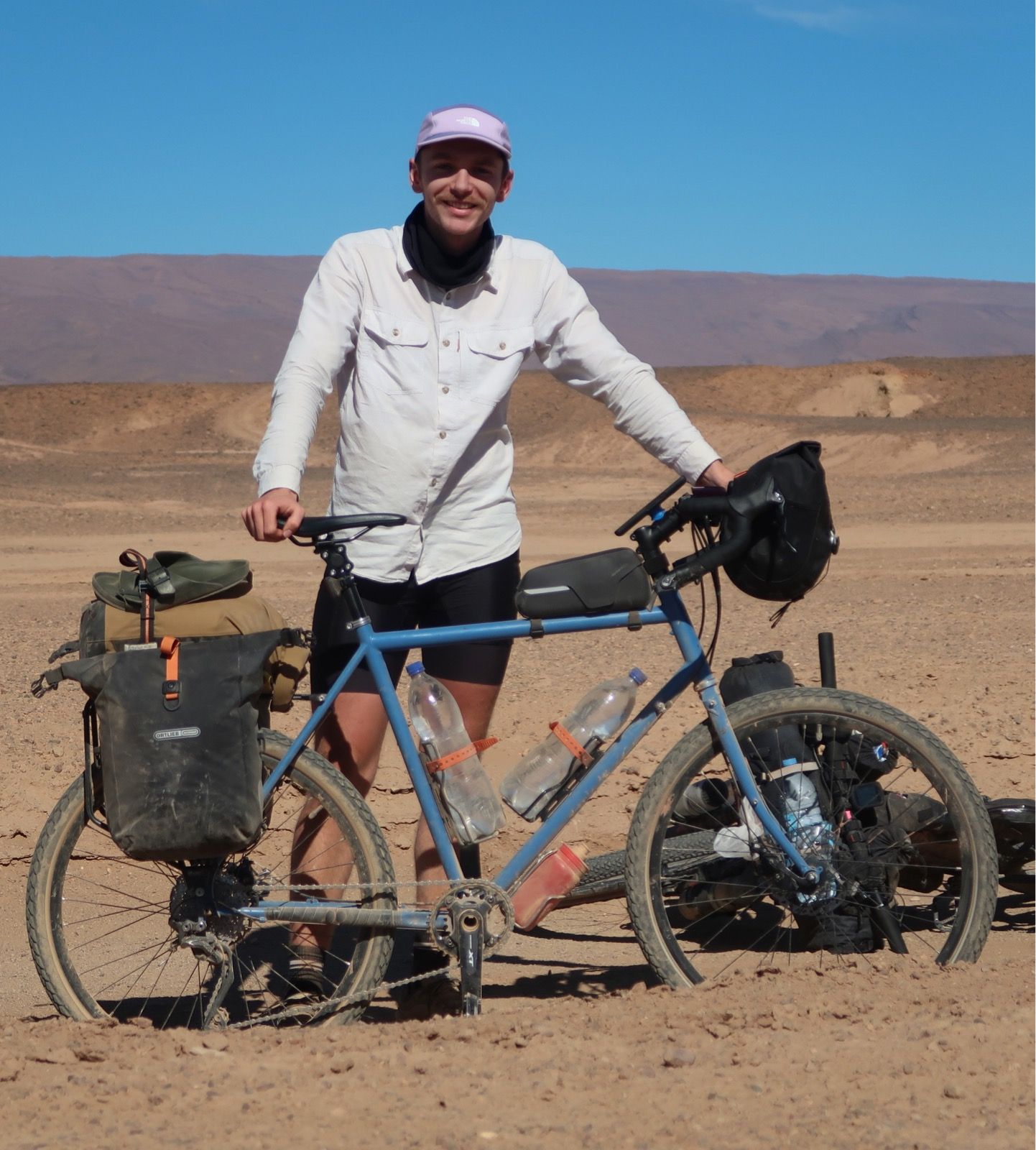
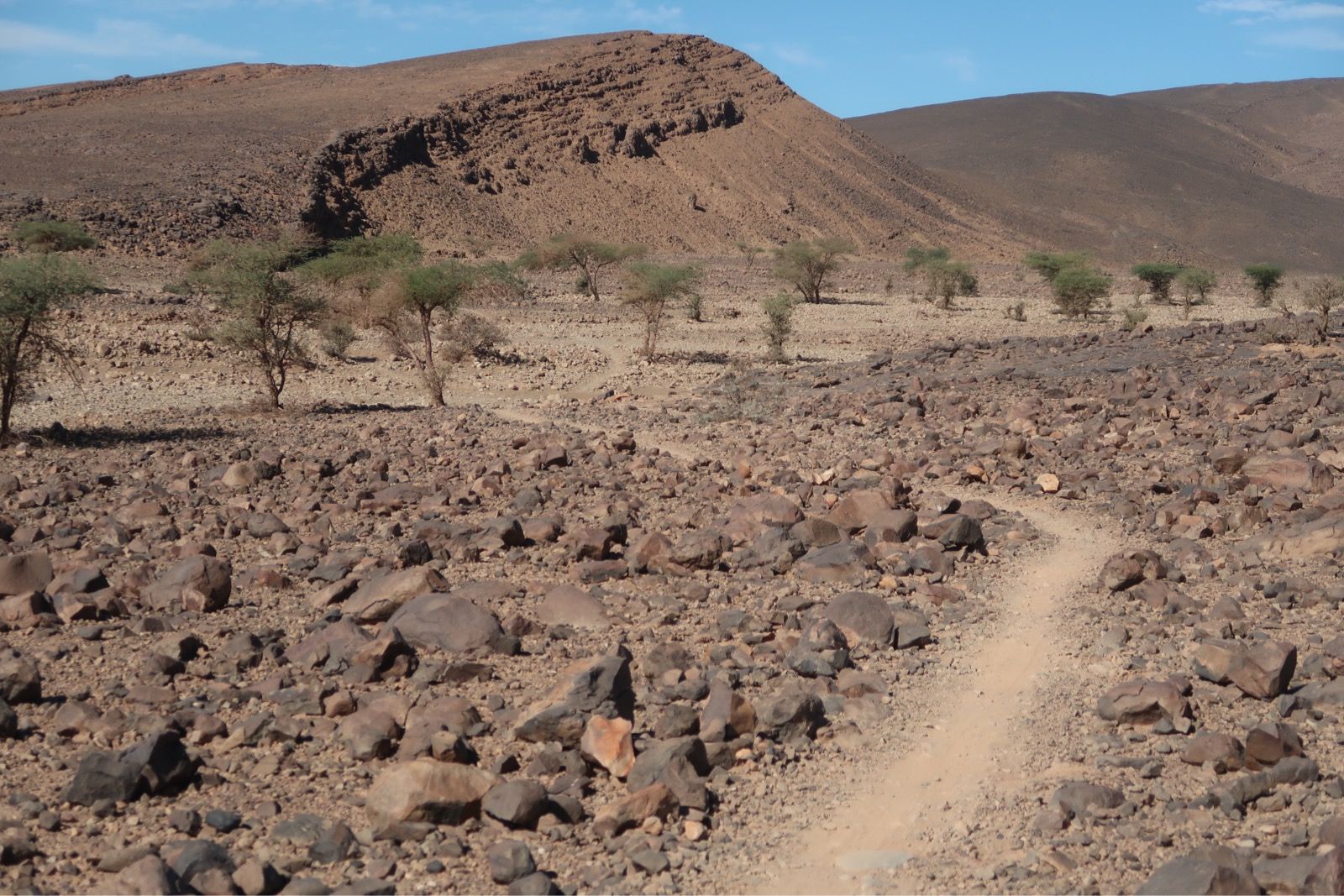
I spent 100 days riding from Morocco to Ghana on a full suspension Mountain Bike during the fall of 2023. It was a fantastic trip with a lot of “ups” and just a couple “downs.” I tired hard to comprehend the culture of Western Africa. Opportunities to talk to people were endless because I was solo, people in this part of the world are extremely outgoing, and due to the remote nature of my route, I was kind of a spectacle. I don’t claim to “understand Western Africa” by any means, however there are certain themes that I noticed which set this part of the world apart from anywhere I have ever toured before.


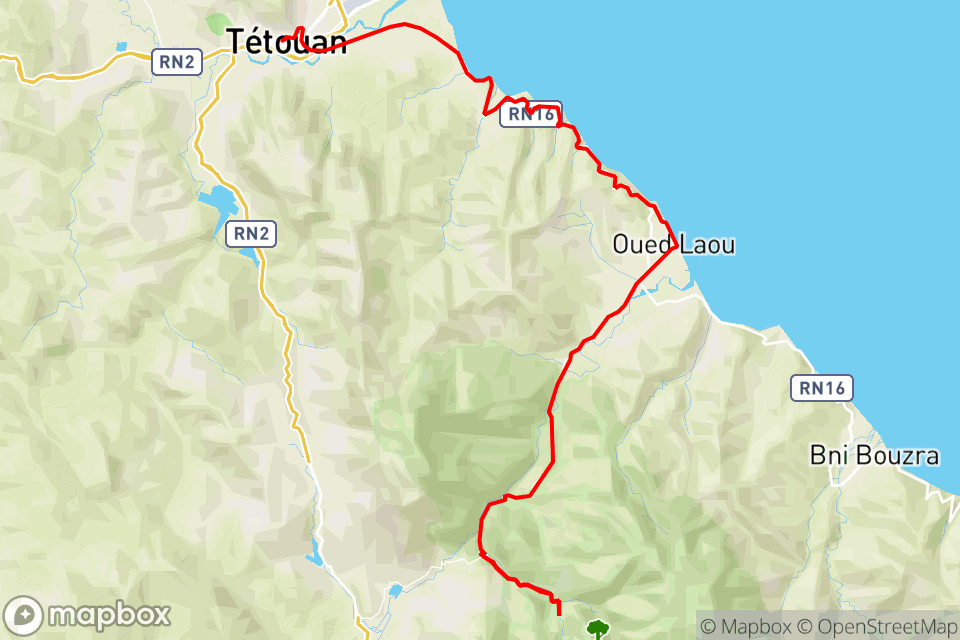
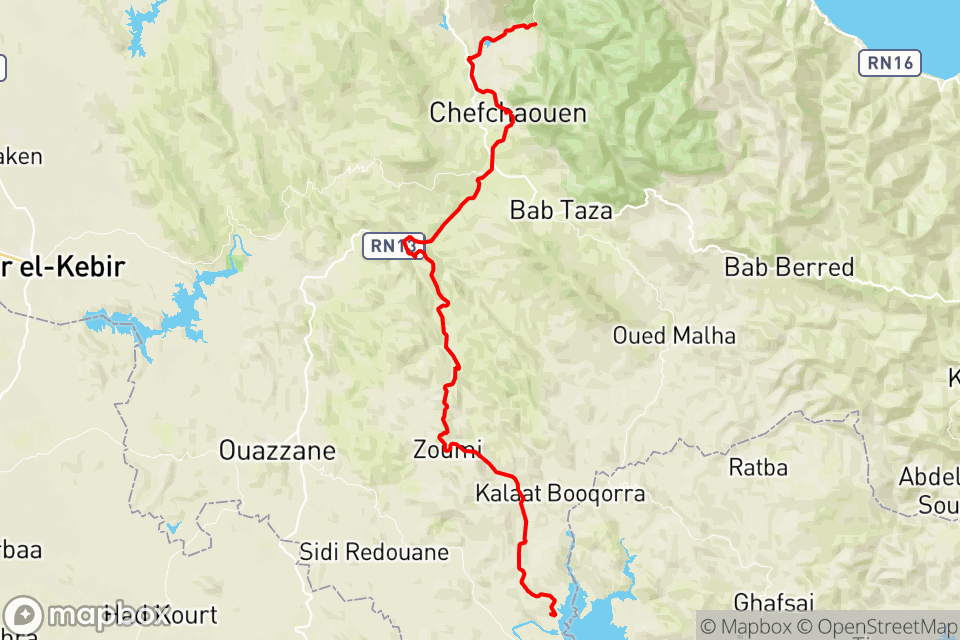
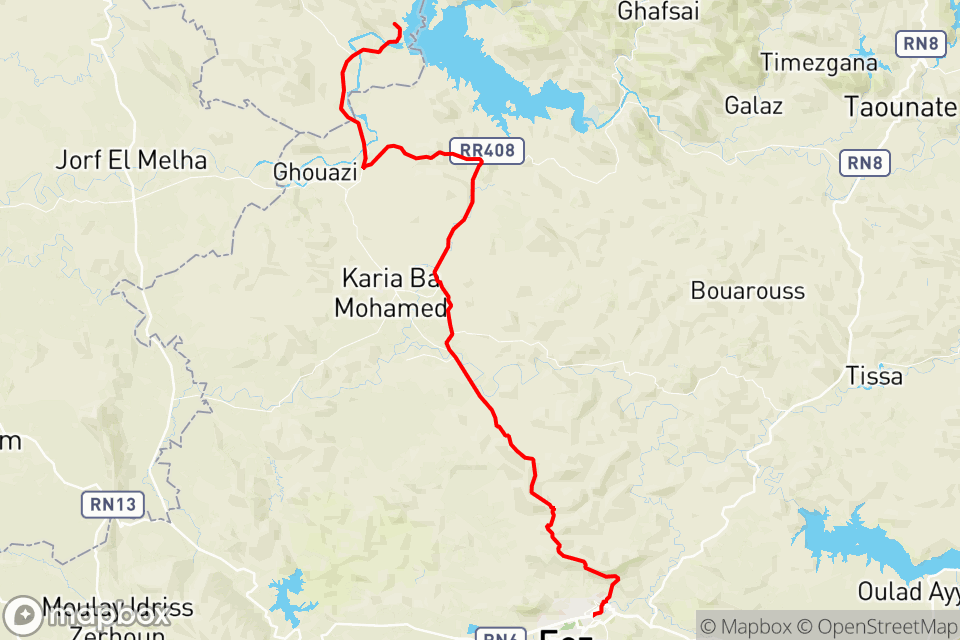
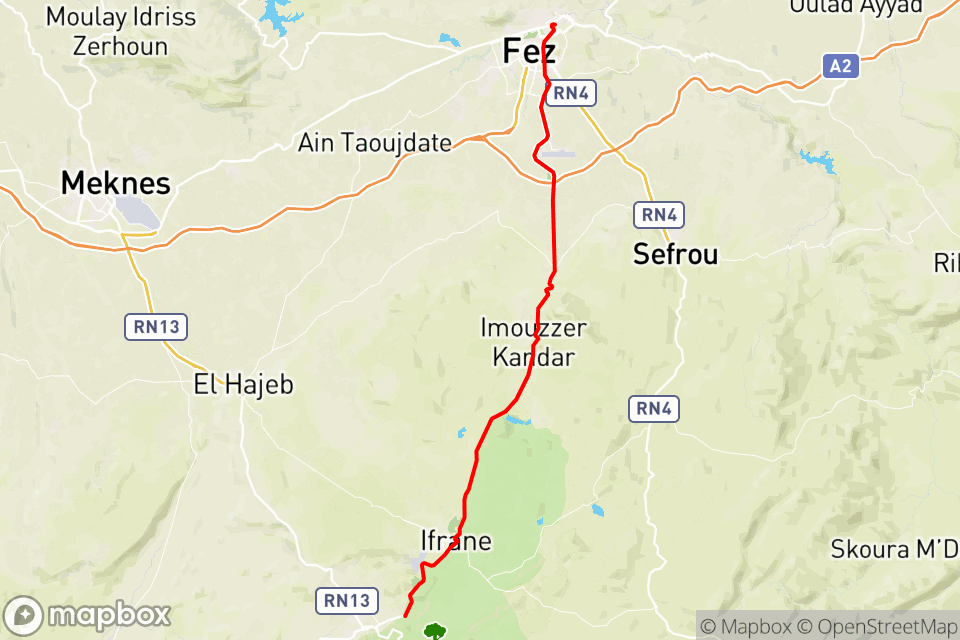
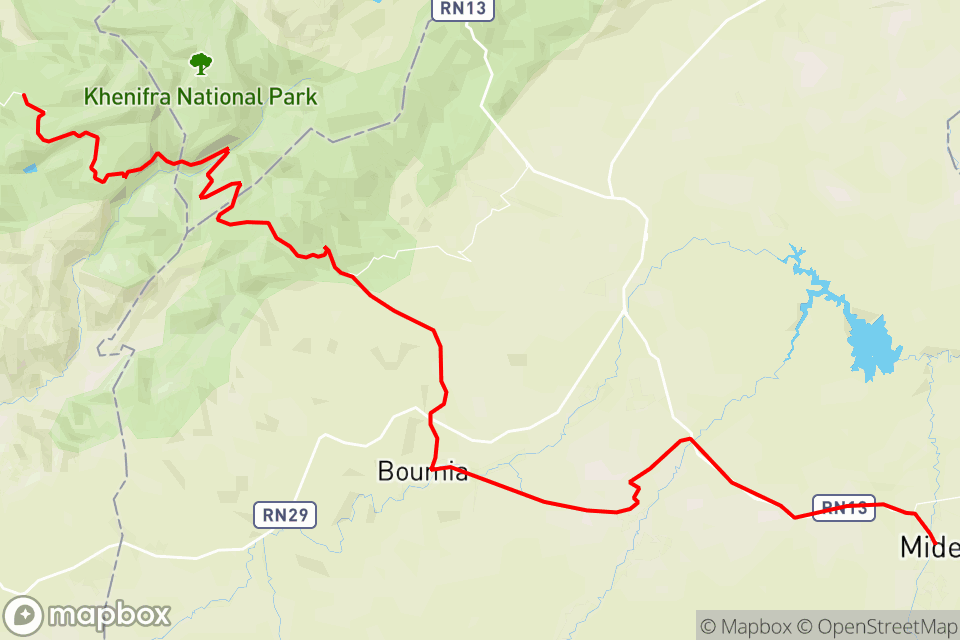
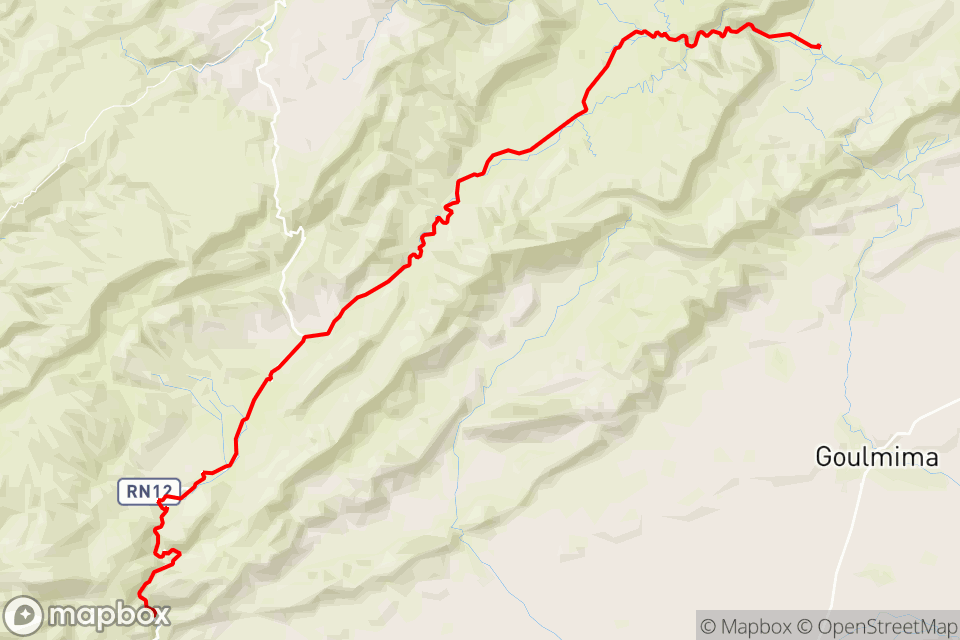
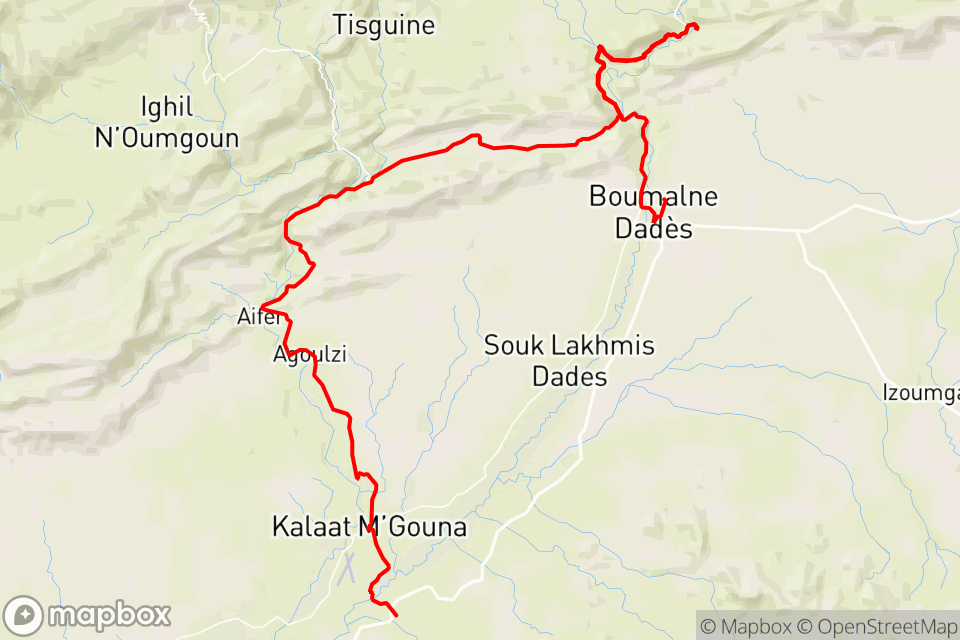
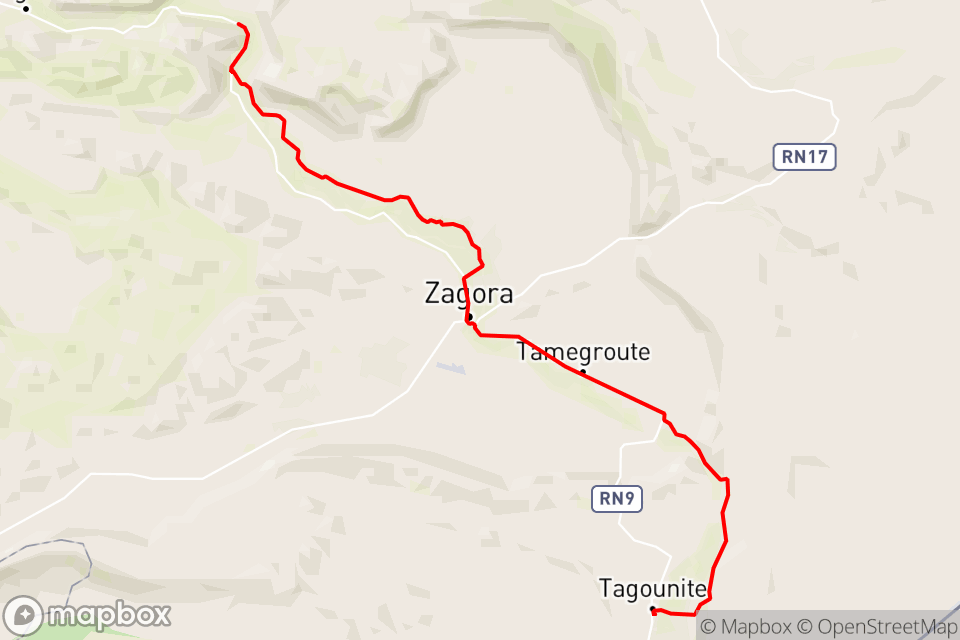
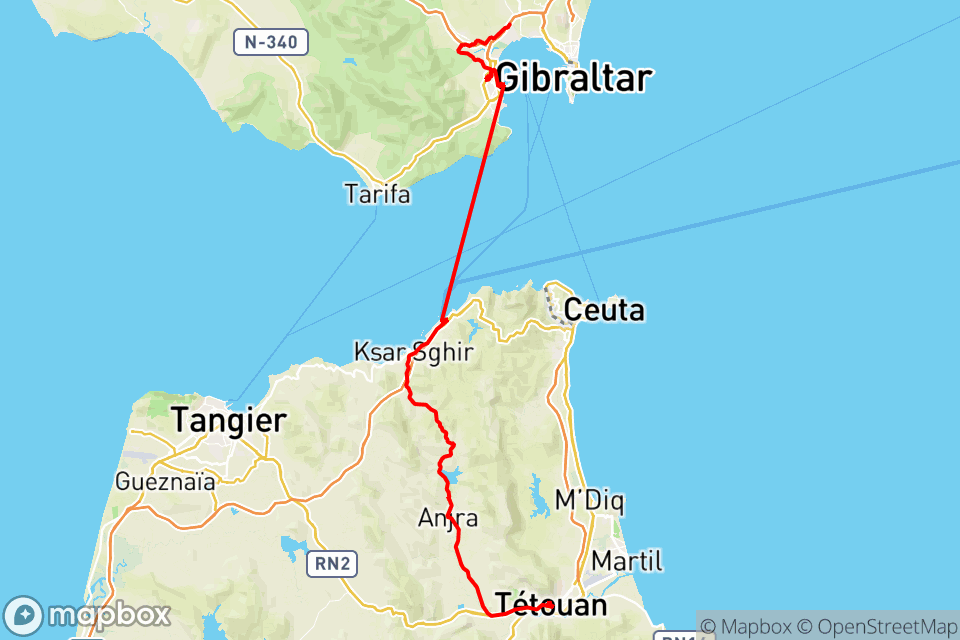
This is the map for the entire route discussed in this post.  To Export GPX files, click on the three horizontal bars in the upper right hand corner of the map and select Export selected map data... To see full screen, click here (opens in new window)


– Day 87 : A Great start to Africa [top]

The morning began well – I can’t believe what a difference staying in a 4 star hotel makes. The breakfast options were simply amazing; Janet and I aren’t used to that because we tend to be “roughing it”. I find it odd that a hotel like this was actually less expensive than some of the other nearby options – but grateful to get a body recharge. No complaints from the staff as I wheeled my bike down the hall and onto the balcony outside the room. This is one of those experiences I wish I could have shared with Janet – the good times!

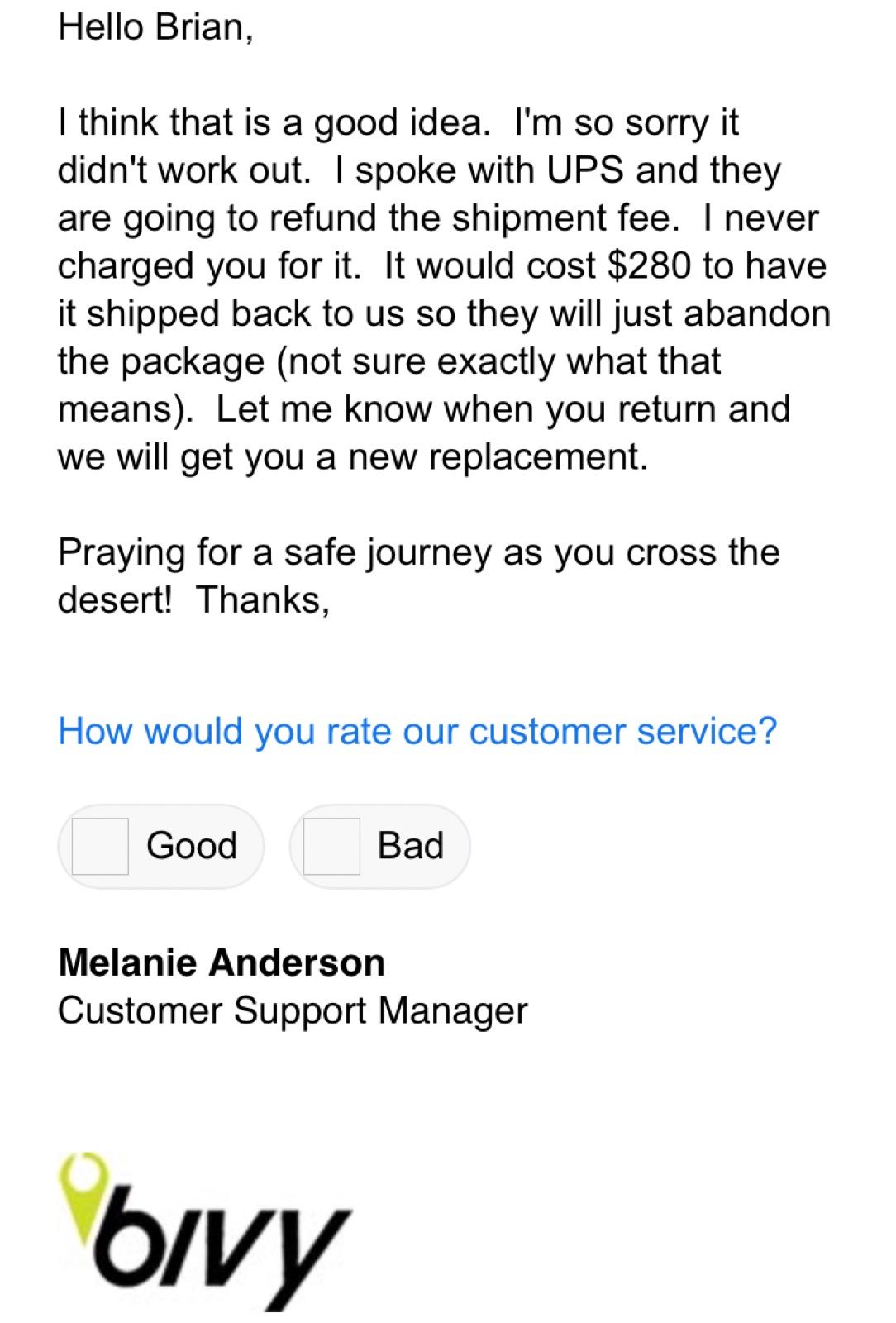
Even though I prepared a ton, I’m feeling a bit unprepared with so many equipment problems. Yesterdays mud nearly depleted a pair of new brake pads; thousands of feet descended in the grit. You know about the ground pad from yesterday (it still works, thankfully, so I am trying to stay relaxed and baby it for the next four months. Grateful for Gregg Bone’s repair suggestion if it comes down to that). A new malady appeared today – my brand new satellite communication device died after working for 1.5 days. I raced around Algerceras looking for a store that might sell something – even a Garmin InReach. Nothing. I thought long and hard about this: people used to travel without these. I do have some hyper-remote 60-120 mile desert sections planned on dirt… I was most looking forward to these sections… but I might reconsider. Maybe. Meanwhile, I am working with BivyStick to express mail a replacement to Fez.

It then became a race to catch the boat. It left in 30 minutes, and the guy in front of me was not being allowed to buy a round trip ticket from Spain to Morocco and back. It seemed like he wasn’t registered as a citizen of the EU. They looked him up in the computer and as the clock ticked away, they guy behind the counter finally figured it out: he was typing “ñ” instead of “n”. The guy insisted his name had “ñ”, but whatever: the computer disagreed. I swear that for every minute computers save from our lives, they waste two.

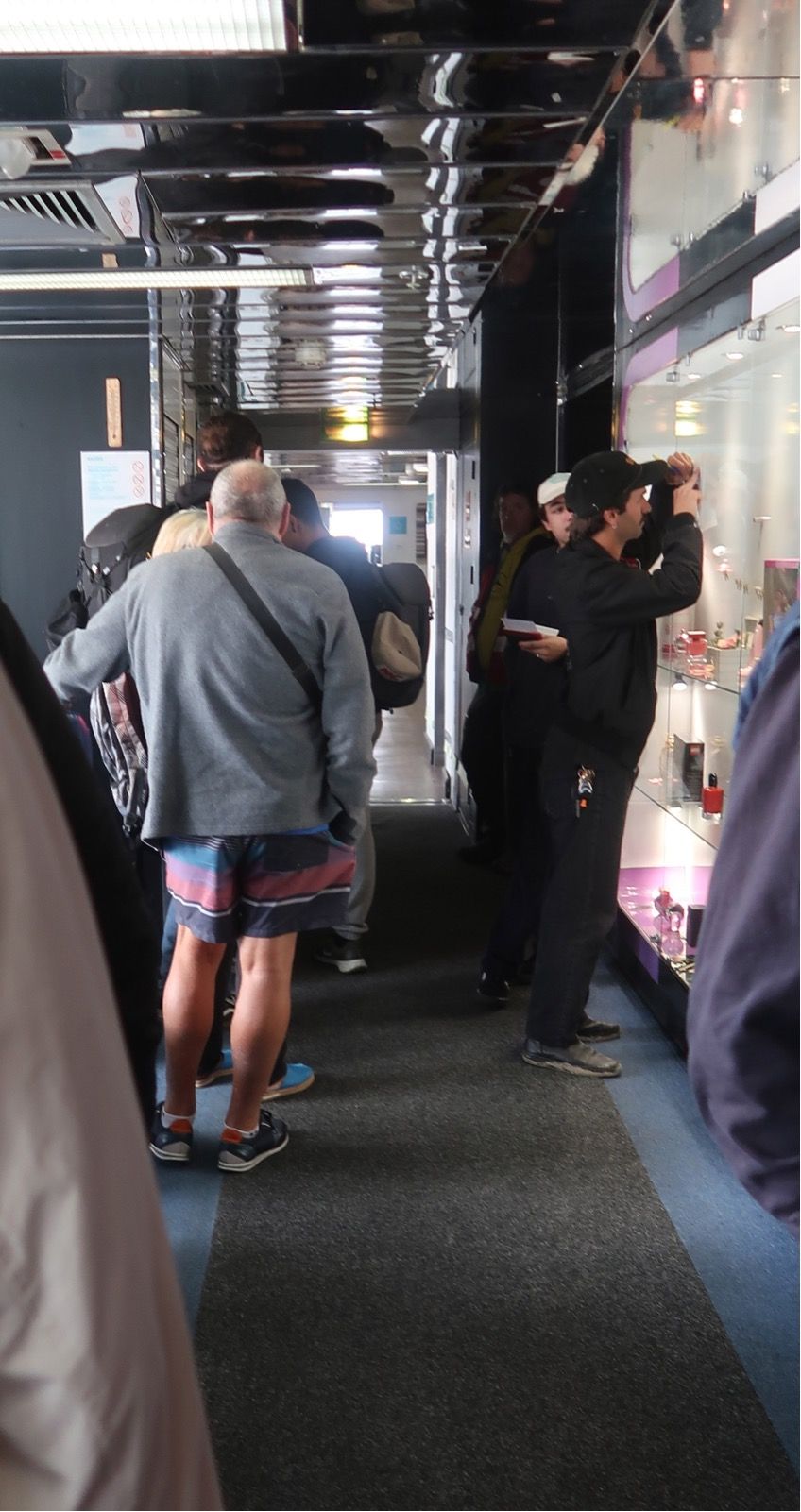
On the ferry, there is a little window where you need to get your passport stamped. This is convenient because you don’t have to do it when you arrive. It’s also inconvenient because there is one guy and 40 people. I started timing and at the rate he was processing people… about 1 person every 6 minutes, it seemed unlikely there would be time to get to everyone during the short crossing. The man only claimed to speak French and English, but he didn’t really speak English. He got hung up on the purpose of my trip. I had written “Leisure” on the entry form which was a BAD idea. I tried to explain that this means “Tourism”, but even with my French and English, he got stuck on that, much like my computer gets stuck on repeat saying “you have entered the wrong password”

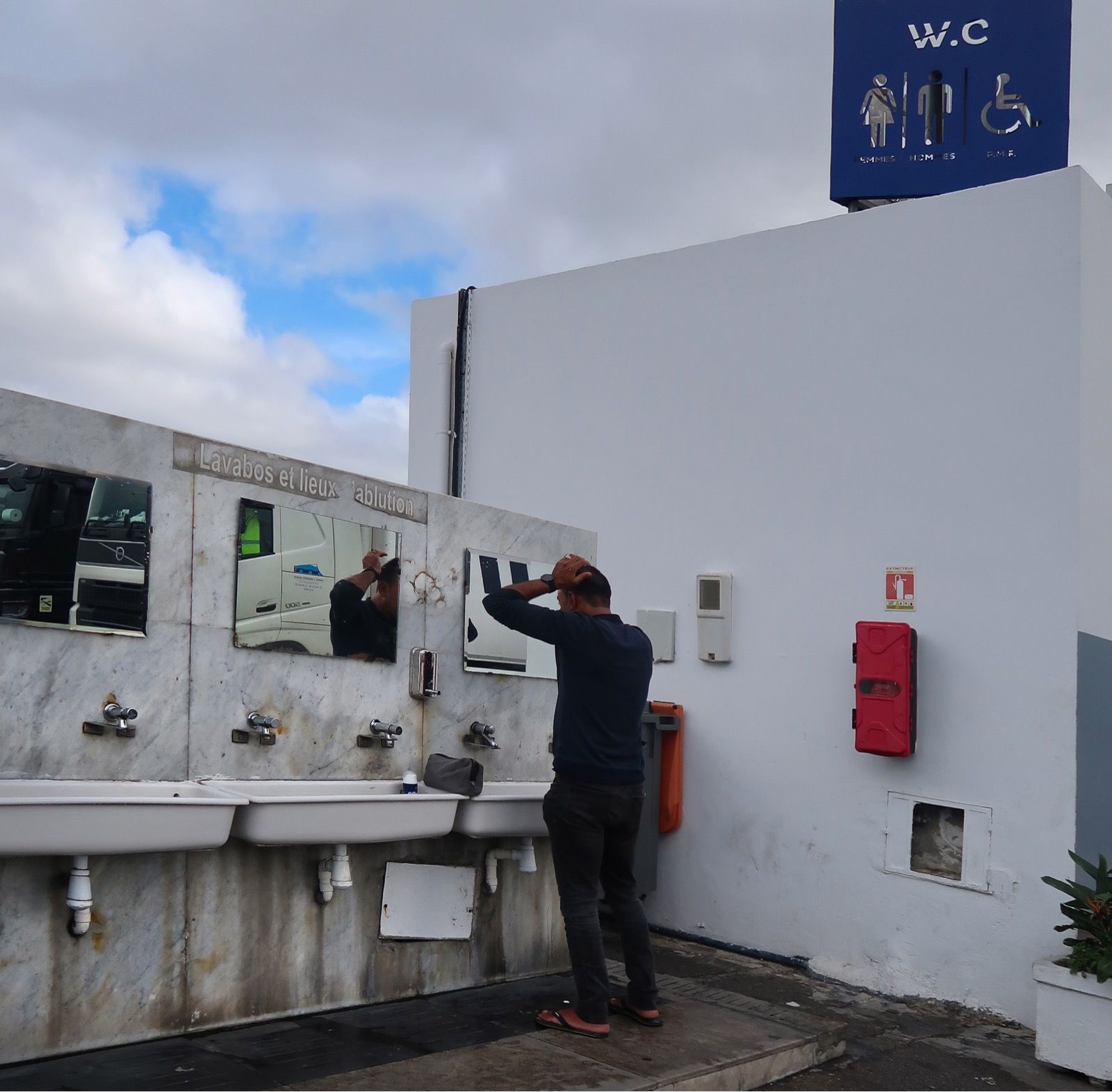
Disembarking from the boat, it didn’t feel like a new continent… but THIS is Africa! I headed straight to the bathroom and inside saw two sink looking things. One near the ground, and another higher with water valves. Unsure if either of these were urinals, I took the safe bet and found a sit down toilet to pee in. I’m going to have to learn a lot here, but peeing in a possible sink isn’t going to be how I start.

The ride began into a fierce rainy headwind. It felt impossible to absorb everything; I was on sensory overload – which is exactly what I was craving from this trip… non stop mental stimulation. It is stressful, but once I have time to process it all, I think I’ll be glad I did this. The first thing I noticed that stood out was the adolescents by the side of the road. When I waved, they would wave back – but with enormous smiles that made you think everything is right in the world. Since when are adolescents so friendly? The kids were friendly too; one kid rode alongside me, maybe trying to race. He swerved about, though, making me think we would clip bars. All I had was “Bonjour, ça va?” I’m kicking myself for listening to these podcasts where the woman just gossips about her friends. That isn’t coming handy when I need to tell the kid he has a cool bike, wanna race? I’m overjoyed that today went well because I had read stories about kids throwing rocks at cyclists in Islamic countries. One kid did ride his bike following me and pantomiming my exaggerated movements while standing, but it was all in fun.

Even the adults are friendly; an old robed man put down his decrepit wheelbarrow just so he could smile and wave as I went by.

Once I got to town, it was dark, and I had to navigate the chaotic streets. This is something I enjoy when traffic is slow or stopped. I love darting between cars and people constantly changing direction. It’s like riding a technical mountain bike trail that moves around beneath you.

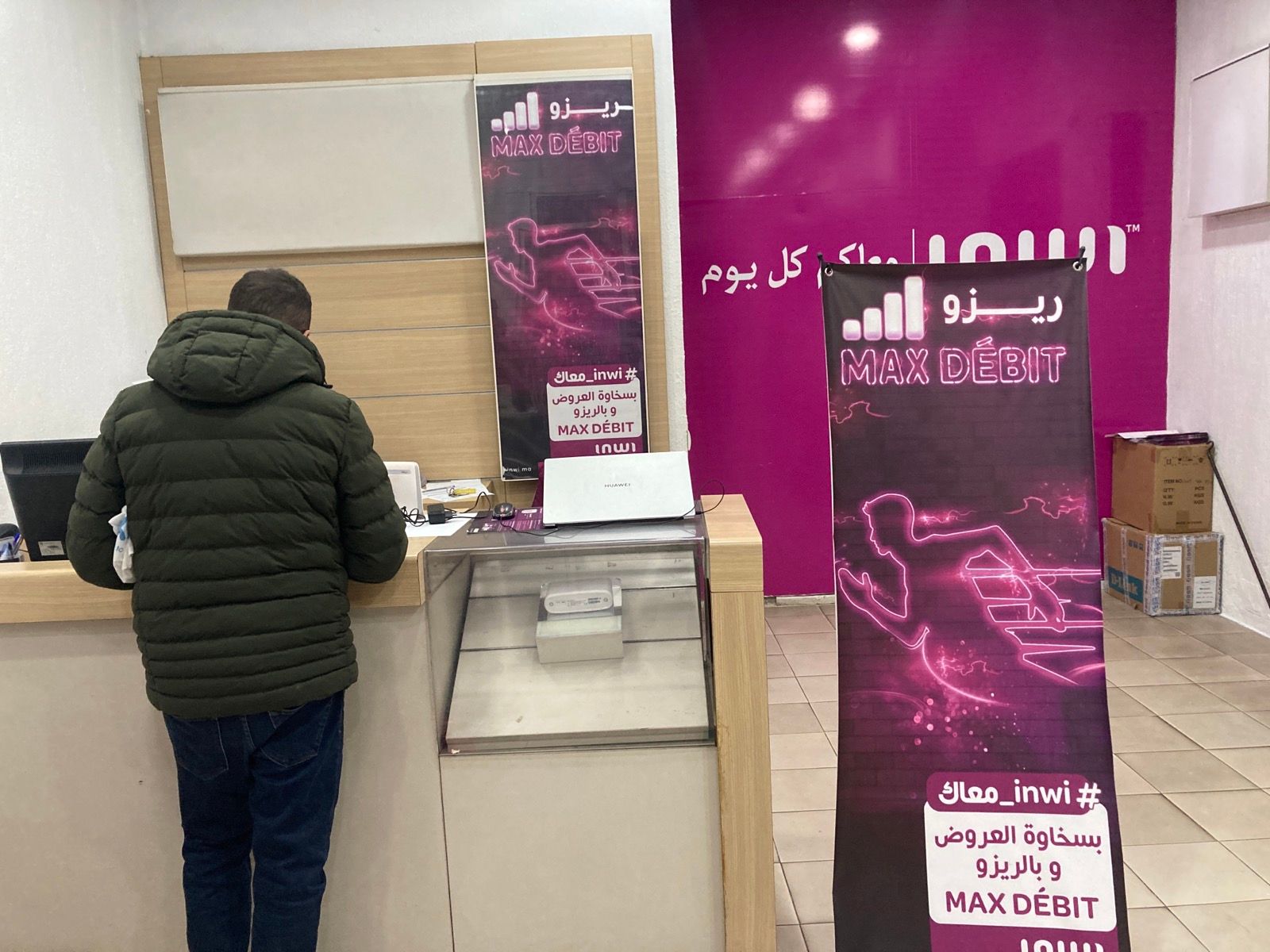
I decided to buy a local SIM card. I’m using GoogleFi as an eSim, and that makes life really easy – anywhere you go in the world, your phone just works with your home number… but it is expensive and I wanted to try the experience of getting a SIM here. English to the rescue, I can’t really do much French I am finding as I stumble over words. It took nearly 2 hours; a slow tedious process and the “system not working,” but I persisted as the guy got his buddy to come help (first they had to give each other big hugs). I kind of feel like a cold American amongst these warm and friendly people.

The guy at the hotel was equally jovial. He couldn’t stop smiling and we chatted for a while. He was older than me, but his mannerisms were like a teen. He was so intent on making sure I loved Morocco. He was bummed that my wife didn’t come. He carefully studied my route map and said it was a great route. it was super late and I’m still in my bike clothes, he said, “you want to go, don’t you!” I liked him a lot, but was also desiring a shower… I can already tell that everything in Morocco is going to take a lot of time…. Good time, though, so I need to embrace that and maybe think more about the journey and less about the destination.


Photos:
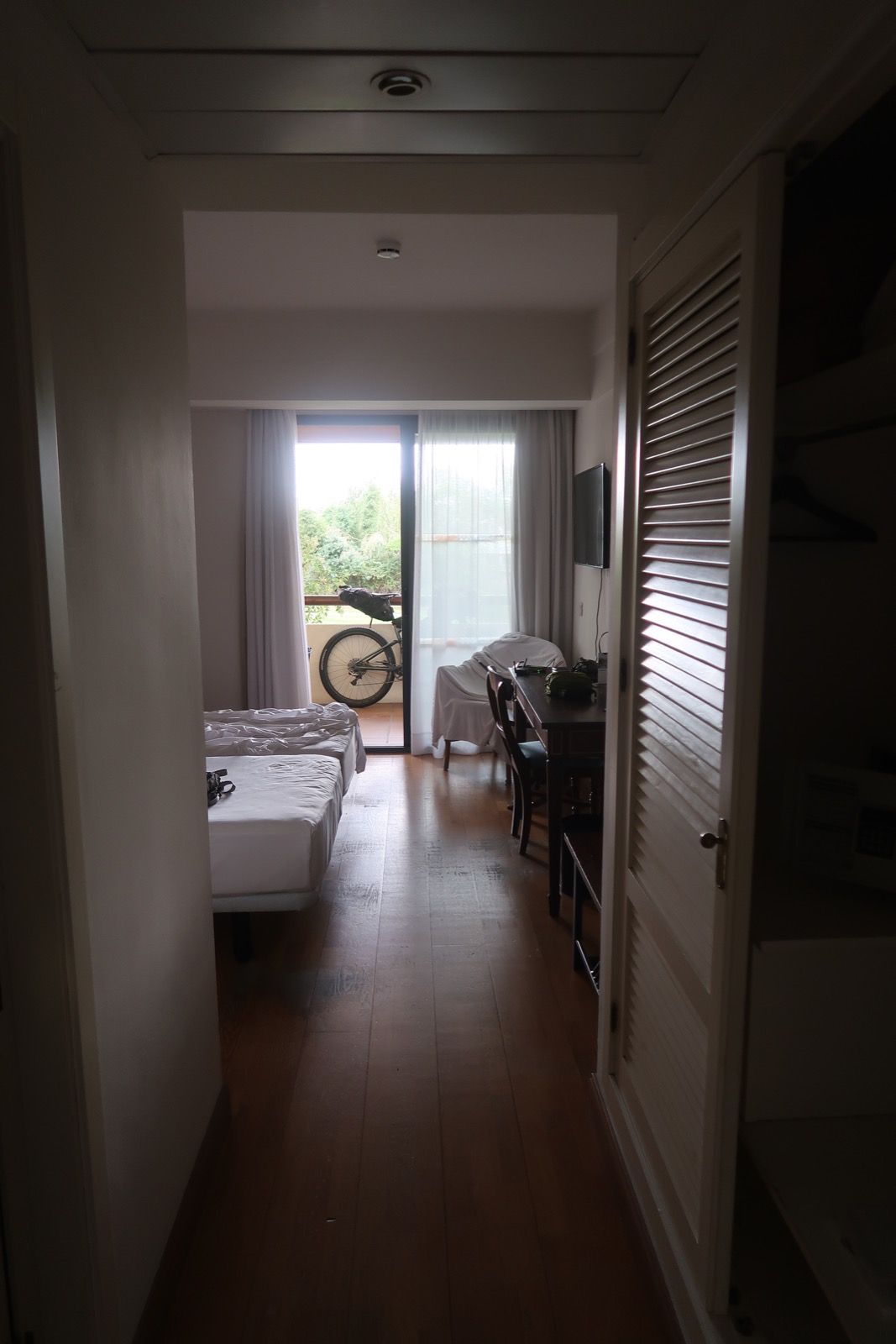


Last hotel in Spain – with a balcony and great breakfast. Wished to stay longer, but anxious for the next country.

Passport stamping en-route. I got lucky on this one. I made up a hotel name “hotel Tetouan” for my destination… and almost didn’t get stamped. The man had mercy. Merci!

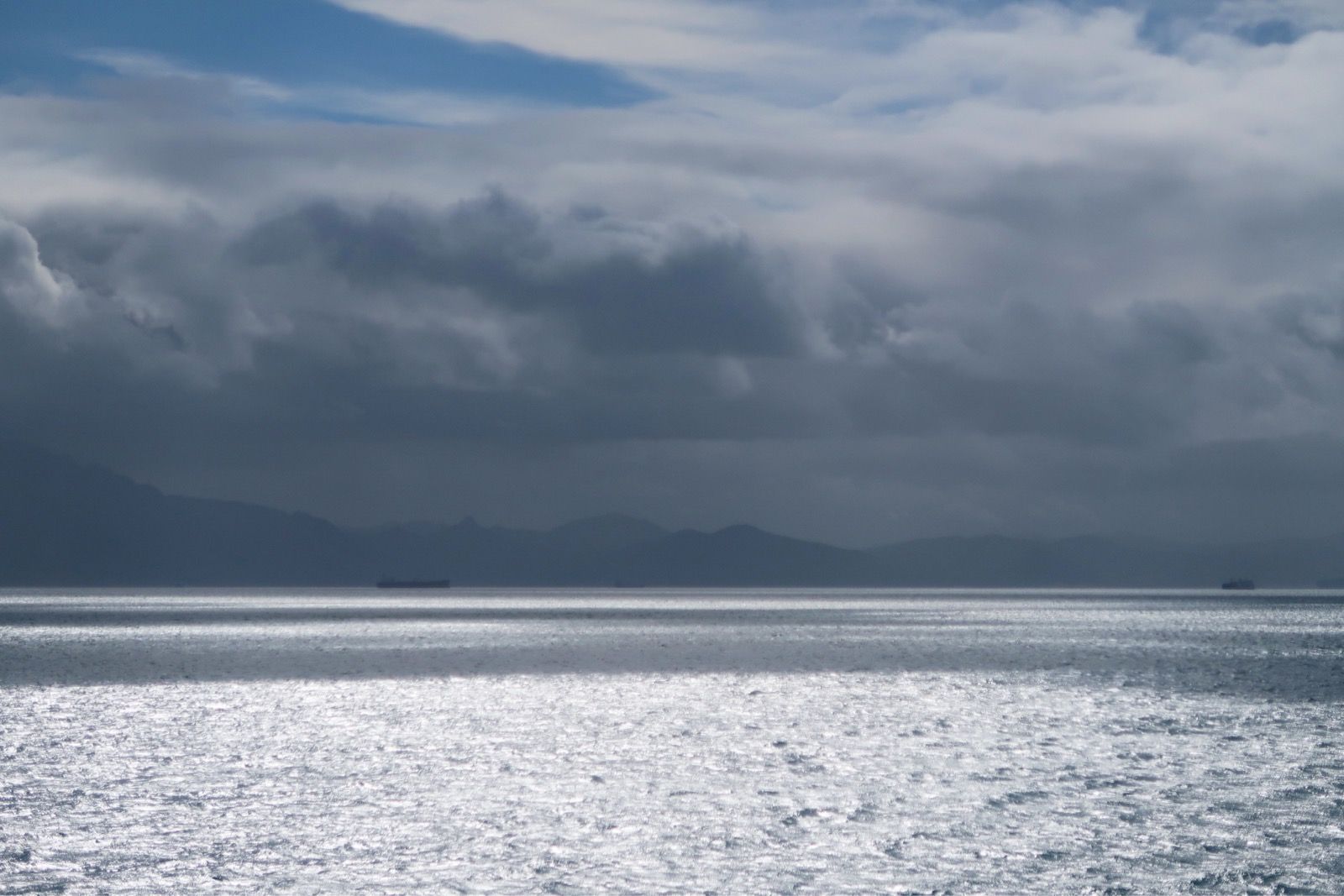
It doesn’t look far to Africa from Spain. It does look wet, though..

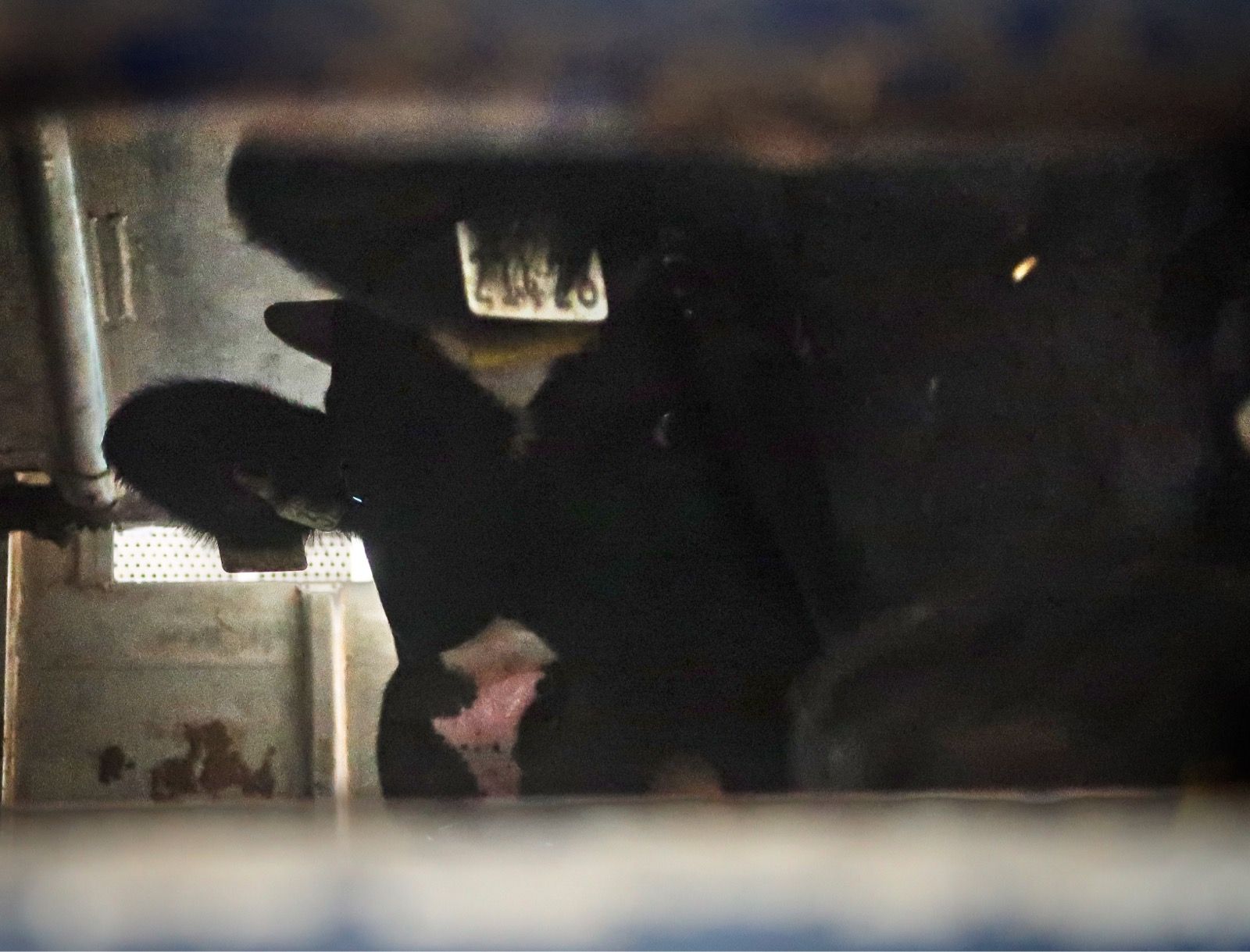
Bikes are easy to transport on ferries. But something smelly was parked near my bike. All sorts of huge trucks in the hold; I peered in and saw these cows headed to Morocco too.

Arrival at the ferry and they have outdoor cleaning stations. This is good news for cyclists.

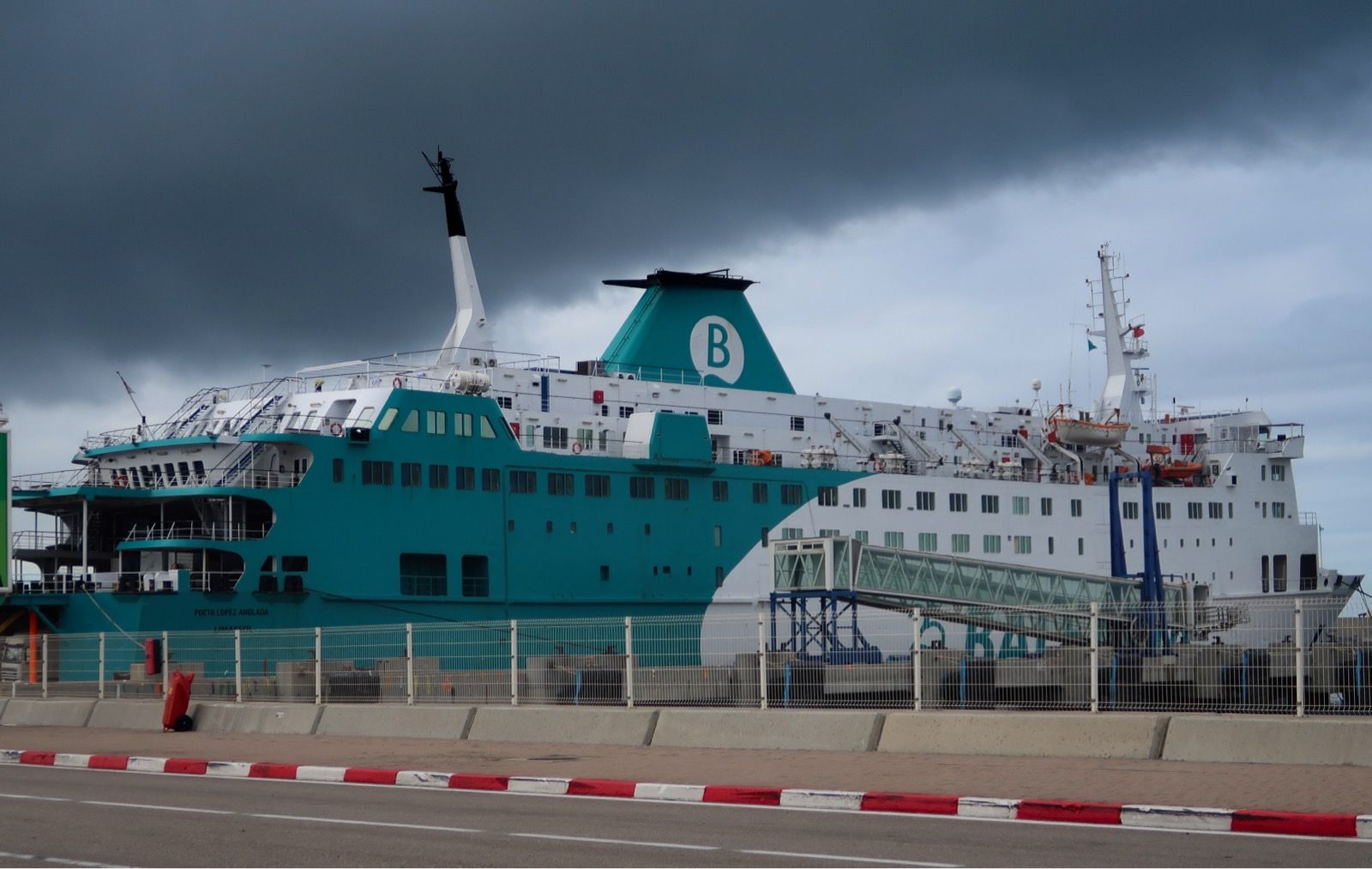
The boat I took. 35 to cross the Strait of Gibraltar. I love the outdoors, but this beats swimming it in my mind. Since 1928, 625 swimmers have swam across the Strait of Gibraltar. 85% male swimmers and 15% female. Interestingly, the average female time is very close to the men’s. Average time is 4hours 41 minutes…which I’d say is competitive with the ferry!

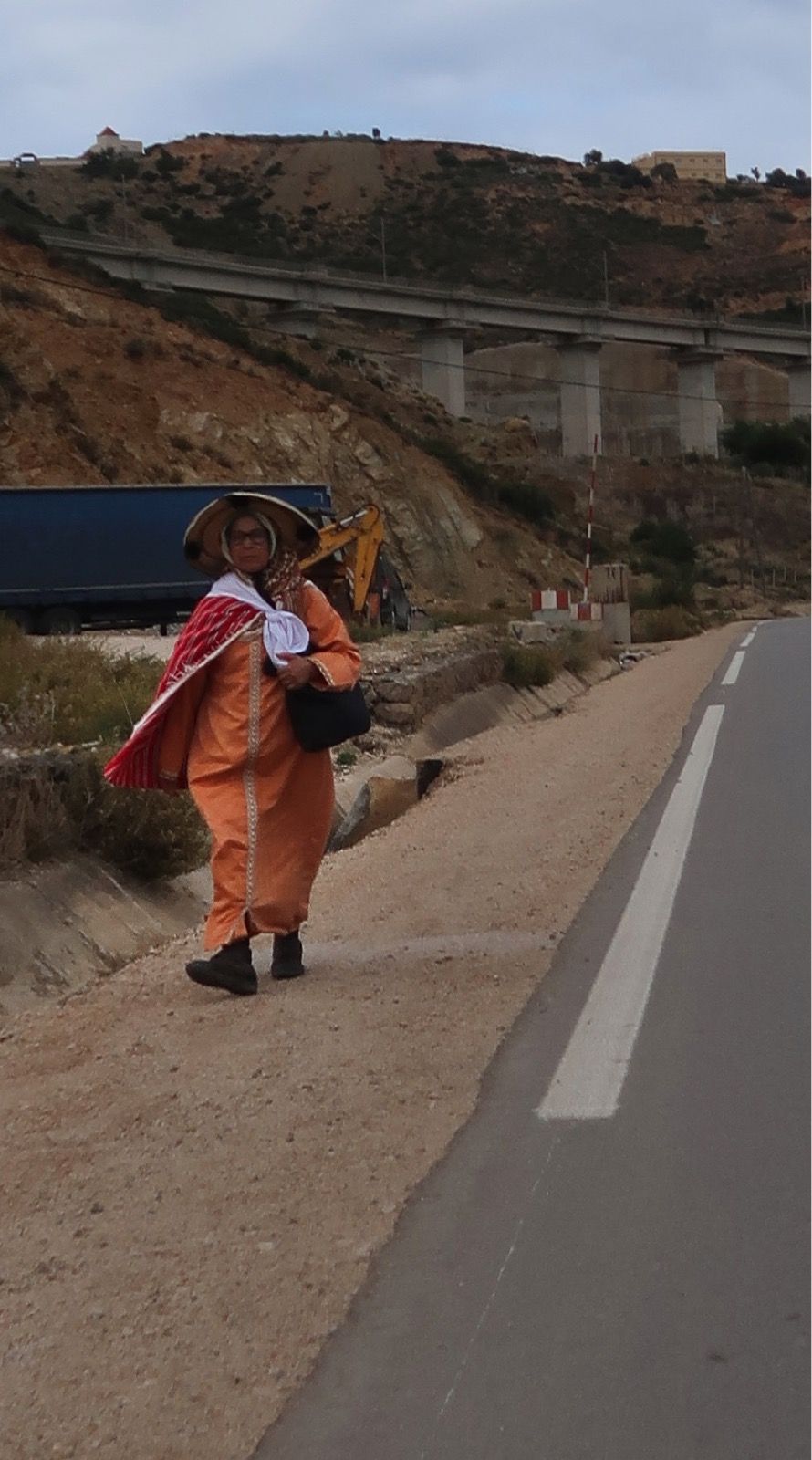
So much to learn! There are people in all sorts of attire. You might think it is still Halloween here. Men wear these robes with peaked hoods that make them look like cone heads. Then there are the more familiar forms of dress, stuff you have probably seen for Morocco… and a little bit of western attire… and me in my tight fitting Lycra. I might need to buy something to cover up a little more…

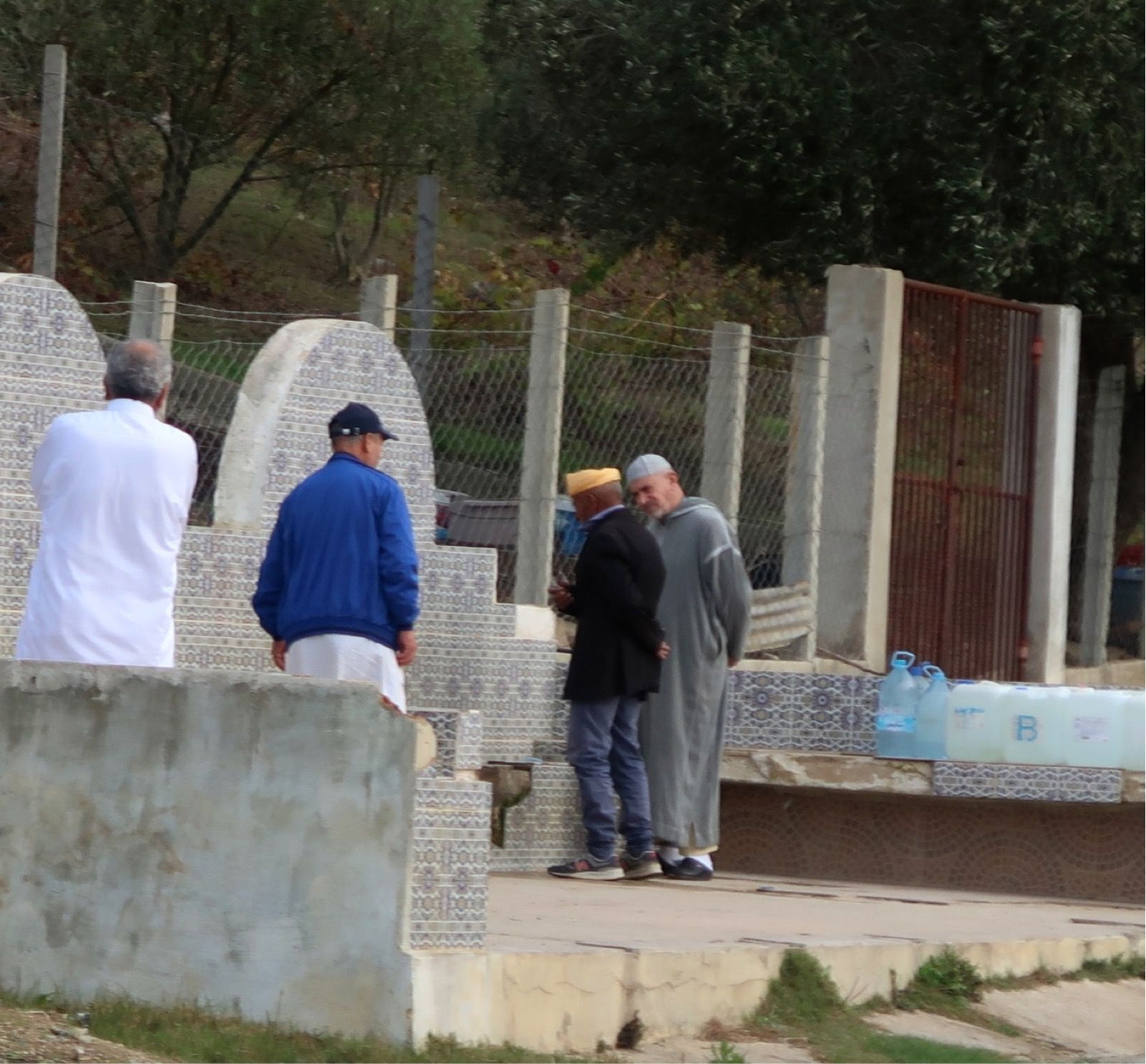
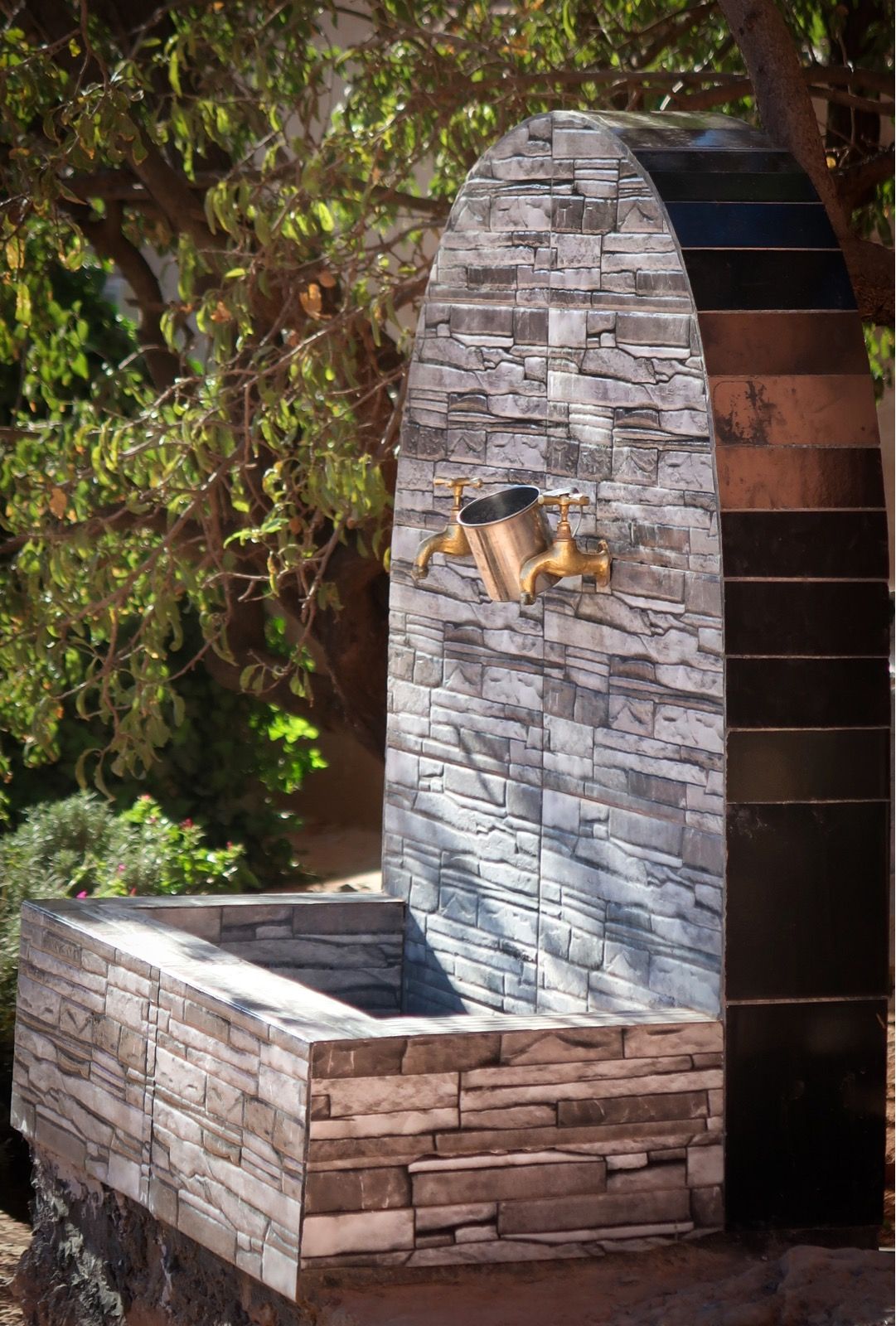
Seethe bottles? I saw severa outdoor fountains here. Happy about that. People gather around them.

Also saw several mosques already and heard the call to prayer and saw a guy kneeling in a field.. mid-work.. again, a lot of stuff for me to learn here.

Patience prevails when buying a SIM card.

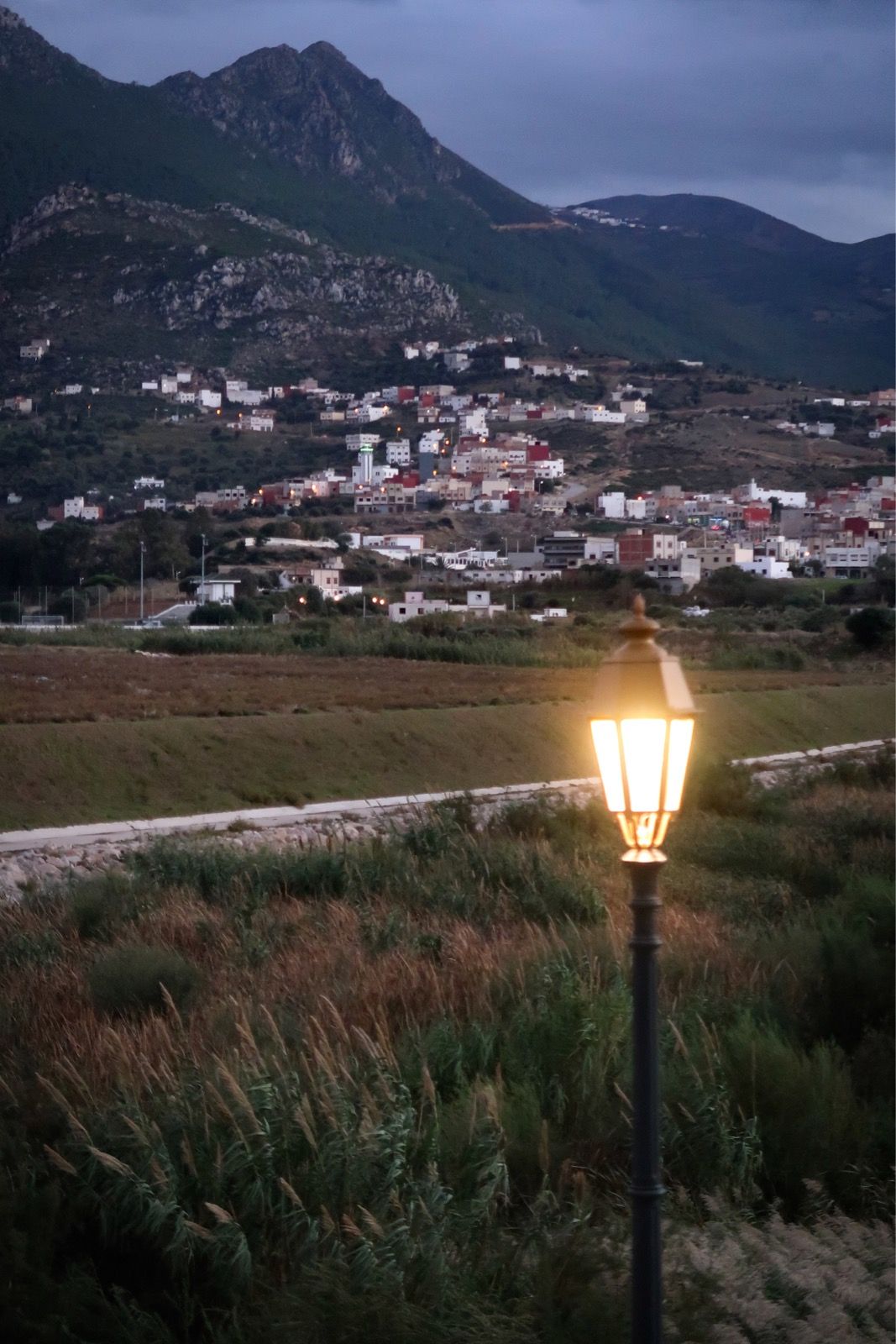
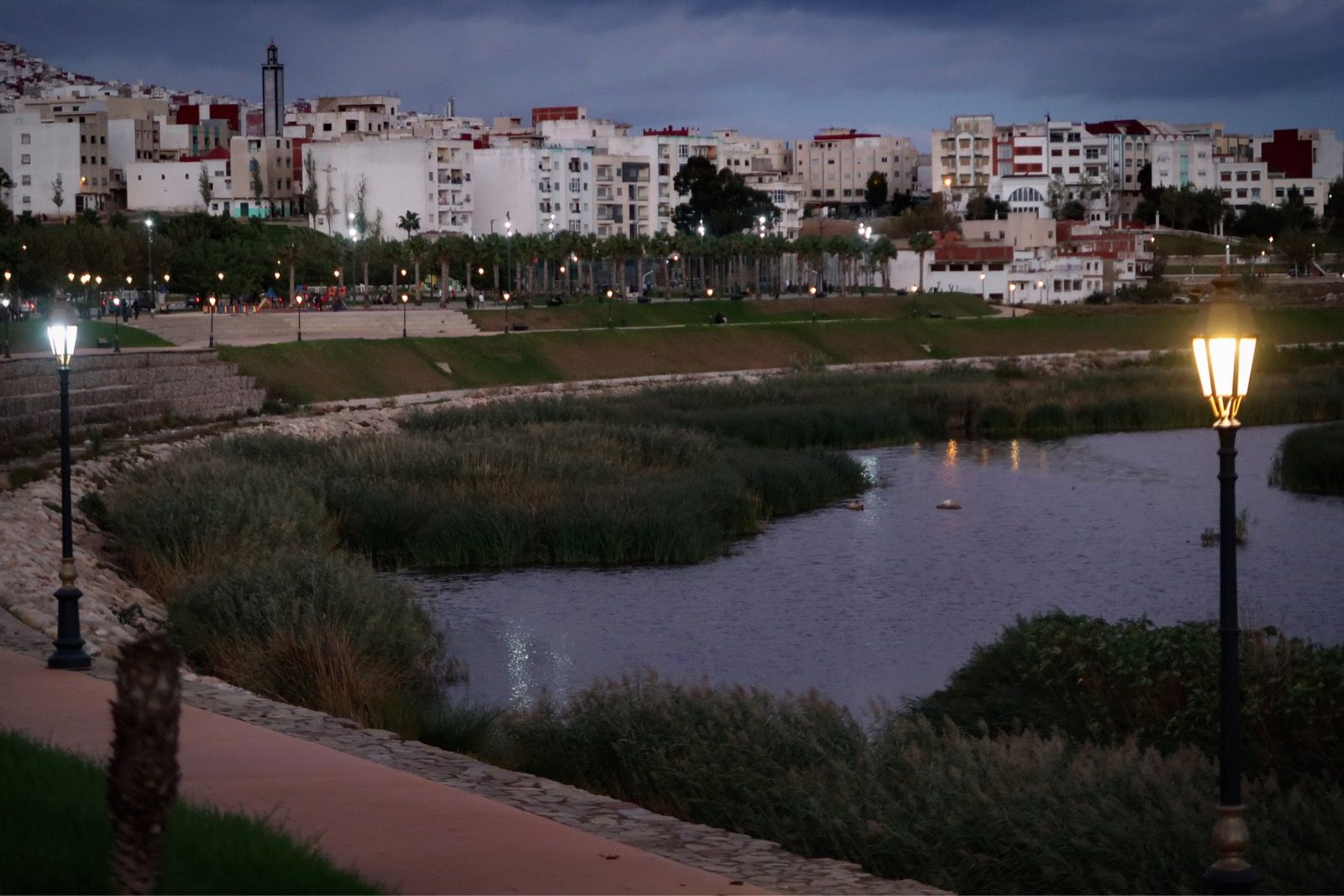
Teotuan Beauty. Gotta sleep now!

Strava Comments:


Ann L.

Sounds like you are off to a good start in Africa, and the right attitude. Yes, it’s a journey not a destination.

Warren G.

Wonderful start Brian! A moment at a time. Don’t let tech foul ups deter you.

Yuwen W.

Cool! Enjoy Africa! I want to go ride there someday 😊

Paula G.

VERY nice last sentence. The journey, not the destination. I’m glad the people have been so friendly. I look forward to the rest of this new adventure!

Warren G.

I’ve been pondering your first day Brian and against my better judgement I’m going to let my professor genes out and opine a bit here. I realize we all travel differently so you can take my thoughts and experiences or just file them away. The things that spur my thoughts here are your tech problems and the rich encounters you’ve already had with locals in just day 1. My journeys through the Himalaya involved a number of first ascents of peaks and remote traverses over wild landscapes. But you know what sticks with me most over the many years since? The encounters with local people and things I learned from them. Most times I had to change my plans and even skip certain areas in order to stop and take advantage of a chance encounter. Staying in a monestary in Zanskar led a monk to send me to his family in a village about a week’s walk away; where I spent two weeks working the barley harvest and fire puja. That connection has remained over 20 years and the little boy of the family is now a teacher and hosted Julia, I and our boys 8 years ago during our traverse of Ladakh. This all required big changes in my plans. Same for being invited to a Uigyhur wedding in Xinjiang after we abandonded plans to cross the Taklamakan Desert by foot and instead staying with a family of a tea shop vendor who befriended us in a market in Hotan. We had to fly over the desert instead but honestly the wedding and family connections fill my cup more than the trek would have. I could go on, but I guess my thought here is that perhaps the tech delays are providence – perhaps you could spend some more time in certain places where you can develop richer human connections than if you were passing quickly through (as you wait for tech to be delivered). Traveling by yourself you have already seen that these connections start quickly. My younger son spent 3 months in Jordan a couple of years back and he was cornered by the owner of a sweet shop in a market who ended up taking him around to villages and his family for a couple of weeks along with many evenings of tea and sweets on the street with his friends. Of course, his plans had to be changed. So… just something to consider, where your inclination and flexibility allows. Any way you do it I am sure you will have a deep experience – your reflections show that each and every day. Travel well my friend.

Mark G.

An amazing and wonderfully written post…so happy for you Brian to have had such an optimistic cheerful entry to this section of life’s journey.

Judy I.

Loving it so far! So was the low sink a urinal or a foot washing station? I think there is always a foot wash area by the fountain outside of a mosque. It’s a must. And water of some kind by the toilet; often a tap but maybe just a plastic bucket and a cup of dubious cleanliness so you can wash your bottom. This is important in religious rites and handy where there in no toilet paper. But then there is no soap to wash your hand. Maybe carry your own TP and hand sanitizer.

Judy I.

Oh and don’t eat with your left hand in public! 😉

Jonathan ∑.

“More about the journey, and less about the destination” Love that.

Janet W.

What a welcome to Morocco! This is what you’ve been dreaming about for a long time. So many new experiences and a lot to figure out. Some of it is not easy, but you are doing it and enjoying the people. I’m so glad it’s going well from the start, except for the dead Bivy. It was fun to video chat last night!

terri W.

I’m thoroughly enjoying the comments as much as your blog post! Wonderful stories, well wishes and experiences today! I’m very excited for you and your adventures! Safe travels!

Brian L.

Warren Gold – thank you so much for taking the time to write down those stories and thoughts. I already read your comment twice, and after this, I’m going to copy it into my notes.app so I can read it again and again – which I need to do. I KNOW you are right. There is such a struggle inside of me to “see it all”… but you nailed it; it’s those connections (especially the 20 year one!) that are the part that is most memorable and meaningful, really. Thank you.

Brian L.

Judy Isvan – im glad you thought of this… you are probably right. It was probably a foot washer. How awful would it have been if I had…. 😩. Thanks.

Judy I.

Brian Lucido: a mistake either way would be awful! Better be sure before using it, just in case! 😆

Alan B.

Good point. As you travel & meet people, the list of desirable destinations grows faster than one could possibly attain them. Which leaves the journey. In which we live.

Sօʀƈɛʀɛʀ 🅅.

Hi Brian. I appreciate all the details and effort you put into the writing. A long time ago I travelled to Morocco taking a ferry from Algeciras to Tangiers and then making a way to Marrakesh. I don’t have anything cogent to offer from my experience. Now that I think of it, I’d like to find my diary and see what I wrote! But yeah, it is very different from Europe. On the ferry across I fell in with a random bunch of people and we travelled together for a while. It dwindled down to a tall Dutch guy and I. Everyone else got sick and headed back to Europe! The Dutch guy and I spoke some French and were able to get by. We were befriended by a Moroccan family and spent a night at their house. Quite an experience. We finally got to Marrakesh and my friend got sick there. I went to the Medina while he tried to recover in a hotel. The big square there was absolutely incredible at night! Our hotel window looked out over it and it was like being in another planet. After a few days the Dutch guy got better enough to travel and he wanted to go home. I decided not to go further south into the mountains. It was 1981 I think 🤔 and I couldn’t fathom hiking alone in those Atlas Mountains without a guide. Later I would visit the Dutch guy and spend a couple of weeks staying with his family in the Netherlands. It wasn’t a glamorous trip.

Brian L.

Sorcerer 🅥 Thanks for taking the time to write that story. I hope that you find your diary. Sometimes I think that travel back then was more “adventuresome”. Actually, I have no doubt. The connectivity these days makes it so much easier, and I like it, but Morocco was probably a very different country in the 80s. Many (but not all) places are fairly modern now. Also, there seems to be a thing for getting sick around here. Wheels to wander got sick. Many people coughing in Southern Spain/Northern Morocco. I am always on “cough-dar” holding my breath in enclosed spaces and darting away from coughers. Didn’t save me from 13 days of illness too…. Didn’t know that you had been to Morocco, and don’t know if the fact that your trip “wasn’t glamorous” is a good thing or a bad one 😆

Sօʀƈɛʀɛʀ 🅅.

Brian I am amazed that I did not get sick there. Seemed like everyone did. My problem vector was the fresh mint tea which I loved and couldn’t resist, but I didn’t get sick. Maybe because I got sick a couple of months before that from bad water in Switzerland I had some immunity? I say my trip wasn’t glamorous because it was really rough and I did camp a lot and was mostly alone. I recall feeling lonesome and a bit scared sometimes and was relieved to get to France afterwards.

Ride Stats:

Elapsed Time Moving Time Distance Average Speed Max Speed Elevation Gain Calories Burned
11:21:26
hours
05:04:31
hours
87.68
km
17.28
km/h
62.07
km/h
994.00
meters
3,391
kcal


– Day 88 : God’s other bridge [top]


I went downstairs for the breakfast and met a long table prepared for a paniphile. There were no fewer than 8 kinds of breads. Flat ones, round ones, rolled ones, puffy ones. I was about to return to my room with a coffee when I spied one other type of food: hard boiled eggs. The man eyed me curiously as I walked to my table with 5 eggs and a coffee, and then he brought over an orange juice as if he was worried that I was going to be starved for sugar. Deciding that I need to embrace this too, I shot up some insulin for the orange juice, and then decided to go for some of that flat bread. I knew that bread was going to turn into sugar faster than Cinderella’s coach became a pumpkin, so I decided to get moving and shot an extra unit into my leg muscle.

When the tall slender man in a blue suit took me to my bicycle, he must have noticed my swift movement. He said, “don’t worry. There is no hurry. I can wait here while you pack your bike.” A sincere smile accompanied his words; again and again I’m being counseled by smart people to slow it down a bit. I feel like a dog that just wants to keep running after the ball – even when exhausted. And exhausted I was… well not for the first 3 hours which were accompanied by a tailwind, a sugar buzz, and coffee… taking me to a lovely, but deserted beach with ease…. But then the climbing to the mountains began amidst furious headwinds. I hunkered down and plugged into the wind.. and into my French podcasts.

Everyone here seems to speak a little bit of Spanish, a little English, a decent amount of French… and lots of Moroccan Arabic. The only two words I understand in Arabic so far are “Salaam-Alaikum” (peace be with you and Gods mercy)…. And a word “inshallah” that sounds like the Spanish “ojala” which means “god willing”. It is now a race to learn French and my speaking has already improved today. I would pull over repeatedly as I thought of things to say in French and speak them to my phone to “test out”. Sure, I can get a hotel or coffee in French.. but the key to a more rich experience is going to be to engage with the people, tell stories, and make them laugh (the later has proven to be the easiest of the three).

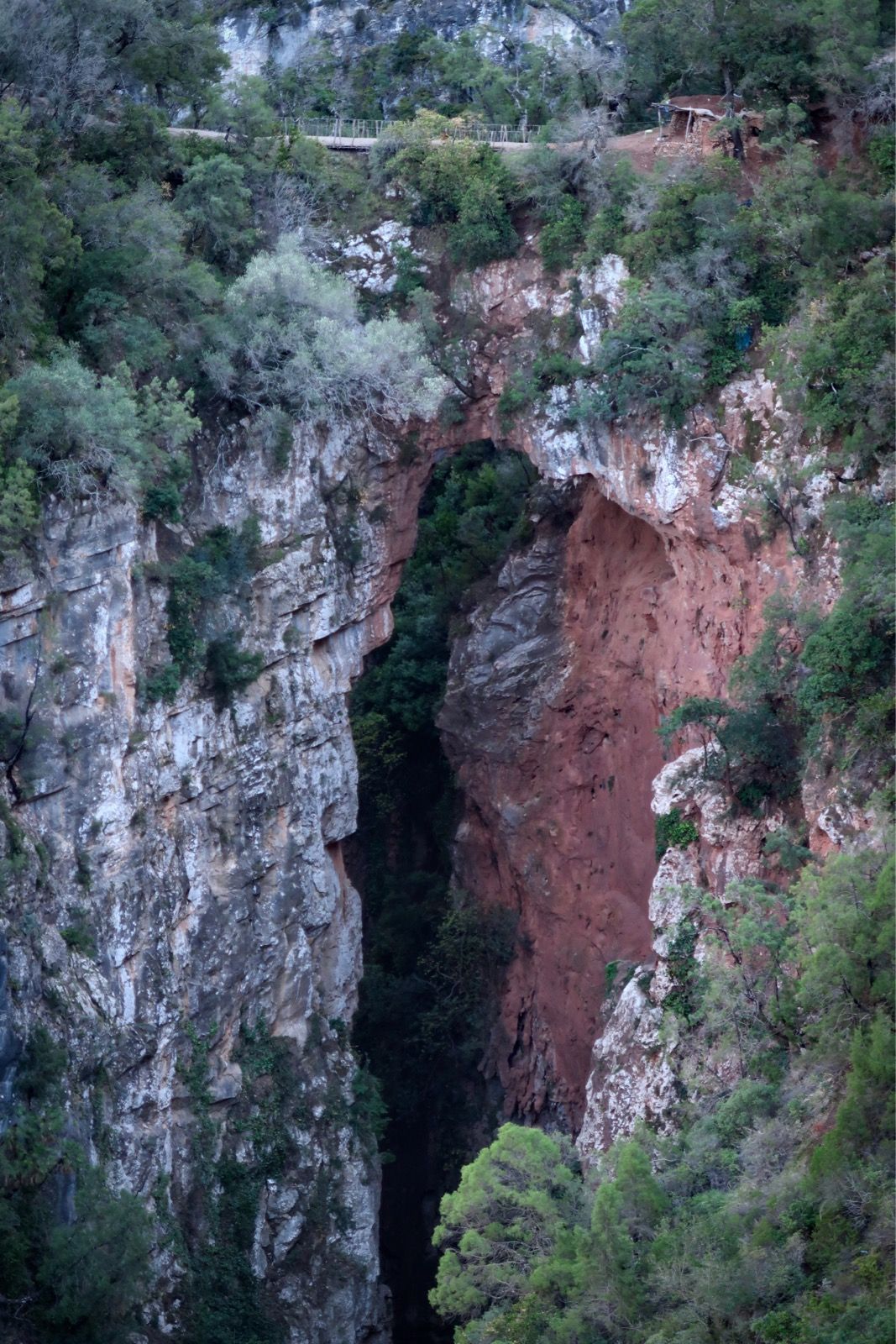
After lots of physical effort, some walking (because of the wind, not the hills) I got happy, saved by the mountain scenery. There seem to be 3 things that are hardwired to the happiness receptors in my brain. Seeing Janet, coffee, and beautiful scenery. The day was turning out to be good, with the objective of visiting “God’s Bridge”. In our travels, Janet and I have come to dozens of God’s bridges…. I wonder if it bothers God that he needs all these bridges, while his son can just walk on water. Regardless, I’m glad God left these bridges around for us to hike to.

It turns out that this was a pretty touristic location. My opinion on touristy spots kinds of flips when I’m alone in a foreign country. I end up liking touristic spots a lot more because there are other people interested in the same thing as me mulling about. And so I ended up hiking with a guy named Omar from the desert of Morocco. I’ll be dammed, he had worked on building the (now) highest dam in the world in Tajikistan. It’s now bigger than the formerly biggest dam in China. I asked if they had a competition going on with dam size… anyway, by the end of the hike (which ended for him once the slope turned 35 degrees upward) he decided to give me his phone number so I can look him up in 800km. He lives right along my planned route, so I’ll be looking forward to seeing a friendly and familiar face in a week or so. I decided to stop “early” (meaning before dark) and got a hotel room for less than $20 USD. Why not?

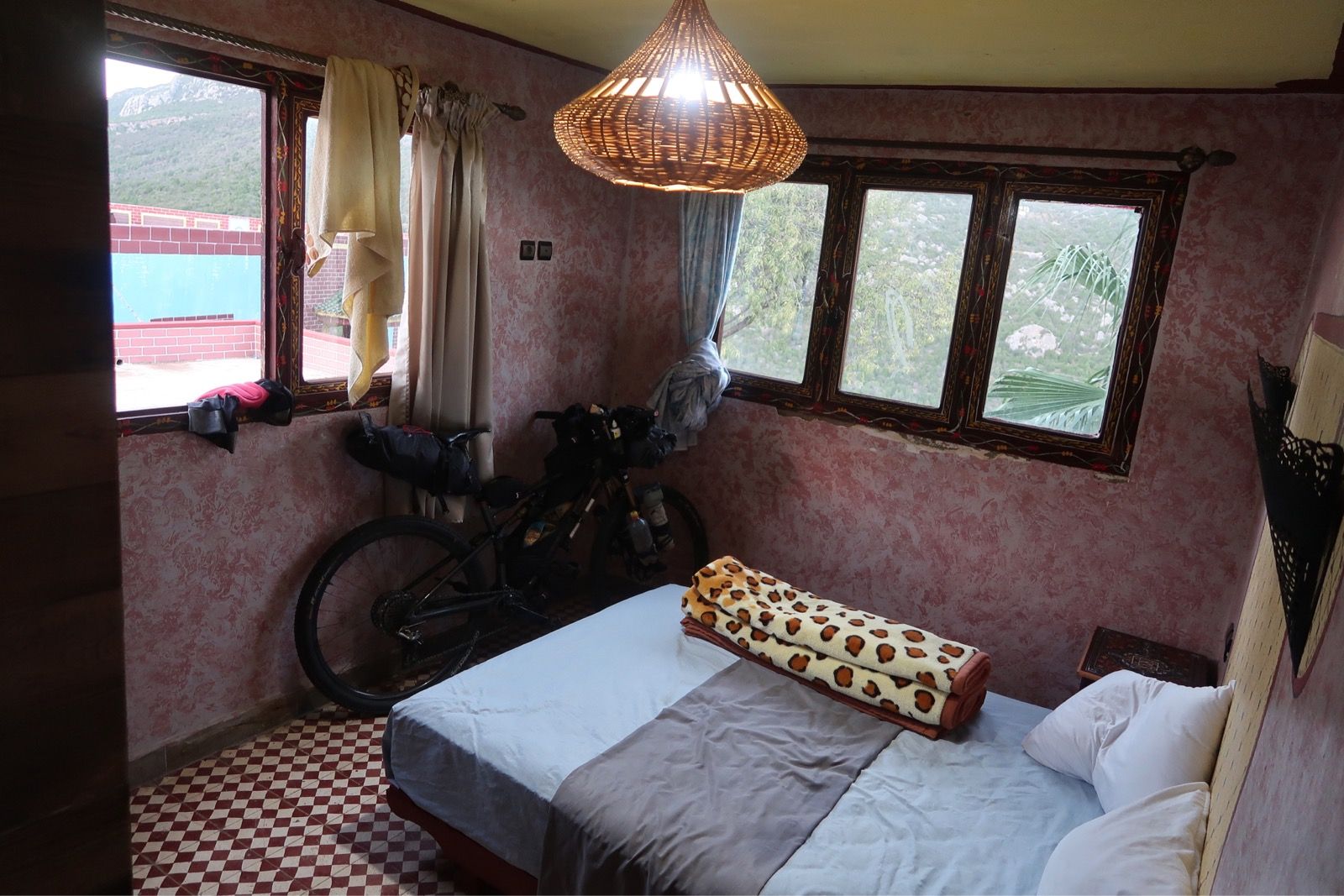
One thing you should be careful of is a hotel run by young men who are not dressed in suits. The smiling guy took me to the room, and quickly picked up the trash and fluffed up the pillows. I learned how to ask for a towel (“serviette”) in French (Janet will laugh at this one, because it sounds like asking for a “napkin” in Spanish). The room probably looks good in my picture.. but because I’m still doing the upside down eating thing, I had the opportunity to become closely acquainted with the variety of unique, but squished bugs inhabiting the floor. A god day.. and good night to you!


Photos:
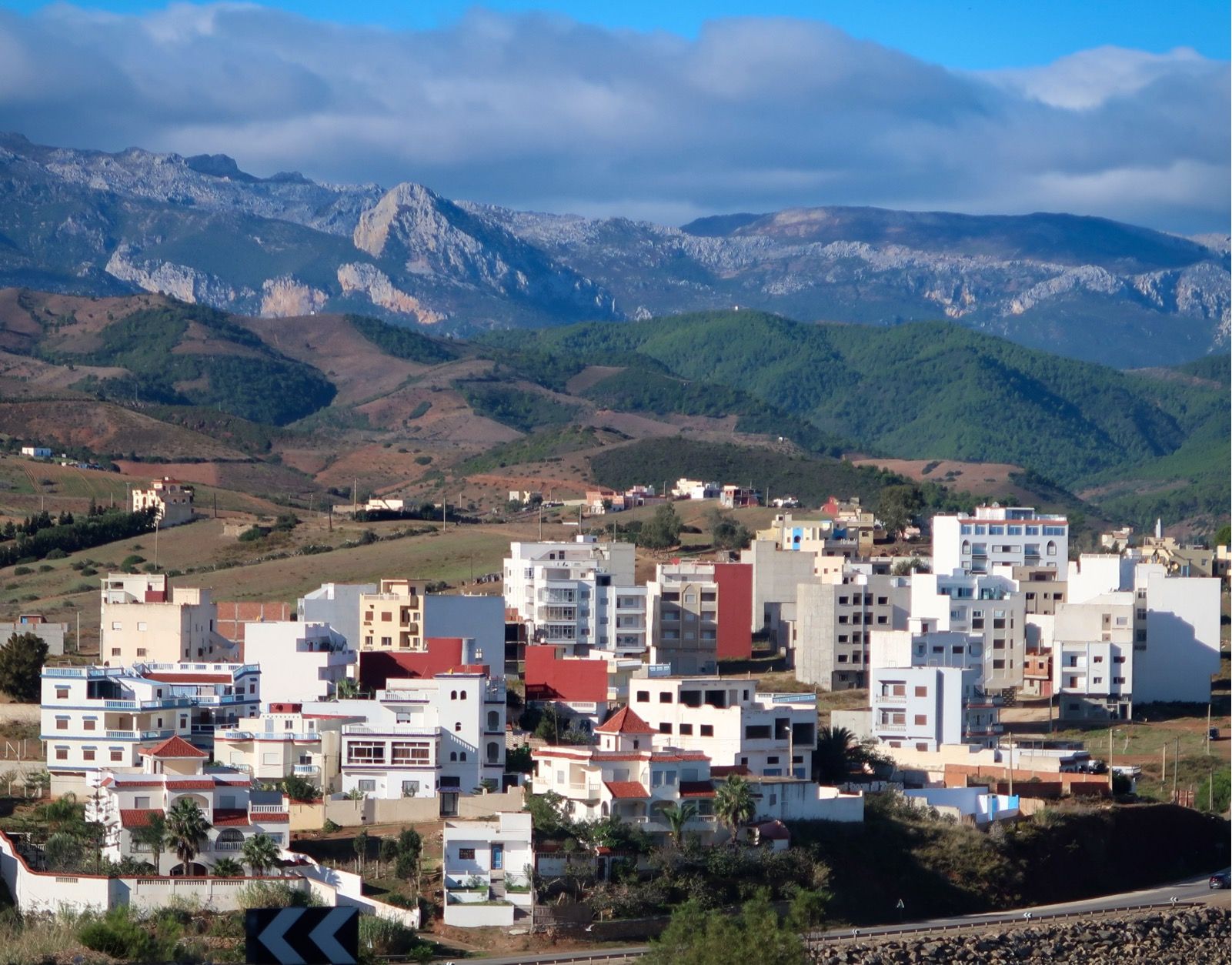


Amazing beaches, but not many people about.

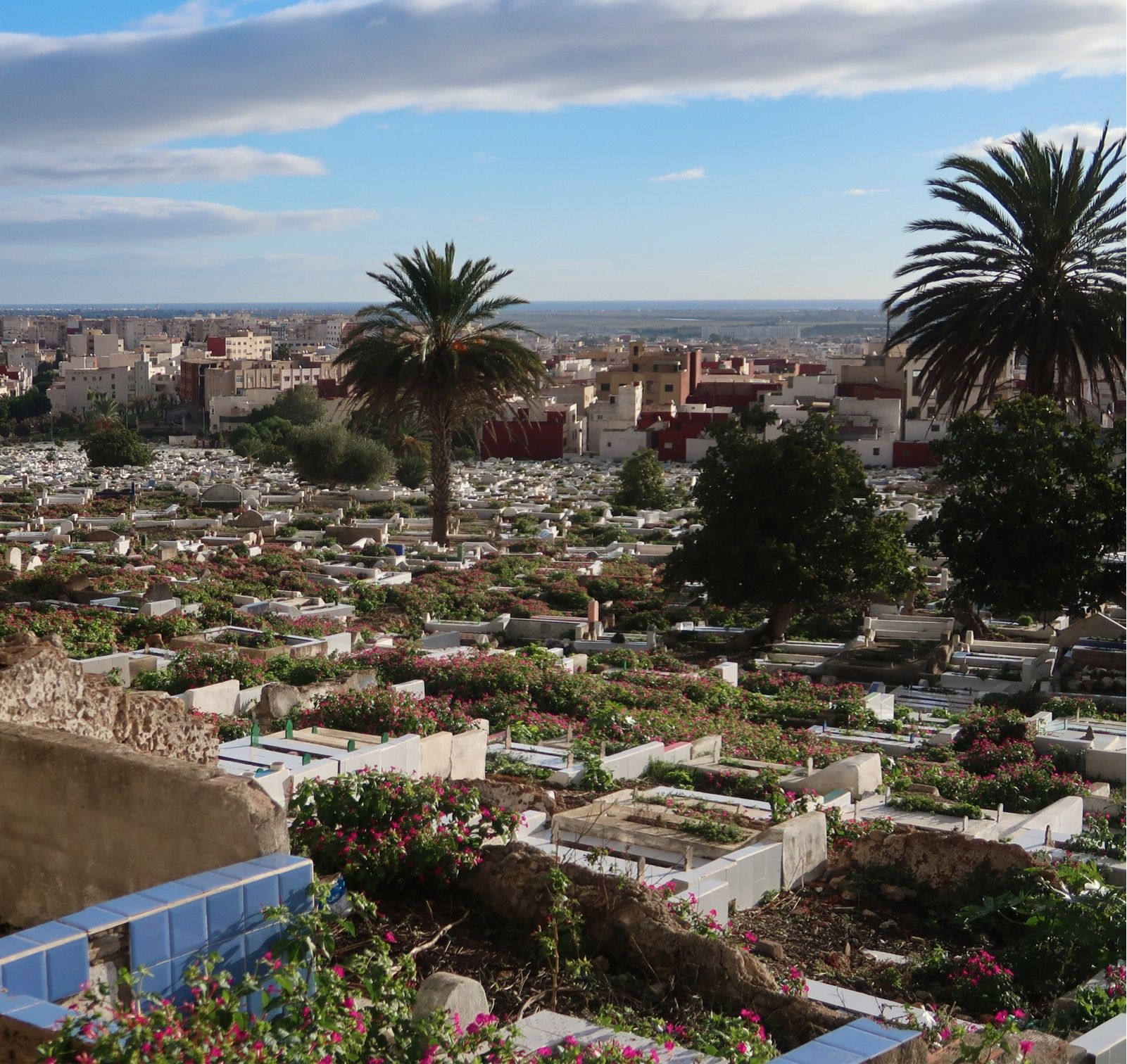
Cemetery in Tetouan. I was actually looking for some tanneries (tourist attraction) but didn’t find them – maybe misplaced icon on my map?

Video of what it was like riding through pedestrian ways of Tetouan.

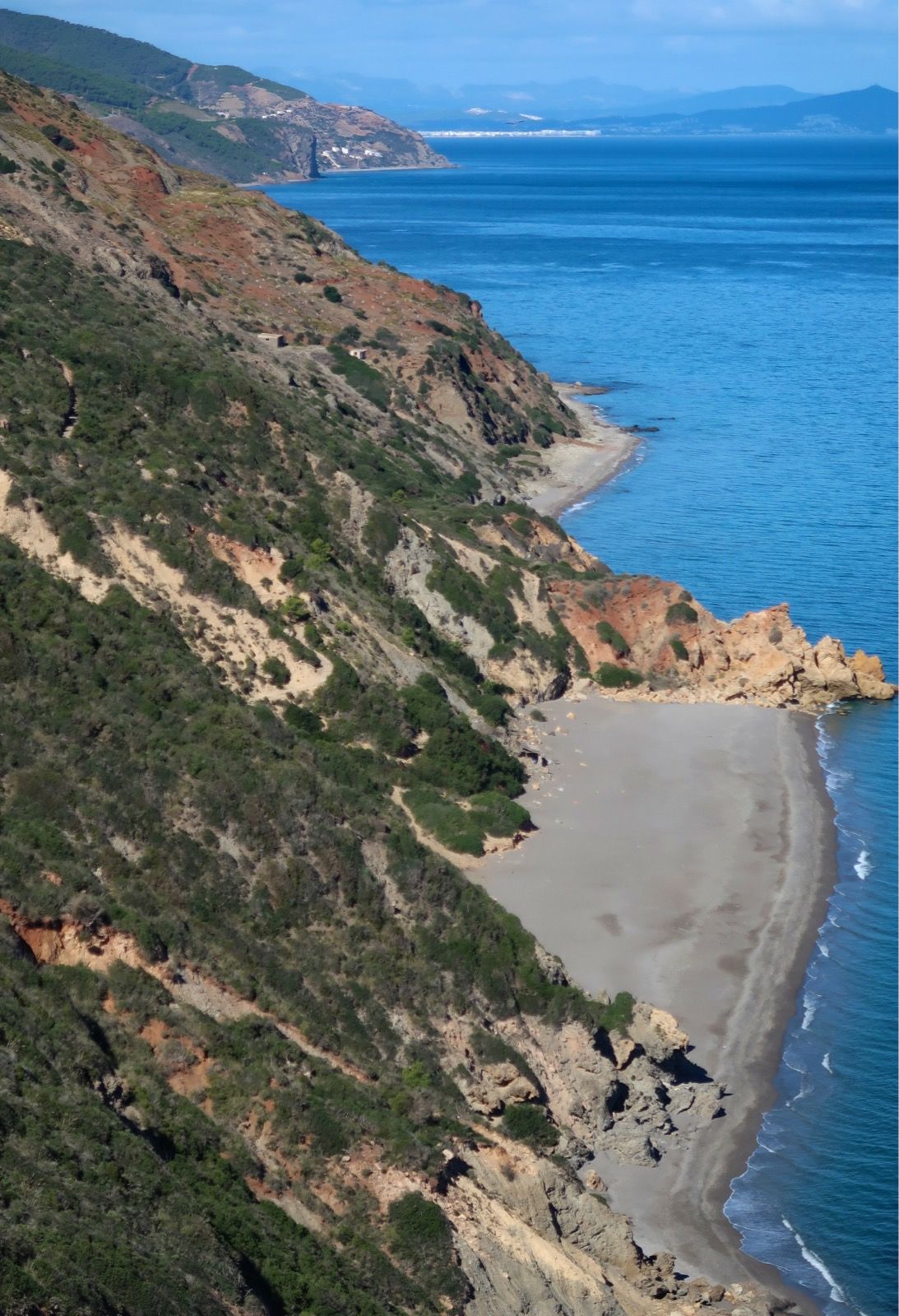
Mediterranean, kind of like California coast!

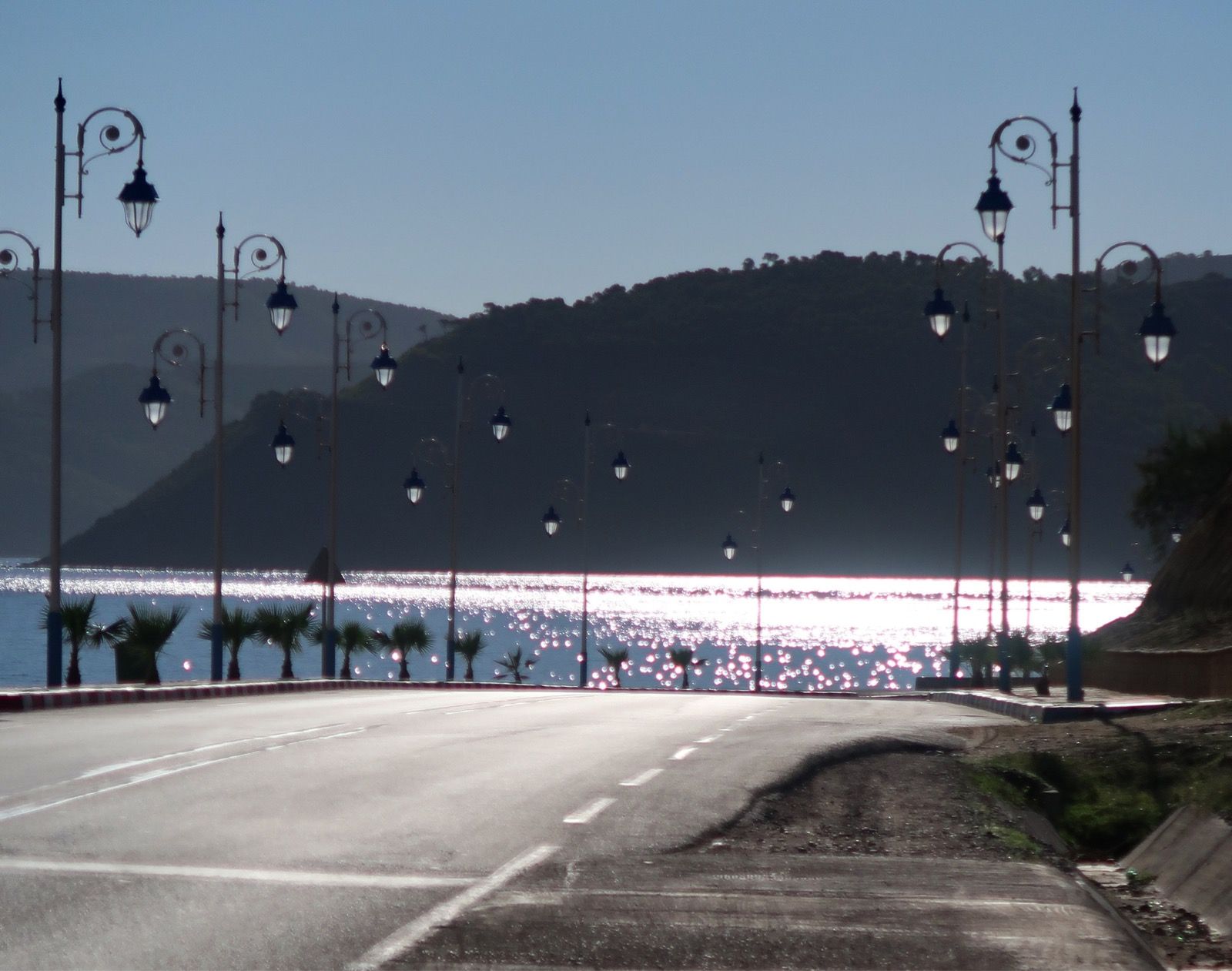
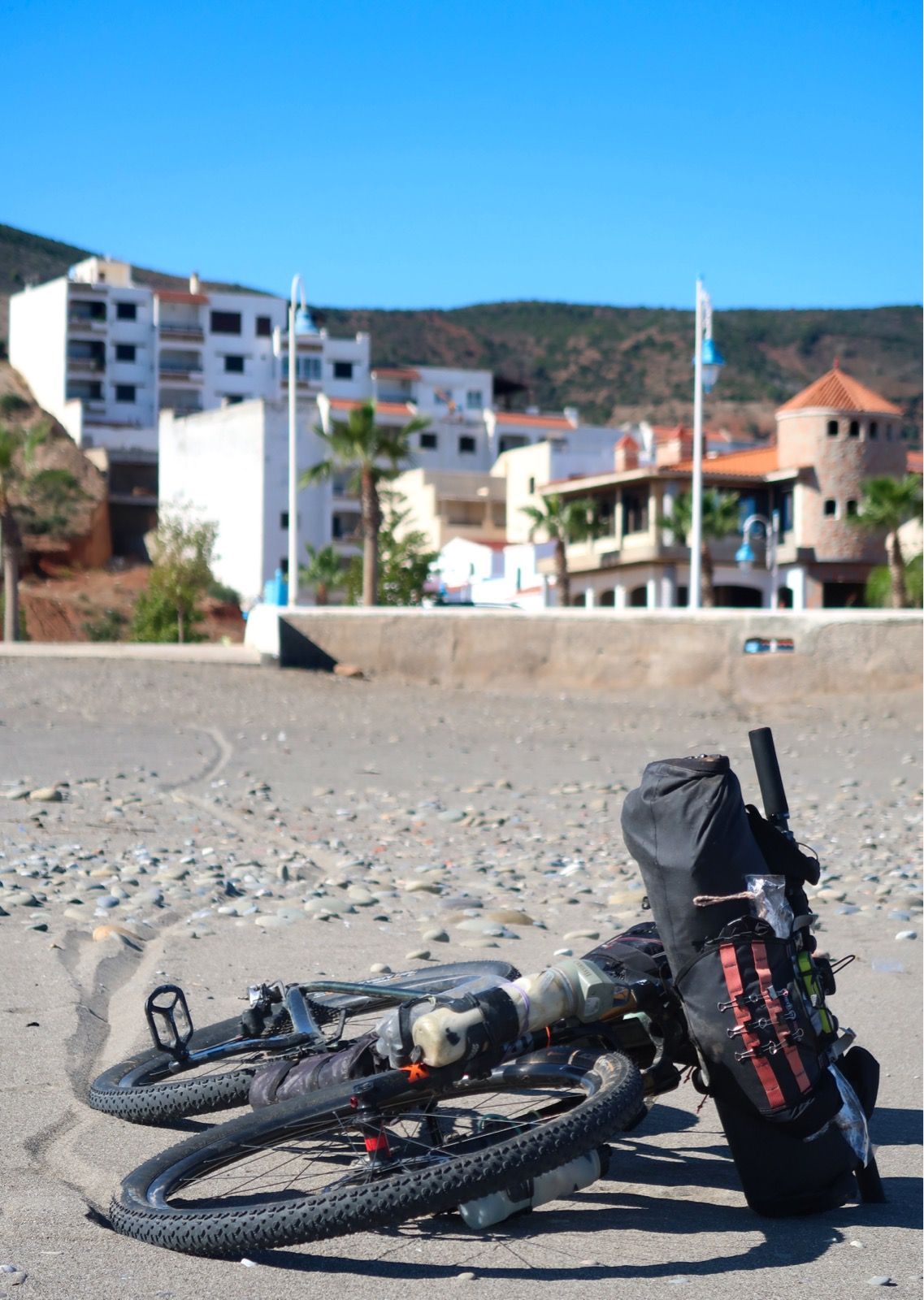
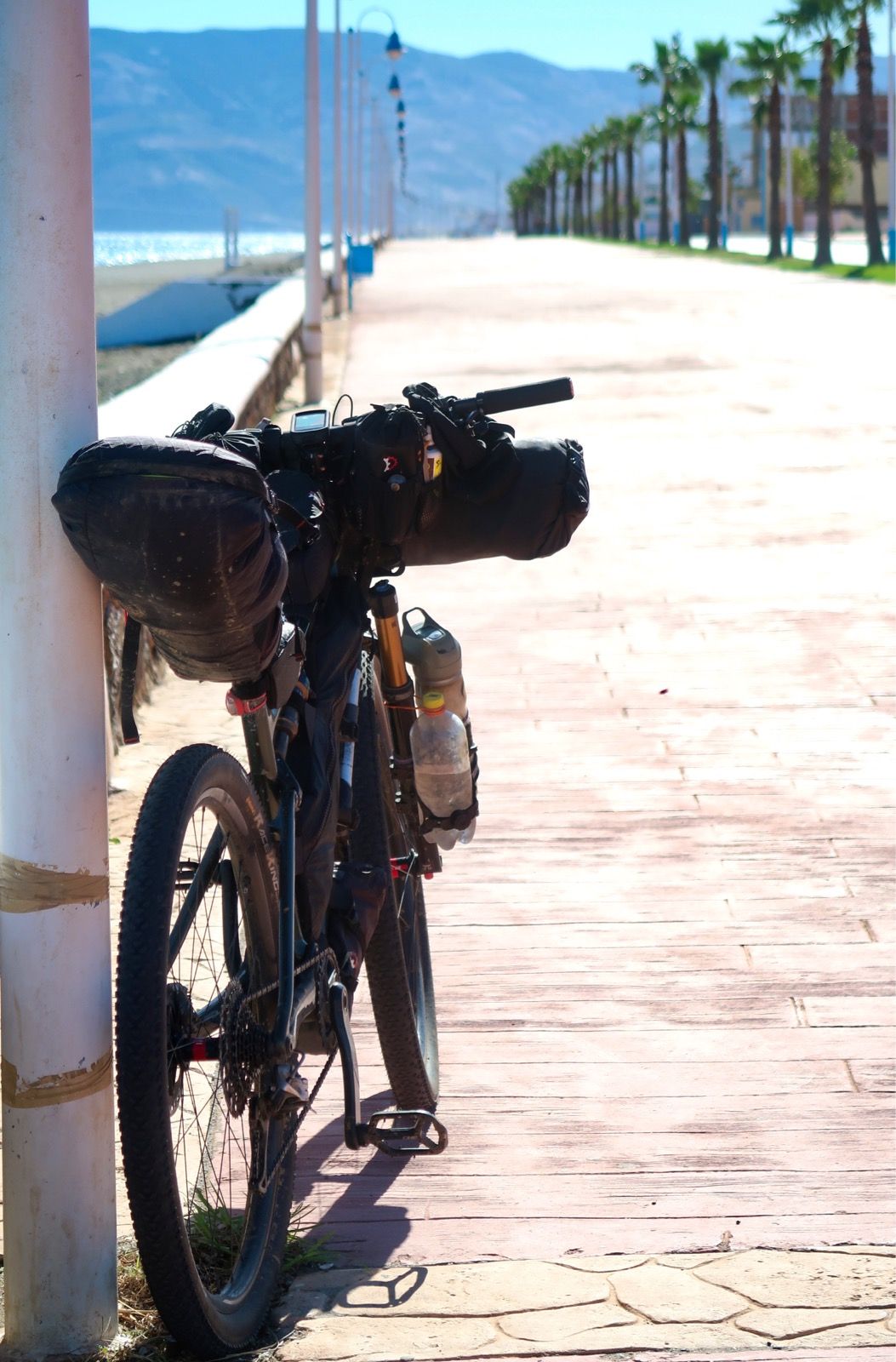
Why is no one out on this promenade on the beach?

LMDIYA is my acronym for the mountains of Iberia and Africa. I’m going to hit the mountains hard here in the north of Africa because they Peter out for a long way until Guinea.

Happy timeS!

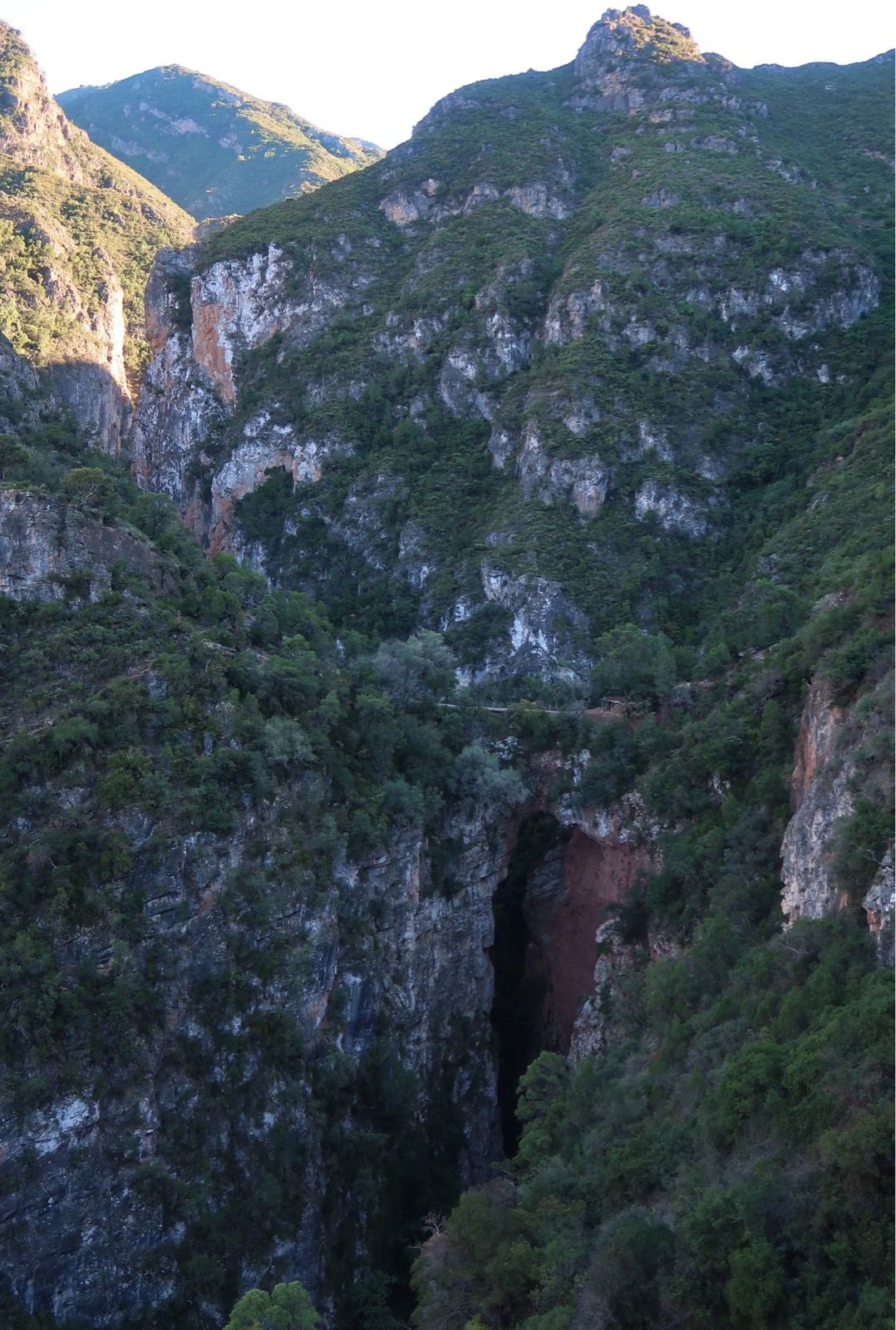
Close up of Gods bridge – todays objective.

My room tonight with the buggy floor.

Strava Comments:


Carol D.

I’m definitely a paniphile. I’d have tried at least half of the 9 different types of bread. Fortunately there are no nearby good sources for my addiction.🥖🍞

Ann L.

I love the three things that make you happy are so simple and genuine. The people there seem so nice and laid back. Great to see a totally different culture from ours. Nice you made a friend on the hike that you will see later! God’s Bridge looks amazing. Such beautiful scenery.
We will take good care of keeping Janet occupied in your absence.

Janet W.

The air looks so clear! It must be the strong winds. Quite dramatic scenery with both mountains and coastline. It was fun talking to you and hearing about your conversations with people in bits of English, Spanish and French! Your French will improve by leaps and bounds each day. Ojalá que no hay chinches en tu cama!

Corrine L.

Absolutely loving your commentary. Keep it coming!

Corrine L.

And stunning scenery!

terri W.

What a beautiful and fun day in the life of Brian’s solo travel. I really need to catch up on the last few months.. sadly I’m way behind but I second Ann and Carols comments. And know that we’re excited to have Janet back! We will be very happy to enjoy Janet in your absence! Safe travels!

Mark G.

My 3 things that enlighten the soul: Jennifer Glenesk , nature, family, adventure….oops that’s four. Great day Brian

Stan H.

I can’t imagine having to decide whether to inject more precious insulin in the name of being polite. God’s Bridge is impressive! “Salaam-Alaikum”!

Paula G.

I love how your happy receptors work. Hopefully the rest of your receptors will work to keep you going strong through the end of February. Your video reminds me of a few movies that I’ve seen. There is usually someone lurking in a hall or behind one of the doors.

Sօʀƈɛʀɛʀ 🅅.

Wonderful view of God’s Bridge! It is as God wills.

Ride Stats:

Elapsed Time Moving Time Distance Average Speed Max Speed Elevation Gain Calories Burned
08:43:37
hours
06:56:57
hours
93.93
km
13.52
km/h
68.82
km/h
1,986.20
meters
3,575
kcal


– Day 89 : أعطني المال [top]


As the morning rose to consciousness, I felt around this new body I was living inside. What was going on? After 13 days of sore throat ripping me from the inside, along with a raspy cough, I had somehow suddenly ditched this illness! Excited about that, but not the rain outside, I departed with the good that could be had from the morning, and headed off to “the blue city” of Chefchauen.

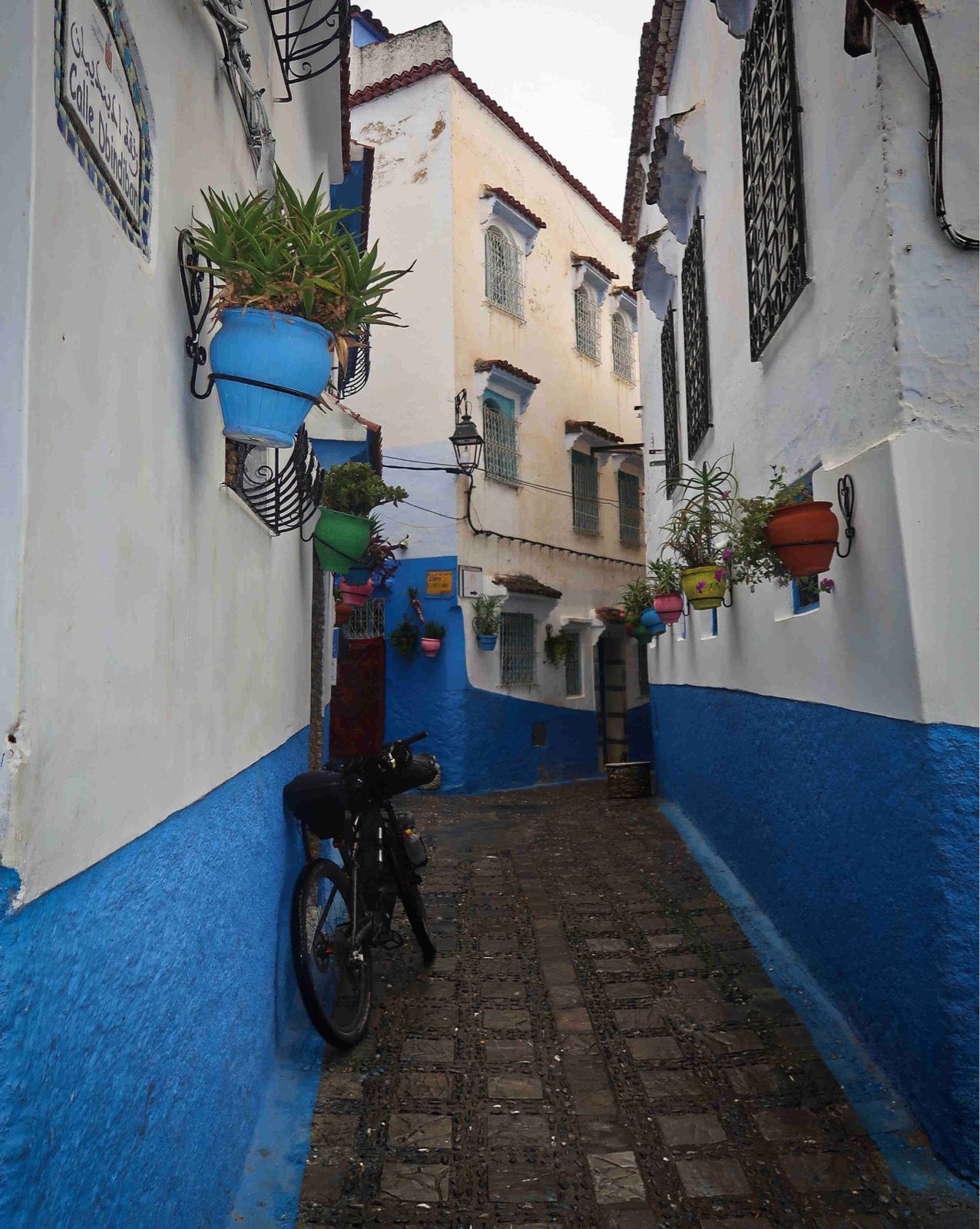
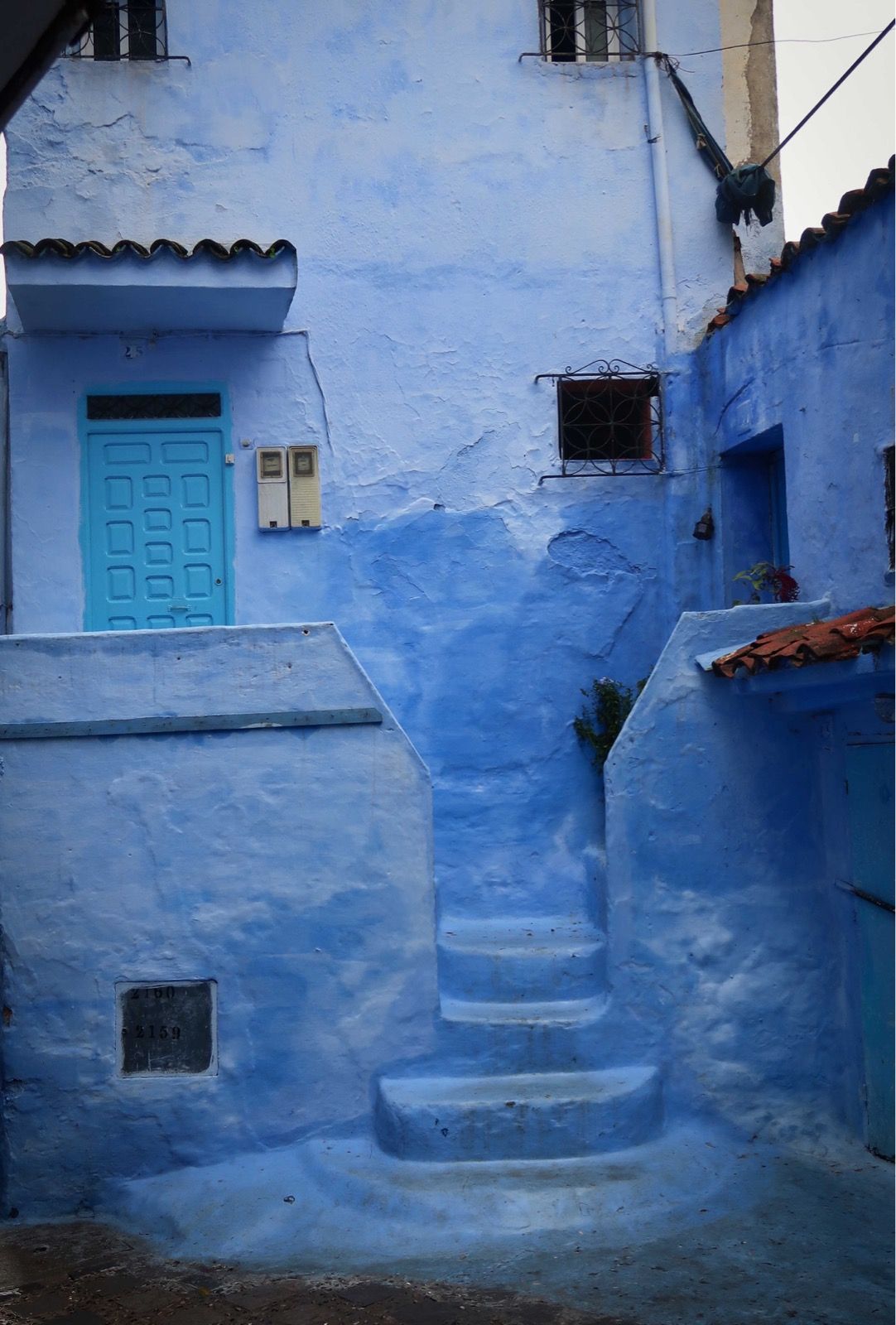
I’m not normally the type of person who goes to see cities for attractions (or one who climbs 1,500 extra feet for such privilege), but I decided to go to this one. I rode through the narrow blue alleys, took some photos and videos, thinking this was nice.. until a robed figure came talking to me in Spanish. He looked like a hooded character from Star Wars, and if he would have had glowing yellow eyes, I wouldn’t have been surprised. “Be careful, be careful” he scratched out, grabbing my seat bag. “Be careful of the wet roads!” He continued. I slipped away from his grasp like a fish and decided that was enough of the blue city.

A couple complicated searches for low carb food revealed that although I’m not yet in the Sahara desert, I have already reached the food desert. Soon I was off to the open road… I turned off on a one lane mountain road and about this point (3.5 hours into my ride), the rain finally let up.

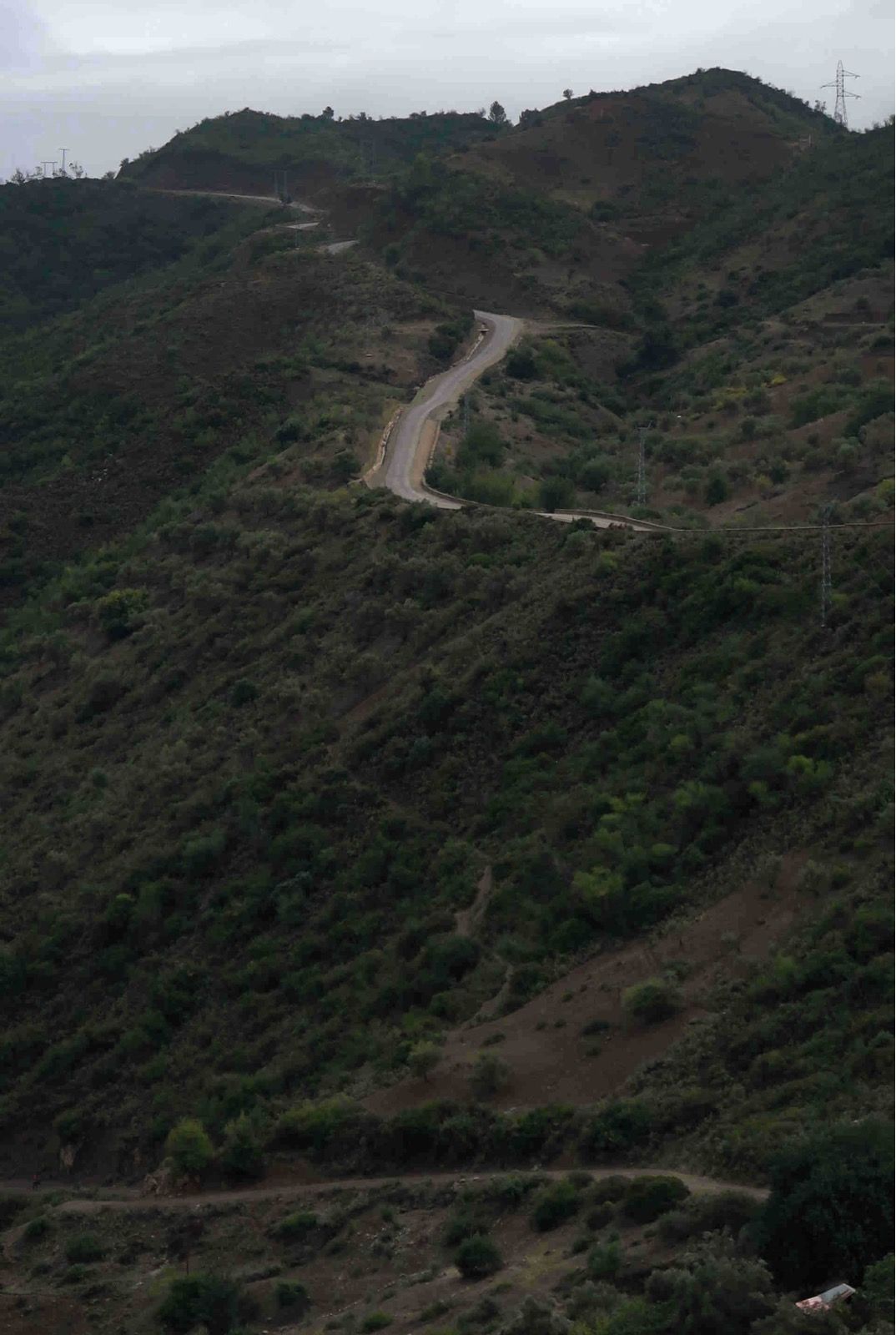
Whenever you cross an international border, there is always a “grace period” where near the border you retain some of the elements of the former country that help ease the transition into the next. The grace period for Morocco ended right as I turned up the mountain road. After lots of beautiful and peaceful riding, I saw a man up on a hill, kind of yelling at a family or two down below. One of the kids looked bored with this discussion and he wandered around me while I was filling my water bottles. I wanted to know what the “fight” was about, so I asked the kid if he spoke Spanish. “No”. English? “No”. French? “No”. He was fluent in “no” in all 3 languages, so I bid him farewell.

Next I saw a cyclist ahead of me. Marcos from Italy was touring, burdened by enough water to fill an aquarium of sea turtles. And a turtle he was, riding about 1/4 my speed. We settled on a French dominant hybrid of Spanish/English/French and spoke in 3 word sentences. He has been on the bike for two years mostly in the Middle East and India. He had a good sense of humor. When I asked if he also had water in the container on his downtube, he said “no, it’s spaghetti”. (You know, being Italian and all) Actually, it was tools. Later he asked my age; I told him and then he wanted me to guess his age. I said “60,”. No. “62?” No. He was 50. Doh! Men, here is some advice: if you have a gray beard and you are 50, don’t play the “guess my age” game. Actually, women, same to you… if you have a gray beard….. Anyway, He has no blog or website; I’ve lost connection with him, even though he was a fun guy. I love the connected way I travel, but I secretly admire these truly off grid people taking their time with bikes prepared for the apocalypse.

Further along, i was coming down a hill and saw two young guys parked on the side of the road overlooking the valley. For some reason, I suddenly thought, “I need to talk to more people.” As a guise, I pulled up somewhat close to them and took a picture of the scenery I wasn’t really interested in. Right away, one of the guys walked up to me and started talking. I said, “do you speak Spanish?” He did.. in fact, he was pretty fluent! It was great to have a real conversation! Jonas has worked in a flower factory in Spain for 10 years. He is here for 2 weeks visiting family. When I told him my name was Brian, he said excitedly, “Are you Muslim?!” I said no. He said, but “Brahmin is a Muslim name!” He then continue that Islam is the best religion. I asked why and he said, “because it is easy”. Easy? I pushed him to explain that one. He said “easy. The rules are simple. You don’t kill, you don’t steal, and when you are talking to your friend, and he walks away, you don’t talk to another friend.” I thought I was losing that in translation, but asked him to clarify… and yeah, that is what he said. Anyway, I really did feel “called” to stop and talk to these guys – the first time so far – I normally consider this kind of stuff divine intervention… but was it God or Allah who drew me to them?

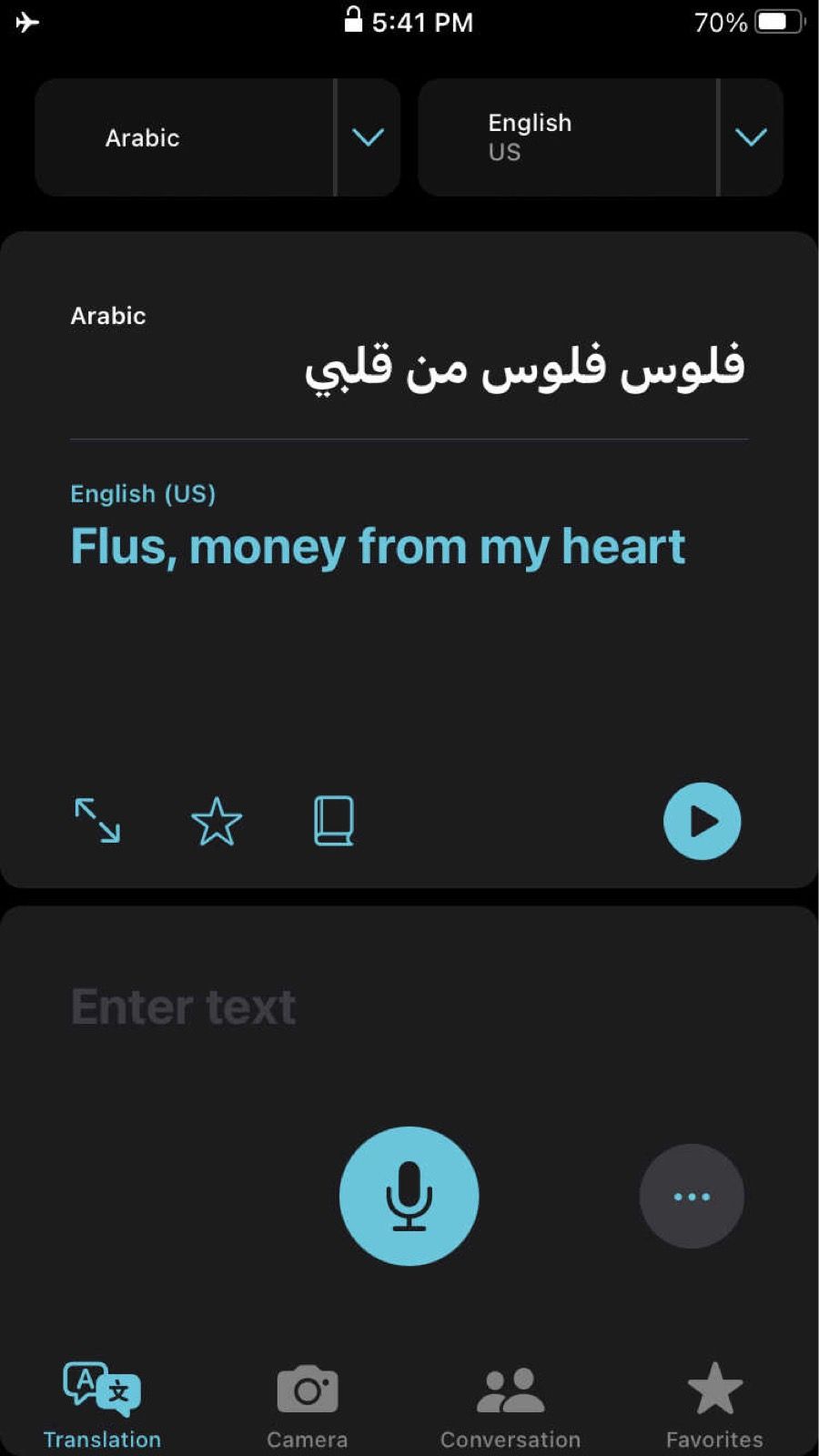
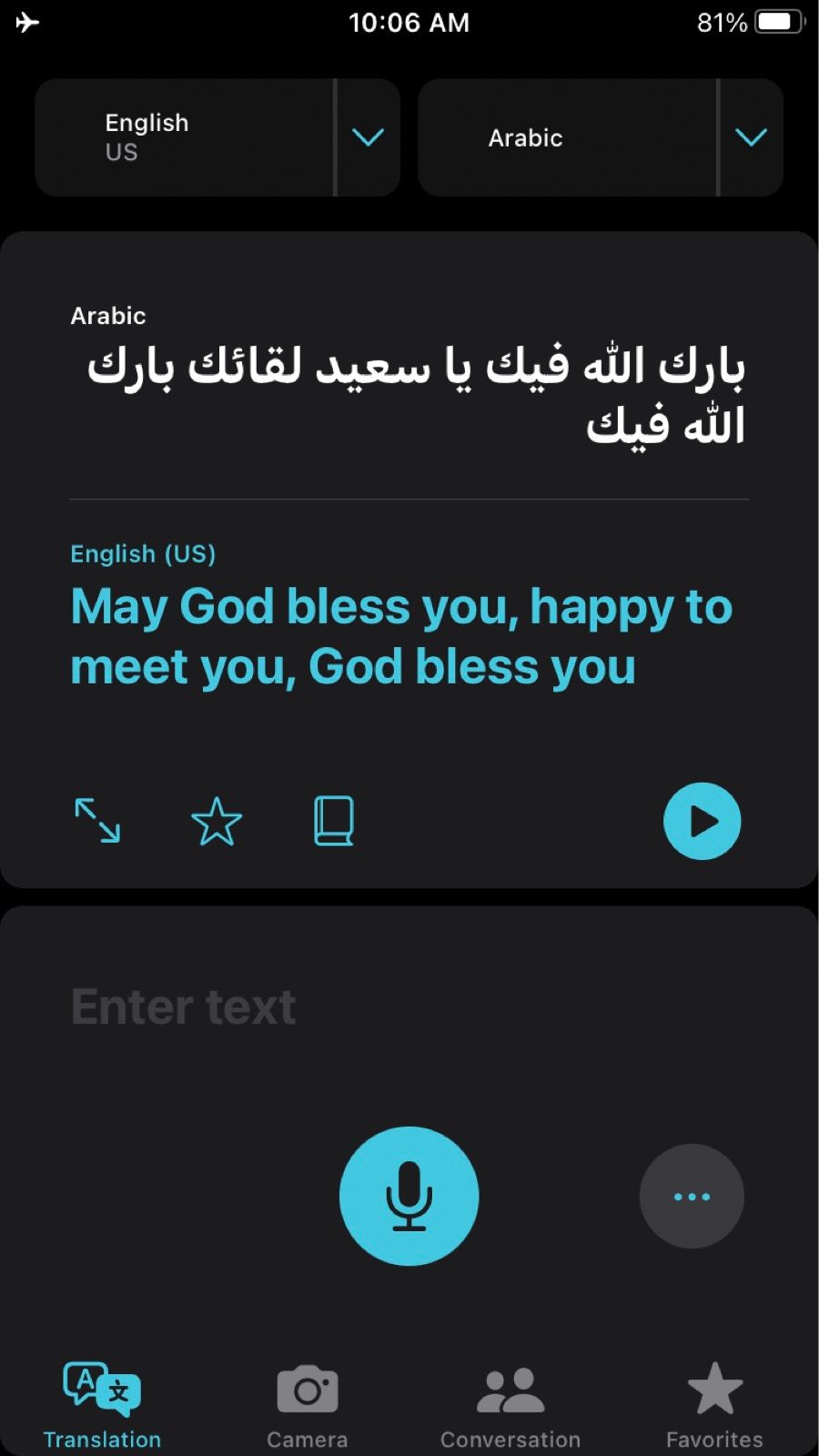
Further down the road, I could tell that I was now really in Morocco. The road turned to a muddy potholed mess. 3 boys rode up alongside me on bikes and started chatting. I tried my 3 languages again, but nothing. So, thinking, “what the heck,” with one hand I pulled my phone out of my pocket and clicked over to my translate app. I had downloaded Arabic for offline use and as we dodged potholes and cruised along at 12 mph, I spoke to my phone, “what is your name?” Each reported their name gleefully. Then they got down to business. I held the phone towards the kid nearest me and he leaned over his handlebars, to speak to the phone, dodging potholes and mud puddles at the same time. My phone quickly explained to me, “Money. From my heart.” My enthusiasm for our fledgling conversation dropped; I said to my phone, “i only have a credit card. I am sorry…. From my heart.” The three kids solemnly accepted this, and simultaneously fist-bumped their hearts briefly riding one handed before turning back. I saw lots of heart fist bumps today.

I didn’t like the content of that exchange, but at the same time, I was gleeful that I could have conversations with everyone now! if I could manage this while riding a bike, no problem while stopped! Upbeat and excited, I pulled over to talk to the next guy who waved me down, but we got by with French.

Not long after, though, I saw a pack of 40 kids come running from behind a house. I knew I couldn’t handle that many kids, so I accelerated. They came running, saying all sorts of things, but smiling and laughing and running alongside me. I picked up the pace and they began to thin out breathing hard. I felt relieved and slowed down a bit once I ditched them… only to find them coming again – they knew a shortcut through the hill! I sped again, but this time they were grabbing onto my seat bag. I accelerated like Marty trying to get the Time Machine to 88 mph. By the time the last kid let go, I saw on my GPS that I was ascending at 5000 feet per hour. These kids would have even given Sepp Kuss a run for his money…. Literally… and now I know where that expression comes from.

…And then it happened. Click-tap-tap-crack. I looked in my rear view mirror and saw that the front runner kids were now throwing rocks at me. Crap! Yup, the stories I heard were true. Luckily, I was so fast that they didn’t manage to hit me or my carbon frame. I wonder what will happen to Marcos tomorrow? Thank goodness Janet was not there.

Now, I decided to hurry. I pushed hard on the pedals, flying over the muddy road. I had seen a hotel on the map, but it involved a steep hike a bike up a dirt road at the end. Fearing kids now, I did worry about being swarmed, but it was dark and I snuck up to the friendly place. It’s really just a house, I think, but it works; I’ve got 3 beds for $12 and a place to stay out of the rain if it comes back. I want to tell you more, but even with 4 bars of LTE, there is hardly internet here. I think the bandwidth is probably being saturated (even though I can only see a few lights around the lake below).

Photos majorly De-rez’d due to saturated data.


Photos:
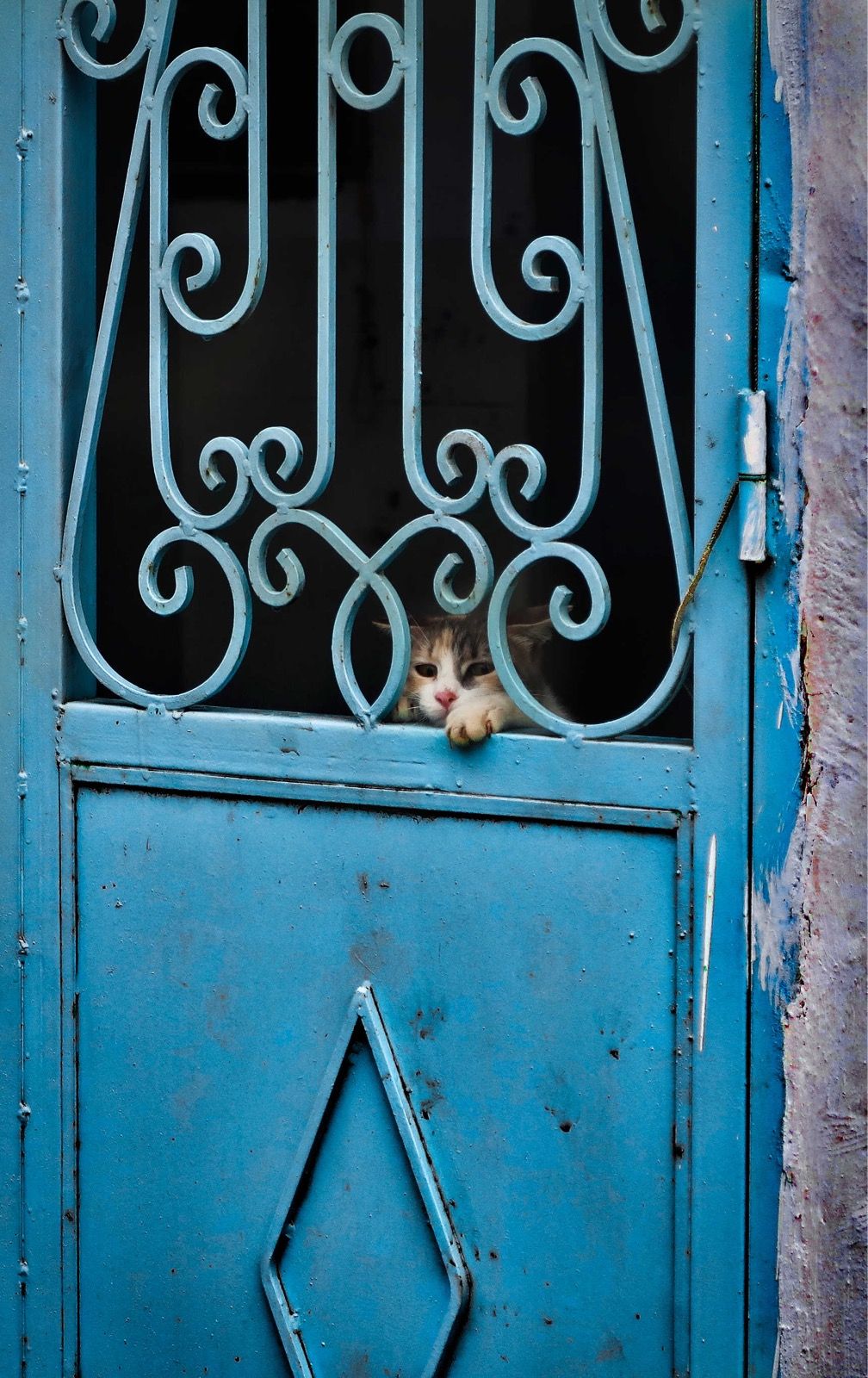


The blue city. I have better pics but might have to upload tomorrow when data is better.

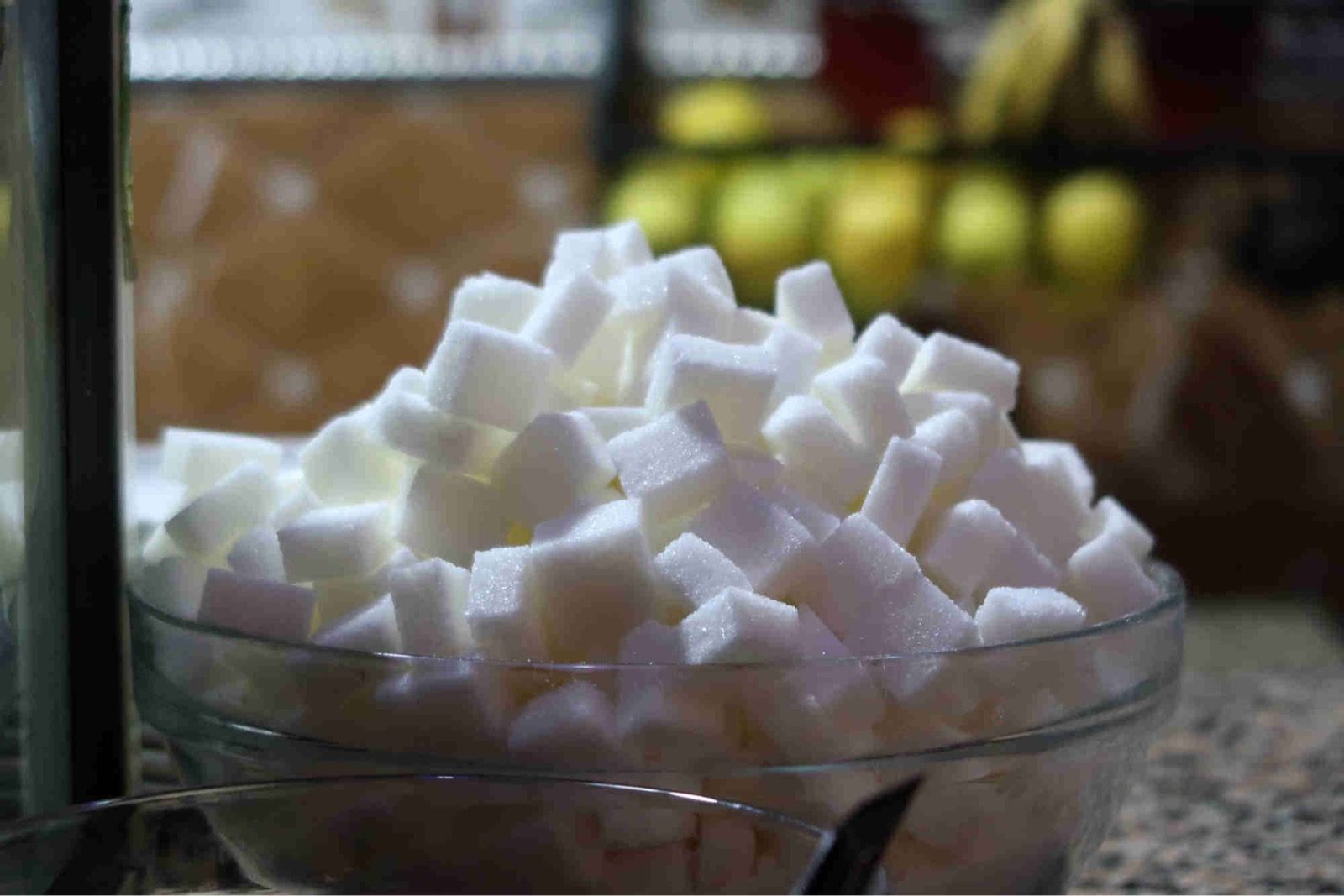
Would you like a little sugar in your coffee?

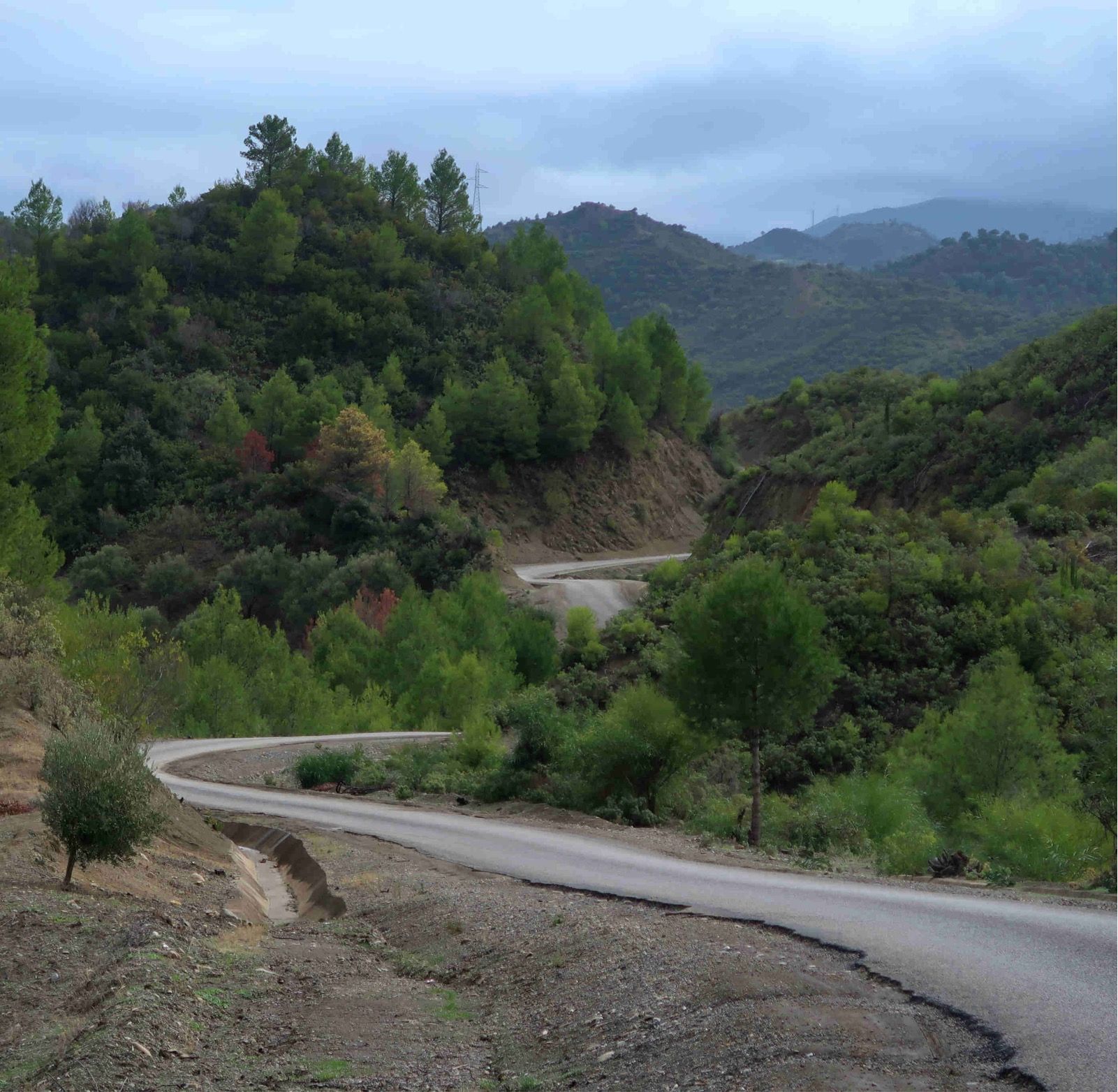
Stil heading for the mountains. Some good riding to accompany all of today’s interesting people.

Marcos the Italian cyclist.

Thought of Gregg bone when I can here. I like the mural. On the left, it looks like “community crush” day.

From my conversation with the kids on the bikes.


Strava Comments:


Ann L.

I’m glad you were able to out ride that swarm of kids. Good thing you are feeling better as you had a lot to cope with today. Very interesting adventure. Hope you sleep well in your dry room!

Tony B.

Awesome story!

terri W.

Wow, Full day of human multi language interactions, and great effort out pacing the kid swarm with a fully loaded bike. Happy you health is back! Safe travels!

Yuwen W.

Wow, I’m always afraid of dogs chasing me…never thought about kids 😳

Stan H.

I wonder if Marcos encountered the kid swarm?

Carol D.

What a wild day! Glad you escaped the rock throwers and hope you don’t meet more. So crazy that the web translate app did more for you than all your hard work learning useful languages.

Corrine L.

Sounds like a crazy day! Glad you and your bike didn’t get hit by rocks. Didn’t know kids throwing rocks was a problem in Morocco. Thought it was other African countries. And glad you are feeling better. Those roads look awfully steep!

Judy I.

Huge miles, tough climbing, rain, wind, and being on a different planet in a different body! 😳 I’ll need to make popcorn for the next post. Safe travels!

Mark G.

Whew!!! What a day✔️

Nancy A.

I have missed a lot of your reports. I’ll have to back track. This was so interesting. 81 miles

Nancy P.

Kitty picture for the win 😊 Thankful that you are so strong 💪🏻.

Vicki C.

I think part of the attraction of the “blue city” was that flys and mosquitoes are repelled by the color. I think tourists are drawn to it though. Impressed that you can go do fast!

Jessica M.

We called the mean dogs on Jim’s trip “yard dogs” – a new term now – “yard kids”!! That’s horrible. What a great day otherwise. Glad you feel better.

Chris Z.

I was wondering what you’ve been up to! Amazing. And this one sounds slightly harrowing. I’m glad you’re okay and got away from the kids unscathed. Thanks Brian Lucido for sharing your adventures and stories. ❤️

Janet W.

You were right when you said this day had a lot of stories! It’s fascinating to read and I’m glad you’re experiencing so much. Good job being inspired to talk to people more often. Those will be the times you remember most when your trip is finished!

David L.

I like the Running from Kids segment you created. Presumably you are the kom!

Sօʀƈɛʀɛʀ 🅅.

I remember being mobbed by children. We were also mobbed by teenage boys who really worried me because it was clear they wanted to take anything they could grab. Oh, and back then it was considered extremely rude to take photographs of people without their permission. I suppose that is different now.

Ride Stats:

Elapsed Time Moving Time Distance Average Speed Max Speed Elevation Gain Calories Burned
09:48:59
hours
07:39:59
hours
131.09
km
17.10
km/h
51.70
km/h
2,529.00
meters
4,516
kcal


– Day 90 : Crow’s Feet [top]


Warning
For my vegan and animal lover friends, I have buried a few “explicit” photos further down and encourage you not to scroll if you think you might not like what you see.

Last night, I arrived at a house after dark, and the owner did not speak English, but his son did. He introduced himself as, “I am Ahmed, I am an engineer.” Like the hotel in Tetouan, they just wanted to make sure I was happy. I am getting used to expressing that I am happy. Very happy (and I sincerely was elated after the near miss with the kids’ rocks yesterday). The place was beautiful, overlooking the lake. Perfectly quiet and the kind of rest I love.

Departing today, rode a bit until I came to a cafe where the man had to light a fire with tissue paper to get the water hot. I went outside to the crumbling pavement – expecting little. It was time to call Janet right after she finished driving home. When the call connected, it was pitch black and she was outside checking out the garden. Delighted she made it home safely, I realized that she is going to have to buy some decaf so we can continue our virtual coffee dates; her bedtime is my morning. As we spoke, I heard all sorts of mechanical noises coming from inside the cafe. 20 minutes after ordering, the man miraculously brought out the strongest, tastiest little espresso I’ve had on this trip. How did it do it?!

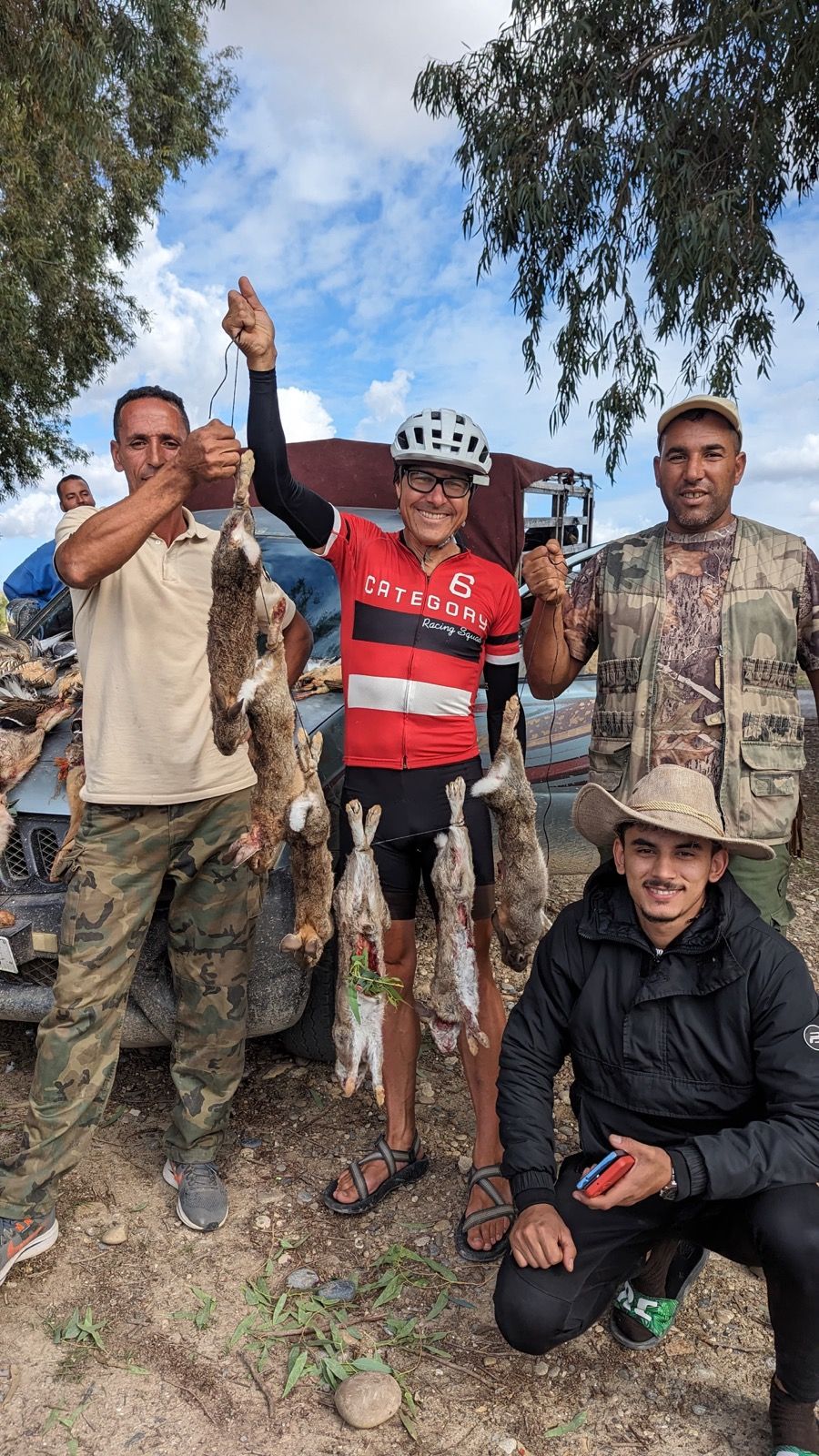
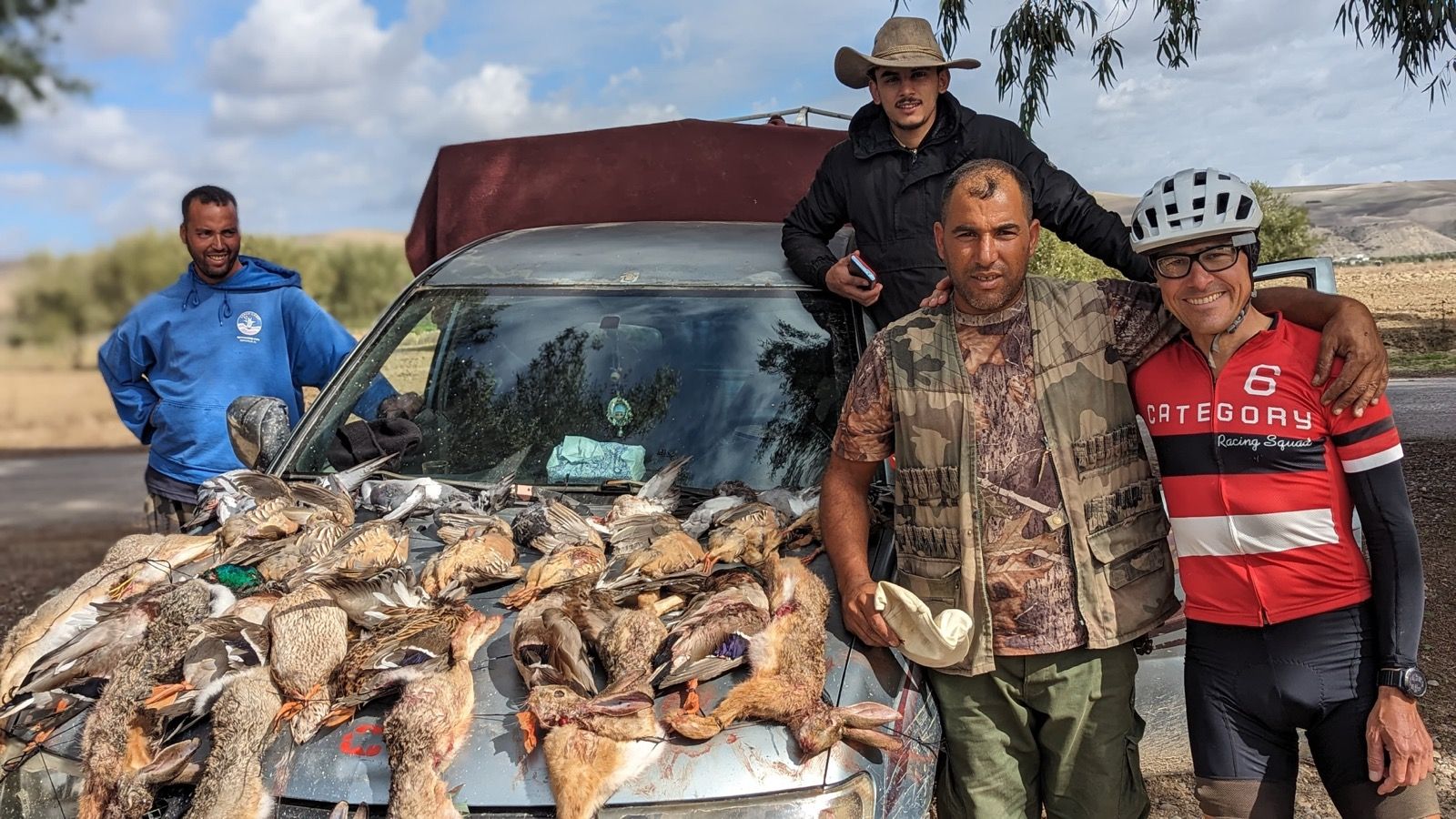
Further down the road, I saw an intriguing scene; There were a bunch of men surrounding bloody carcasses splayed all over the hood of a pickup truck. I kept pedaling… but a few minutes later turned around to ask what the heck was going on.

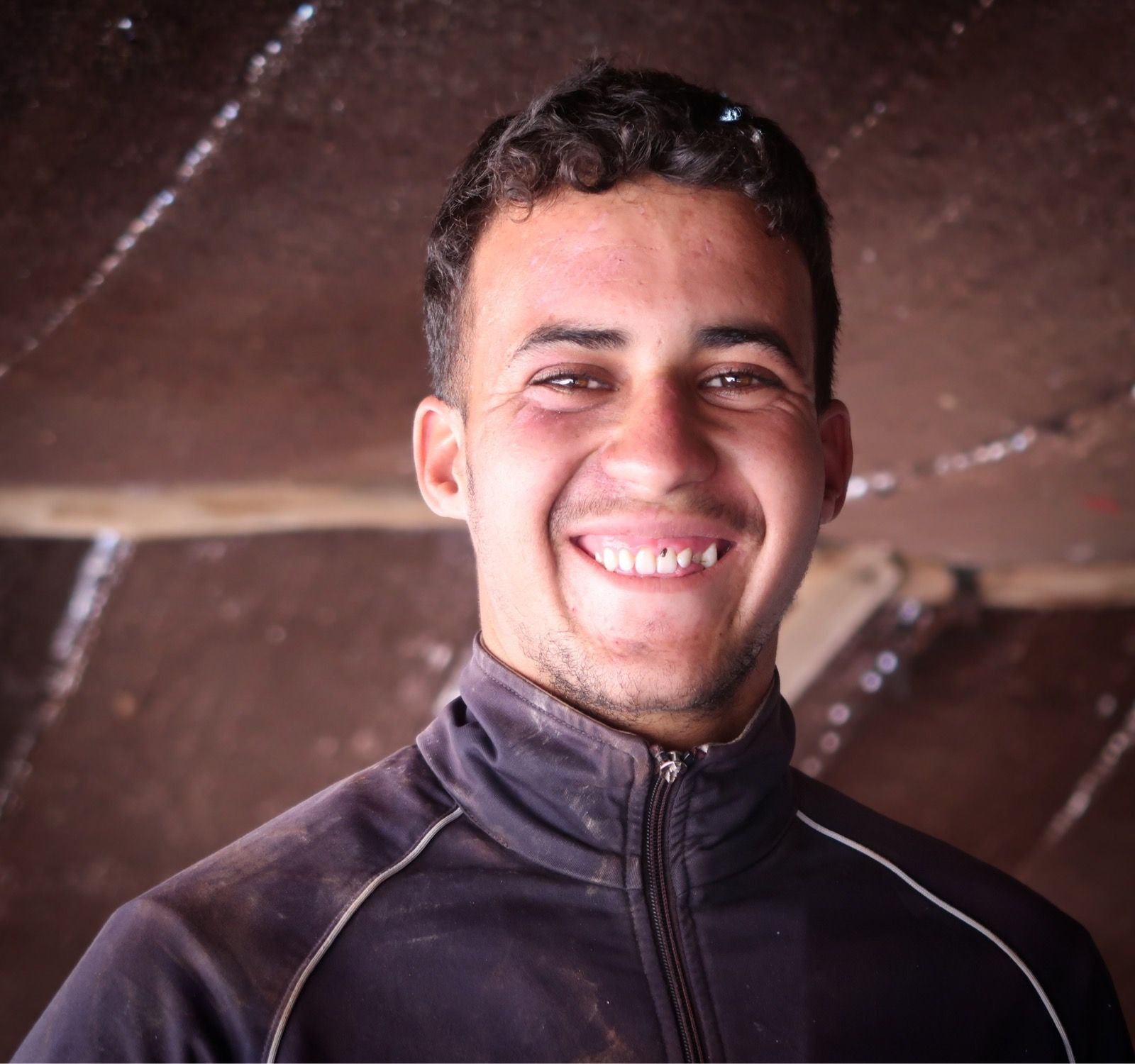
I pulled up and acknowledged them, trying my various languages to engage them. One guy named Yahya spoke a few words of English, and slow enough French that I could ask him all of my questions. He said that they can hunt rabbits, pheasants, and ducks for these next 3 months. They camped out last night and now they stuff the insides of the animals with eucalyptus leaves to help preserve them. They will drive fast with the bodies spread all over the truck and the wind will help preserve them. As he told me all of this, he put his arm around me like we were long time friends… that huge smile the whole time. His face very close to mine. At least you don’t have to worry about drunk guys here – no one drinks alcohol, which I really like. Being so close, though, I worried I might have bad breath. If you saw us talking that way, you’d probably see my body language just slightly tilting my head away. I was a little uncomfortable being so near to a stranger, but in another way, I kind of liked it. This is how the guys here interact with each other… warm, friendly, smiling, and in your face. I try to imagine what it would be like if we were this close at home.

Each of the guys had something to say. One guy asked me if I spoke Russian. I said, “no, why?” He said that he was studying Russian. I asked, why? For work? He said “because it is cheaper!” I THINK he said he had lived in Russia to study, and that living in France is too expensive. In a few minutes, we were all best buddies, so they asked me to pose with some of their critters… and I’ll share a couple of these photos with those of you who aren’t squeamish. Each guy came to me separately and said, “welcome to Morocco.”

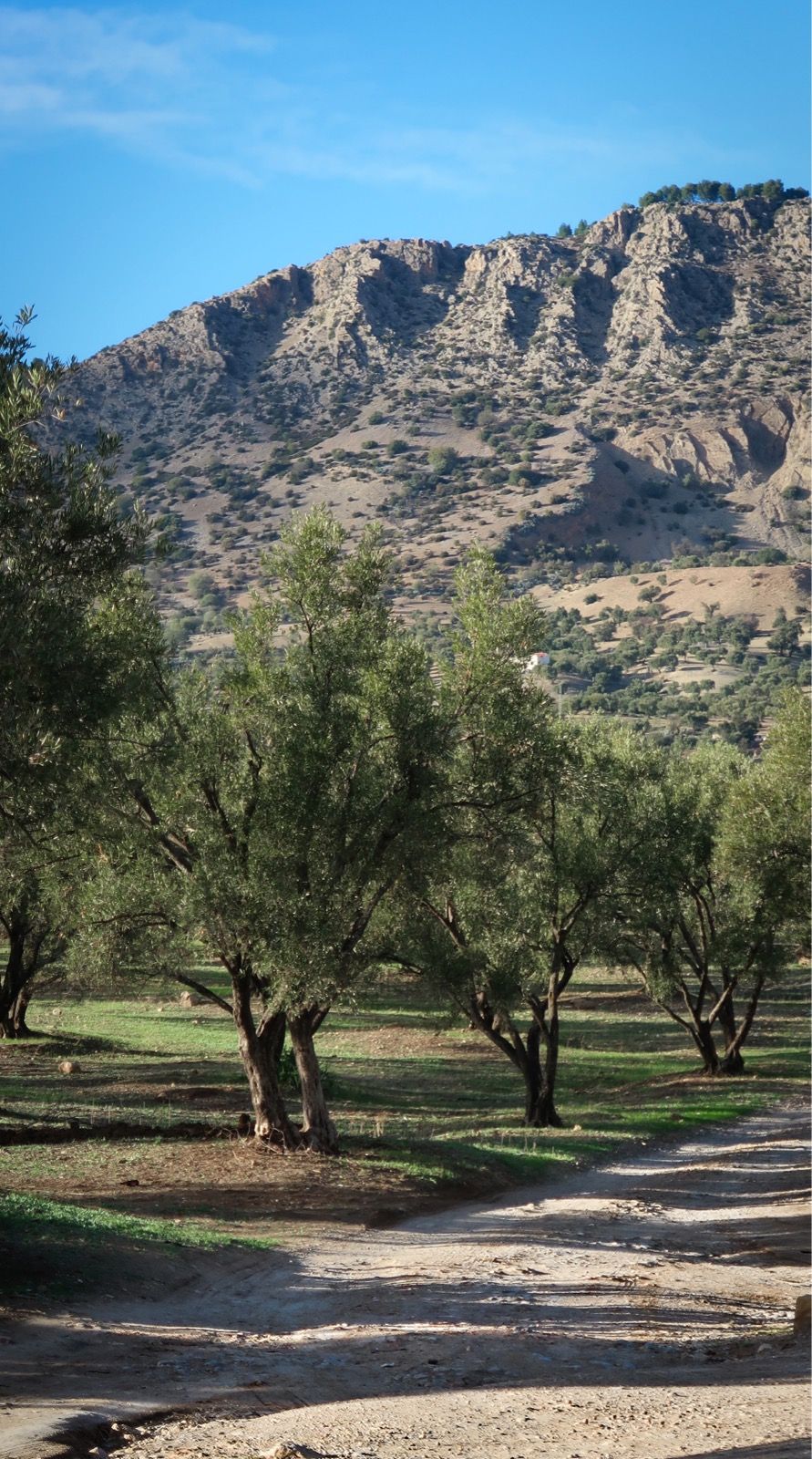
Another theme seems to be concerns about money. Elsewhere, a guy told me that “if you don’t have land here, you don’t have anything.” He claimed there are 800,000 Moroccans working in Spain. Without papers is better because you don’t pay taxes, and apparently in the last year, Spain has become quite amenable to this situation. Once I left the National park, the land became mostly cultivated with olive trees. People were working, plowing the land by hand or with animals – and beating the olives out of the trees with sticks onto a cloth tarp. I think about the above, and my friends who want to be “conscientious buyers” at home. Which is the “right” choice: , should you buy locally to minimize CO2 emissions? Or, should you support the way of life for 85% of the people who smiled and waved at me today?

The smiles… I can’t get over that. When someone smiles like the people here, I just inherently like them. And if they aren’t smiling, but have those crow’s feet that make them look like they are smiling – even when they aren’t, just as good. Why would anyone want to have crow’s feet removed?

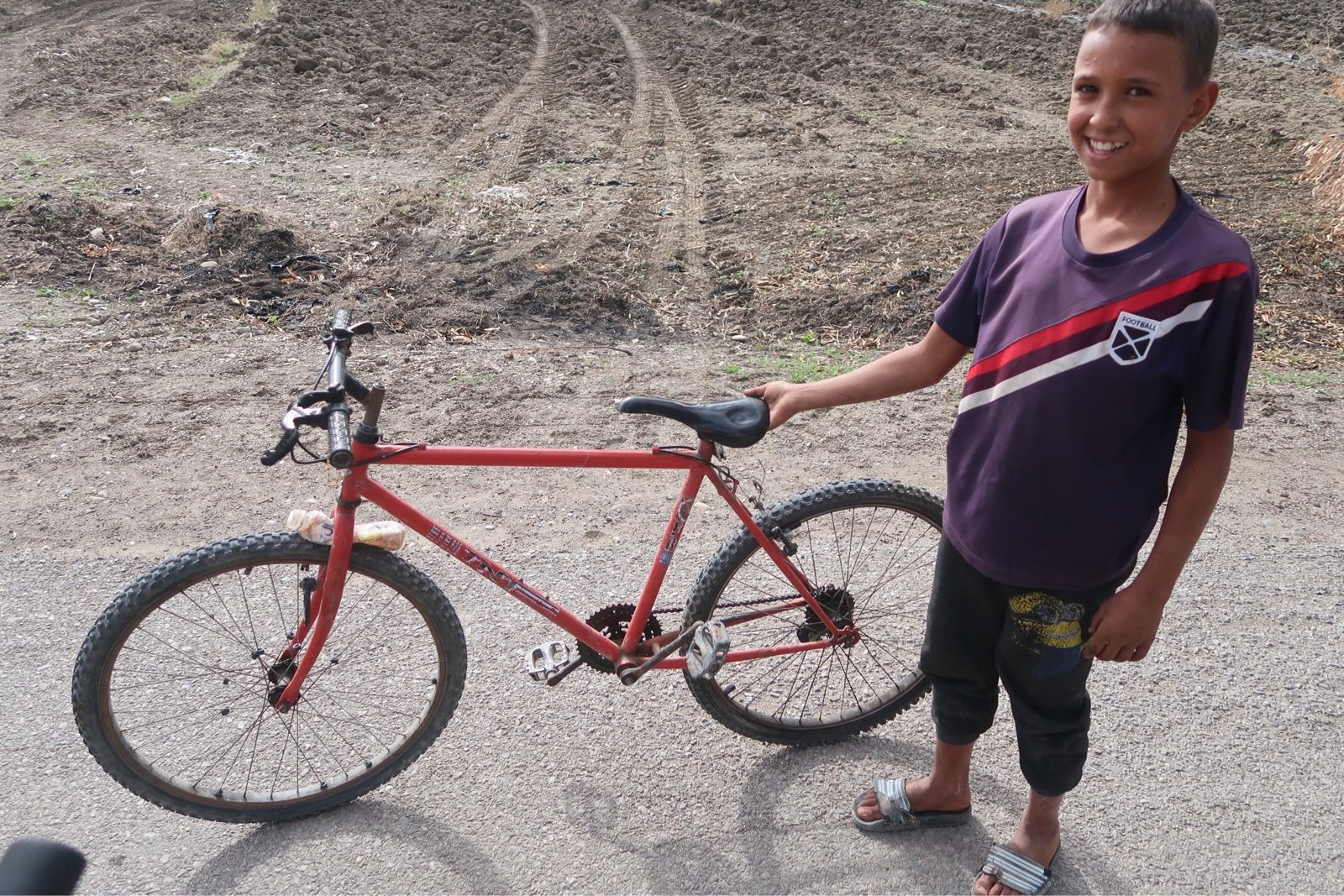
The kids on bikes are my favorites. After what happened yesterday, I realized that you can’t throw rocks and ride at the same time. So far, almost all of the kids have been great – though I did narrowly avoided another round of rock-throwing today. Anyway, I stopped to talk to one kid because his bike was making a horrible noise. I thought, I’ll fix his bike for him; I have tools. We used the phone translate app (which by the way isn’t helping as much as I thought – I think Moroccan Arabic is different from Arabic). Anyway, the kid explained that he put this plastic bottle on his tire on purpose – so his bike would sound like a motor. He’s the first “motorized” biker that didn’t bow his head and say, “I know, I’m cheating..”

You guys know I wanted to avoid the cities, but I decided to go to Fez anyway. I somehow fell into the maze of narrow, noisy, and crowded streets. At first it was exciting, but then it became overwhelming- I felt lost and claustrophobic. The GPS didn’t work well in the tight quarters. I finally found my hotel with the help of 3 little kids. I felt like Indiana Jones slipping out of the street from the bad guys – exiting the chaos of the street, down a narrow alleyway, and suddenly though some doors where a polite man was offering me tea… one moment being touched from all angles, the next sitting on some pillows and rugs, surrounded by colorful patterns sipping mint tea.

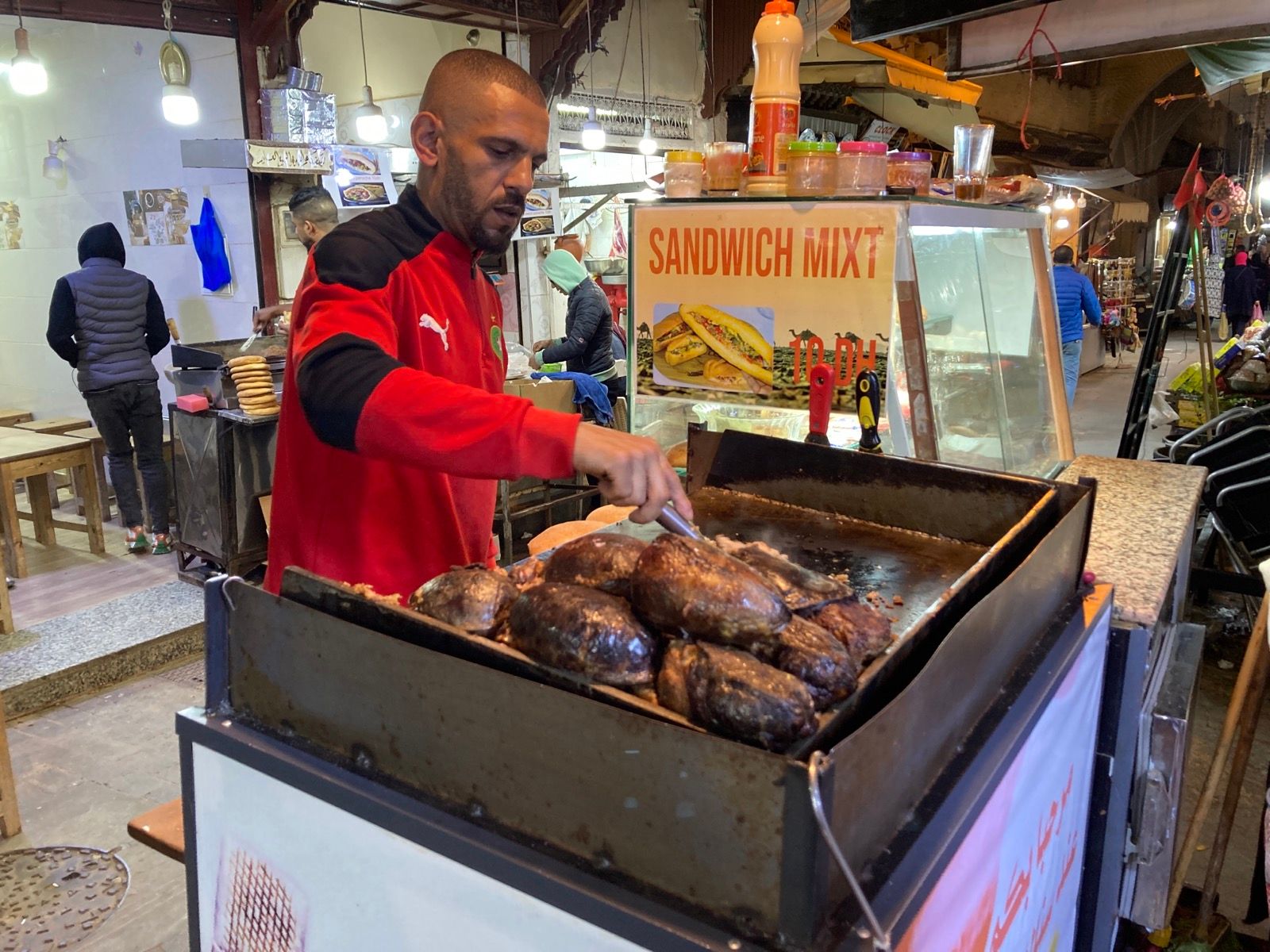
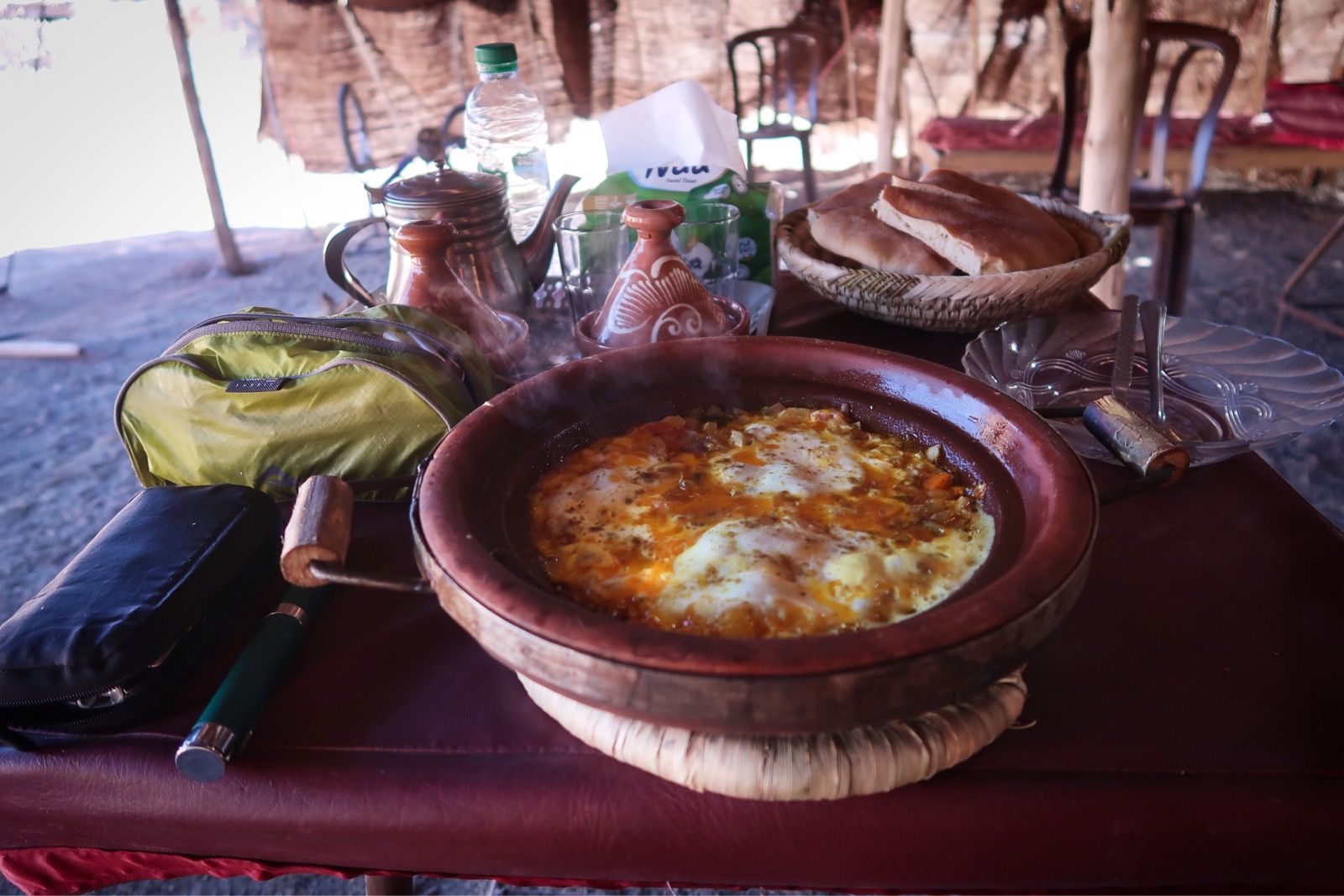
It didn’t end there either… 3 broken ATMs (never found a working one) and a ton of wandering trying to find a low carb meal made for a very late finish. I finally got a guy to make me some kind of meat. I had him add in half a spleen (you read that right) because, hey, he had it there… and it sounded nutritious. Fingers crossed 🤞


Photos:
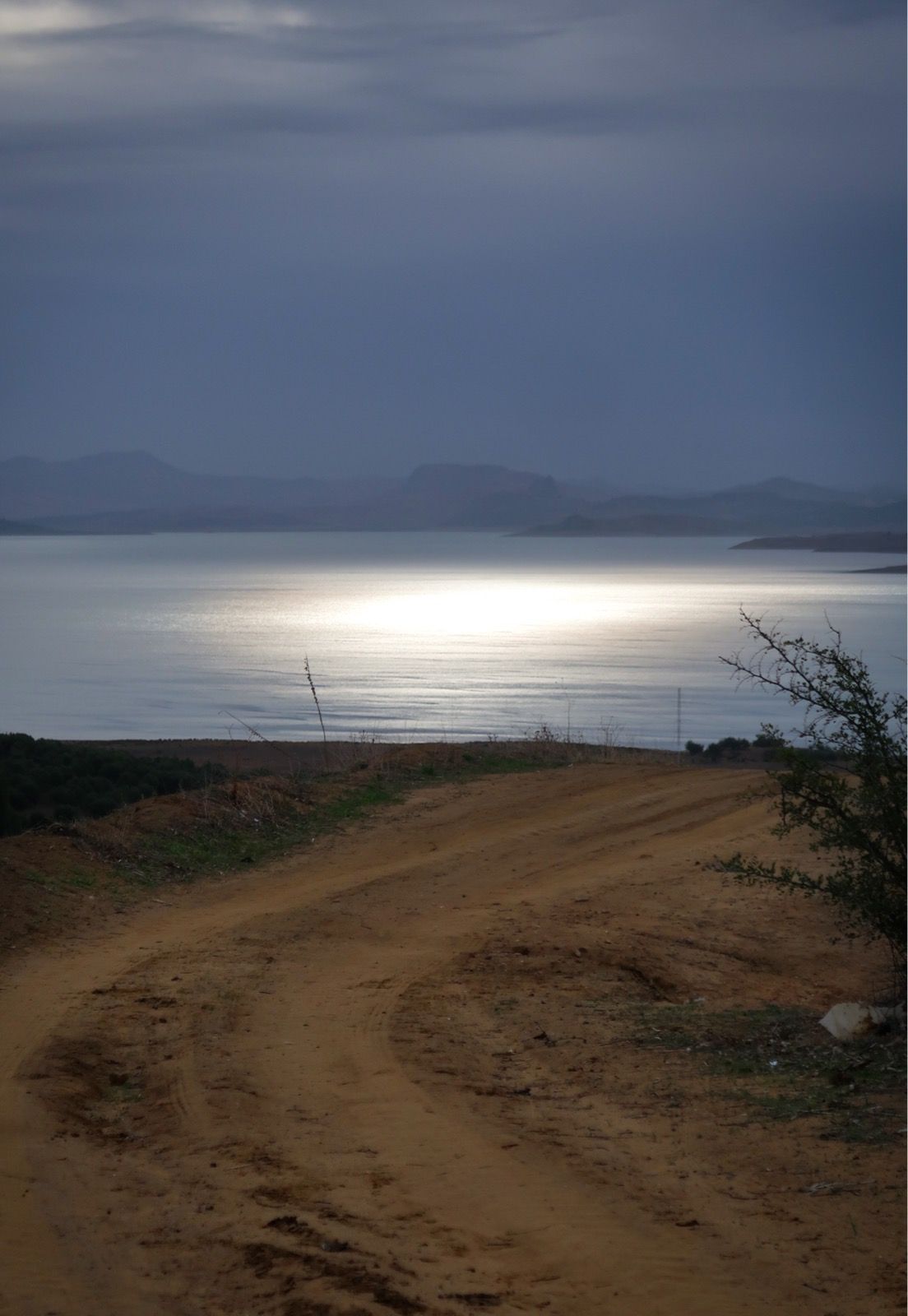


View leaving my room last night.

Men and women ride side saddle exclusively here.

Yahya

The bottle to make his bike sounds like a motor.

After I got him out of the road, he refused to come out for a photo.

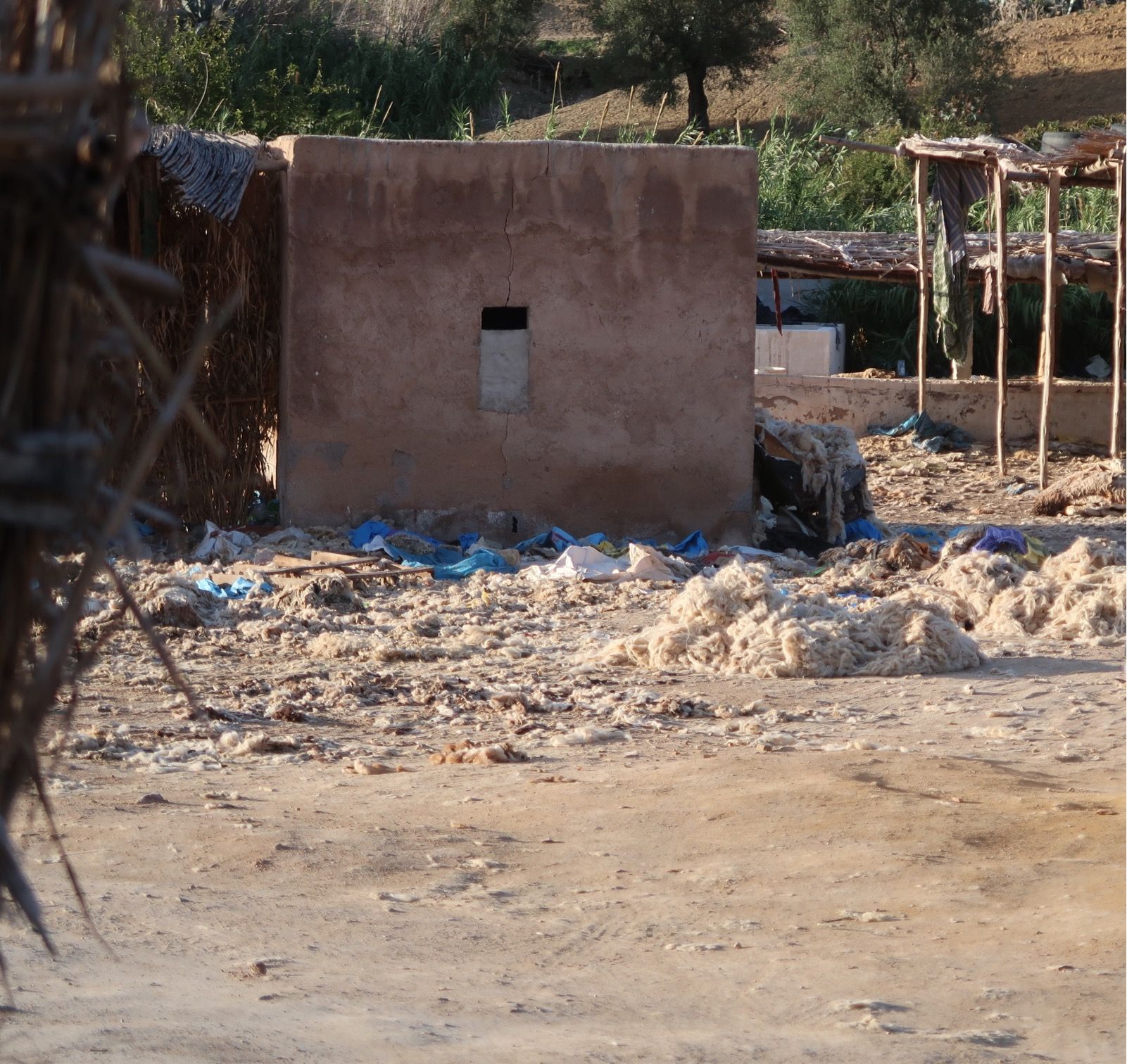
In my travels, I often get to see “stuff” before it becomes a tidy end-product… like wool socks in this example.

Frazzled coming in from the streets like an Indiana Jones movie… and suddenly I’m in here drinking tea, still wearing my helmet and bike action suit.

Up front is some low carb spleen. I am not sure from which animal. I verified I understood correctly and pointed to my abdomen. He shook his head “yes”.

Strava Comments:


Janet W.

So glad we got to video chat just now! I just read your post and so much more happened today than what we talked about. It looks like the people you meet are enjoying the interactions as much as you are! The photos are wonderful, and the climbing – wow! Make time for you to rest too. Thanks for helping me get my phone back working state side again.

Mark G.

I am loving this new format of your Strava Blog entries. Reading about the day’s adventure is so very interesting. Your reaching out to folks and immersing yourself into a a segment of each other’s day is mutually rewarding and enriching I am sure. BTW on my Oregon tour last year I met a whole troop of kids with the motorcycle water bottle add-on – actually sounded a lot like a motor. and That Room!

Mark G.

…did you see Strava runner @AndrewWaddington – he had a nice 6 mile run in Fez yesterday.

Nancy P.

Thymus… ok but spleen 🤔
I shall call you Indiana Lucido 😉

Nancy P.

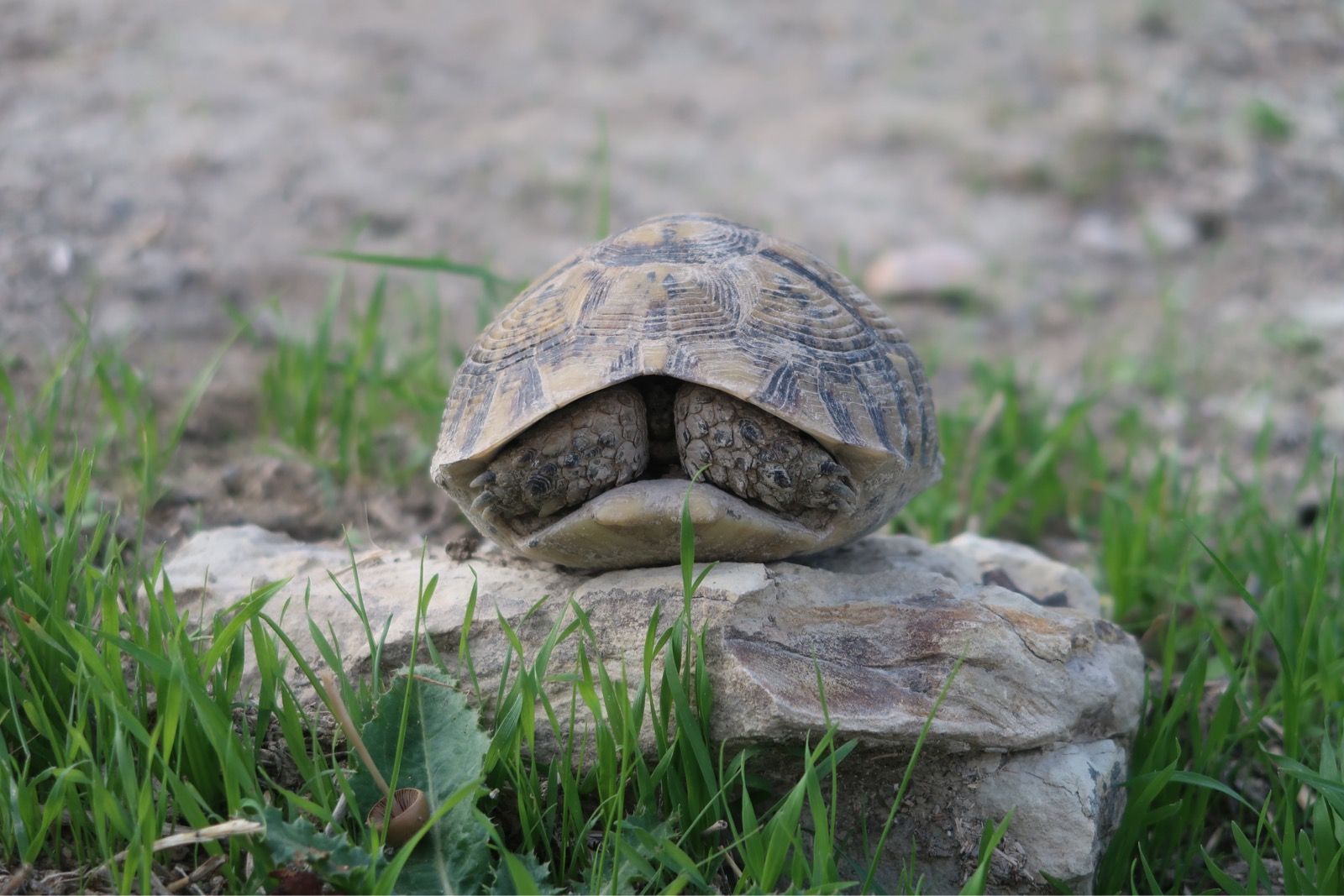
Commented before I looked at the photos! You rescued my favorite animal, a tortoise🥰 thank you 🐢
Was the meat actually liver? what did it taste like? I don’t know much about spleen’s, but those look a lot like livers.🤷🏼‍♀️

Scooter R.

side of low carb spleen 🙂

Ann L.

I love the simple friendliness and warmth of a lot of the people you have encountered there. Your smile in the photos tells me you are enjoying this experience so much and it makes me happy for you. Janet Wagner glad to hear you arrived home safely!

Sօʀƈɛʀɛʀ 🅅.

Venting your spleen is good for you, and eating someone else spleen can be good too I guess. I’m vegan. The butchery doesn’t offend me. The smiles and closeness are a good thing too. I remember the way people would ride donkeys for miles sidesaddle at a walking pace and thinking my god I would rather walk. The various wardrobes. The minarets! Back then people wore handmade bespole shoes. Do they still?

Brian L.

Nancy Prier – yes, it was actually spleen, and it’s flavor was overwhelmed by the onions. Very tasty dinner. Sorcerer 🅥 I like how you are such a wealth of knowledge on so many topics. I had to look up “bespoke shoes”, but will be on the lookout now.

Brian L.

Mark Glenesk – I did see a pair of runners down at the bottom of the climb right before climbing to Fez. It’s hard to do flyby on my phone, but maybe.

Ride Stats:

Elapsed Time Moving Time Distance Average Speed Max Speed Elevation Gain Calories Burned
10:54:56
hours
08:04:47
hours
115.87
km
14.34
km/h
52.49
km/h
2,009.00
meters
3,594
kcal


– Day 91 : Facts about Morocco [top]


Ouch! My Achilles hurts! Since the striking encounter with the geologist kids, I had a niggle in my lower left calf that developed into something real this morning. I made a segment called “Running from Kids” in the hopes that I’d at least get a KOM for this suffering… but it turns out that there were 6 other people who were more scared of these kids than me!

Today on the road, I met another cyclist named Omar. He had a Scott bike, and I asked if cycling was popular here. He said “no,” and that he was able to get this bike from the USA only because he works in customs. They is now a factory in Morocco making “s***” bikes, so Morocco taxes imported bikes heavily to encourage people to buy locally. I asked him if kids threw rocks at him, and he said, “no because I have a Moroccan face.” He made a grisly bear form with his face and arms to demonstrate how I need to approach the next pack of kids.

I met Mohammed today. Not THAT Mohammed. Mohammed is kind of like Santa Claus in the US. Every store or mall has a Santa Claus impersonating the real guy up North… and after I met my 3rd Mohammed impersonator today, I decided that one could hedge their bets and say, “nice to meet you, Mohammed,” instead of asking for a name. This Mohammed went straight for the real question: “What do you think of the war between Israel and Palestine?” I was sitting on the curb, and jumped up quickly – curious to know what he thought. I haven’t read the news enough to understand what is going on. I had noticed in Spain that all the graffiti I had seen pertaining to the matter was pro-Palestine. Also, I had seen two Spain protests (also carrying the Palestinian flag). He was a teacher, and he refused to let me cheat with my phone translate app. Even I understood the French coming out of my app, but he said it wasn’t good. Either that, or he was afraid that my phone would record him having an opinion on Israel/Palestine. He took an ambivalent stance. “It is bad that the Israel attacked the Palestine.” “It is bad that the Palestine attacked the Israel.” True to form, he corrected my mistakes in French as I unsuccessfully tried to dig deeper into his opinion, or anything about what is happening. What is the stance in the USA, I wonder? I’ve heard that the US gives more money to tiny Israel than any other country. Is that still true?

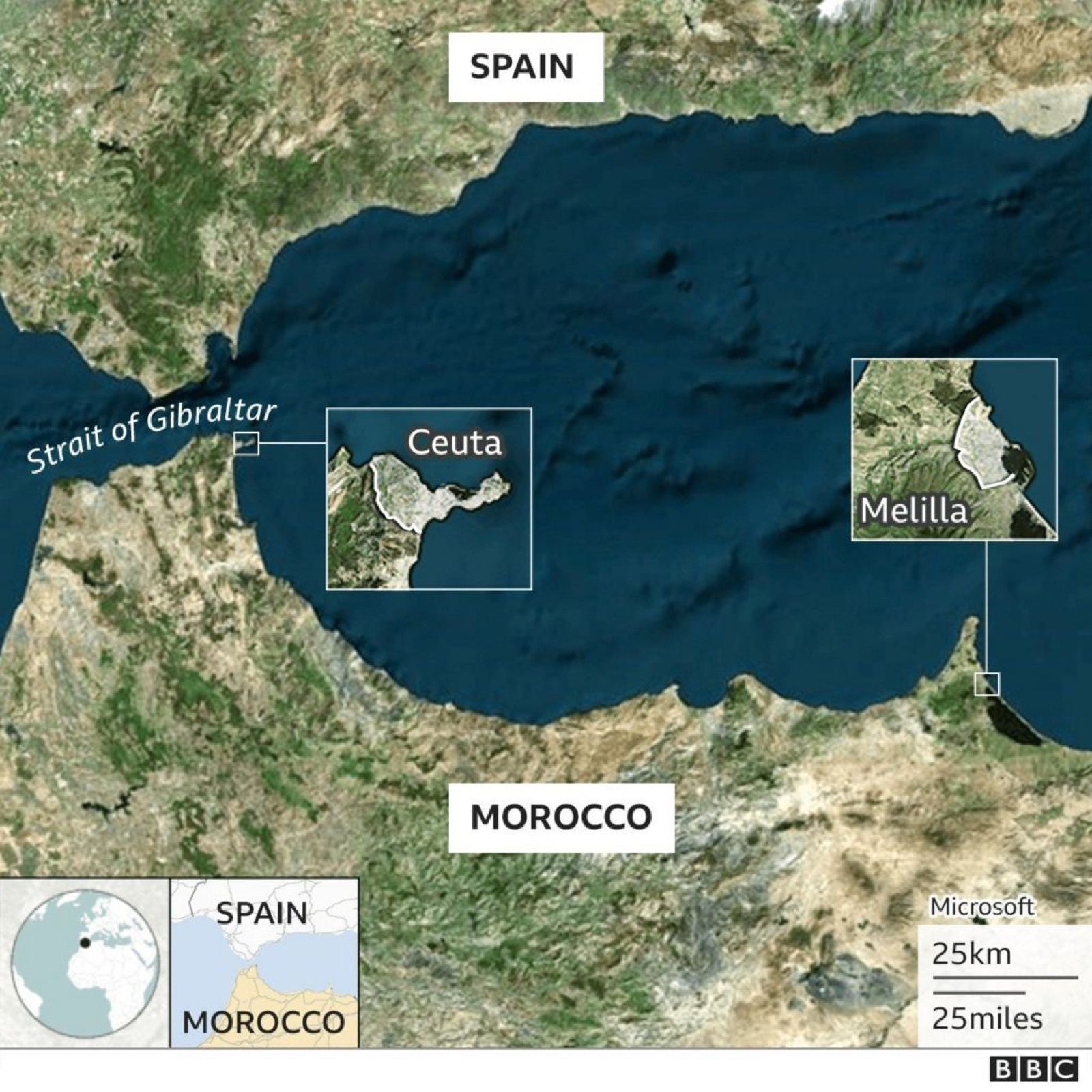
I’m on a fast track to learning; many of you probably already know this stuff, but others can learn along with me. Those super narrow and crowded streets in Fez I told you about? That is called a “Medina”. It sucks for getting anywhere quickly; today I learned that the idea was to protect cities from invaders. Before drones, I could see this being a very successful strategy. Speaking of Drones, they are illegal in Morocco; I decided not to chance bringing mine to this country that is about the same size as California. When I entered Morocco, I was about the same latitude as Nacimiento Ferguson road on the Cali coast. Now my latitude is the same as San Clemente, CA. Did you know It is actually possible to ride your bicycle from Spain to Morocco! Spain has 5 exclaves in Morocco, and one of them is Ceuta – so I could have taken the boat from Spain to Spain and then ridden across an international border on the African continent. Ceuta is tiny; I’ll post a screenshot.

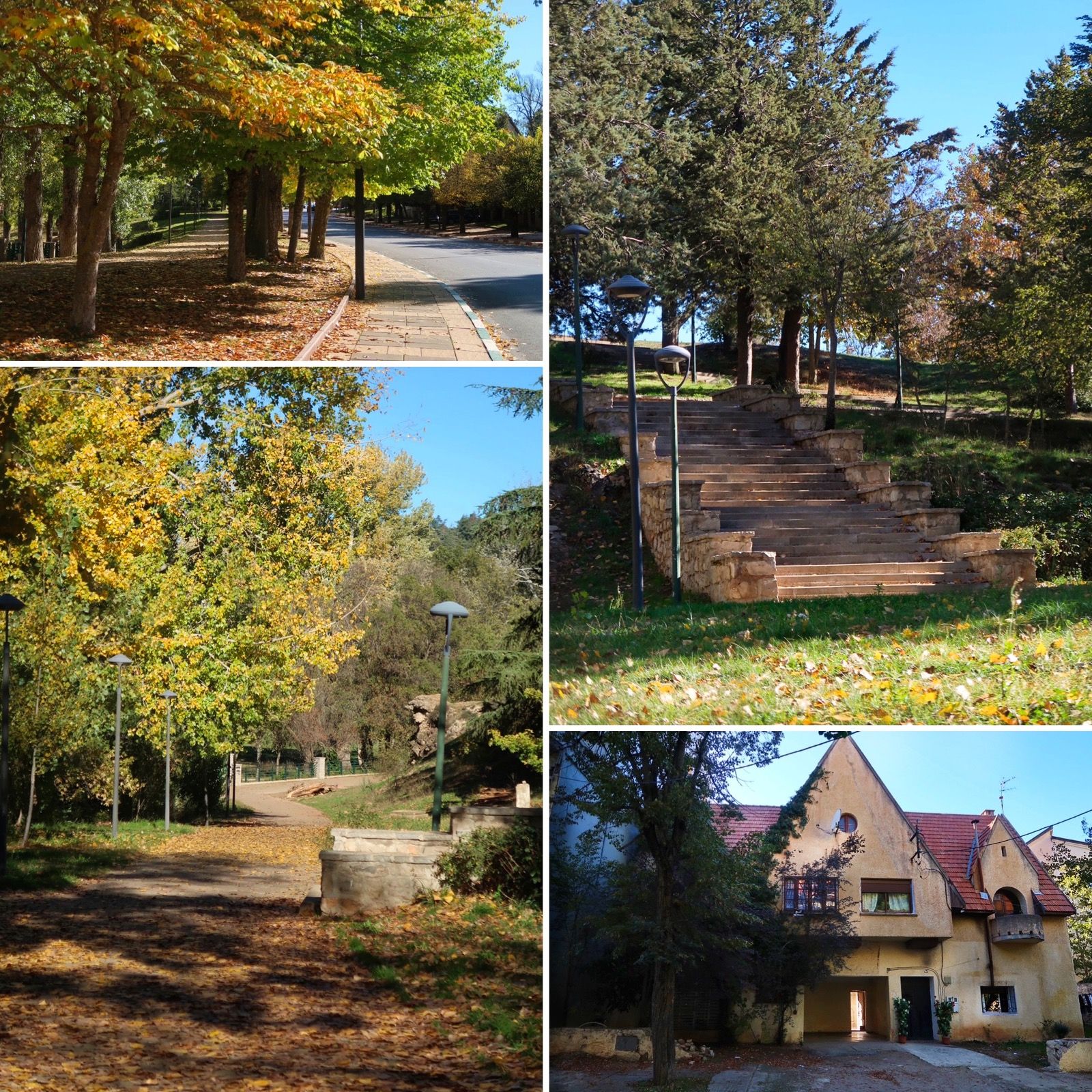
With the latitude as a frame of reference, it maybe isn’t too surprising now to see some of the photos I’m posting today. I’m slightly guilty of thinking Morocco was mostly camels and desert (though there will be a lot of that up ahead too). Today felt like i was riding through the campus of some Ivy League school in the fall. While we are comparing Morocco to the West of the US, did you know that Morocco was the first to recognize the US as an independent nation?

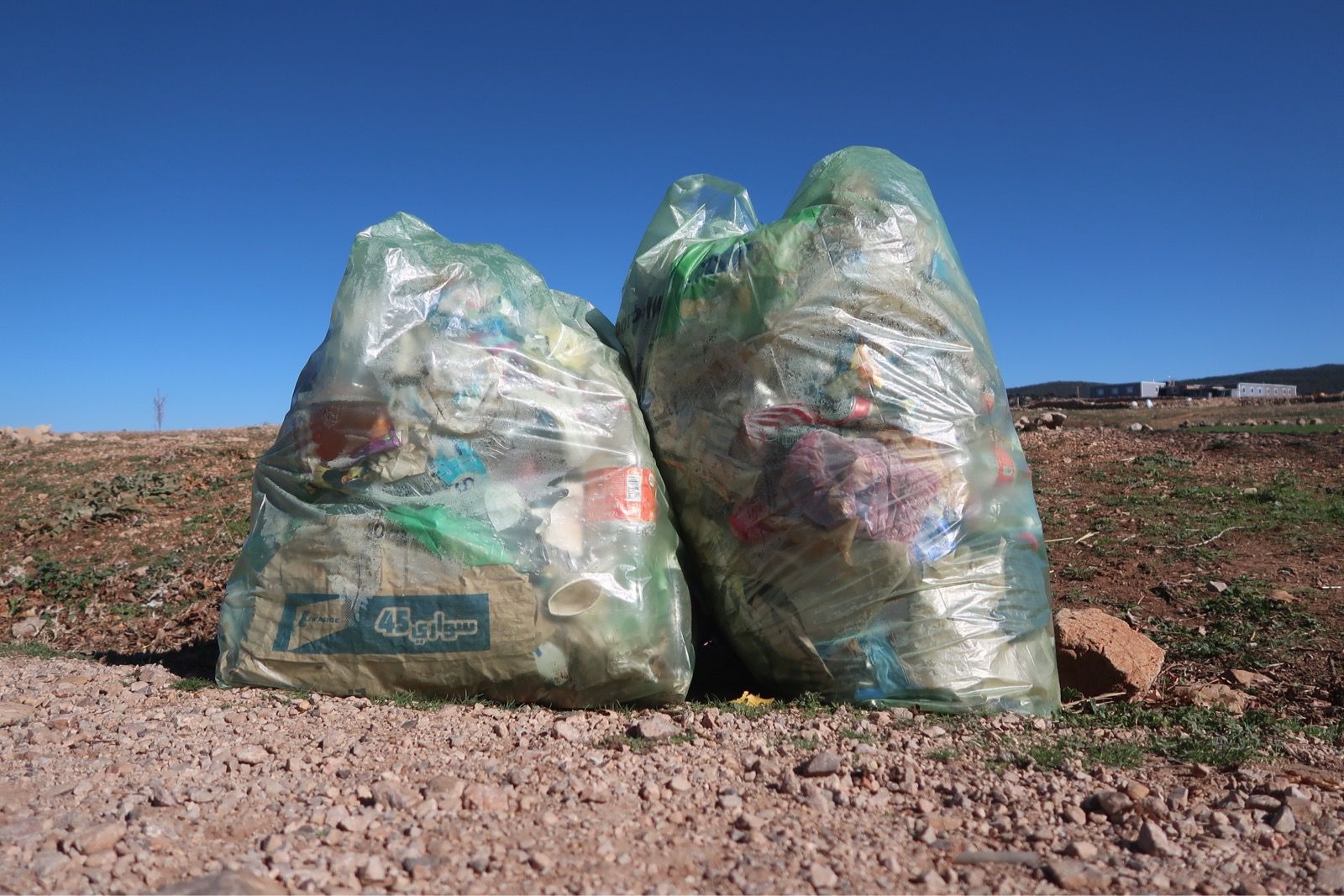
Morocco still has me a little surprised in that once you’re on the paved roads, it is more developed than I had imagined. Morocco, Guatemala, and Belize all have similar GDPs per person… but Morocco so far feels more well-to-do. So far, there has been much less trash on the side of the road (see my photo for bags of cleanup). I am guessing that the Southern portion is going to be the other side of that balance. By the time I (arguably) leave Morocco, my latitude will be that of Guadalajara, Mexico.


Photos:
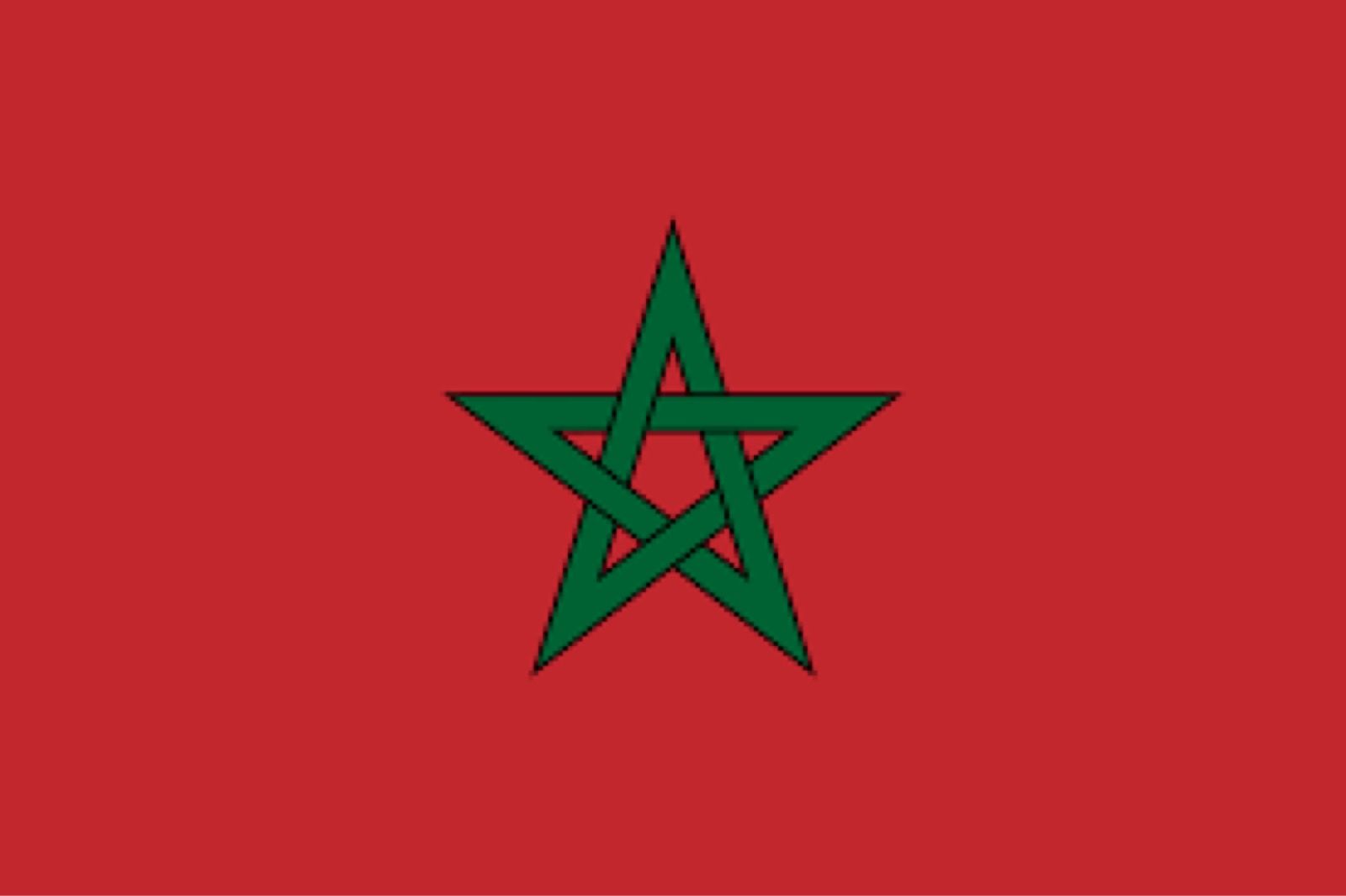


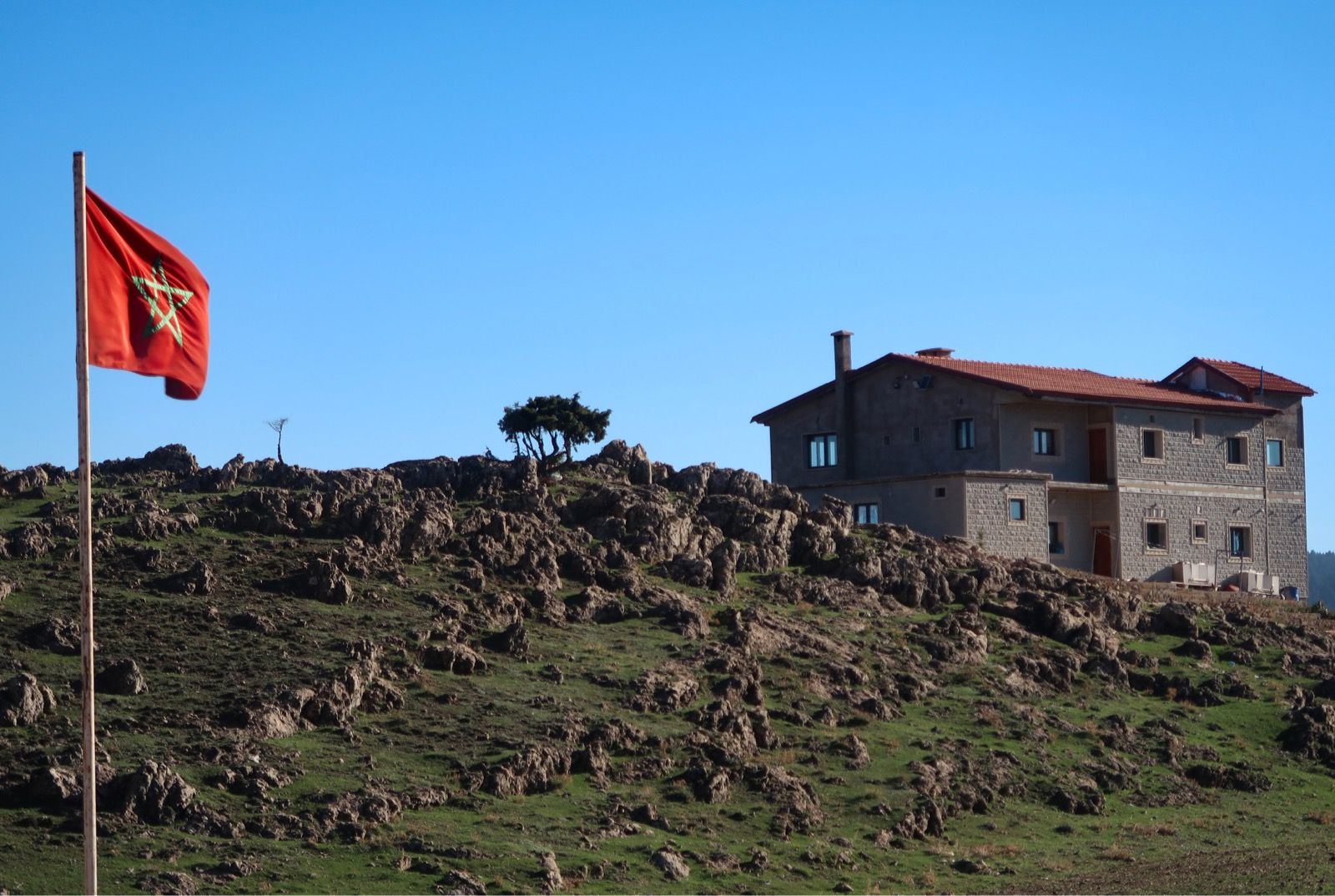
Morocco’s flag. The five pointed star probably represents the five pillars of Islam, which according to Wikipedia are: “Muslim creed, prayer, charity to the poor, fasting in the month of Ramadan, and the pilgrimage to Mecca for those who are able”. This all sounds good to me. Especially pilgrimages!

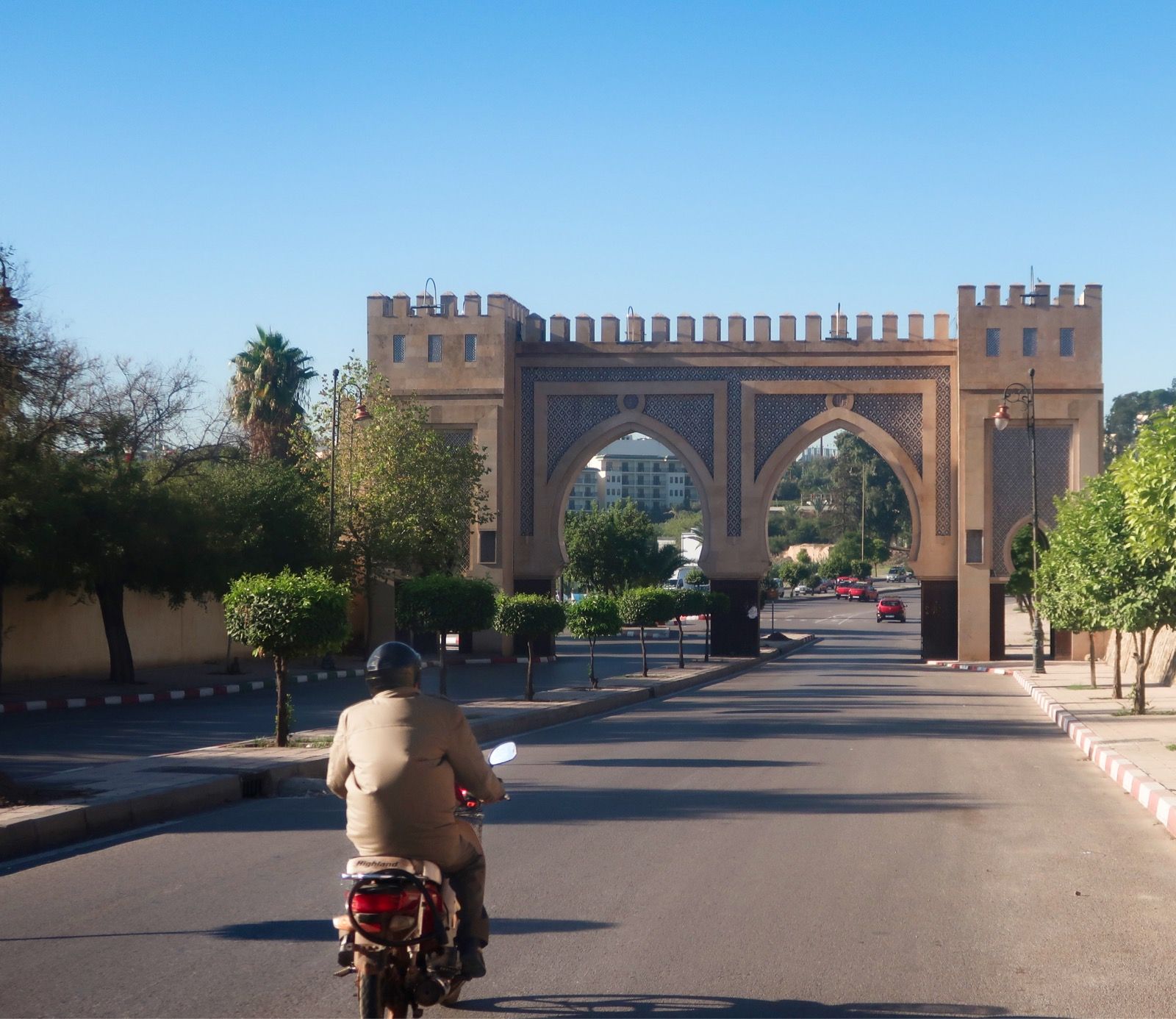
Goodbye Fez. I didn’t especially want to come to Fez, but glad I saw what I did of the Medina.

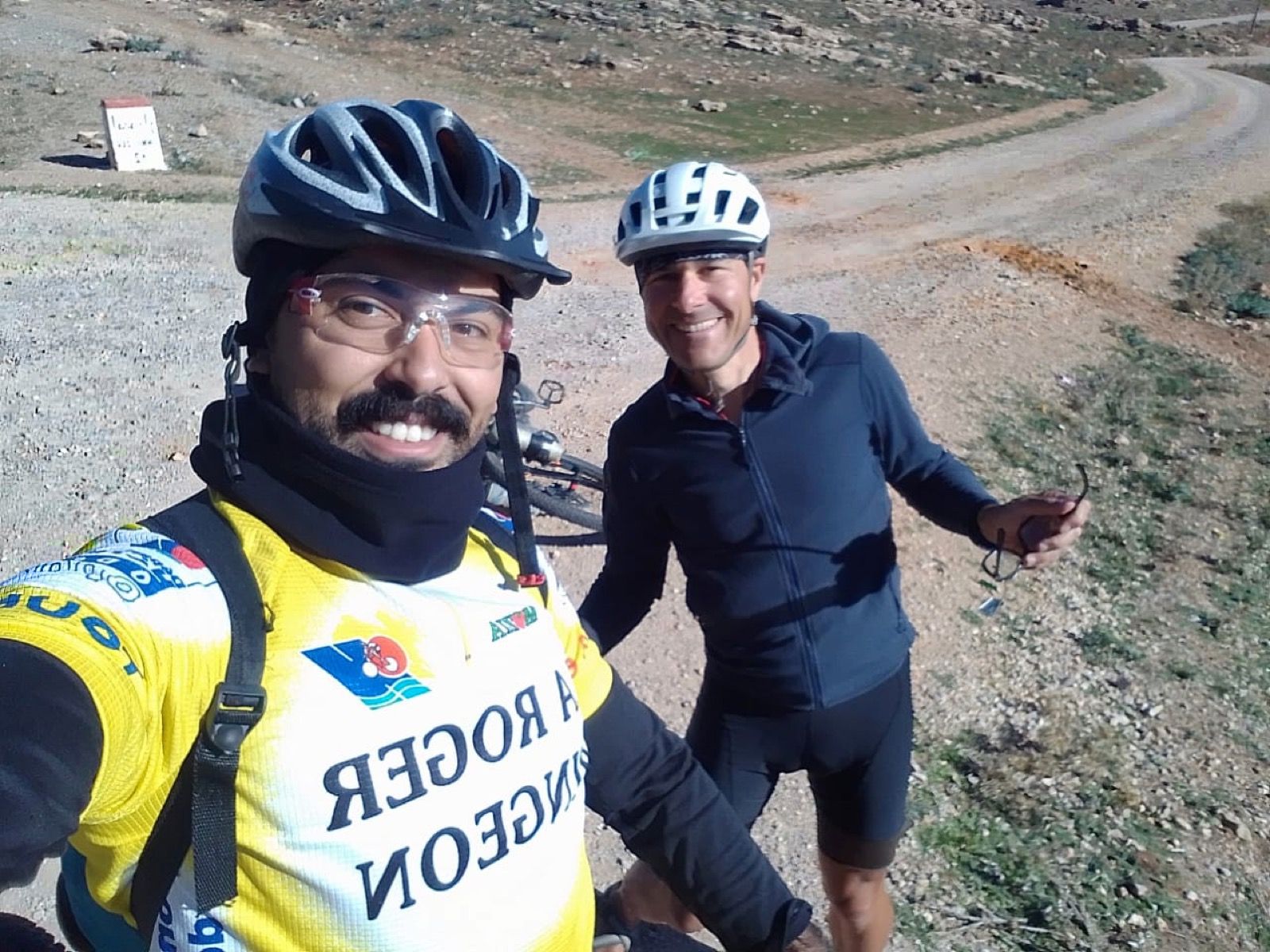
Me and Omar.

This photo is partly for Janet. She is always interested in the trash situation is various countries. I noticed that for miles, there had been trash cleanup along this road. I felt at liberty to eat my canned tuna and then deposit the cans as I went by these bags. No recycling in Morocco yet.

I got another room to stay in. It will be 30F tonight here in the mountains and I am with my summer bag. Plus, I made the mistake of drinking “fresh squeezed” orange juice this morning. Being polite has its costs, and I got sick pretty fast. Janet knows about the orange juice thing, as we both got terribly sick in Mexico the same way. This time, I am immediately on Cipro. I want to go back to eating sterile food, but canned items are shockingly expensive. Feeing shaky and feverish now; hoping the meds kick in fast.

Morocco has the middle, the high, and the anti Atlas Mountains. First up is the middle, which we are entering here. If I can stay healthy, I hope to journey the other two as well. I am a bit worried about the cold temps. The high atlas takes me to 10,000’. I will try my best to enjoy these mountains. A slight warming is coming, but I am a bit late, really.

Here is that map of the Spain Exclave I was telling you about.


Strava Comments:


Carol D.

I always learn from your posts Brian . What was that dance video though?

Martin G.

These Stravelogs have been so much fun to read! Stay safe:-)

Mark G.

Hope the achilles situation clears up. You are chewing up some miles and elevation. I will guess that there will be some pretty flat mila ahead.

Tony B.

I’m enjoying all of your stories and pictures of your travels in Morocco. I’m also following a gal on Strava who was in France then Spain and now Morocco. She’s a week or so in front of where you are at. Truly beautiful place. And yes you have a lot of flat terrain coming!

Janet W.

It’s a treat to get to video chat with you every day, and I’m glad you are feeling a little better. Thank goodness you had the choice of a cabin instead of camping outside! Everyone you meet seems so friendly and interested in conversation, even if some of it gets lost in translation. Less trash = more tourist visits = good for everyone!

Jennifer G.

All I will say about the Israeli/Palestine war is that bombing and killing thousands upon thousands of children is a sign that humanity has failed

Ali G.

I can add to what my mom mentioned that the majority of UN members stated recognize Palestine as a country, it is critical to see the current violence within the context of the 75 last years, that every day the US continues to arm Israel to drop bombs on Gaza and continue building walls and a system where some people have fewer rights based on how they were born is a horrible thing. As Americans we need to do better to hold our government accountable

Ali G.

You may also be interested in former president Jimmy Carters book: Palestine peace not apartheid

Ride Stats:

Elapsed Time Moving Time Distance Average Speed Max Speed Elevation Gain Calories Burned
07:10:44
hours
05:00:34
hours
84.22
km
16.81
km/h
62.31
km/h
1,549.30
meters
2,428
kcal


– Day 92 : Átun, baby. [top]


I opened another one of these little cans of tuna, and wondered to myself, why is the tuna so awful in Morocco? I was on my 4th $2 can (I also couldn’t understand why these tiny unlabeled cans had been so expensive). Suddenly, it hit me. This isn’t tuna… it’s cat food! I had paid $2 each for 6 little cat food cans. I read last night that you are supposed to offer back 50% of the original asking price – and never pay more than 70%. It is my fault, I guess. I didn’t know the word for tuna, so I just said “Atun” in Spanish and pointed. You get your food here over a counter with the items stacked on dark shelves behind the proprietor. But it’s not like I said, “meow”. De he really think my cat wanted peanuts and yogurt along with the cat food? I have to carry the crushed cans until I find trash, and some of the oils have stained my bag. There is always a positive side to these things; thanks to the odors, I am now making more kitty friends than people friends.

I’m riding uphill When I catch up to a man on a horse. We are going the same pace so we strike up a strained conversation in French. I’m trying to ask him about where his going and such, when I discover he speaks Spanish pretty well. Now we have a real conversation going; I’m trying to be polite, asking about his family, and complimenting him on his horse (though I read yesterday that you need to direct all complements to God here because otherwise, people will want to give
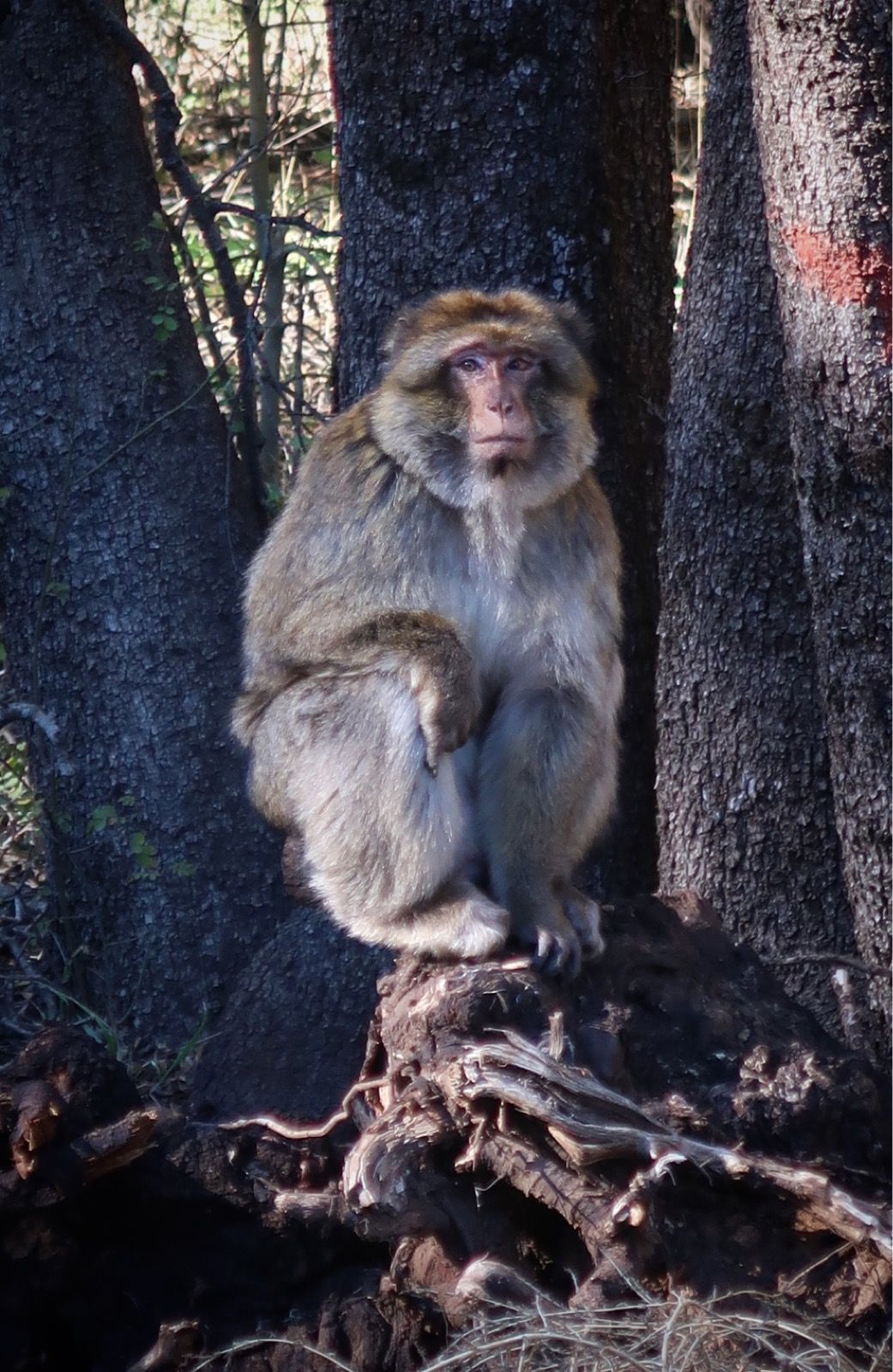
You the thing you are complimenting). I’m not sure how you would direct a compliment about a horse to God, but when I get time, I will think of a way. He said he works for the park, up ahead. We are doing well, riding side by side, when he says, “would you like to ride my horse?” I joke, “yes, and you can ride my bike to the desert for me!” He said I would need to exchange for a camel, and dismounts. I hop on the horse. Instead of riding my bike, he pushes it along and guides me on a short trail towards a clearing with a dead fox. I mention the fox and he says, “let’s take a picture of you on the horse”. Before I hand him my camera, I’m already starting to get the idea of what this is. Next he guides me, pushing my bike to an area with guys selling stuff. I dismount and an another guy shoves small tomatoes in my had so I can feed it to the monkeys wandering around. Yup, I’ve been duped, and I have the photos to prove it.

I handed over enough money to buy 5 cans of cat food in case he was into that. I didn’t feel good about it, but I feel like the true value in my payment is the story, not in the posed photos. I just want people to be “good”. Good people make me so happy and those are the people I want to thank with my money. Ironically, they are also the ones who are least likely to accept anything in return for their pure kindness. But now you have this story, and I have reminders on my phone – not to trust everyone. Sometimes I think the “bad” stories are the most genuine ones. Hopefully that doesn’t make me sound like a cynic. I appreciate many of you recently sharing your own stories, even if they aren’t always glamorous.

Women. Up until today, whenever I have approached a woman in Morocco, she lowers her eyes and goes to fetch a man. Today was different, as I rode into the Middle Atlas, I was now amongst people with a different culture. I stoped by some women and children getting water. The women had a lot to say this time; no men around. I pulled out my phone and handed it to her. She spoke vigorously into it, shaking a bit as of she were casting a magic spell to turn my phone into a butterfly. She pointed down the hill. The message in English was something about going with a brave heart. I interpreted this to mean that she thought I was brave to ride down the hill. We did some more back and forth with lots of peculiar results. I have the phone set to automatically detect the language of the speaker and to play back the translation immediately. So as she vehemently spoke her next verse, I peered over her shoulder with horror. The phone thought she was speaking English, so I could read the words “sexy porn” on the screen. Terrified, I grabbed the phone from her before it translated this sentence out loud in Arabic. I pushed all the buttons as fast as I could, trying to prevent the phone from speaking – saying “no, no, no” in case something came out. Luckily, 50% of the Moroccan population is illiterate, so she didn’t seem to read the Arabic that had already appeared on the screen.

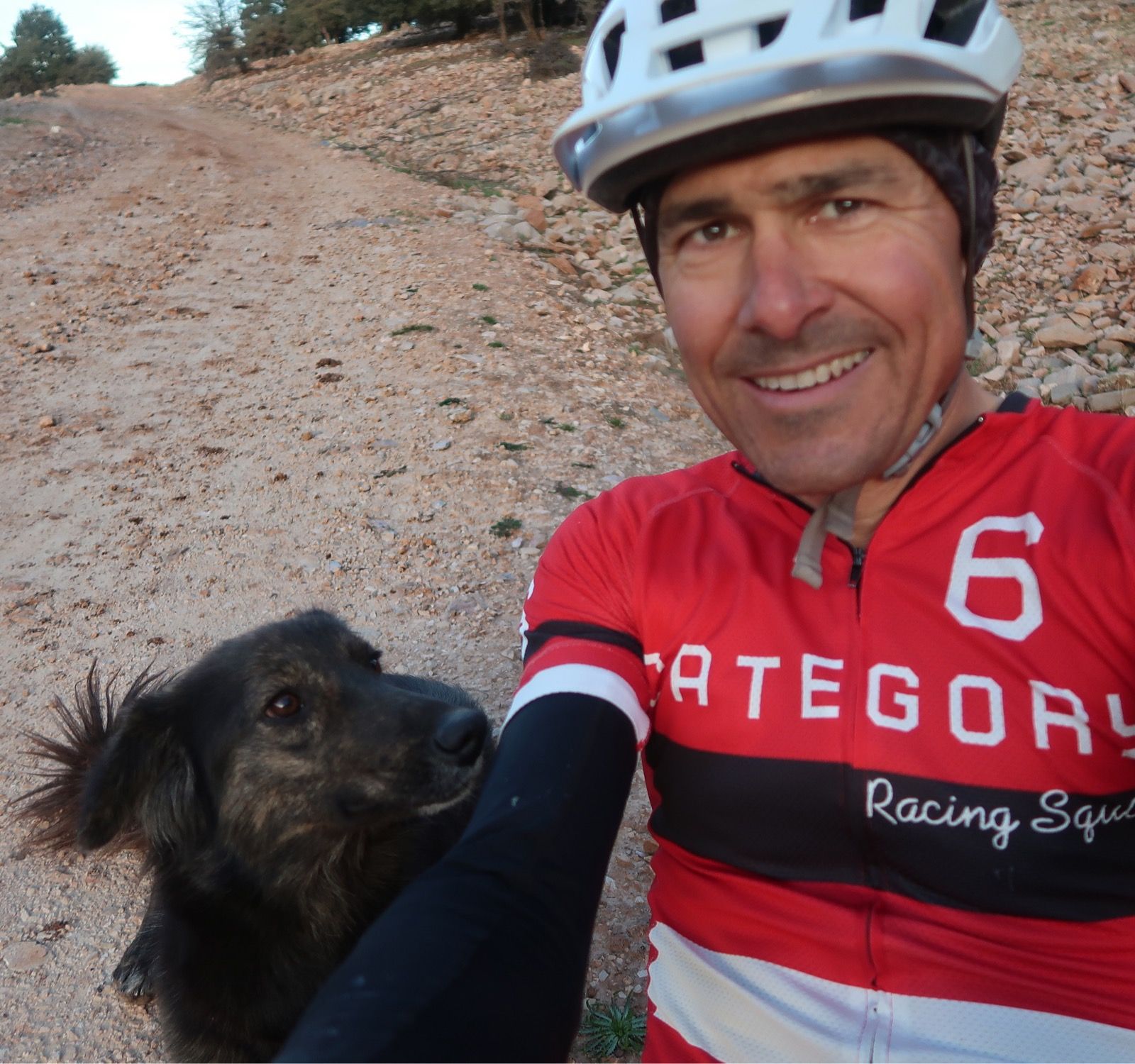
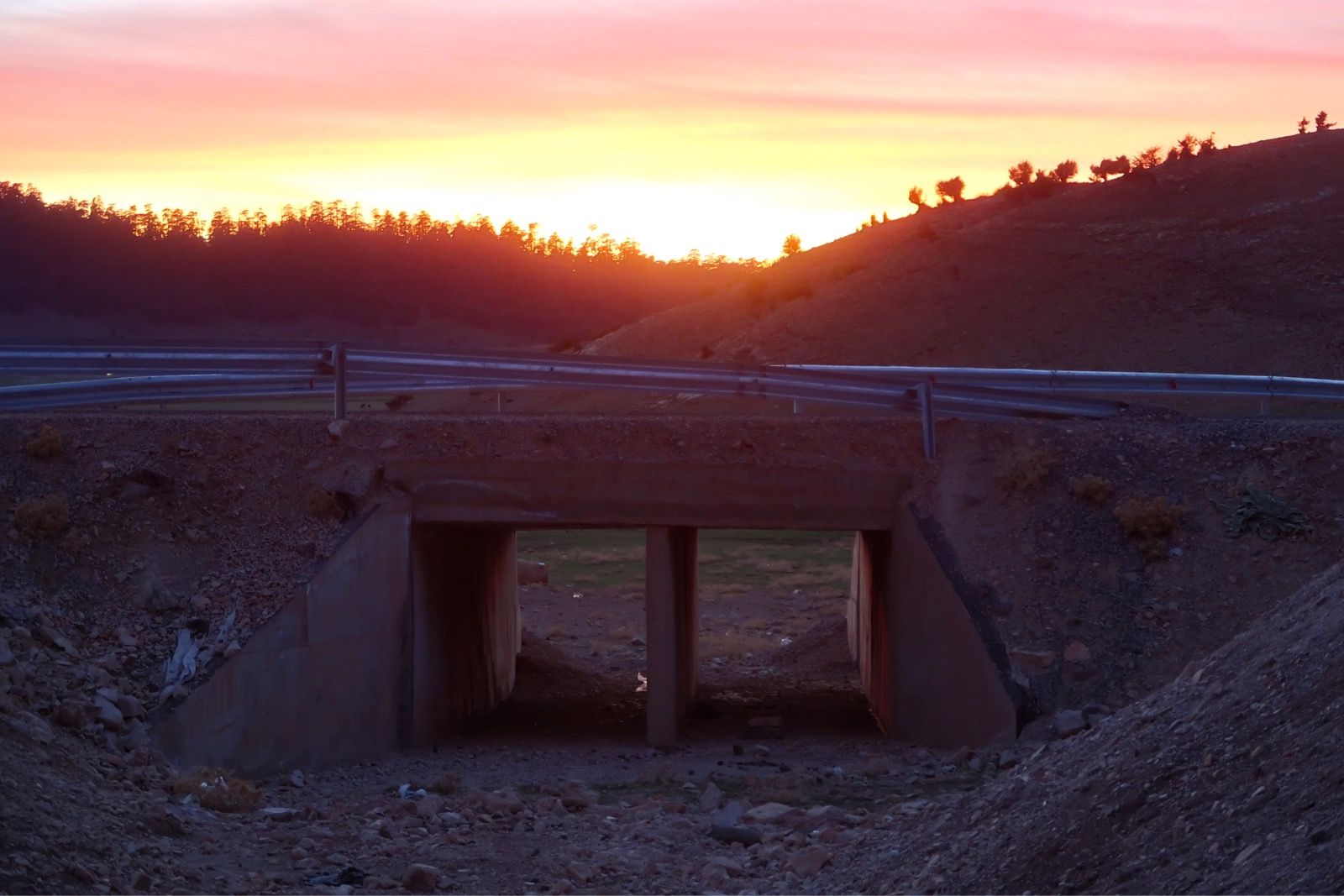
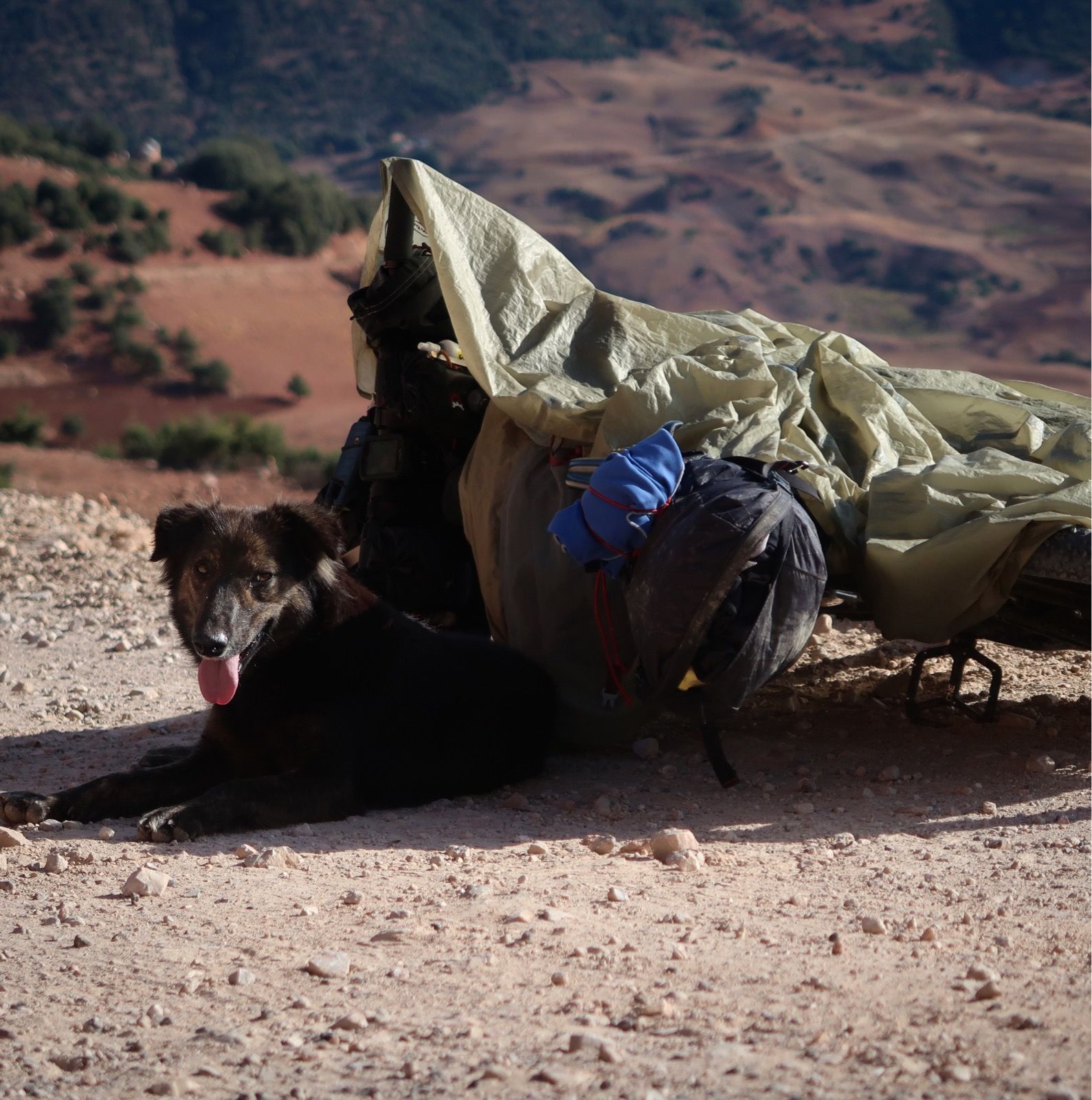
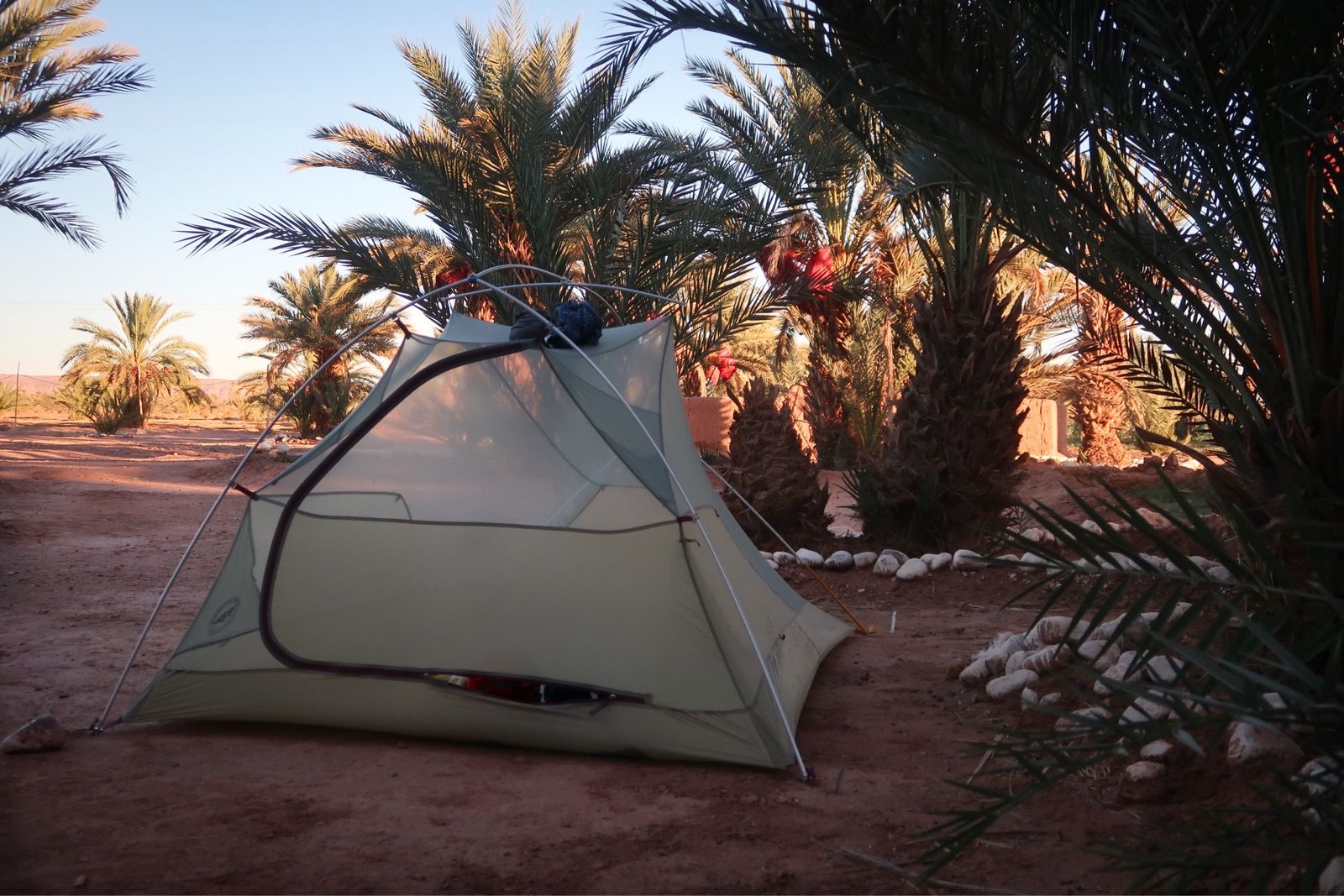
For the last 8 miles of my ride, I gained a new friend. As I was riding by the lake, a dog had been with two men, but he came running towards me in a friendly way. He then ran alongside me. 8 miles is a long time on these roads, and I kept wondering when he would turn back – but he didn’t. I started to like him and talk to him. If I were ever to travel with a dog, he would be the one.. I even worried about his welfare when other barking dogs came. Now he is at my camp with me and making me feel safer. I gave him a can of sardines and he devoured it. There was a temptation to invite him in to the 3 person tent, but he isn’t very clean and has sardine breath now. I am feeling super sick all of a sudden. I’ve taken my 3rd Cirpo, but in the last hour, something hit me hard with some pretty severe outcomes. It’s cold and I was camped under the road – not far from a tiny collapsing shack. Little did I know, but people live in there. Without lights. It was creepy and they probably heard me and were scared. They shone a flashlight my way. Hope my puppy friend keeps me safe.

Uploaded between bouts of vomiting. Ugh. Now I have vomit splashes on my socks. Not too good right now.


Photos:
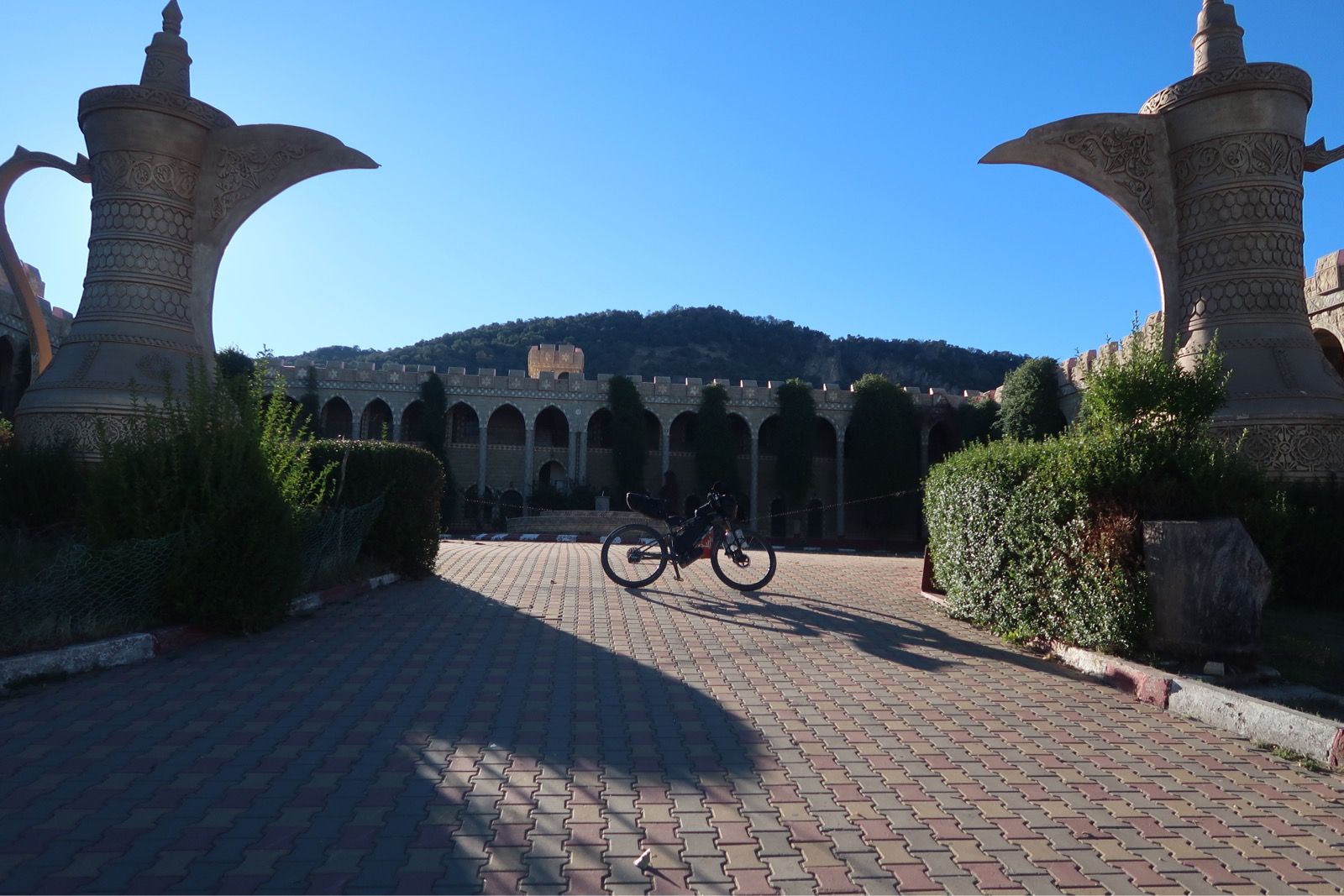


Strava Comments:


Ian G.

Dude, skimmed the story and wow, what a day!! 🤢

Janet W.

So sorry you’re sick. I hope you can stay warm and sleep so you’ll feel better tomorrow. Now I see you’re already past the left turn onto the yellow road I mentioned earlier. Maybe it’s not paved. If you need to, you can go back and on to Khenifra to get a hotel and rest. So much more happened on your ride today! Your doggy friend could protect you from the monkeys. Feel better!

Tony B.

Another fantastic story! So to hear you’re sick. Perhaps the dog is enjoying the cat food smells and thinks it’s reward will be some delicious treats!

Carl N.

Dang!

Anne F.

Feel better soon!

Tracey A.

Please take care of yourself Brian! I hope you feel better soon! We’re sending lots of love, hugs and healing thoughts your way!

Nancy A.

what a day!

Osman I.

Get well soon my friend, now I’m beginning to worry about you.

Ann L.

Oh no Brian, I hope you start feeling better soon!! 🙏
Your dog friend looks really sweet. He has eyes like yours.

Stan H.

All that, and oh, by the way, you rode 75 miles and climbed 8000 feet on a loaded bike. Again. Wishing you health, Brian!

Jessica M.

Uggh sorry you are sick. Puppy 🐶 love always help. That’s a big day!!

Corrine L.

Hope you are better soon. That puppy is very cute! Hope puppy love helps you!

Warren G.

Hope you feel better soon!!!

Stephen Mark R.

Wishing you well. The food is an issue. When you get to a bigger place you might be able to sling the catfood and find something to settle your stomach. We are all rooting for you

James P.

I hope your stomach feels better soon! Hang in there. Your trip sounds epic!!

Dan L.

Sorry you’re sick – hope you recover soon! But such great stories, and memories for the future! I’ve only done short bike packing trips with a friend’s dog (pulling a trailer on my bike), but yeah it’s loads of fun and I hope to do longer dog packing trips someday!

terri W.

Sounds like a really tough day and especially sorry to hear that you were sick. Hopefully today is much better!

Paula G.

Maybe a little cat nip would help you feel better.

Mark G.

love that dog already

Ride Stats:

Elapsed Time Moving Time Distance Average Speed Max Speed Elevation Gain Calories Burned
09:47:51
hours
07:22:08
hours
122.23
km
16.59
km/h
60.41
km/h
2,442.00
meters
5,181
kcal


– Day 93 : Travels with Mila [top]


I still talk to God, only here, I call him by a different name. Last night when my intestines were tearing me apart, I said, “please Allah, make my stomach feel better in 10 minutes.” Allah doesn’t work on Swiss time, but by by 2 am, I wake up on the ground with a deflated air mattress, freezing… and a better stomach. It was so cold, but I found the hole in the dark and patched it. Then, since my neighbors were probably asleep, I gave Janet a video call at 3am (6pm her time).

In the morning, my new buddy Mila (named by my sister for “miles,” because Mila is going to be doing a lot of miles!) was faithfully waiting outside the tent. We split the next can of sardines 50/50, and I used the empty tin to give her an entire bottle of water. I can see why people love dogs. After having been chased by so many mean dogs, you can quickly forget that there are loving dogs out there too. She never begged; always patiently waited. We set off, and I found myself lingering on the downhills waiting for her to catch up. A pack of dogs came to attack her and I turned back to defend her. I started to think of ways to carry her downhill. She easily outpaced me on the ascents. What am I doing? I really liked her, but having a dog means no hotels and difficult border crossings. I said good bye to her at the top of each hill… just in case. She caught up to me while I was drying the tent on a downhill, but after 2 hours together this morning, we had our last goodbye. 😞.

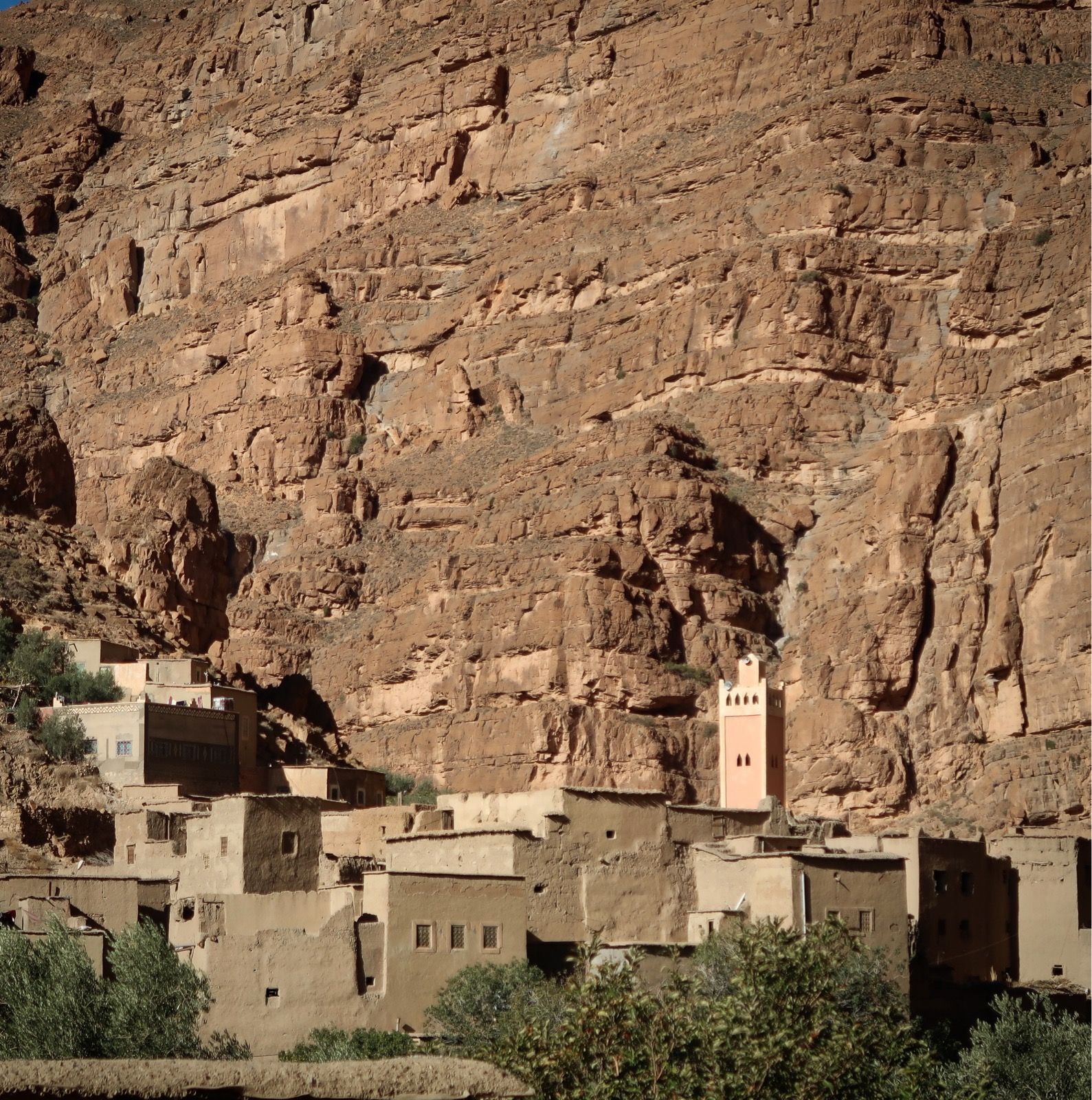
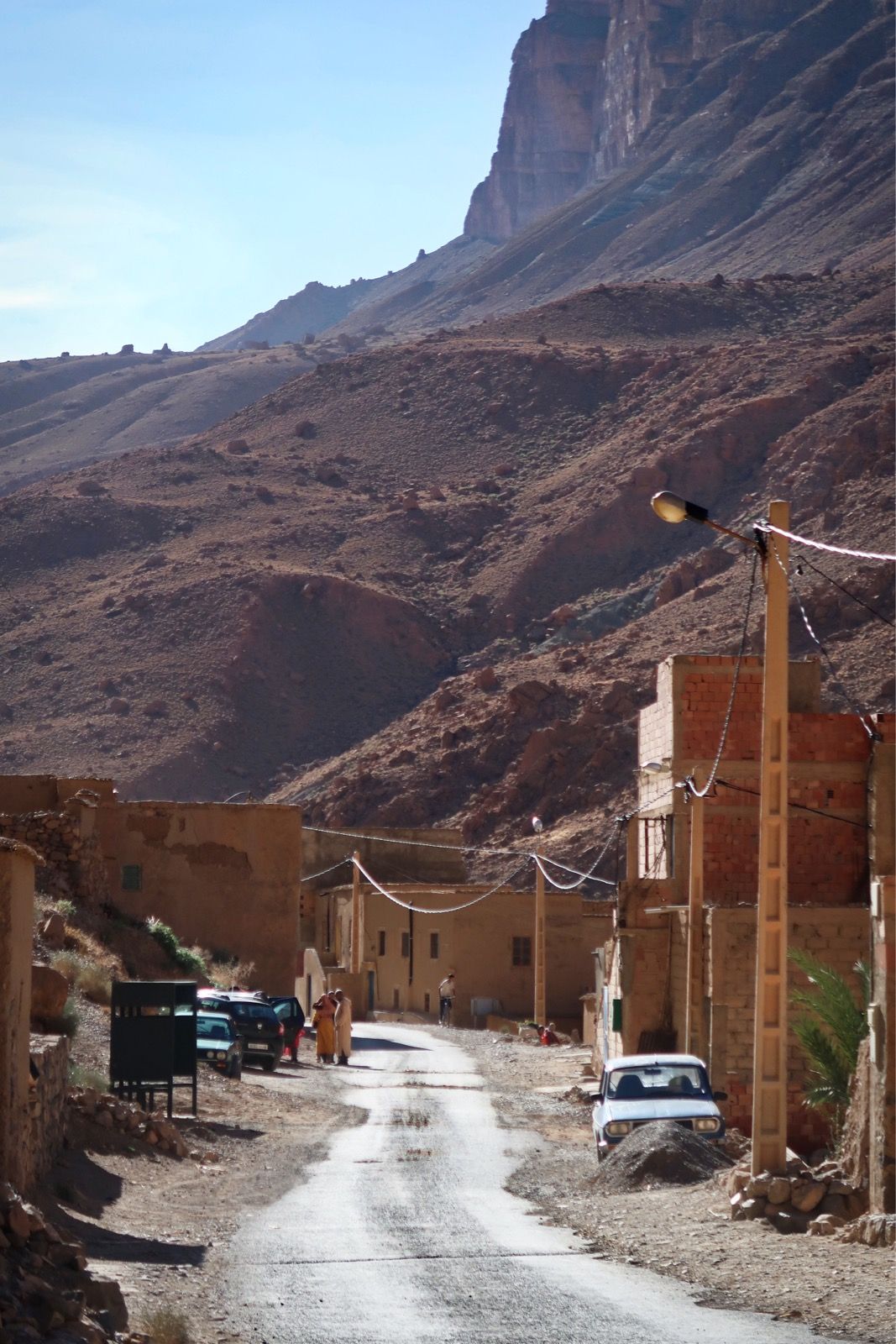
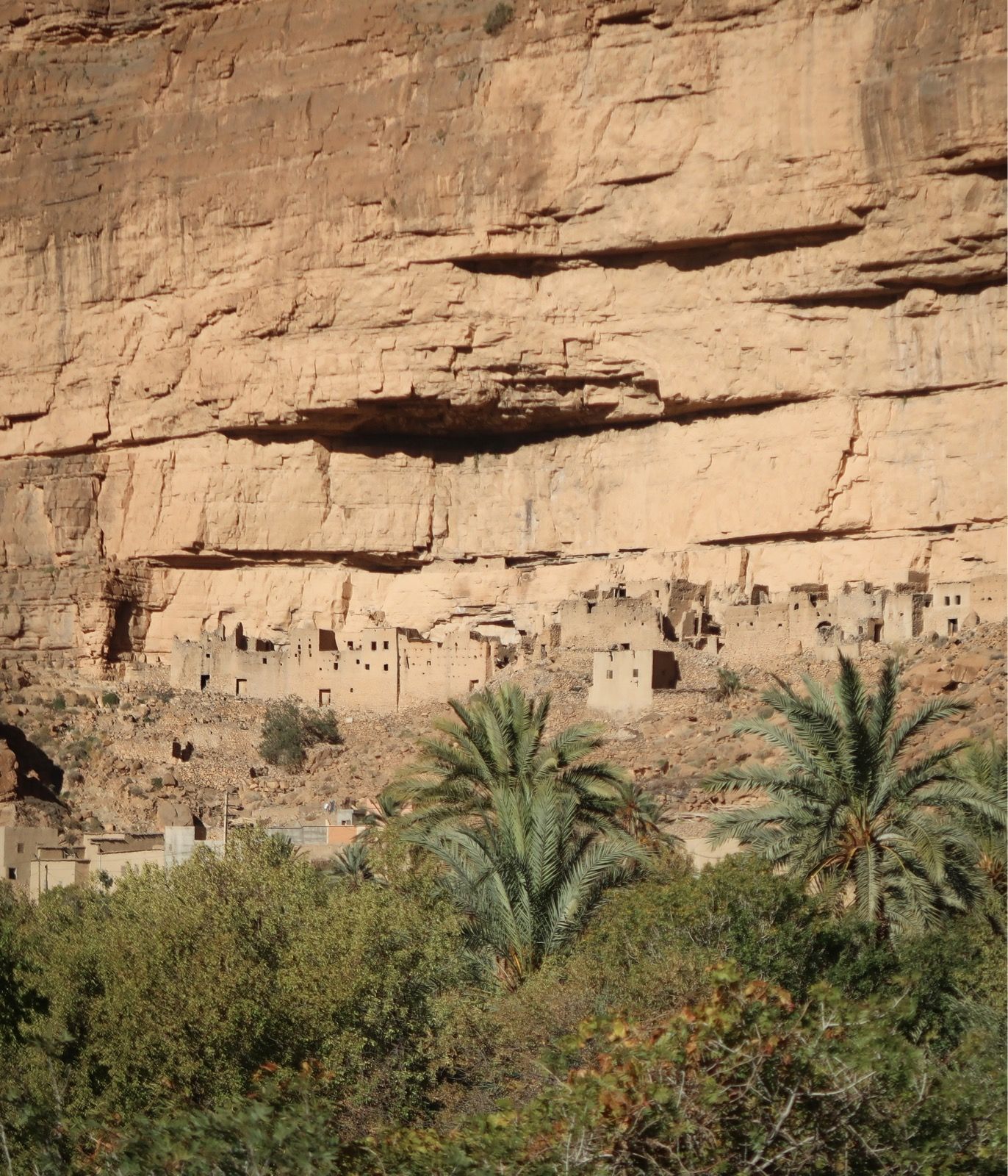
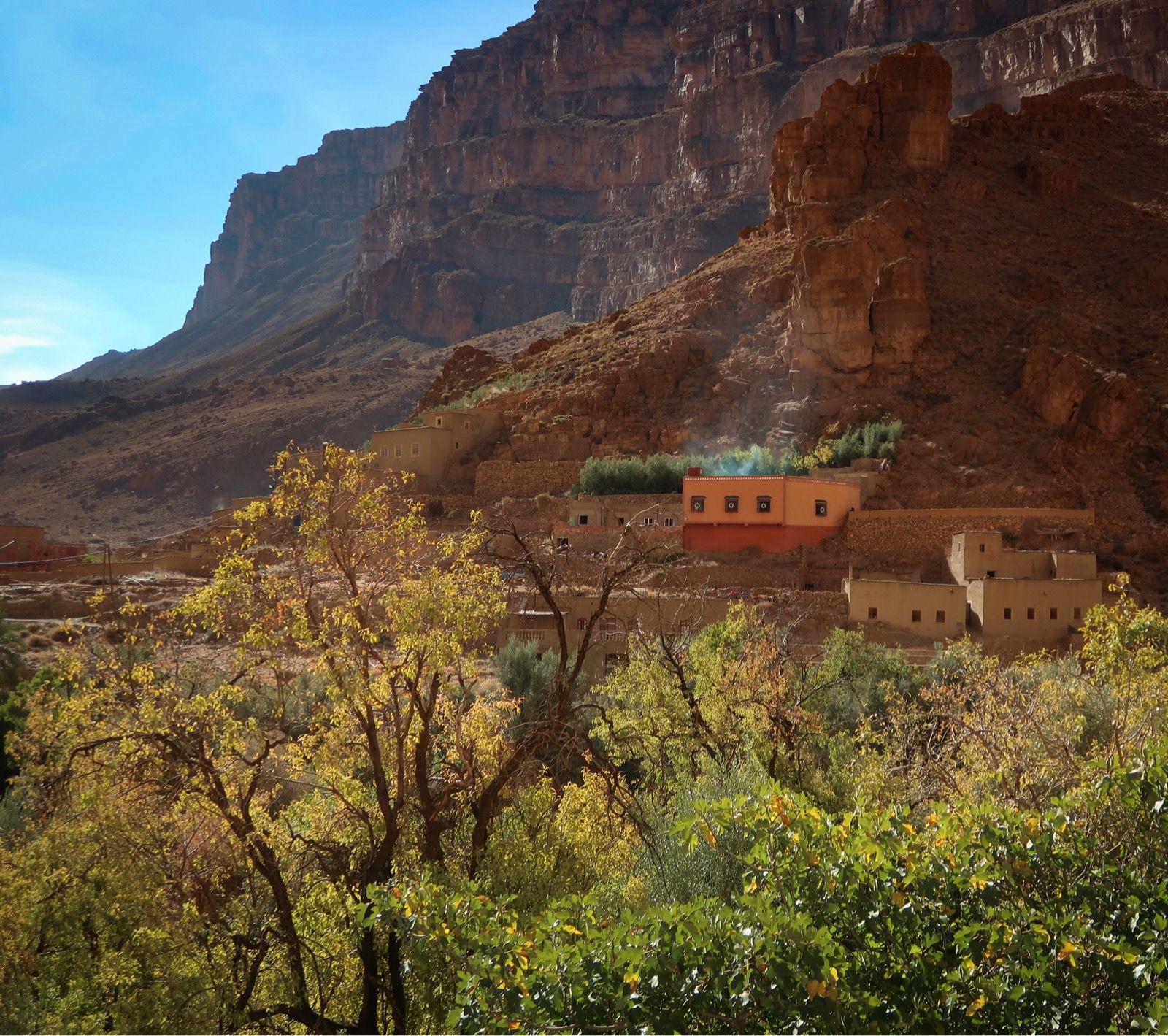
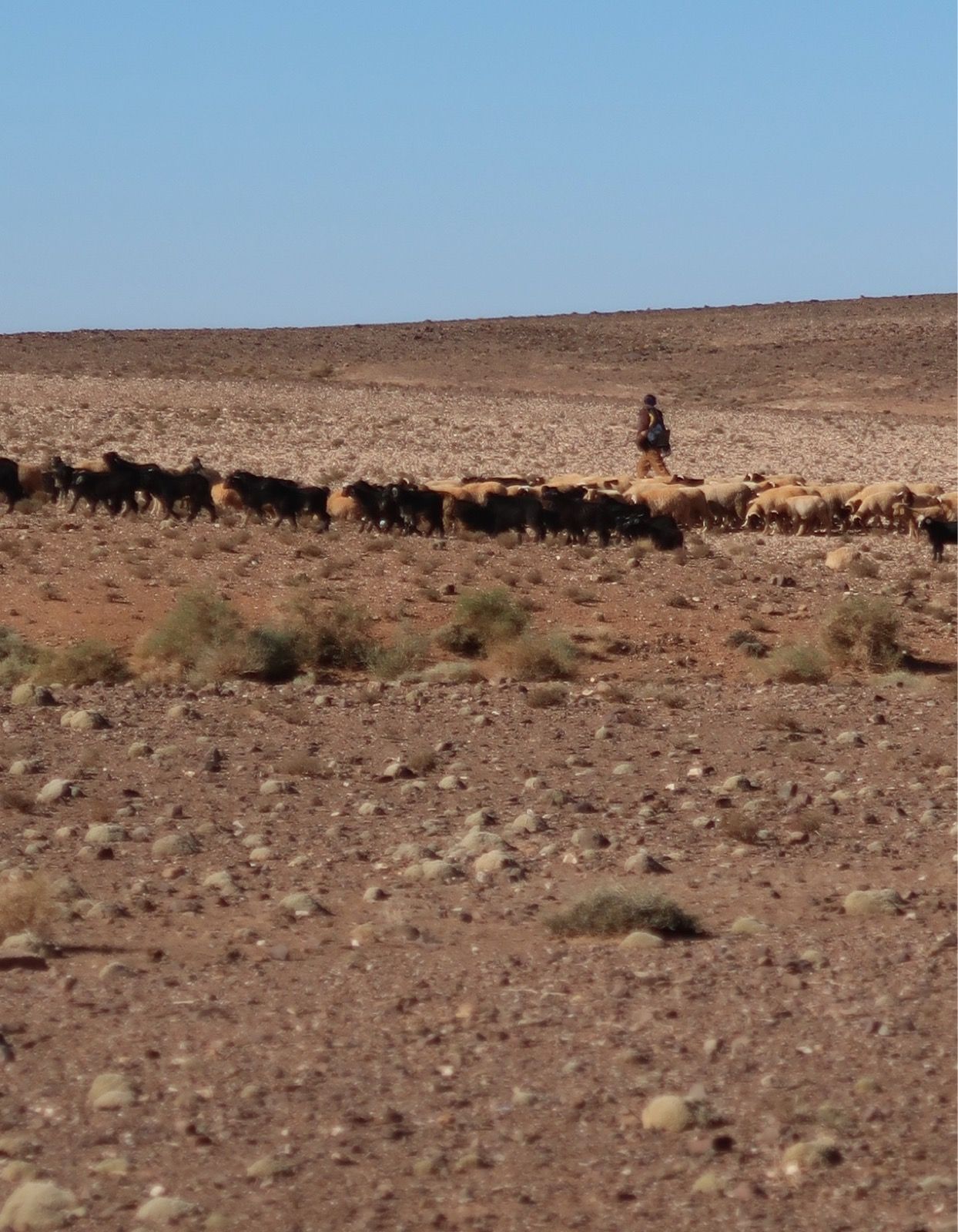
So, some of the mystery has been solved about my Arabic app. For the last 36 hours, I was amongst the Berber people of the Middle Atlas. Anything I told you in English about what was said during that time was just pure coincidence! This explains why “what is your name?” works, but nothing else made much sense. The “Berbers,” who prefer to be called “Amazigh” are not a homogeneous group of people. They actually have 4 languages that can’t be understood between each. They have a variety of cultures, living in different places, and they are NOT Arabs. Their bloodline is actually from Stone Age people of Northern Africa. The people I met in the mountains spoke nothing other than their own dialect, meaning that of the 5 languages I have available in my head or pocket, body-language was the only one that worked. I wish I knew what the kids were saying; one girl came running towards me down a steep hill with her hand up. She said “shoes, shoes”. That is all she said over and over. Did she know one word of English and want shoes, or is this a homophone in her dialect? People live a hard life in these mountains. I have included a photo of some of the houses. I have a rough idea of how hard it is after freezing last night, and trying to find water that wasn’t contaminated with laundry detergent. It is not densely populated, but there is always someone somewhere. If you think you are totally alone, stop and study the landscape. If you are good at “Where’s Waldo” you will see the men, blending in with the rocks, guarding the sheep. In the rest of the world, cellular phones and YouTube have revolutionized the monotony of shepherdry, but here the only entertainment is a guy in red on a bicycle trying to say, “salam alikalum” and waving back with a big smile.

Still suffering bouts of nausea, I did my entire ride on half a can of sardines and the first 7 hours on one bottle of water. The other bottle I had given to Mila. Parched, I got to a dusty town and tried to take the easy way out to water: a gas station. There I met Mohammed, an English teacher. After some conversation, he showed me his bike – a Trek with a belt drive and generator hub. Wow. He said, “I bought this for $1000USD it was stolen in America from some hard working man. It is bad, I know. All the bikes in Morocco are stolen from hard working Americans.” At least he was being honest. He spoke soft, excellent English, and when I told him about my freezing night last night, he said, “you can borrow my sleeping bag. It is 5 Celsius”. I said, “but how will I get it back to you?” He said, “life is not important.” “What does that mean,” I asked. He explained, “I am Muslim, and material items are not important. This is how it is for Muslims.” He invited me to his house to get water, which i purified just in case. He invited me to stay a few nights… and I wavered. His dad is bedridden with Alzheimer’s, and I worried about painting a brown Picasso in his toilet. I came close to saying “yes”, but decided to ride onwards in the tailwind.

The scenery changed from mountains to desert, and I really just wanted to get a comfortable place to recover my insides. A guy named Rashid found me and before taking me to a hotel, he happily gave me the Cliffs Notes on Berber people, which I posted above. After much chat, he suggested we have sugar free tea tonight. Hence the abrupt ending to this post. Good Night!


Photos:
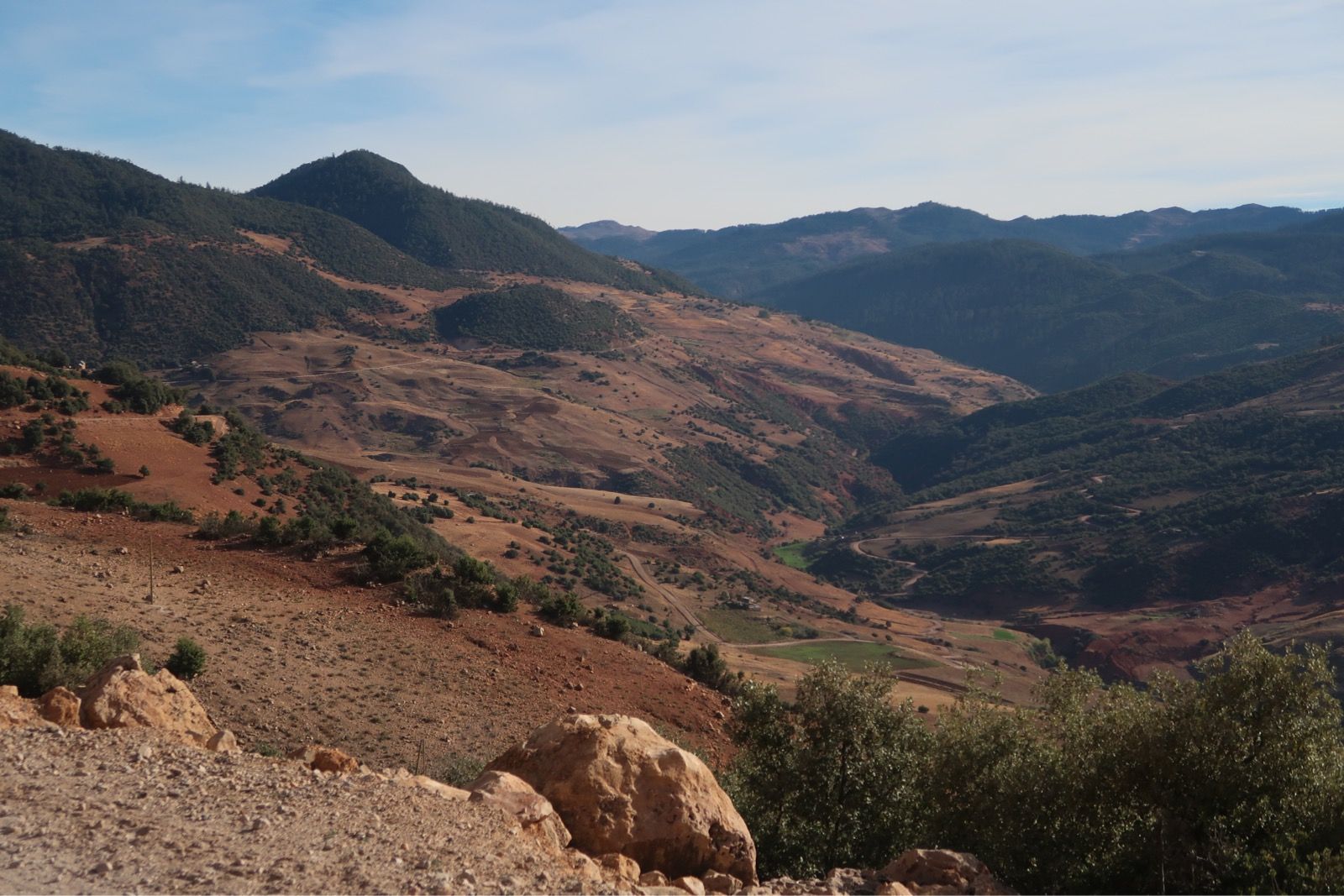


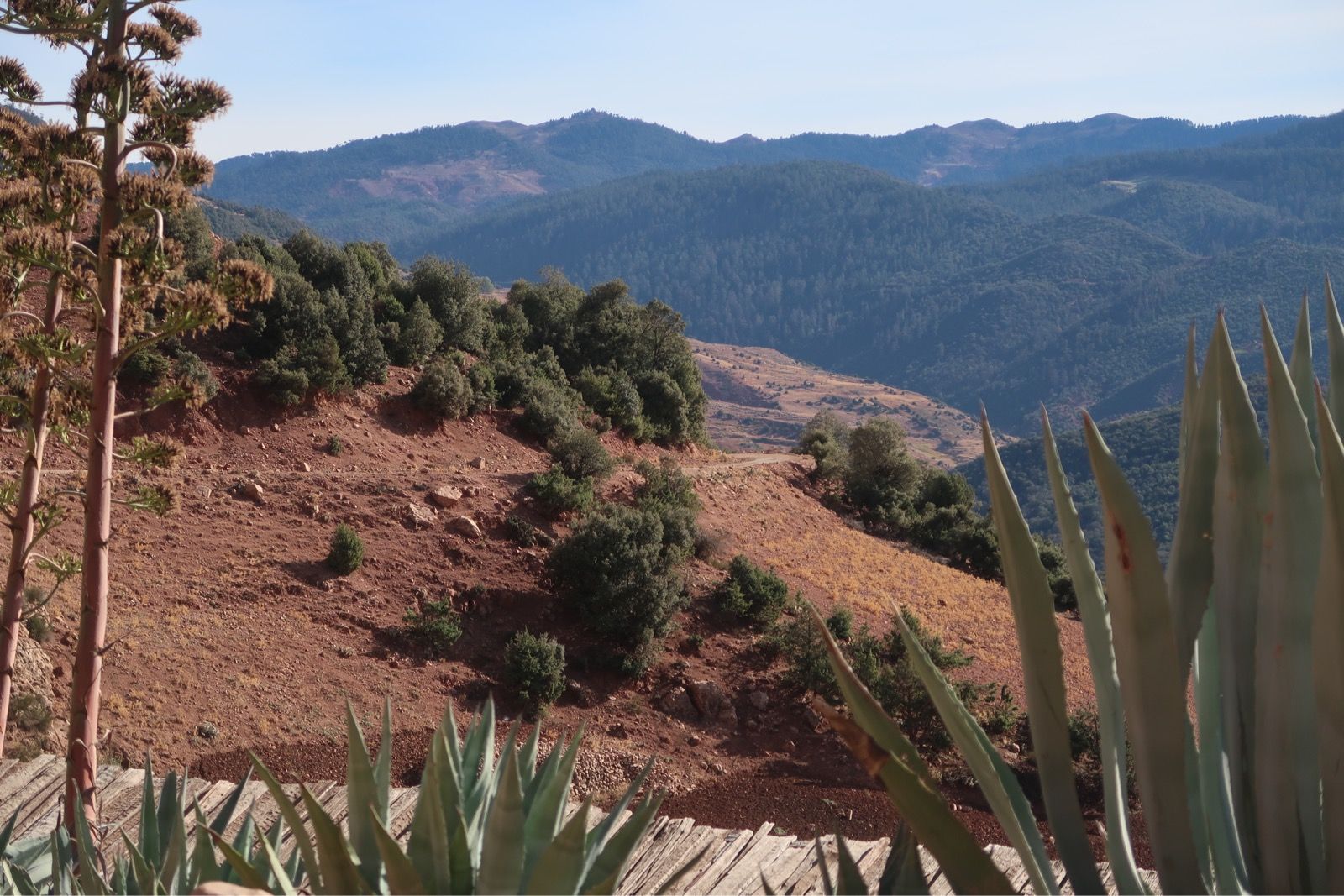
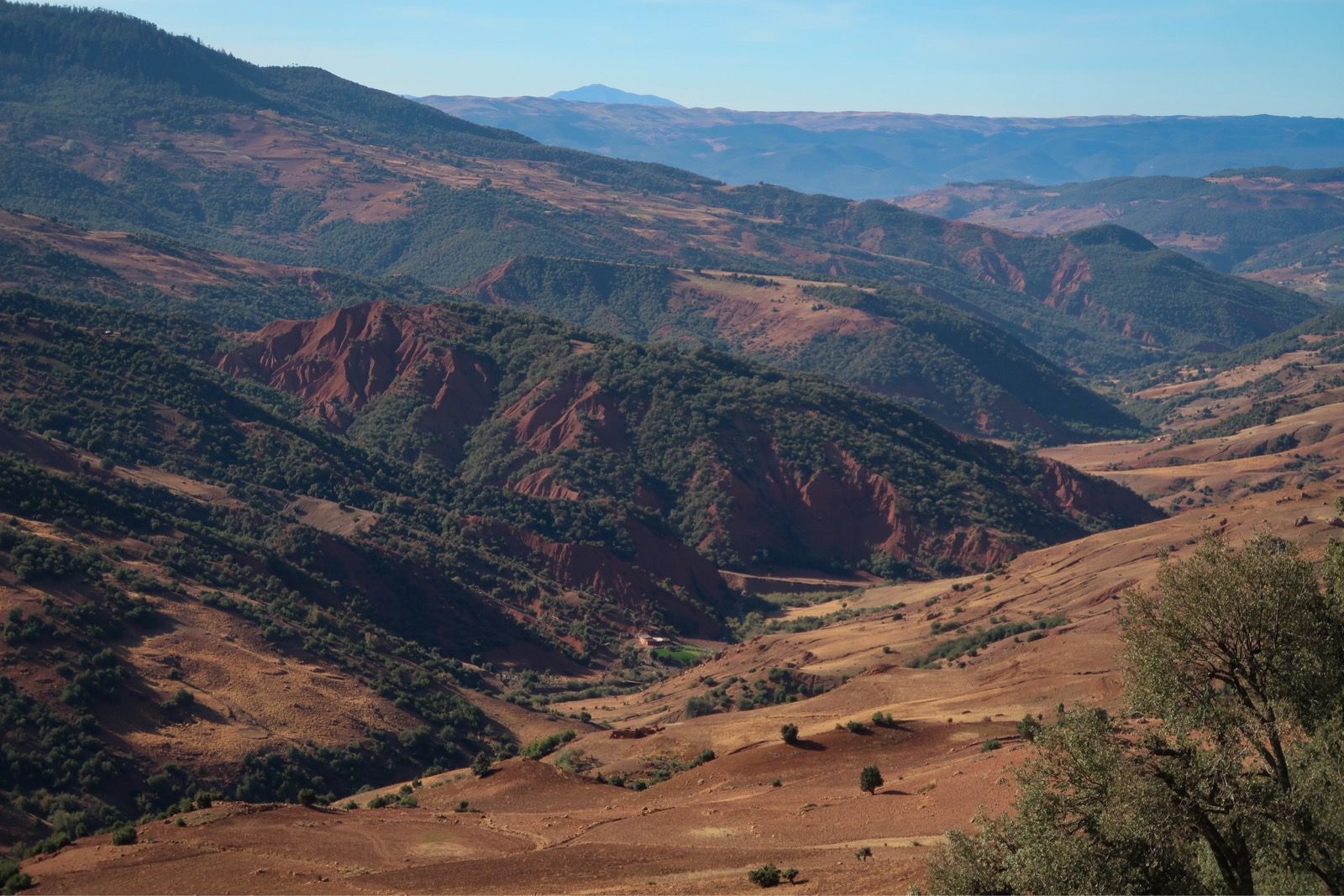
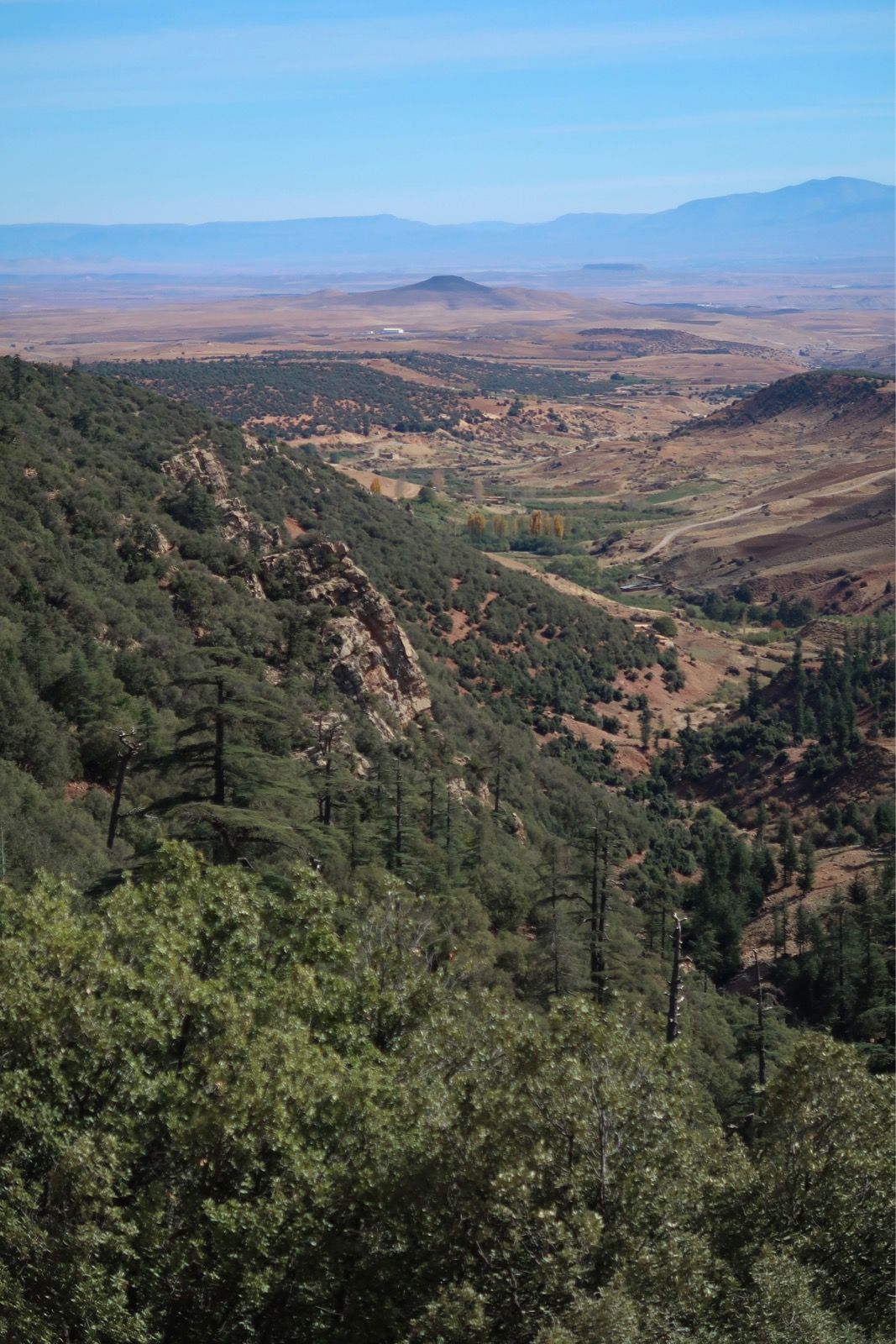
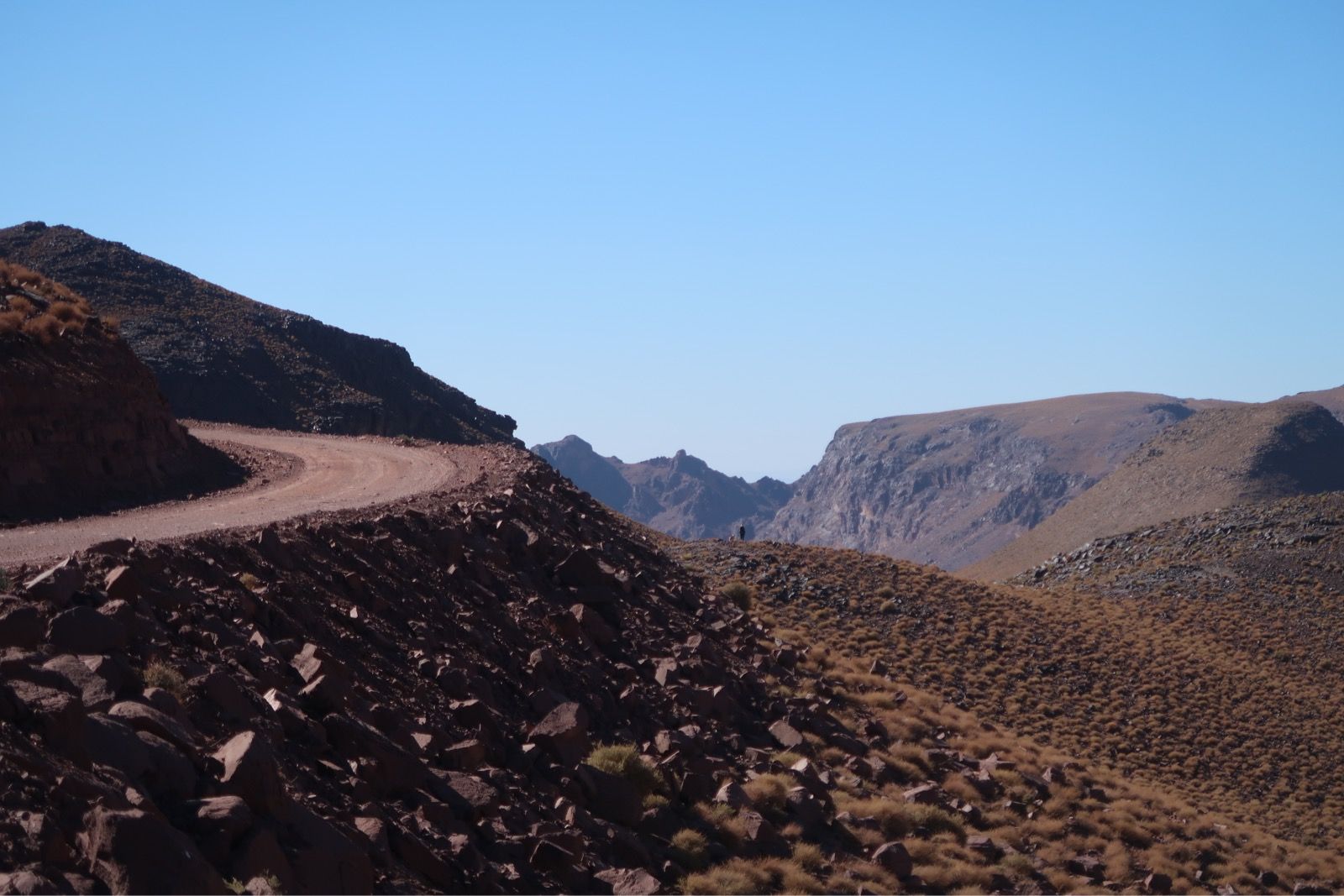
Just so you know what the Middle Atlas looks like.

My camp last night.

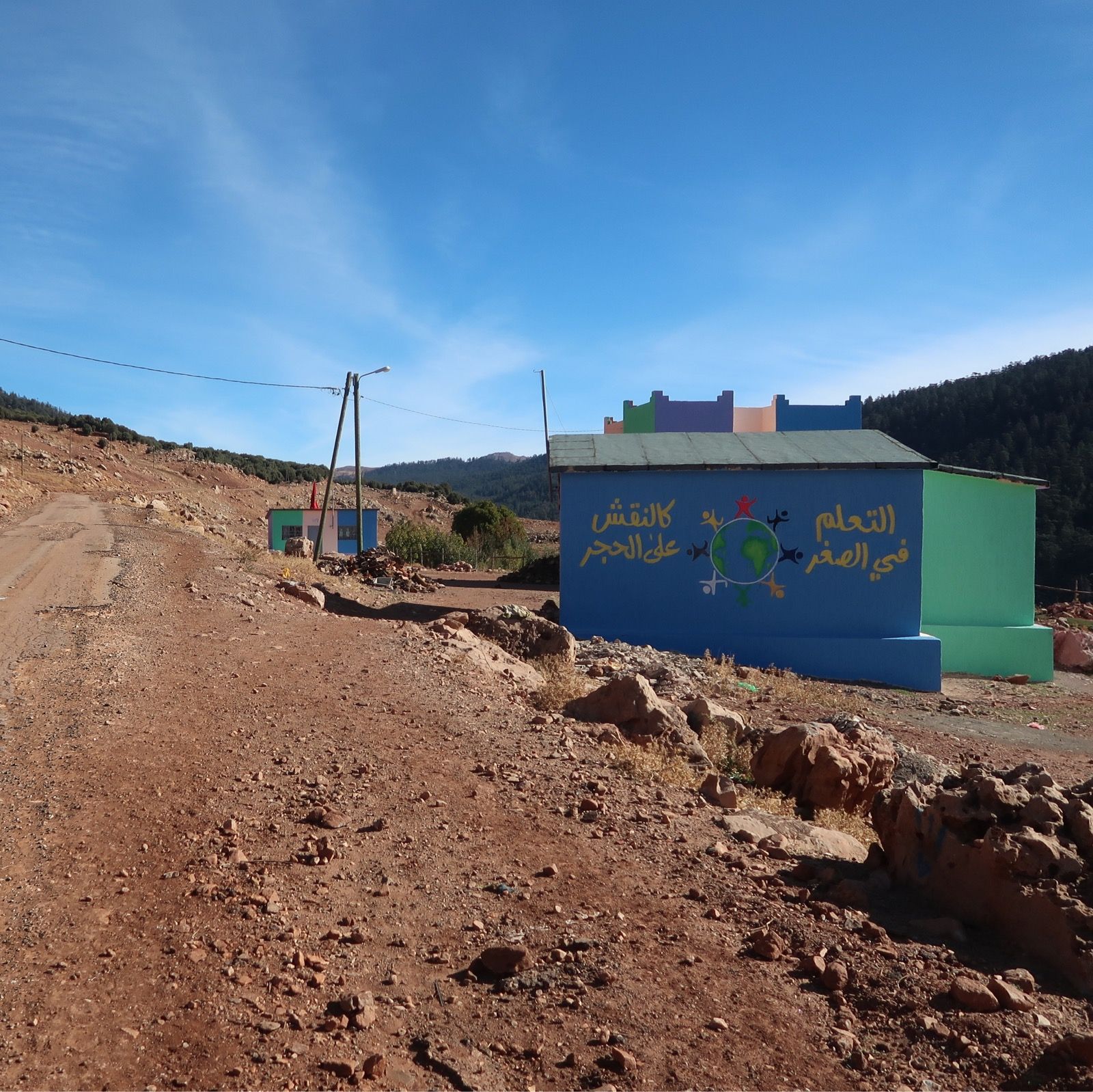
A school in the mountains- probably no longer operational; I went to look for water but much of the inside of the building is broken. I am guessing that the 50% literacy rate is related to these types of things.

My one water bottle tasted like laundry detergent- even though I filled it from a tap by the “sexy porn” women yesterday. Here you can see the suds in the only surface water I saw today. Decided to push on with chapped lips to a better source.

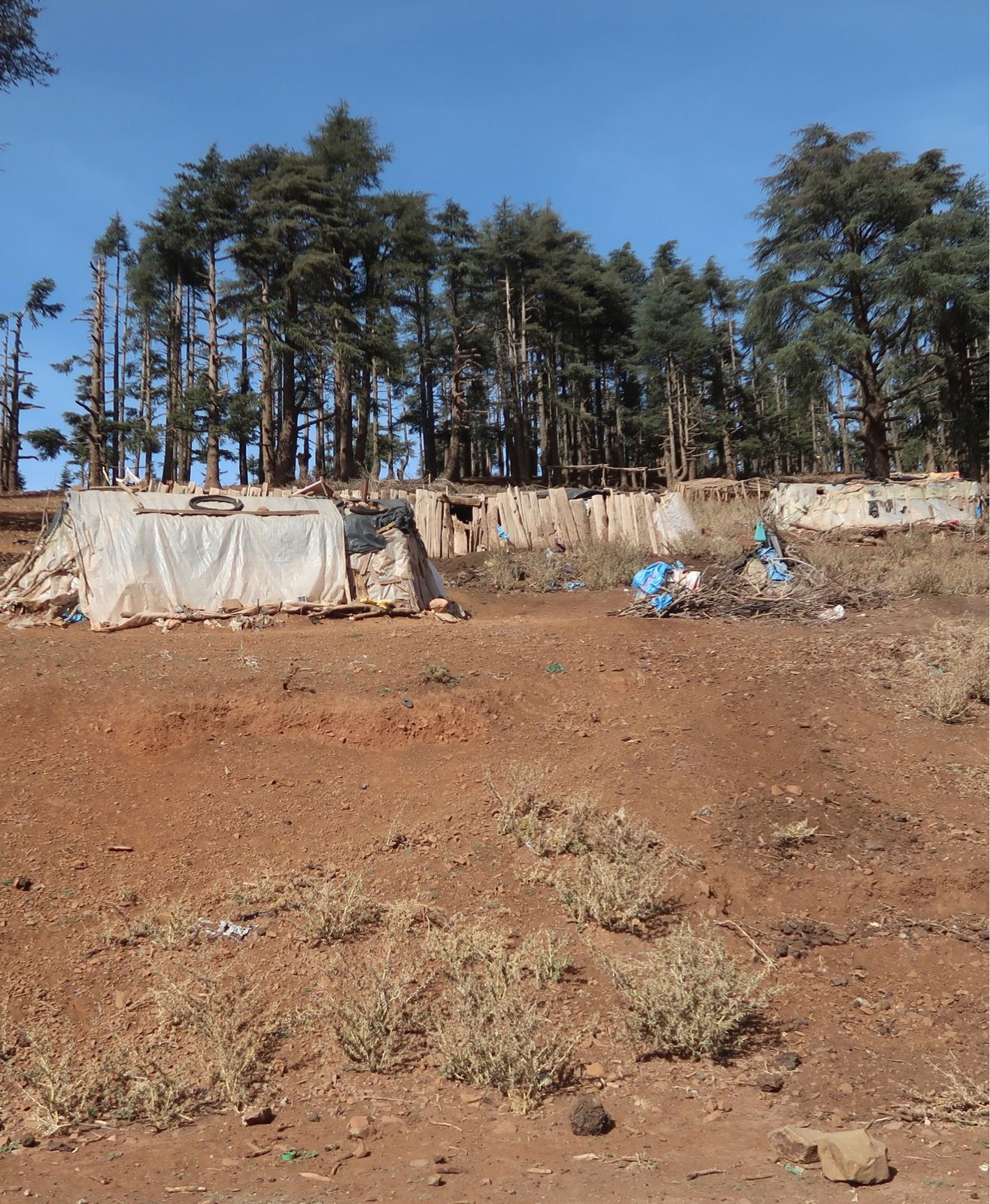
Examples of how the mountain people live up here. It is cold – we aren’t even up to the snowy part of the year yet. People amble about at night – in the dark without flashlights or in some cases electricity in their homes. In the winter, that must mean long chilly sleeps.

Mohammed of Bouhmia.


Strava Comments:


Thibau V.

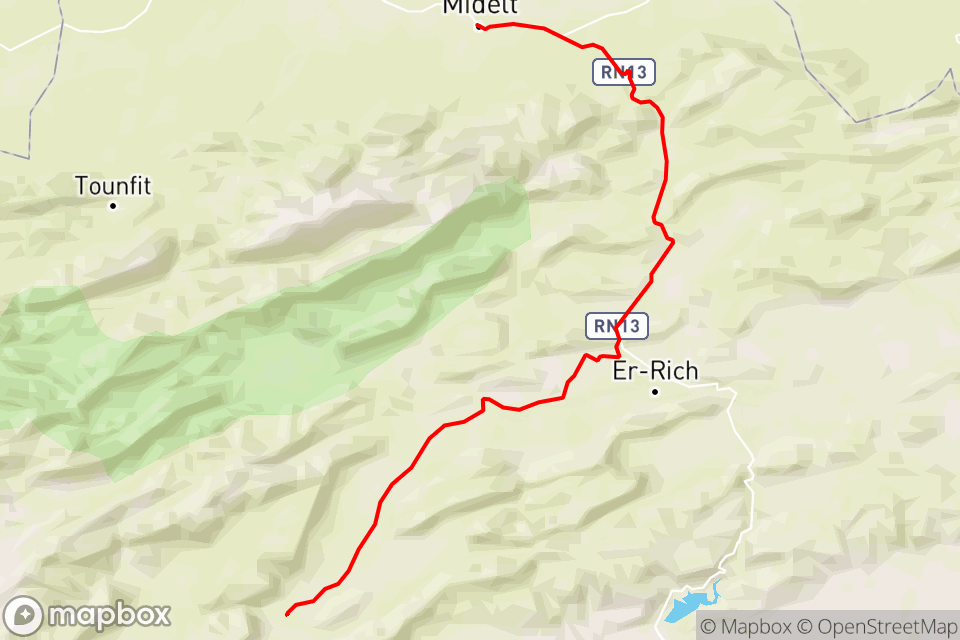
Hello Brian, I’m a 25 yo cyclist from Belgium. Yesterday I stayed in Midelt. Tonight I’m spending the night in Er-Rich (80km southwards of Midelt). Tomorrow I will had to Amellagou (60km from Er-Rich). I’ll probably stay in ‘Le refuge bleu’. Maybe see you there? Have fun!

Brian L.

Thibau VdB – did you meet a guy named Rashid yesterday? We were talking in the street today and he mentioned he met a Belgian cyclist yesterday. We discussed that is was Tibot,from Belgium who I met two days ago…but then he said there was another guy from Belgium but not with long hair. I figured I was not understanding him… but now I see it was you! You both have the same name even. He has headed West, though. I would like to meet you… but need a rest day tomorrow. Not sure I will catch you but am following your Polarsteps now.

Yuwen W.

Brian Lucido what a small world! I just talked to Thibau VdB about you, and now he already found you! 😀

Jessica M.

Glad you are feeling better. Too bad you can’t find a buggy to pull Mila!!

Thibau V.

Brian Lucido oh what a coincidence, but I don’t think I met a Rashid so far. In fact, I didn’t meet any cyclist yet in the 2 weeks I’m cycling here in Morocco. I talked to Yuwen W who I met in Tarifa and she said that you were travelling here. Anyways, I’m heading to Merzouga the coming days and I’m not doing the crazy mileage so maybe we’ll meet one of the coming days 🙂

Janet W.

Yuwen W you are the Saint of unlikely meetings! Because of you, Brian and I met on the road in Colmenar, then you met Thibau and now Thibau and Brian have met in Morocco. You may have a connection with Allah also! Brian Lucido , I’m glad you’re getting some rest today and hope you don’t miss Mila too much. She’s a survivor and do are you!

Steve C.

Hopefully not as cold as Gila Hot Springs that one night brr… 🥶

Tony B.

Always an adventure! Look forward to reading your stories daily. Hope you’re feeling better and get the sickness out of you soon.

Yuwen W.

Janet Wagner I’m wondering what’s the chances of unlikely meeting you here in California 😉

Ann L.

Hope your stomach continues to improve and you find some sud less water soon! Mila seems like a really good dog and company. Too bad you can’t keep her for the whole trip but I know it’s just not practical.

Warren G.

Brian – you are amazing! You cover more miles and elevation on rough roads while sick than I could do on a consistent basis feeling chipper on pavement with no load. Your language story matches with most of our travels, esp. in mountain areas. In northern Pakistan nobody spoke Urdu, each valley had their own distinct language and culture. Whenever we met someone who spoke english we had them help us write down a set of 20-30 words that we had in as many languages as possible. Further complicating things – my younger son just graduated with a degree in Arabic and he tells me that almost nobody outside of the big cities speaks or uses modern, standard Arabic (it is a recent artificial construction). There are many different versions of Arabic and many of them are very different from each other. Even with his background in Arabic he had trouble communicating in rural areas throughout the Middle East. Hopefully folks you meet will be conversant in modern standard traveller’s sign language :). Hoping your stomach heals quickly!

Brian L.

Warren Gold – wow, that is cool your son studied Arabic… but I am now learning the diversity of these languages… which makes it frustrating! I don’t want to “give up” on trying to talk to the people, but one would need several lifetimes to learn all the variations of each language. By the way, you probably know this, but even modern sign language is not standardized! Some of the gestures I have encountered still leave me scratching my head! Thanks again for the additional information!!

Brian L.

Steve Crocker , no it wasn’t even close to being that cold. I guess I’m becoming a wimp.. but then again, there weren’t hot springs right next to the tent either!

Sօʀƈɛʀɛʀ 🅅.

Brian the linguistic and cultural journey is going deep now. You are a terranautical person. You are talking to it all now, including a dog. Really amazing stuff.

Paula G.

You are one tough cookie Brian….and a very informant teacher too!

Mark G.

MILA!!! I love her. I hope you get to meet up with Thibau VdB

Ride Stats:

Elapsed Time Moving Time Distance Average Speed Max Speed Elevation Gain Calories Burned
09:39:10
hours
07:02:41
hours
113.24
km
16.07
km/h
55.58
km/h
1,569.00
meters
3,796
kcal


– Day 95 : The Tea Party [top]


Do you remember being a kid and holding your breath, swimming to the bottom of the pool and having a “tea party?” Today I had a tea party, except instead of holding my breath, I was holding my heart. It seems to be the custom here to gently bow your head, and put your hand over your heart, kind of like an American “pledge of allegiance.” I did read somewhere that Moroccans believe that love comes from the liver (I assumed that is why they were serving spleen and not liver at the food stall)… but in spite of that internet knowledge, I see lots of hands on hearts. The internet says this means “peace be with you.”

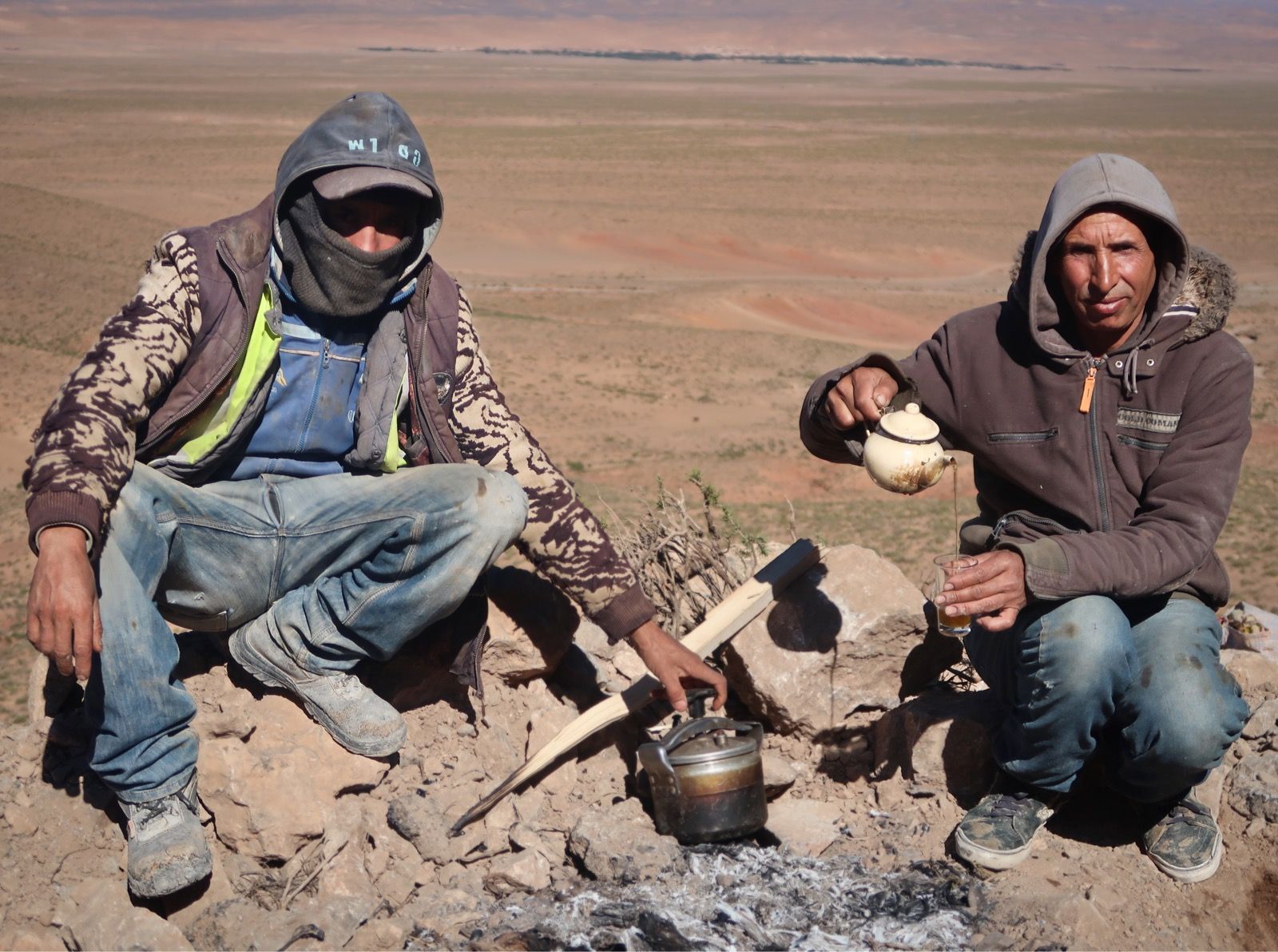
I crouched with the generous road workers who had invited me to tea, and we began to talk via the phone. They understood everything I said translated into Arabic… but the words coming back to me were like poetry from one of those songs where you think you know the words, but really, you’re just making it up. I figured the thick treacle was safe to drink; the cloying sweetness would prevent bacterial growth like a wasp preserved in sap for a thousand years – I took a sip.

Our conversation was fun, perhaps more fun for me, as I laughed each time I rendered a translation. The mention of God universally appeared.

One of the men told me that he had hurt his eye, and I replied that I hope god helps it heal quickly. My tea party companions seemed to like that. It seems you can’t go wrong with mentioning God.

They offered me bread and more super sweet tea. Siri must have done a good job explaining diabetes, because they solemnly acknowledged this, looking a little disappointed that is was only going to be a partial party.

Later I texted with them trying to exchange some selfies that we had taken. The reply was a few voice recordings. At first I thought I would use my spare phone to translate.. but then I remembered that my favorite Mohammed had offered to help me in any way. WhatsApp makes it easy to forward the recordings, and he came back quickly with a translation. “Are you the person on the bike? I don’t understand the photo you sent. If you want, you can come later and I will show you the cafe where I work.” 🤔?? Wait, these were road workers!?

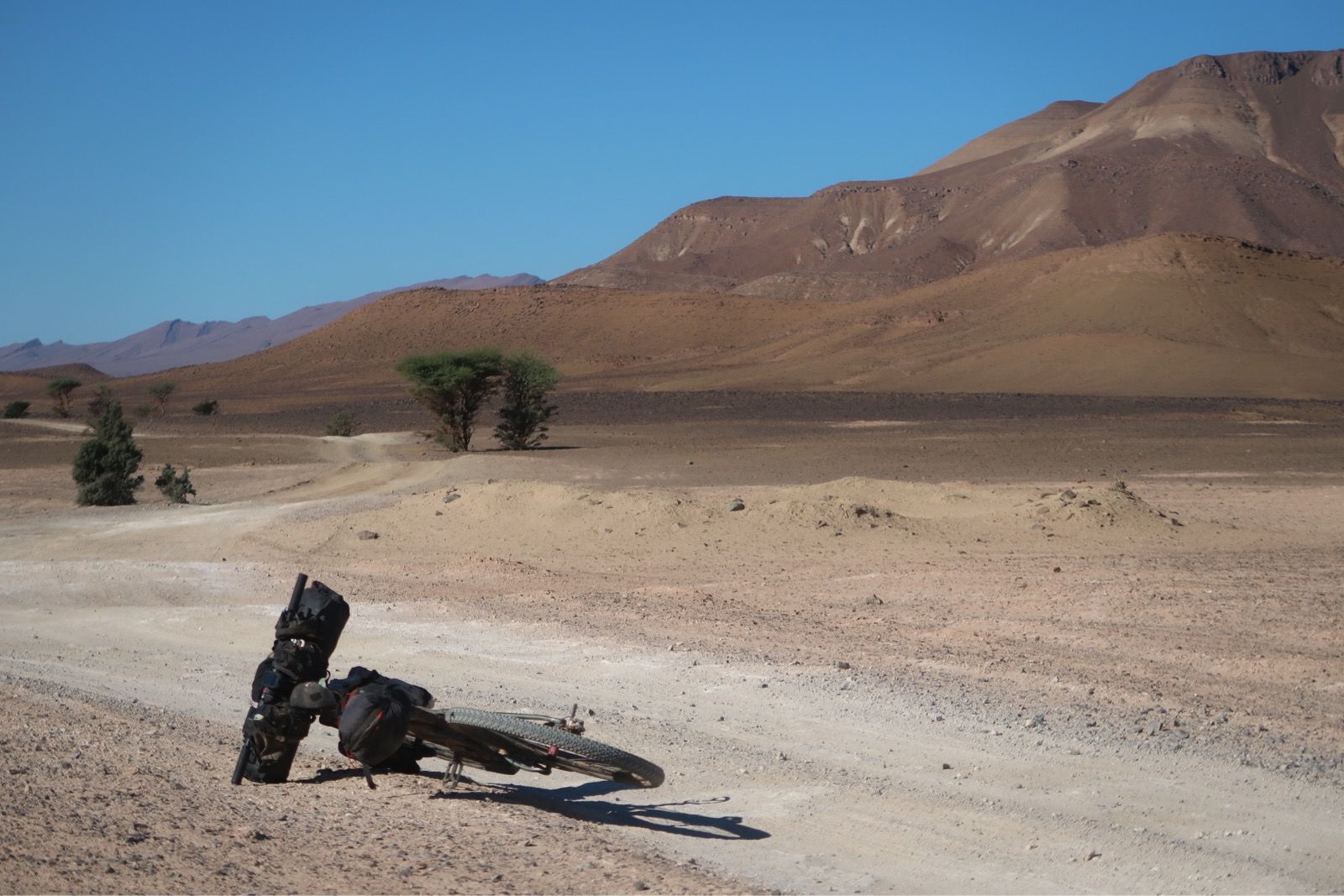
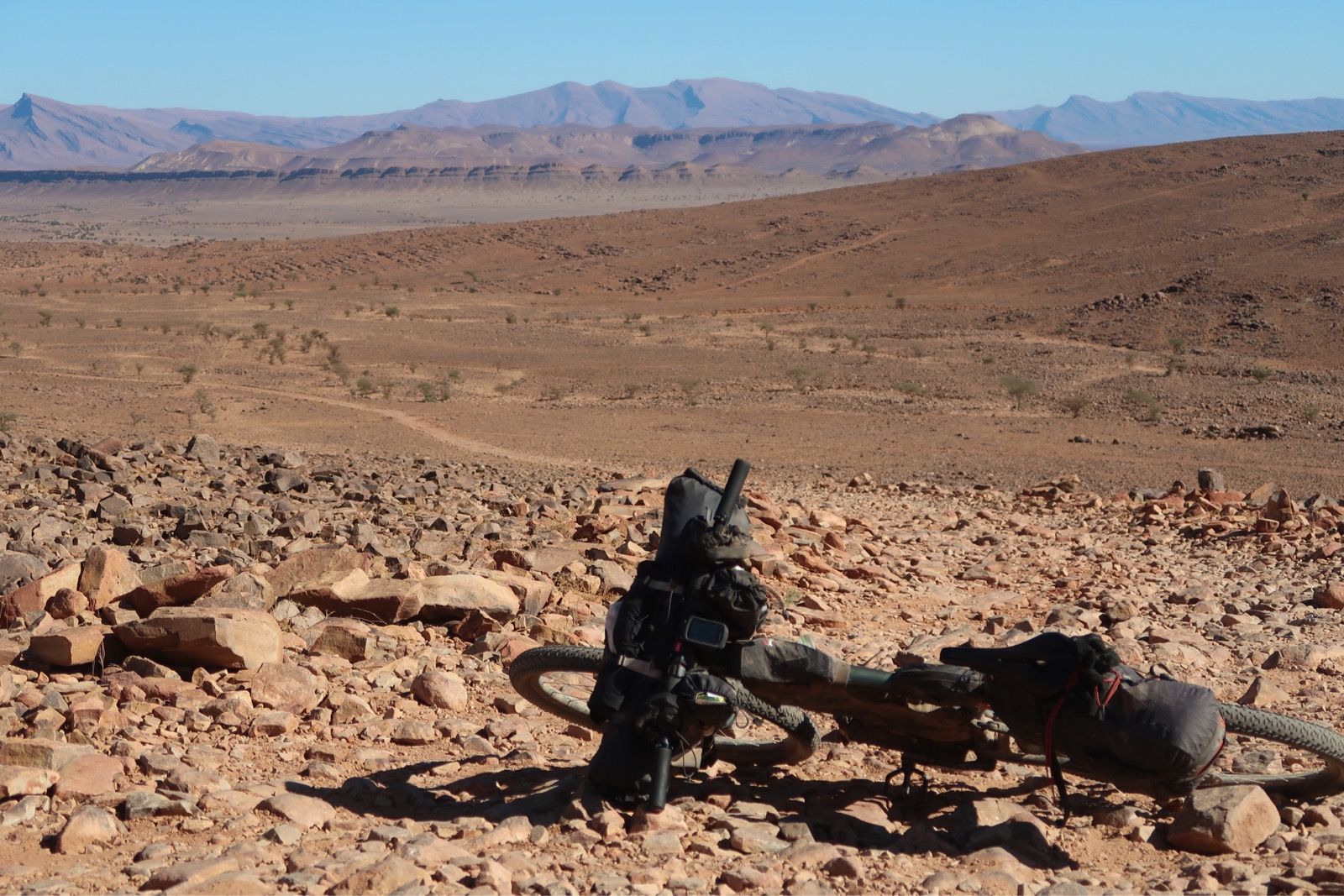
Later I decided to ditch the popular Merzouga route and take what I thought would be the “road less traveled”. Indeed, it was less traveled by cars. The desert scenery was fantastic. Along the way, I saw many kids always running out to see me. Some would give me a high five, while others would practice their limited French with me. Everyone seemed to know the following nouns: “pen, candy, gift, phone, and money.” The lone accompanying verb in these cases was “give (me)”. I have considered buying some pens, as I sometimes hear “stylo” shouted before the running child appears. I day-dream about these kids using these potentially gifted pens to become gifted A+ students. Would you carry pens to hand out, risking perpetuating the demands?

One group of kids, who did not belong to the high-five clan chose to throw a couple of rocks my way, all of which missed by a large margin. I decided to turn around and ask them why they did this. As soon as I made a “U”, they ran away. If I see these kids again, it may be in the 800 meters at the 2040 Olympic Games. It definitely won’t be in the Shot Put event.

I abandoned the route to the famous dunes at Merzouga because I know of some other dunes along my route, and this new route promises an additional gorge. Plus, I have to admit that I have a little aversion to “constructed experiences” that you pay for. The two things to do there are rode a camel to a tent in the desert… or ride side-by-side dune buggy vehicles. It’s not that I mind paying the money; I guess I prefer the element of surprise. The price I pay for this, though, are these staccato conversations where I sometimes don’t know what is going on, or I use my left hand (the poo hand) to make a gesture, or I don’t give God enough credit for what is happening here. Sometimes I wish I had a tidy and cohesive story for you that wrapped up into a neat little package rather than these sloppy bits and pieces.

A little bit of continuity came at the end of the day. You may have seen a comment on my Strava from a Belgian named Thibau VdB – he happened to run into Yuwen W in Spain. Janet and i happened to meet Yuwen in Spain, and she knew of Thibau. The whims of the space-time continuum seemingly have decided that Thibau and I should now meet in real life – and by chance, that is exactly what happened this evening! So I will end writing here and go out to chat with this young Belgian.


Photos:
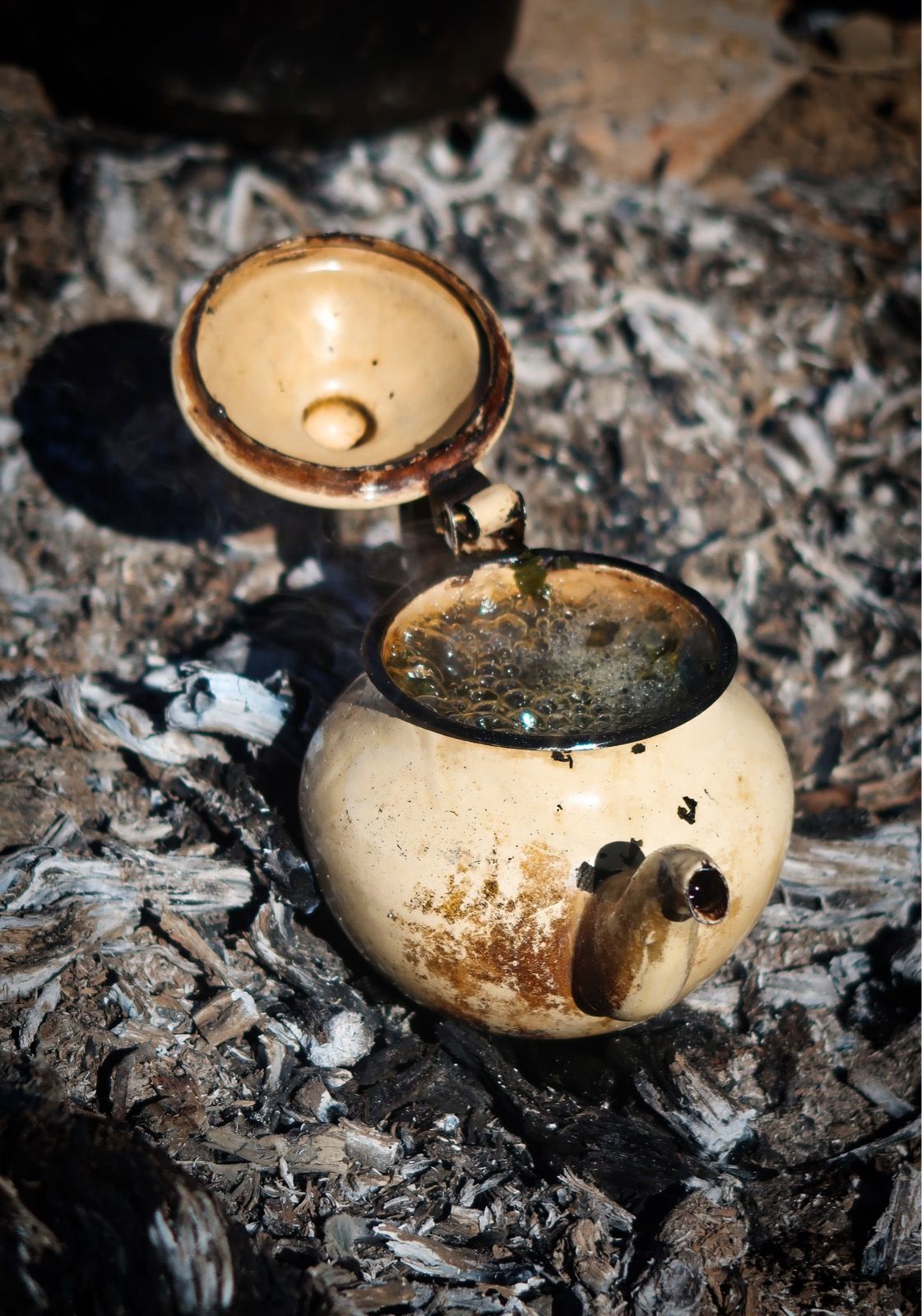


The tea… sugar already added. There may be some water too, but not sure.

These guys invited me to a tea. I really liked them as they were interested and curious and welcoming. They pour the tea back and forth between the pot and cup several times before serving it. There is a little fire right here on the side of the road for heating the tea.

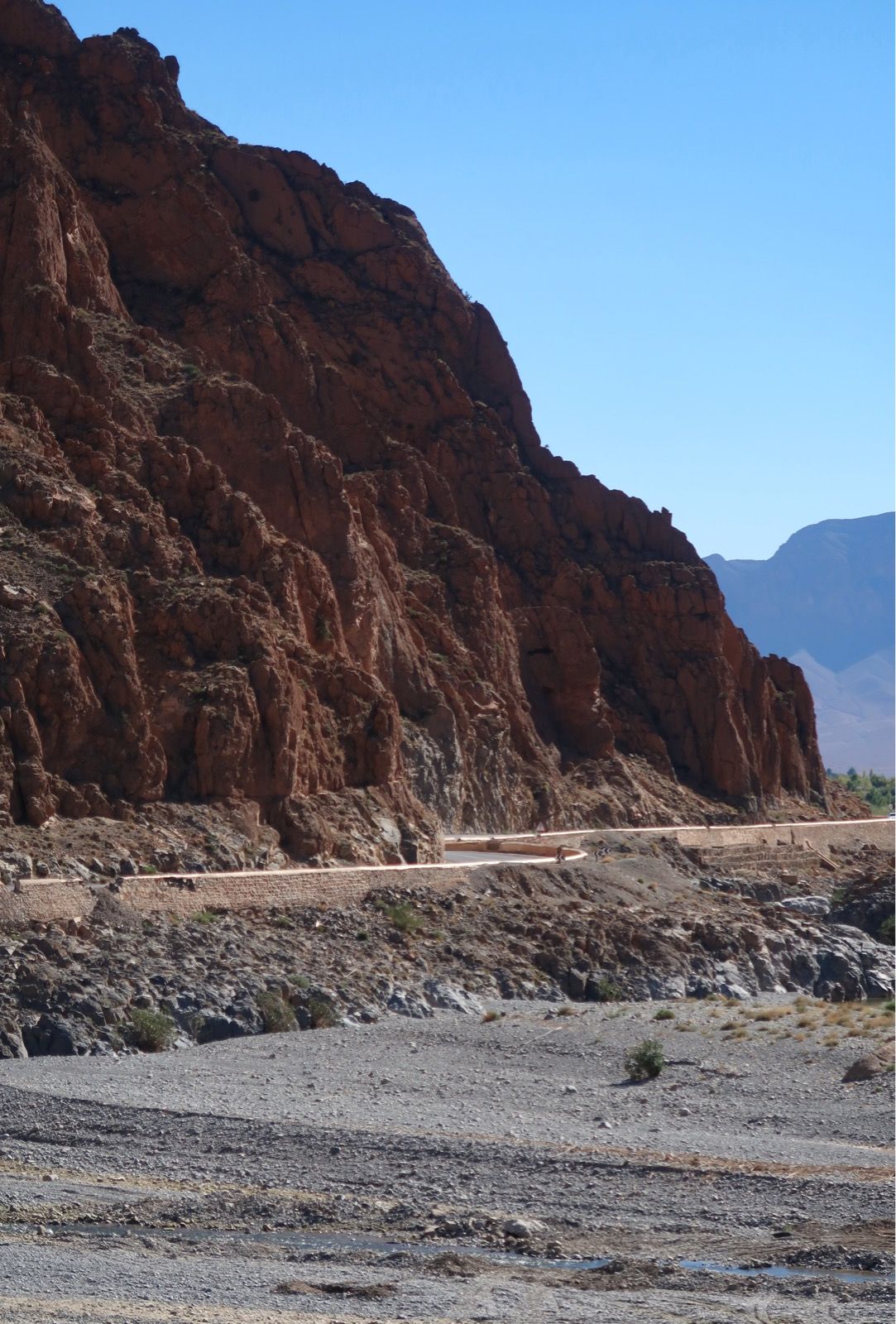
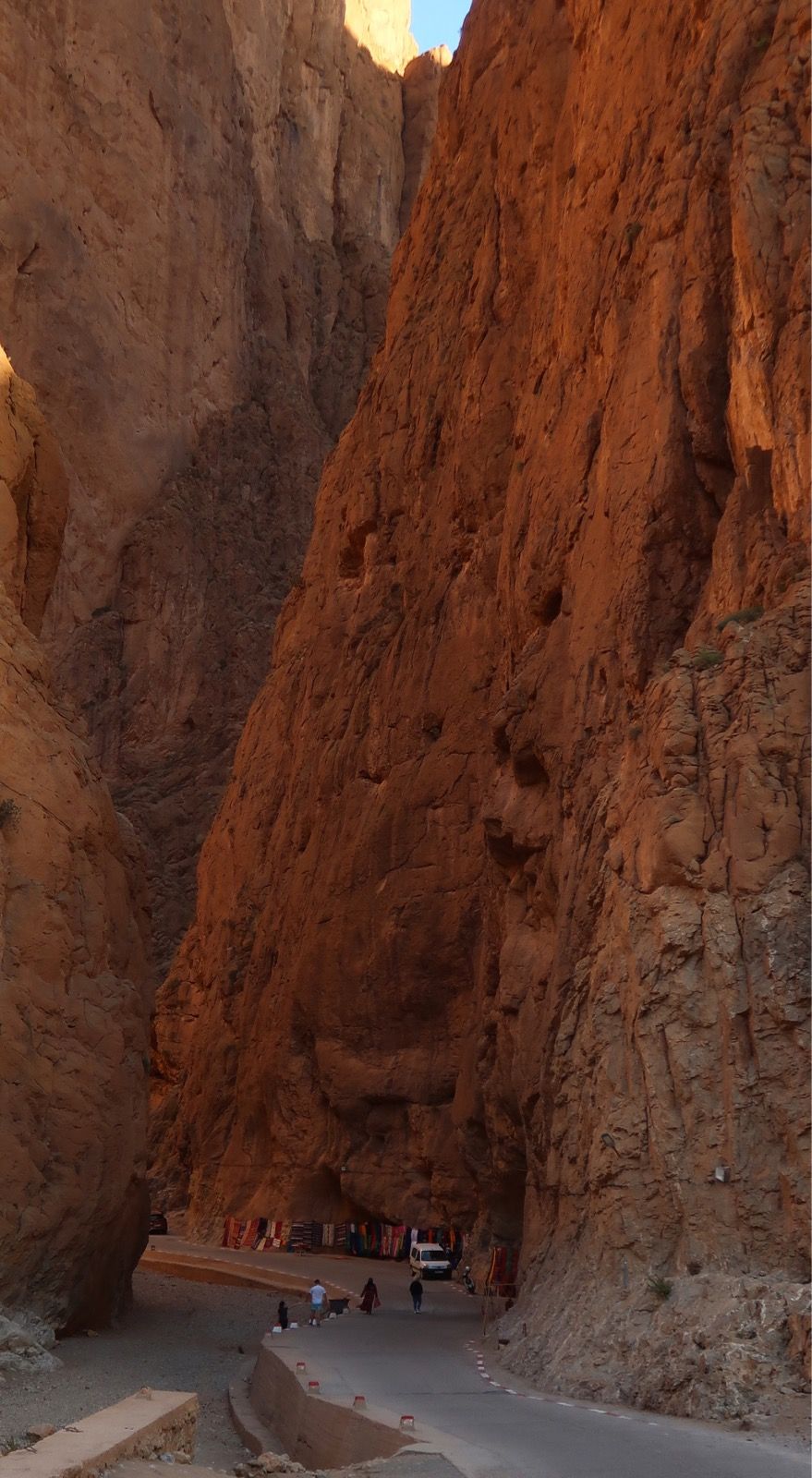
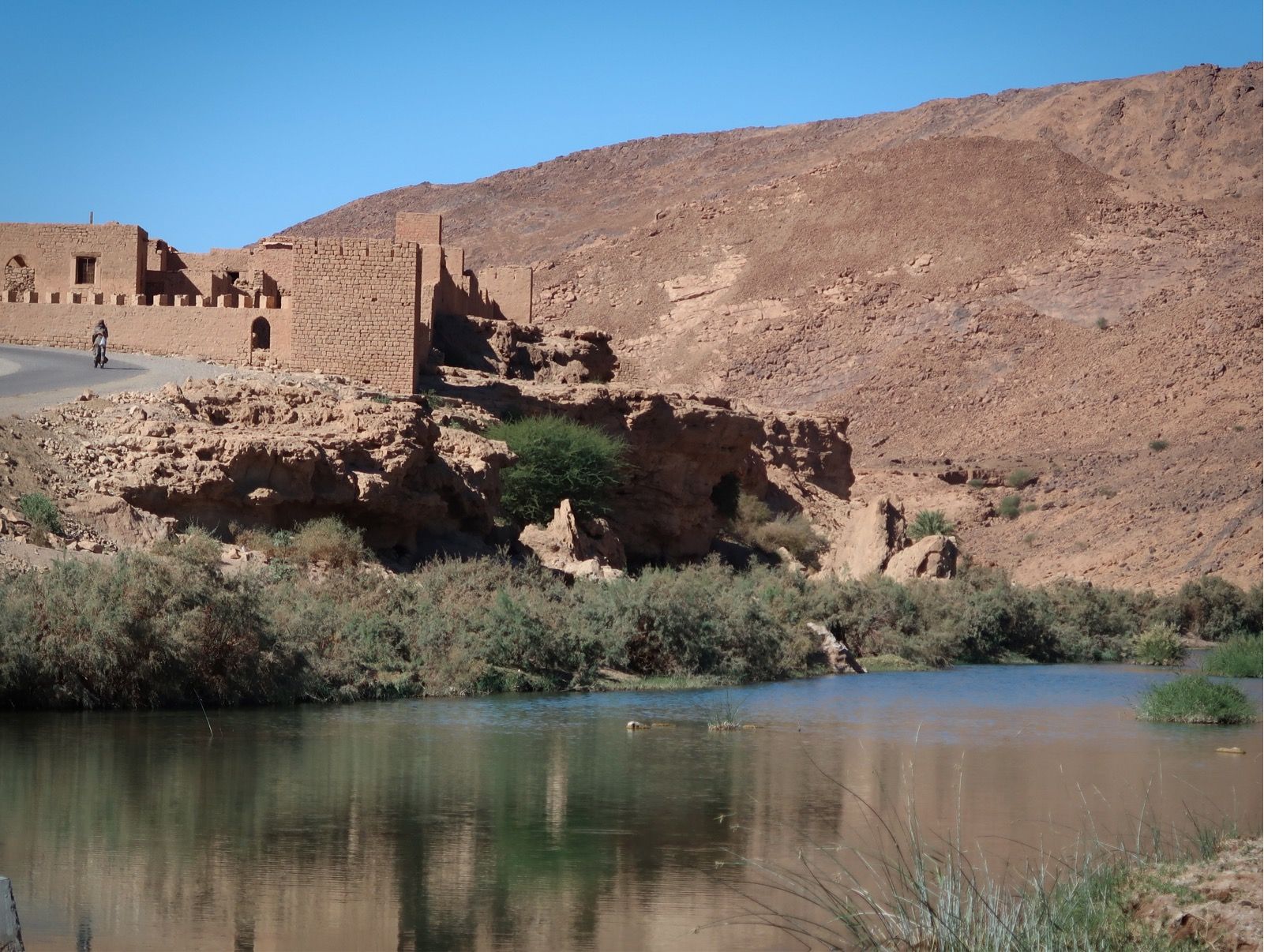
Today’s gorge was along a major road, but I think I will go through another one tomorrow that looks promisingly beautiful on the map.

It has belt drive and a chain.

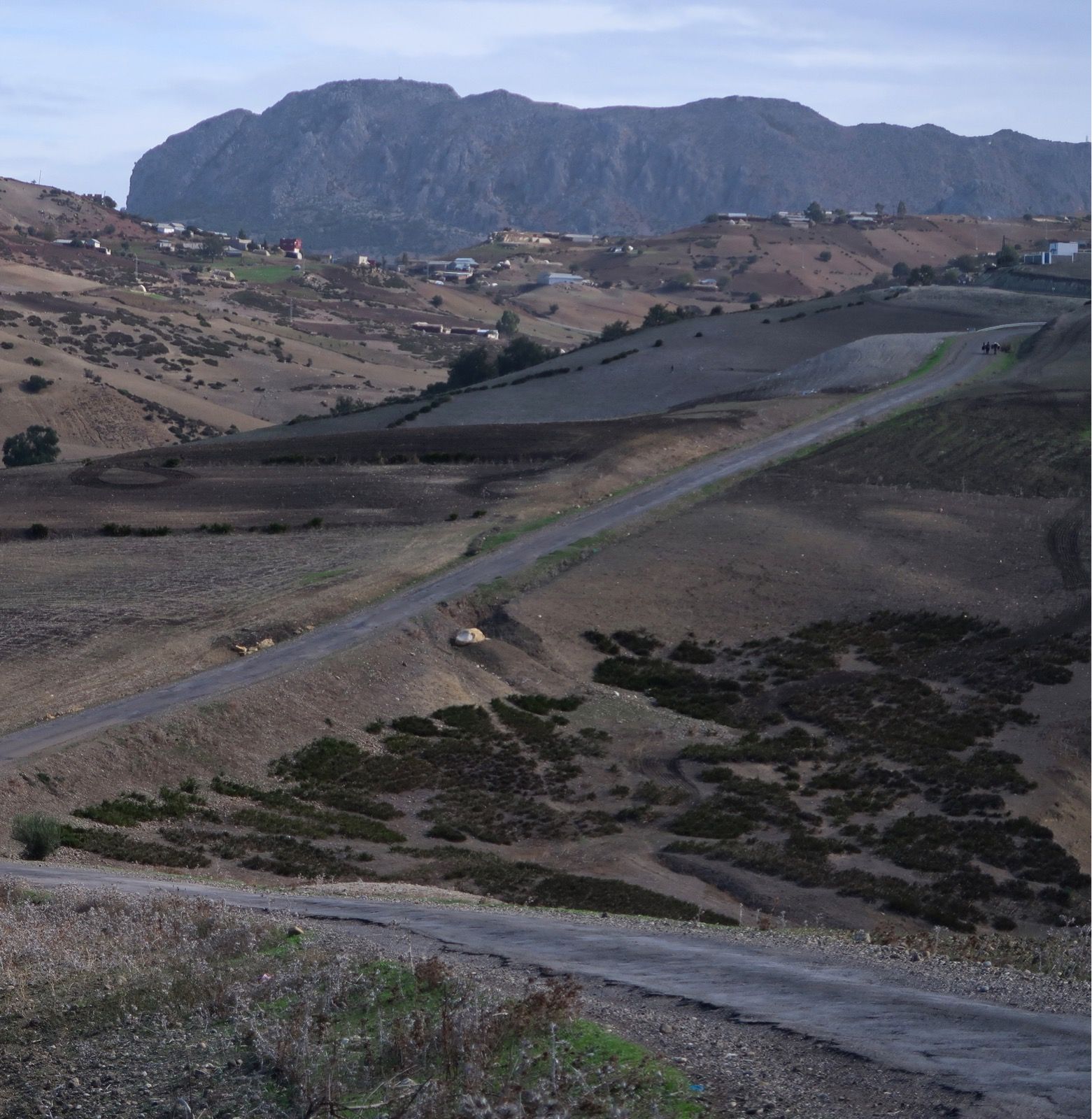
Once I left the main road, I took this route which was very nice and quiet. It was paved like this almost the entire way!

Many tiny little settlements, spread out. Each house is about as far as you can see from the next house. This means that you can visually monitor the land with the fewest number of people.

The underbelly.

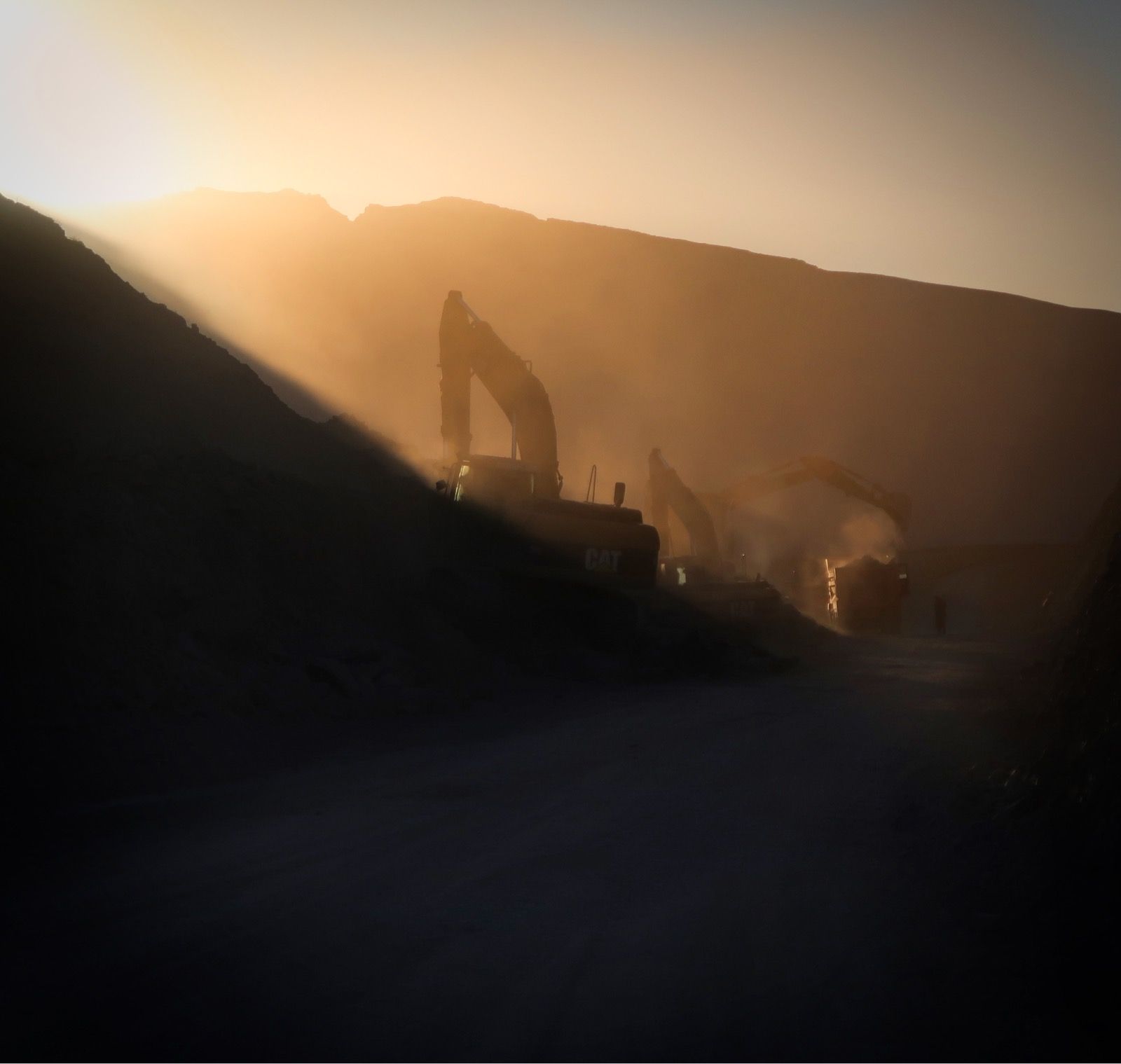
Many roads are actively being built; so many machines were working simultaneously on this road project, and the map I am using is often different (by a few hundred feet) from the real life new road.

I got a room and chatted with Thibau for and hour or two. I’ll tell you more about him soon.


Strava Comments:


Tracey A.

I am enjoying reading about your adventures so much! You are meeting so many wonderful people.

mary P.

I love your adventures…been following you through Spain. One of my favorite countries. I think I met the man from Italy when I was in Spain in 2018. He rode his bike from Italy to Santiago de Compostela.

Stan H.

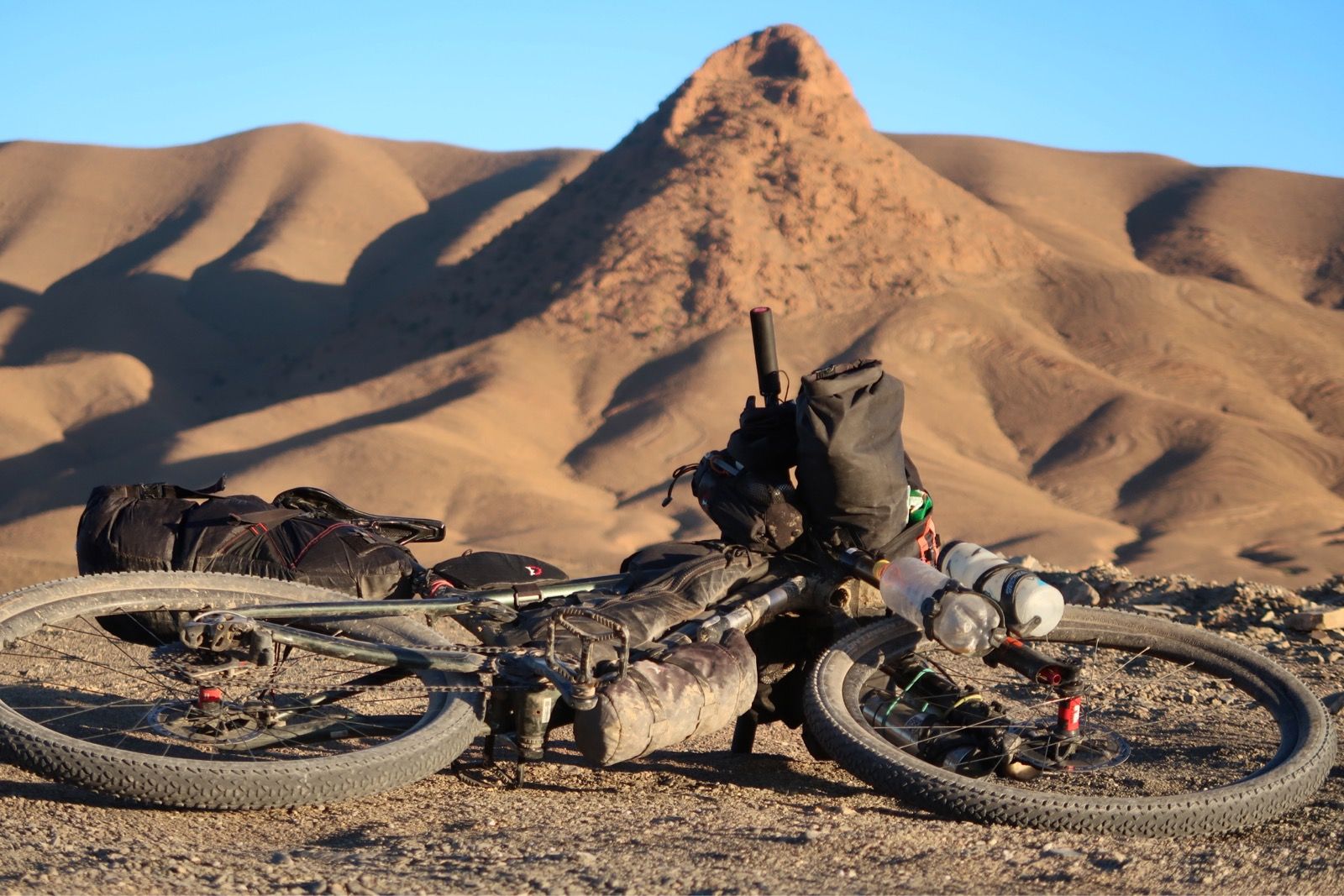
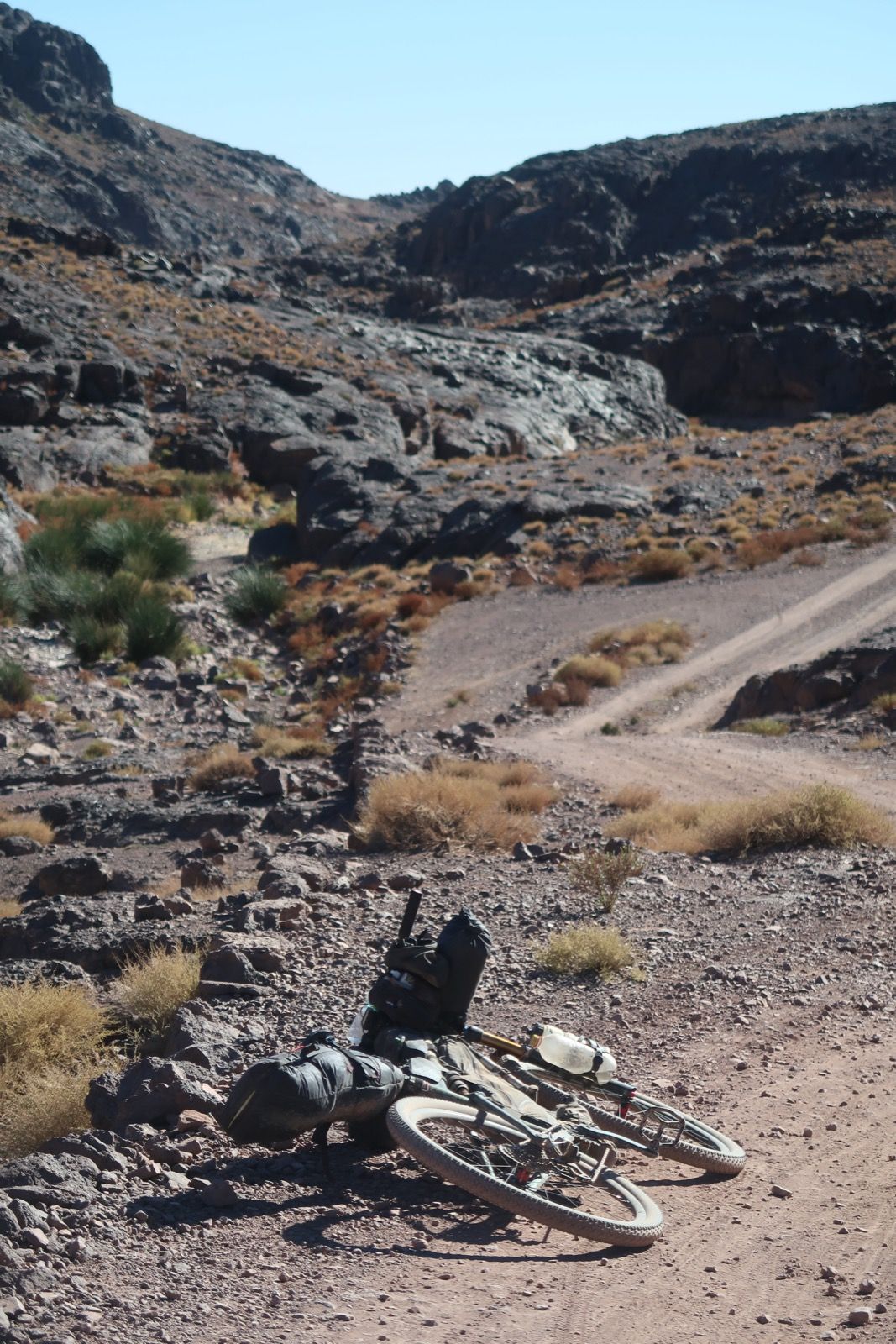
I like the pic of your bike on its side with the mountains behind it. I’m not really sure why…just an unusual, but nice, composition I guess. Also, love that you turned around to ask the kids why they threw rocks.

Scooter R.

Fascinating

Paula G.

You seem to be learning so much about different people and their cultures. This is the stuff that books and movies don’t show us. You are a great American ambassador!

Janet W.

You are making the most of the very opportunity to experience Morocco, which I hear is not considered part of Africa by the locals. This is one good thing about traveling solo. If we were together, I might be too shy to stop and speak up. Good job writing notes during the day, as reminders for your Strava stories. Happy we did another fun video chat today!

Ann L.

Sounds like you had a good day and are interacting with some interesting people.

Vicki C.

I like the bits and pieces of your experiences- it wouldn’t be daily life- always throwing us a curve- if it were wrapped up in a nice little package

Jessica M.

Spectacular! Thanks for always sharing!!

Mark G.

Carry pens. Love the chatty I don’t need the cohesive packaged story AND so happy you got to meet up with @t

Mark G.

Thanks for that video with the zoom in

Yuwen W.

Wow, I’m so happy that Thibau VdB and Brian Lucido you guys finally met. 😀

Ride Stats:

Elapsed Time Moving Time Distance Average Speed Max Speed Elevation Gain Calories Burned
09:00:32
hours
06:27:02
hours
136.39
km
21.14
km/h
56.22
km/h
1,080.20
meters
3,054
kcal


– Day 96 : The Wisdom of Youth [top]


Today was definitely the most scenic ride I have done in Morocco, if not ever. But today was also filled with events that may change the rest of my trip.

It started on a high. I had talked to Thibau for 2 hours last night, and another hour this morning before leaving. He is an insightful 26 year old national champion runner from Belgium (sub 4 minute 1500m) who was inspired to bike tour by his uncle. They did 3 tours together so far, and when his Uncle went home from Spain 4 weeks ago, Thibau kept going. Describing himself as “not a cyclist,” he is enjoying this tour immensely; doesn’t do big miles and takes rest days. From my point of view, he is “doing it right,” too. For example, yesterday he met a guy in those desolate mountains, and rode backwards 30km, ending up going to class with the kids for 2.5 hours in the morning. “Why not?” He said. “I couldn’t come to this hotel at 11am!” He described the kids as being very shy in the classroom – even though they were sneaking looks at him. He showed me a picture of 15 smiling kids and said, “I can’t post this; none of them are smiling.” I disagreed, they looked happy… and then I recognized some of the kids! One of them had spoken a couple of words of English to me in the street, asking for money.

As part of our conversation, I told Thibau that I was going to “go to Africa”. (This is what Moroccans say to me when I say I’m going past Mauritania. I always come back with, “but THIS is Africa..”. They say, “you’re right, but…”. They don’t consider Morocco to be Africa.) Thibau asked poignantly, “Are you looking forward to it?” An excellent inquiry. I thought about his question for a while. Finally, I responded, “I am looking forward to everything except for people asking me for things.” The last couple days, I’ve realized that saying “no” to hundreds of kids per day really wears on my conscience. Thibau and I then talked about the kids. He claimed that none of them have asked him for money, and none have thrown rocks. I said, “I could believe it because some of the routes I took were quite different – but we did this exact same route today, and I must have been asked a hundred times for pens, and candy”. He told me one time a kid asked for money and he said, “no”. How is it possible that we are having such a different experience? Being Belgian, Thibau is fluent in French (which I envy, and PS, did you know Flemish is the same as Dutch?)… so surely he would understand what these kids were saying! If you look at the photo of how he towers over me, you couldn’t say that he looks like a local – especially with his heavily laden bike. Meanwhile, today when I continued down the road, I was met with no less than 400 requests for candy, pens, and money. But let’s get back to that in a moment.

Thibau had some good questions. He asked, “Will it be hard for you to go back? I mean, I feel like Morocco has changed me. I am a different person now, and when I go home it will be hard.” He has been here 3 weeks. I quickly replied, “no,” but thought about his question all day. Should Morocco be changing me? Should this be a profound experience? Am I not feeling changed because I’m too connected to home? Thibau said he only calls his mom once a week; his dad less. Or is this something deeper… the wisdom of youth. Often we credit our elders with having deep wisdom, but looking in the opposite temporal direction, maybe there is something to be re-learned from those younger than us. Between interruptions, I thought about this question all day long – trying to unveil why I didn’t think this trip has changed me.

And interruptions there were. I thought I was the first clever person to see some topo lines on a map and identify a good cycling route. I learned today that I am just following in others’ pedal strokes. Despite the very remote nature of the desert course, kids would come running towards me – sometimes from seemingly impossible distances, they could always head off my bike. Hands out, a cross between a high five or a “gimme,” they would stand in the middle of the road using every French word they knew. “Donnez-moi un bonbon! Cadeaux! Stylo! Une photo!” They ran alongside me demanding. If I had emptied all of my bags and filled them with candy and given each kid one piece, I’d have nothing left before I finished. The desert looks empty, but the kids appear from everywhere. How did this happen? Today I developed a theory when some of the kids suggested a photo in exchange for candy or money. People who have come before me give the kids candy, and in exchange ask for one of those adorable photos – because the kids here are beautiful, fit, and healthy. Certainly Instagram worthy! Alternatively, I could be like Thibau and go to class with the kids for a couple hours, play some games with them, and come back that evening feeling like a changed person. You can probably already tell which path I admire more…. Yes, a 26 year old made me think a lot today.

Let’s interject some positivity for a moment here. On a long seemingly deserted section of road today, a teen in a long robe stopped me. While I dread the children, I’m really beginning to love the teens here. He said his name was Redwane, and he spoke some English. He explained that he worked in the mountains with “metal” (I think he meant mining). He smiled the whole time, and I had to know: “Where are you going? What are you doing way out here waking?” He said, “I am studying.” He held up a piece of paper torn from a notebook with several handwritten lines in Arabic. “I study while I walk. I like to walk in the mountain,” as he pointed up to a rocky cliff with no trail that I’d have difficulty navigating in the Sierra. Yes, he really walks up there to study. I loved his peripatetic studies, and told him I listen to French in one ear while cycling, humbled by his ambition.

So you may remember at the beginning of this discourse, I mentioned trip changing events. Near the end of the day, 4 women and 4 girls were walking in the middle of the road towards me, each with a huge bag of green shrubbery on their backs. They were all beautiful and smiling, but as I rode towards them, they ran towards me as if there was an emergency. They barricaded my path with their bodies and I stopped. One of the corpulent women was holding a baby and they surrounded me quickly – each had been eating a piece of fruit, and the redolent fragrance of sticky peaches filled the air. “Dirham! Dirham!” (The Moroccan currency) they chanted, their sugary hands grabbing towards me and my bike. That is 16 hands (18 if you count the baby). They were all smiling and laughing, but I retreated backwards as they pressed forward. The smiles looked like Halloween witches with the fruit stuck to their faces. I rushed backwards, difficult with my injured Achilles. This was too much, I darted away, shaken and full of adrenaline. Yes, my friends, laugh if you want, but a group of girls scared the crap out of me today.

I can handle the severe pain in my Achilles, the saddle sores, the long miles, the climbing, the rocky trails, the challenges of finding healthy food, the vomiting and sick stomach, the heat, the cold, the diseases that I have vaccinated for, the rain and wind… BUT… being swarmed daily – even by beautiful women – and being nearly yelled at “Vous plus riche donnez-moi argent!” And the like all day long is really testing my resolve. This is the hardest aspect of the trip for me by far.


Photos:
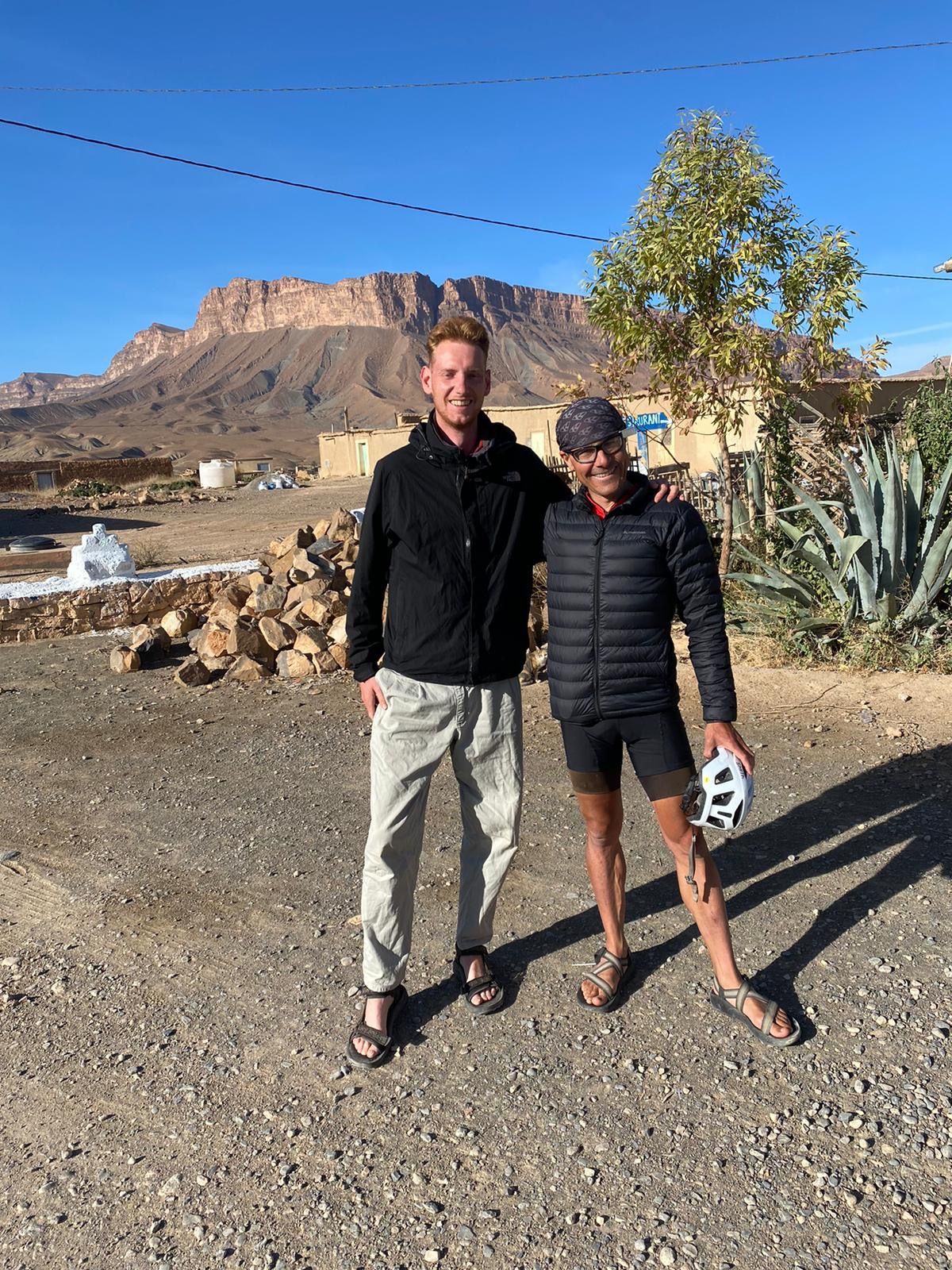


Me and Thibau

The first narrow canyon I thought was the most beautiful ever… until I got to the next one!

Daily life here in the mountains.

I realized that today is Sunday. Maybe i saw so many kids asking for money because they were not in school? This just occurred to me now as I was thinking of a caption for this photo.

Kids run from amazing distances over rough terrain to come ask for things. If you see a kid running, the only possibility is they are running to head you off. They succeed on this 95 times out of 100.

The Todra gorge.


Strava Comments:


brian W.

I wonder if these shrub hauling women are suppliers to the Knights of Ni. Perhaps you should have demanded a shrubbery. (Sorry, couldn’t resist a Python joke.) Great writing as usual.

Carol D.

The Todra gorge has stunning vertical walls. The photo into the sun with the mountains is great. Your interactions with the money hungry would be difficult.

Ann L.

Very dramatic looking walls and scenery. The daily interactions of the money asking does seem like it would take a toll on you. Such a different way of life there!

Mark G.

As always, thank you for this post. Brian. I sure do understand why the aspects of the trip that you speak of would so difficult and taxing. It would be taxing on any person’s emotional state. It makes it hard to engage with people in a way that would be symbiotic. It is my hope that you find those moments in the days ahead. Perhaps a pre-made sign that says, “I don’t have any money, pens, candy, etc. Ask my friends that are behind me, coming soon”

Mark G.

….. One more thought How about an old worn floppy hat on top of your helmet, some raggedy shorts, loose shirt, scruffy beard, and a bunch of light crap bungee to your bike? I kind of like the guy you described last week that was a biker that looked like they were getting ready for the Armageddon.

Corrine L.

So much to ponder in Morocco. While cycling through astounding natural beauty. I love your discourses.

Tony B.

I’m fortunate to enjoy your stories that you so eloquently write. I’m humbled as well. Thank you!

Judy I.

I have never been to Africa. We saw some ritual begging in Japan that was very dignified (ie: you don’t work so you can devote your life to God) and kids in Turkey will ask for handouts, though they are rarely given. In Cuba the kids really wanted toys and sports equipment, while their parents graciously accepted the toothbrushes and pens we were told to bring. In central China we saw minority beggars by profession, some horrifically mutilated at birth to ply this trade. It wears on one, our incredible luck of being born in the first world with seemingly endless natural resources, compared to those in barren lands who can barely survive. We have a natural wish for justice, we want to share our toys with our new friends, but there are so many of them! This is the dilemma of immigration and population: Africa is growing while the west is shrinking. Empires rise and fall. Maybe their day is coming. Don’t feel guilty. I think you are helping just by being there. Flash your incredible smile. Maybe team up with some other cyclist/s for awhile. You might be a little homesick. 🏡

Jim S.

It’s so interesting to me that you and Thibaut have had such drastically different experiences with kids asking for candy, pens, etc. It would really bother me too Brian, especially during a hypo!

Janet W.

I’m happy you and Thibau met and spent time sharing your Moroccan experiences. When a new country is so different and challenging it helps to like soul to share with. The scenery is inspiring, especially the Todra gorge, and certainly lifting your spirits, as you scan the countryside for approaching children. So happy to be able to talk to you again today! Don’t let the kids get you down. They are fine and just ‘doing their job’.

Pinkypants W.

Thank you for sharing your experience.It is good to ask yourself this question.It is good to meet brothers on a similar path.I suspect your face gives you away, unlike. Thibau

Osman I.

I think small cultural nuances elicit very different responses. Perhaps you smile to the kids, or make eye contact with them, but Thibau doesn’t… or the kids think that he isn’t that much older than them…or he may look more European (like them) than you do. They say “Africa” when they mean “Sub-Saharan Africa, just like in America, the term “Asian woman” doesn’t accurately describe an Israeli woman, although Israel is in Asia.

Osman I.

I grew up in a village near a NATO air force base in Turkey. One of the US servicemen gave my brother a quarter, as a gift. He was traumatized for being mistaken for a beggar, until my father explained (discreetly, in Turkish) that it was a token, not money, and that in some cultures, coins are exchanged as souvenirs. Although we thought we were familiar with American customs, all of us (including my parents) couldn’t really figure out why the man gave him that coin (my brother certainly didn’t ask for it), but after having lived some 60 years with that mystery, I now realize that maybe some other kids he saw earlier, had asked? I still don’t see that in that village as a real possibility, but maybe something was lost in translation.

Paula G.

So many emotions. We’ve been to Rocky Point Mexico many times. The kids would surround us there too. They had more things to sell though. It still made me sad, to know that I have so much, and they have so little. It’s kind of like animals to me. So many cats and dogs get put down daily. I want to save all of them, but that’s just not possible.

Sօʀƈɛʀɛʀ 🅅.

It’s profound Brian. There are moments where even though I’m inside the USA, every single day, I feel like I’m from outside of the USA. And for me, it’s true, I’m not from the USA, also an outsider, and a tourist. We are all insiders and outsiders at the same time. Inside-out or outside-in? Seams like what we wear gives us away. A change of clothes happens metaphorically too. That’s just too superficial though, I know. Expressions, gestures, posture, style – some unusual and easily recognized – are nearly impossible to conceal – give our identity away, and trigger reflexive responses in others. I know what it is like to be identified as someone who doesn’t belong here, and it can hurt, not just feelings either. Yes you come in peace, and do you go with God? Or is it something that is said just to get along. Repeat something enough, it is said, it eventually becomes true. Then there is change. That’s what scares and inspires.

Sօʀƈɛʀɛʀ 🅅.

That gorge is gorgeous! Forgot to say. Wow

Brian L.

brian w ”Bring me a Shrubbery!!” Definitely one of my favorite skits. Thanks for the comic relief!

Brian L.

Judy Isvan – thank you for the compassionate comparison of the various countries. It makes you think! For example, I like the idea of what you said about Japan; the principle of giving everything up to serve God. This seems like something I would want to support even. Similarly, people who really need food, like you saw in China… who were militated and cannot work. I want to give to people in those people because they actually are in need. Janet and I gave food to 3 people in Spain who we truly believed were in need. They were thankful, and I think we helped them. I did some research online this morning about this situation in Morocco, and it’s not need based. Good people coming from other countries “want to help” and ask “what should I bring as gifts?” Experienced people say “Don’t bring gifts,” while well intentioned people say, “bring pens and candy,” – and coincidentally, that is exactly what the kids ask for. It is a demand artificially created by us, the foreigners. Also, there are even signs posted by the government saying not to perpetuate this practice. Candy and pens do not help the children, but encourage them to continue this silly game of harassment. Thank you for your comment about other parts of the world!!

Brian L.

Osman Isvan Thank you for your story (and appreciate you pointing out that Israel is in Asia; I like these little nuggets of thought). I especially appreciate your brother’s perspective, and like to hear why is is like from “the other side” of being a recipient of these gifts. I’m certain the giving always comes from a good and well meaning place… I just worry that it does more harm than good. For those well to do people, choosing the right charities is so much more work than just passing over the gifts or money.

Brian L.

Paula G – yes, I feel your pain when you see poor dogs or hungry looking people. Neither of these are right, and if we can help – especially with nourishing food, it’s good. These kids here, while not wealthy, they are healthy athletes – beautiful skin and radiant hair; rarely overweight and definitely not hungry. For them, it feels more like a game, and since they lose each time they play with me, the sad faces they give when they don’t receive a pen is what weighs on me. I don’t feel like any of them are starving… if they were, it would make me sad… instead, in this situation, I’m feeling more “pestered”. Thanks for your comment.

Stephen Mark R.

Everything is situation dependent. Perpetuating begging for candy isn’t a good idea. Yet, when in West Africa I caught a fish I was asked by a young man if he could have it. That night he led me deep into the shanty town to eat with his family. The great experiences are out there.

Sօʀƈɛʀɛʀ 🅅.

I’ll relate a sort of anecdote that many here will probably relate to when travelling in other countries. It’s happened many times to me. So I’m on a train and a group of USA Americans comes aboard and it is instantly cringeworthy because they are so loud and obnoxious. The people on the train aren’t from the USA. The Yankees swagger with great ebullience speaking in a volume I can understand from halfway across the carriage over the din of the railroad. As things develop eventually I can hear German and French speakinin derogatory terms about these boorish Americans. It happened in the UK too. It is almost a comedy actually and I wouldn’t be surprised if there were SNL skits about this.

Thibau V.

Hey Brian, it was really nice talking to you at the Refuge Bleu. Thanks for all the kind words. About the children: yesterday I had a walk with Simone (the wife of the owner) in the neighbourhood. Suddenly kids were also asking for candy, backpacks, tshirts… They also followed us. The best thing to do is say no and ignore them in my opinion. Suddenly one of them threw a stone and we said that this was the last warning sign or we would go to an authorised person. First bad experience also for me. Yesterday was also sunday so the kids don’t have school. Also keep that in mind, some of them have nothing to do so they annoye us because some other guys in the past gave something and they think we’ll do it also. Today I was also followed by 2 kids but after riding 5 minutes at faster pace I didn’t see them anymore. It’s definetly not a nice experience but there are way more positive things then that. Btw, I arrived today in Goulmima, The owner of the refuge bleu has some friends here that he contacted. So now I’m staying with them for 2 days. The guy here said that I really need to rest well so he decided that I’d stay an extra day. Anyways, they’re treating me like a king so you don’t hear me complaining. Good luck with the trip Brian!

Braden L.

Wow, thanks for all the detail, you put me there!

Julie K.

You know, I think the reason I like to bikepack is to get away from people. When you mentioned the environmental difficulties, finding food, body niggles, etc. all being easier to deal with, I can totally relate! Nature and bikes are easy. Humans hard. You will change and grow from this experience, no doubt!

Ride Stats:

Elapsed Time Moving Time Distance Average Speed Max Speed Elevation Gain Calories Burned
07:55:51
hours
05:55:47
hours
109.69
km
18.50
km/h
53.44
km/h
1,218.30
meters
3,380
kcal


– Day 97 : White Wraps [top]


I decided to take today off. Partly because I am waiting for the Bivy stick to arrive, and partly because I needed to do a little emotional reset after yesterday. I felt good and happy about Morocco again after a rest and some solitude. I read other people’s travel blogs and friends’ Stravas and got excited about traveling again. Clear sunny mornings are good, like a fresh start for the soul…

This afternoon I went to get groceries and was called over to chat with a ~30 year old named “Zack.” He was just sitting on a patio, and roped me into a conversation about rock climbing; a popular tourist activity in this gorge. His English was good, so I sat with him for a while – a little warily, always having to decide with whom to invest time. A conversation with a friendly local is a very positive experience… but it can also just be a fake out to lure you into some trickery. If it is the later, then you know that part or all of your conversation wasn’t sincere. We talked rock climbing and of his dreams to go to the USA. “It is hard to go to the United States on a visa. It is easier to marry an American woman,” he said. I momentarily pondered how I could help him here.

Several women were picking up sacks behind me, and he pointed out the white wraps the women wore around their bodies. That means they are married. “It’s easy to tell!” He happily joked. Right at that moment, a young woman sans-white-wrap came and sat down beside us. We said “السلام عليكم” to each other, and then they quickly spoke between themselves in Darija, the Moroccan dialect of Arabic. He then said to me, “See, she is not wearing the white! She is looking for an American husband. Are you married?” I explained that I was, and he laughed. Overall, it was a jovial exchange, and I enjoyed his company for over 45 minutes. He said he wants to go on a bike tour with me, so I invited him to ride tomorrow. “No, next time you come to Morocco, we will go together.” The woman eventually left the table to go sing in the kitchen and live another day free of white-wrap.

According to the Koran, Muslim men are allowed to marry non-Muslim women as long as their brides are “People of the Book” — Christians or Jews, both of whom recognize Abraham as their spiritual forefather, as Muslims do. A Muslim woman, however, cannot marry a non-Muslim man unless he converts.

Quite the double standard.

Online, I also read about a movement where men would wear the hijab to be in solidarity with women who are forced to do so (i.e. Iran). In Morocco, law does not require women to wear Hijab, but almost all women I see do. 🧕

When I see people, I don’t automatically know if they identify as Berber (Amazig) or Arab. The majority of the people I have talked to have called themselves Berber. Clearly, there isn’t homogeneity within these groups, let alone between them. The main unifying factor might be Islam, but that seems to have diverse interpretations on how strictly it is followed in each region I visit. I’ve wondered about my interactions with women; you will notice I have only talked to a few. Contrary to my expectations leading up to this trip, though, women walking on the side of the road will almost always acknowledge me with a wave. Usually a smile, and sometimes a “السلام عليكم”. I imagined it would be more of the downturned eyes and scurrying away like I saw in some places in the North.

That’s it for today!


Photos:
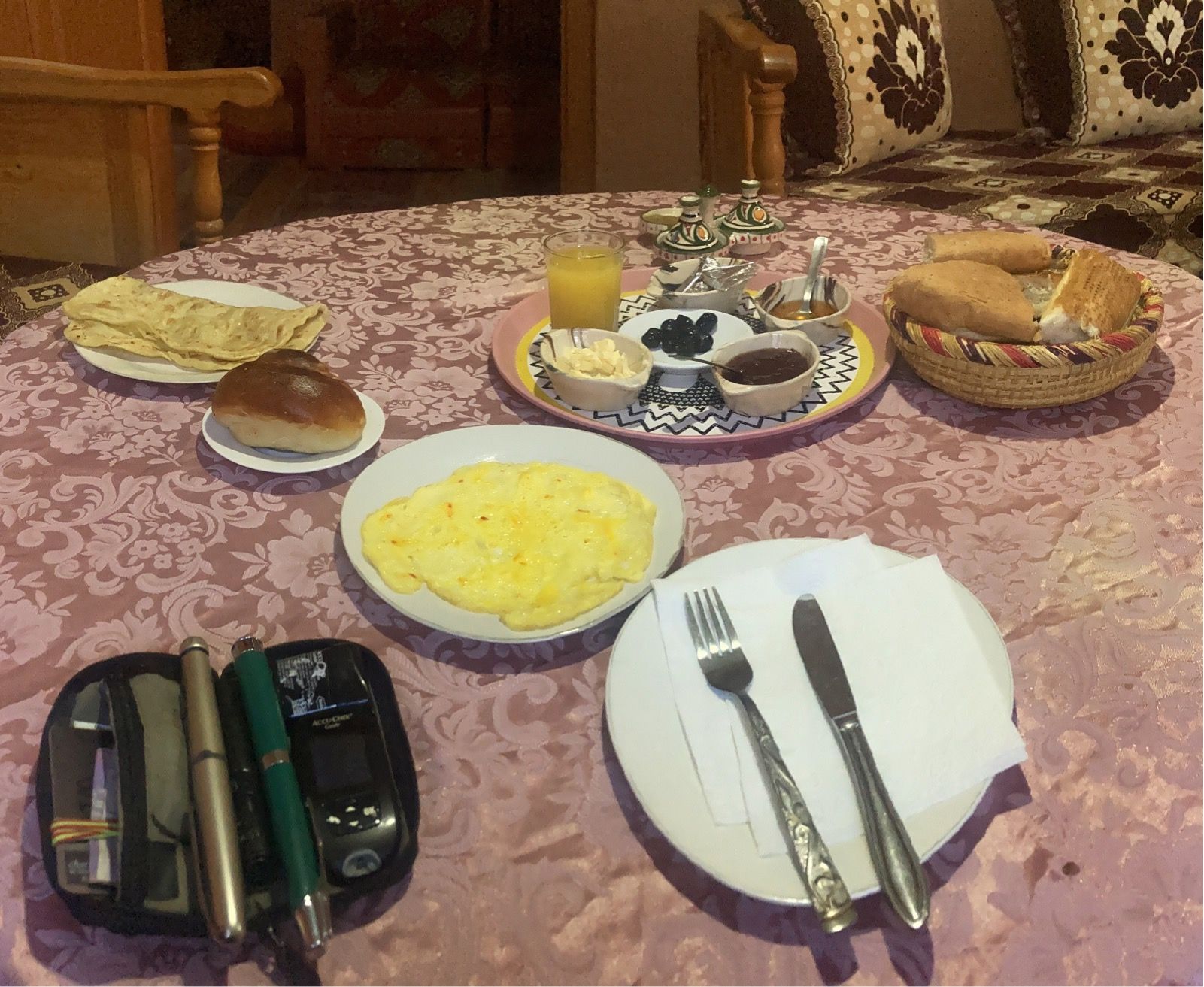


This seems to be a standard breakfast here. From top left clockwise: flat bread, tray of orange juice, olives, jam, honey, butter, a bit of processed cheese. Unlimited bread, Berber omelette, more bread

Strava Comments:


Mark G.

What a great day! Your knowledge of the variety of customs, cultures, and languages is truly inspiring

Boris F.

It’s okay to take day! realign, reset

Judy I.

When they list the things associated with longevity, social connections rate very highly. Taking time to talk to people is a good investment! The marriage route to citizenship is an interesting one. We have two friends who brought home Russian women they met on bike trips. One couple just celebrated their 25th anniversary and they are very happy. The other ones just filed for divorce and the man will likely take a big financial hit. You just never know! Glad you’re already taken! 😉

Ian G.

Interesting cultural history. Complicated

Ann L.

Nice way to emotionally recharge. The breakfast looks delicious.

Paula G.

The breakfast does look really good! I may start calling you ‘Father Brian’ because of all the religious teachings you are giving. Thank you, and keep it up. God be with you.

Janet W.

I’m not surprised you received a marriage proposal, but I’m glad you are happy with just one wife! You are getting immersed into the Moroccan cultures – more than one – and all of us are benefiting also, when you get motivated to study and share with us!

Ride Stats:

Elapsed Time Moving Time Distance Average Speed Max Speed Elevation Gain Calories Burned
01:13:26
hours
00:23:29
hours
2.40
km
9:48
min/km
5:48
min/km
21.00
meters
193
kcal


– Day 98 : International D Day [top]


No, it’s not International Dave Day (Dave Scheel’s birthday), today is international Diabetes Awareness Day. I’ve been patiently waiting to share a little nugget with you: Thanks to the tentacles of the internet, I had a “rare find.” Lukas Preiter is a young Type 1 diabetic. This alone isn’t TOO special because 1 in 300 people will get Type 1 diabetes (as opposed to 1 in 3 or even 1 in 2 who will get the usually reversible and completely unrelated type 2 diabetes). What is special, is that Lukas is bikepacking. Right Now. In West Africa. To Togo. He is ~80 days ahead of me, and although we have different routes, some sections are very similar. What are the chances of two type 1 diabetics cycling Western Africa?

Lukas is on an ambitious project to cycle to Togo, and when he arrives, he wants to test people there for type 1 diabetes by stabbing their fingers and making them bleed. He’s probably not going to win the popularity contest, but he is doing something good. He is raising money to help get people treatment, because in countries like Togo, Type 1 isn’t usually diagnosed; more often, the afflicted simply die of unknown causes from a condition that is 100% treatable. It’s an ambitious project for sure. Daily, I think about how a tiny raindrop of liquid means the difference between life or death for T1s. This is a link to his Instagram if you are curious about his project:

https://www.instagram.com/reel/Cxw2L5xNnzm/?igshid=MWMzODhndHNmZjk5Zw==

I really hope to meet Lukas in real life and I admire what he is doing. Hopefully he will still be in Togo when I arrive.

Rather than pummel you with stories about the hardships of being stoned, I’ll tell you about my emergency beacon saga. I arranged with the manufacturer to express ship a replacement 8 days ago. The device arrived in Morocco, but it has been stuck in customs for 4 days. I called Morocco UPS today, and the problem is that my name was not put on the package, and so I cannot pay the customs. This means that I need to have the shipper pay a fee to put my name on the package and then I can pay the fees. “This process should take just a few weeks,” the kind man said. At the moment, I’m at the place where the package was supposed to arrive.

I thought hard about this today. In 1492 when Columbus sailed the ocean blue, even the Queen (let alone his poor mum) didn’t know his position. Fast forward to today, and if the King of Morocco (Sidi Mohammed bin Hassan al-Alawi) felt so inclined, even he could flip on Strava to see where I have been galavanting around his country. Actually, I hope he does so he can tell Baba Nwel (Arabic Santa Claus) to give the rock throwing kids lumps of coal this Christmas. On second thought, make that soft coal. Strava would be a good fit for the king with the crowns and all.

Anyway, you have probably gathered: I have decided to push on without the emergency beacon. I have already spent enough money on shipping* to buy an entire village copies of “How to improve your aim.” Cellular reception has been good so far, and I’ll keep laying breadcrumbs on my tracker page from my phone when it has reception. I am aware that reception won’t be guaranteed due to frequent power outages in future countries on my list, but I’ll try to let you know ahead-of-time before I go into remote zones… like maybe tomorrow?

*update: I was not charged for shipping. Thanks, Bivy.


Photos:
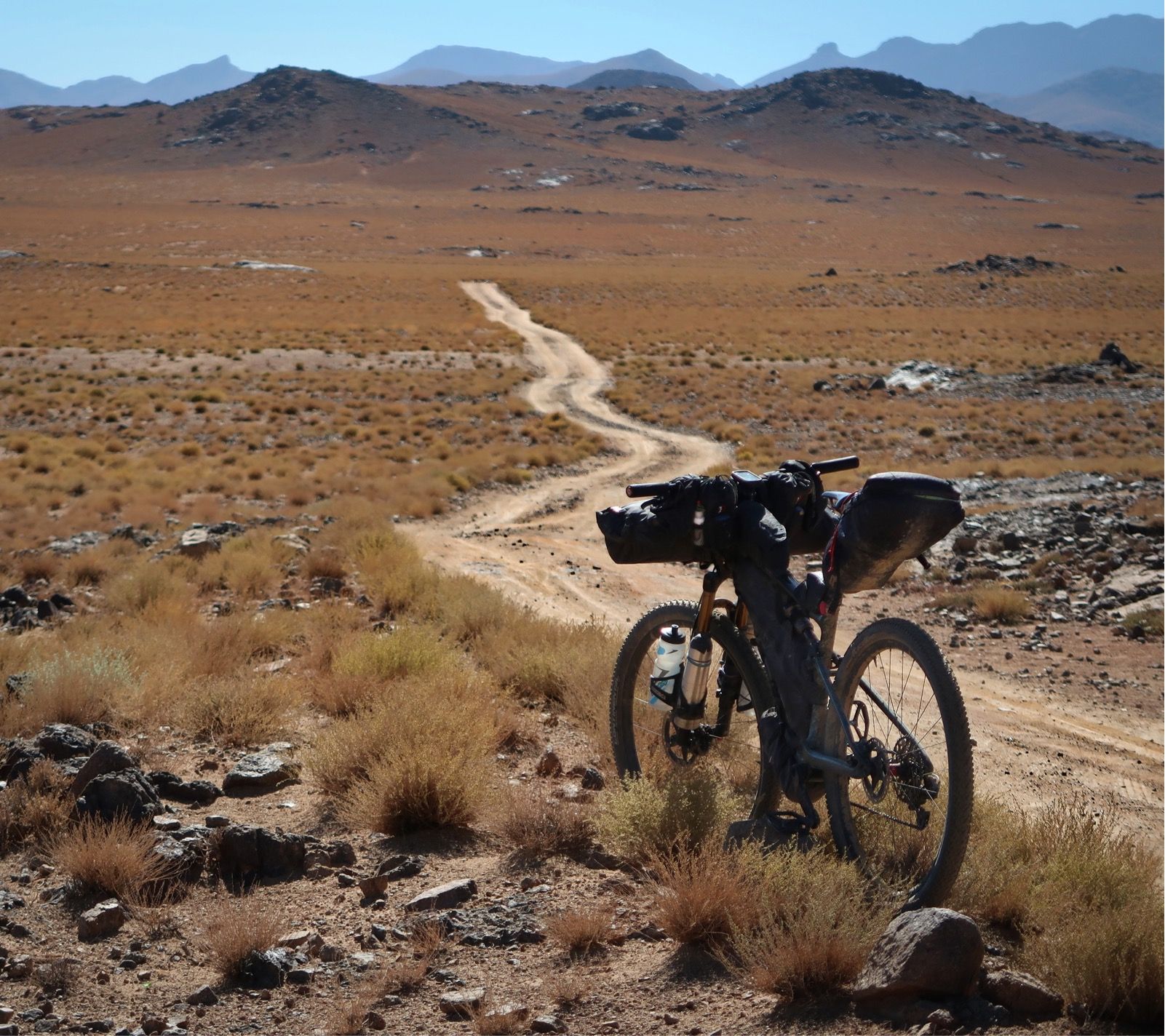


Good riding today. Kids are in school and I found a place with maybe no people.

I always like “the trades.” People who work and make things. Making stuff is as real as it gets.

I found a bike shop! Too bad I didn’t find it sooner – looks like there is a trailer back there for Mila. Wonder how she is. 😞 🐶

People often sell stuff out of their vehicles here. One cool sight: I have many times seen vans with full-on barista espresso machines set up in the back. Perhaps this is the Moroccan version of a tailgate party because alcohol isn’t allowed? I LIKE!!

I saw women sitting by side of the track with what looked like clear plastic water bottles that looked like they had been filled with milk. I would have liked to buy this! But given that I’m just getting over my stomach problem, I decided to play it safe.

Like we have trash day at home, it looks like today was propane tank exchange day out here in this very rural area. It leads me to believe that people have a decent standard of living. I want to emphasize that the kids who ask me for stuff all look healthy and well fed (just so you don’t think people are starving here; it’s not like that).

Camp tonight.

Hot off the press (after I made this post). The satellite communication device will be abandoned in Morocco. But Bivy made good on the fees. So, they are a good company, I think.

Strava Comments:


Paula G.

How could your name have been left off the package??? That makes no sense to me. Now I’m going to worry about you. Good thing you didn’t tell all of us about your journey ahead of time. I do love that the people are so friendly.

Chris N.

That welder’s eye screen is pretty sketch, but not unusual given the locale.

Carol D.

That was a big ride today.

Gary M.

No shit Chris Neary, long term eye health is most likely not in that guys favor. Also that container looks like it has a galvanized type of coating on it (hard to tell) which is highly poisonous without proper ventilation.

Janti of the J.

Chris Neary Gary Madgett at least his hair is short, so it will only catch a little bit on fire. 🔥

Chris N.

Gary Madgett, yep it’s galvanized. Good practice is to grind the coating off where welding will occur (improves weld quality, too). Excessive inhalation of zinc fumes will cause a temporary condition called “zinc shakes” Not fun

Braden L.

I’m picturing you in a full face helmet and chest protector. Maybe a bullseye on your back…good thing they are mostly off target 😜

Dave S.

Who needs a beacon? The stone throwers know where you are! Thanks for the shout out. BTW, I gave up getting stoned 25 year ago and I’m a better man for it. You should give it a try 🤣

Janet W.

We talk almost every day all about our days and I love it. When I look at your photos I feel like I can barely imagine what it’s like to travel in Morocco. It’s so different that California, which is why you are exploring and enjoying it! I always love the tent and road detour photos!

Ride Stats:

Elapsed Time Moving Time Distance Average Speed Max Speed Elevation Gain Calories Burned
09:14:27
hours
06:12:07
hours
112.78
km
18.18
km/h
59.23
km/h
1,382.50
meters
3,690
kcal


– Day 99 : Muad’dib [top]


Remember when you were a kid and you wanted to write a secret message to your friend? Maybe you made a secret code like I did where A=Z, B=Y, C=X… no adult could ever figure that out! Well, today I found the secret decryption code for sugar on the back of a 7UP can (see my photo). Up until today, these were “hidden sugars” for me! This is the first word I can read in Arabic.. well, basically I just look for the two “l” things at the end.

Every day, I feel like a child. I speak French like a child, can’t read like a child, stumble like a child with my weak Achilles, and I speak mostly to children. I am going backwards. Any day now, I am expecting my gray hairs to turn back to black.

As I exited the small grocery store with a can of mushrooms, a can of sardines, and a tiny nugget of expensive cheese, A woman and her son approached me close. Both made sad faces and the woman made the universal symbol for food by bunching her fingers together and tapping her mouth. Here I was, with food in my hands, and these poor people were hungry. Of my 3 items, I decided to offer them my can of sardines. The woman wagged her finger, “no.”

I should have known, a modern young mother; she must be worried about the BPA in the can or maybe the mercury content of the fish. I reluctantly held out the small piece of cheese towards them. This was to be my main source of calories tonight, but I was thinking it would be rude to offer the mushrooms. The mother wagged her finger again. No.

What, are they dairy free too?!

Here the son took over and pointed through the clear refrigerator doors behind me – at a 1.5 liter bottle of coke. The mother nodded in approval.

Hunger is no joke, but this looks more like a drug deal to me than hunger. If I ain’t eating sugar, kid, neither are you!

This gave me an idea… when kids ask for “Bon bon” (candy in French) I offer up a can of sardines instead. So far, I haven’t managed to give any out to my little trick-or-treater friends. Morocco is suddenly getting better as I learn how to make it work. If people are actually hungry, I can help them.

Speaking of making it work, I changed my route again today, and had a pensive and peaceful jaunt through the mountains. I have been brightening back up on Morocco. There are so many things to like about bike packing here. This rocky but quiet route gave me time to think.

But not as much time as you might think. I’ve become quite a busy correspondent, having added nearly one Moroccan per day to my contacts list. I stop riding periodically to reply to messages from some of the good people I have met along the way. Remember that young teen named Redwane that I met walking alone in the desert? I had asked him what he is studying, and he replied with this:

“Of course my friend,I study the course of poetry from the Abbasid era to our time, which has undergone a relative change in terms of content and form. As a weapon that the Arab tribes used to raise their value”

Ok, buddy! (I’m making the airplane flying over my head gesture since you can’t see me). I asked some more questions, and then shot his very polite replies to my friend Josh in Pennsylvania for decryption. Josh is a professor of Arabic philosophy. My 7UP can trick isn’t going to work here.

This brings me to my point for the day (yes, today has an actual point).

In Spanish, there is an adjective for our word “polite.” That word is “cortez.” It lives in the dictionary, but I’ve never heard anyone use it in a real-life sentence. Instead, in Spanish, to say someone is polite, you say they are “educado,” which means “educated.” It’s the same in Portuguese, “educado”…. And guess how you say polite in Arabic? “Maudib.” I did some research on this today, and “Muad'dib” means “a person who educates.”

I’m now riding along, juxtaposing Redwane with his slightly younger colleagues. The kids in these towns don’t need aid-workers who come and toss them pens, candies, and balloons like a rolling piñata. What they really need is a Muad'dib. A teacher. Pens, candies and stupid gifts are cheap and easy. Being a teacher, especially a good one: That is hard, and it’s a vocation I increasingly admire.

So, when a kid threw his shoe at me today (and hit me in the back) I turned around with the hopes of teaching him a lesson. He bolted up the dirt hill alone – wearing only one shoe. The other kids stuck around, ratting him out with their fingers – as if I needed to know which one was guilty. The kid vanished over the top of the hill. Man can these kids run. Today I failed as a teacher. But I commend all the teachers (and homeschoolers) out there. This is tough work. I call you Muad'dib.


Photos:
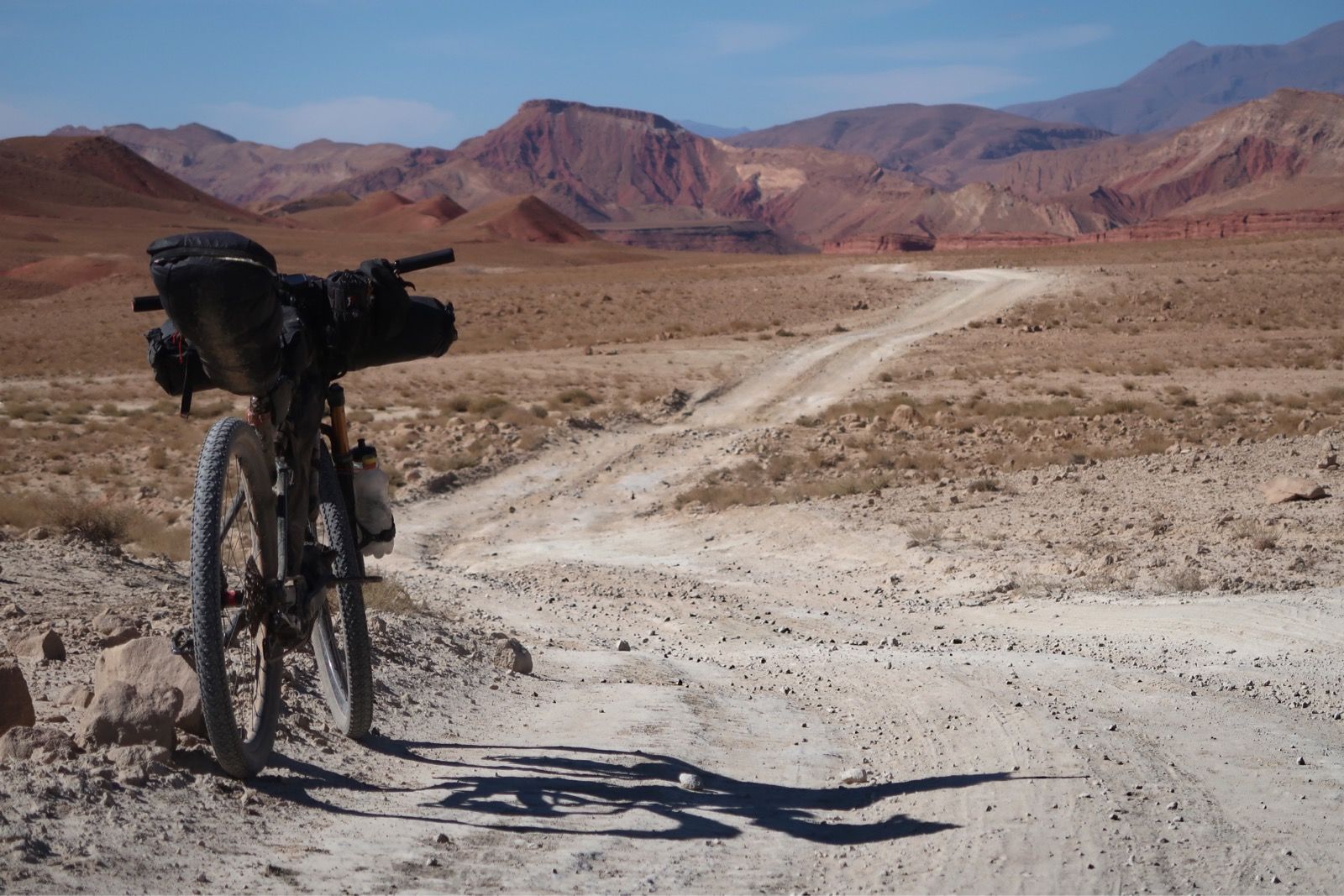


My favorite kind of riding. Just a few shepherds and the mountains.

It’s been harder to find water, but I do occasionally come across these nice faucets.

I headed to the Dades gorge today.

Secret decryption key found on the back of a 7UP can!!

My kinda road!

Meika and Milo want a dog. They are running a campaign to collect votes.

Camping at a campground again.

Strava Comments:


Ann L.

That is one fancy looking water spigot!
Such beautiful and serene scenery. I can see why you love it. I vote yes on a dog 🐶 for Meika and Milo too! Those puppies in your photo are really cute! Whose are they?

Aaron B.

Muad’dib is also a name for the main character in the sci fi classic, Dune, which resembles a lot of your geography lately!

Janet W.

Why is the carbohydrate key secret? You must look for that before you buy any can of soda. The red hills and canyons are beautiful, they do look like Sedona. You picked an awesome super remote route! I know Meika and Milo are almost irresistible with their requests for a pet, but I hope Mary and Steve say no, at least for now. On the other hand, since you are now a dog owner, maybe I will surprise you with a dog at our house when you get home!

Brian L.

Janet Wagner – I should have explained: that can was the first thing so far that wasn’t entirely in Arabic. It had both languages, this a translator.

Brian L.

Aaron Bickel – thanks for that comment. Did you read Dune? Isn’t it 1000 pages or something like that? Now I’m inspired to read it… or audio book.

Aaron B.

Yeah, I liked it a lot, but it’s pretty long and some would say it’s a pretty dense book. Could a fun audiobook during your travels!

Ride Stats:

Elapsed Time Moving Time Distance Average Speed Max Speed Elevation Gain Calories Burned
07:32:09
hours
05:27:33
hours
82.33
km
15.08
km/h
62.30
km/h
1,422.00
meters
2,917
kcal


– Day 100 : As Good As It Gets [top]


Today encompassed everything that is joyful about bikepacking. It was a long and remote stretch of grit, sand, rocks and chunder. Constant undulations in the terrain, keeping you guessing what was going to lay hidden behind each beautiful turn. Now that I have left the tourist trail, the few children of shepherds come running to see me; faces so innocent and sweet – not asking for candy – I actually WANT to give them something for being so good. But I don’t want to pollute this remote and pure region, so I resist any temptation.

Along the mountain-desert course, I found a few alcoves that were assembled from piles of rocks. Sheltered below, a jug wrapped in a wool blanket for evaporative cooling – with little cups nearby for drinking. Who left this? Morocco has Trail Angels leaving water! I got an idea. I left some money on top of each jug, even though I only took water from one of them. Daily, I’m presented with the opportunity to give, but here, the shepherds could probably actually use the money – unlike the acquisitive kids living well around the tourist spots. Plus, by leaving the money clandestinely, no one will associate the gifts with a tourist guy riding by on a bike.

How to give right; it swirls in my head all day. If a child makes a sullen face, IS it REAL? Do they deserve my foreign aid? Or do they already have a Palace Divine in their own back yard where they practice throwing rocks, hurting the innocent trying to drive them out? To whom should we give? It’s tough to navigate the complicated path of charity, giving, and foreign aid.

Sorry if I am talking too much about these decisions and charity and giving. It’s a big part of my journey, though.

Midway, I saw a low tent and pulled over to a place marked on the map as a “Gite”. A slender young man came to meet me. He said his name was “Brian”. I was floored to be meeting a Brian-brother out here in the middle of the desert, but we worked it out laughing: “Brahim” sounds an awful lot like “Brian” – even when you say it over and over.

Normally, I don’t accept prepared food, but I liked the vibe of this little tent in the desert. In our cobbled French and Arabic, he agreed to prepare a “Berber Omelette” – “tres chaude” (very hot) at my request. He rolled a propane tank down the hill to a covered kitchen, where he worked a bit with a young woman to prepare a meal. Out came the sizzling omelette. The omelette was spattering bubbles of aromatic oil all over the clay dish in which it was served. “assez chaud?” (Hot enough?) He asked with a big smile. “Oui! Oui! Je suis très content!” Later he came to show me some satellite maps printed on paper of the route I’d be doing. He only knew a few words in French, but we had great success this time with my Arabic app – probably because he knew to speak Arabic Arabic instead of Darija. He said, “it is an honor to have you here coming to visit”.

The name Brahim comes from “Abrahim” – it means “Father of Nations.” I hope that he fathers good people like himself.

I dig deep to ride the rocky trail to get to a place with food before dark. Just before dark I got to the pavement and found a smal stall by the side of the road. I asked for 3 cans of sardines by showing him one of the cans that I already had. He brought 3 different cans and I said I would take them all. This is when thing derailed a bit. He called his two friends over to help. Even though the prices had been written on a piece of masking tape on the boxes, they peeled them off and began to seemingly discuss the prices of each can, taking a few minutes per can. The friend would then tell me a price in French. On can was 6 MAD. The next can was 9 MAD. The other one wasn’t assigned a price, but all three were going to be 150 MAD together. I’m not the best at arithmetic, but I think there was a problem here. I decided to reject that very expensive 3rd can, and then they said, “no, no, ok”. All 3 cans for 18, which actually sounds reasonable. I agree to that, but they talk some more. I’m starting to notice these two helper guys with rotting teeth have very bad breath. Actually, it’s 20, he announces after a bit. I get my 20 out. It’s 25 now. Ok, I pull out my 50, hoping to escape the odiferous maw. 25 seems to be ok; he makes the change, and gives me 22 in return for my 50. I look him in the eye, and he finds another 2. Welcome to Morocco!

🇵🇸


Photos:
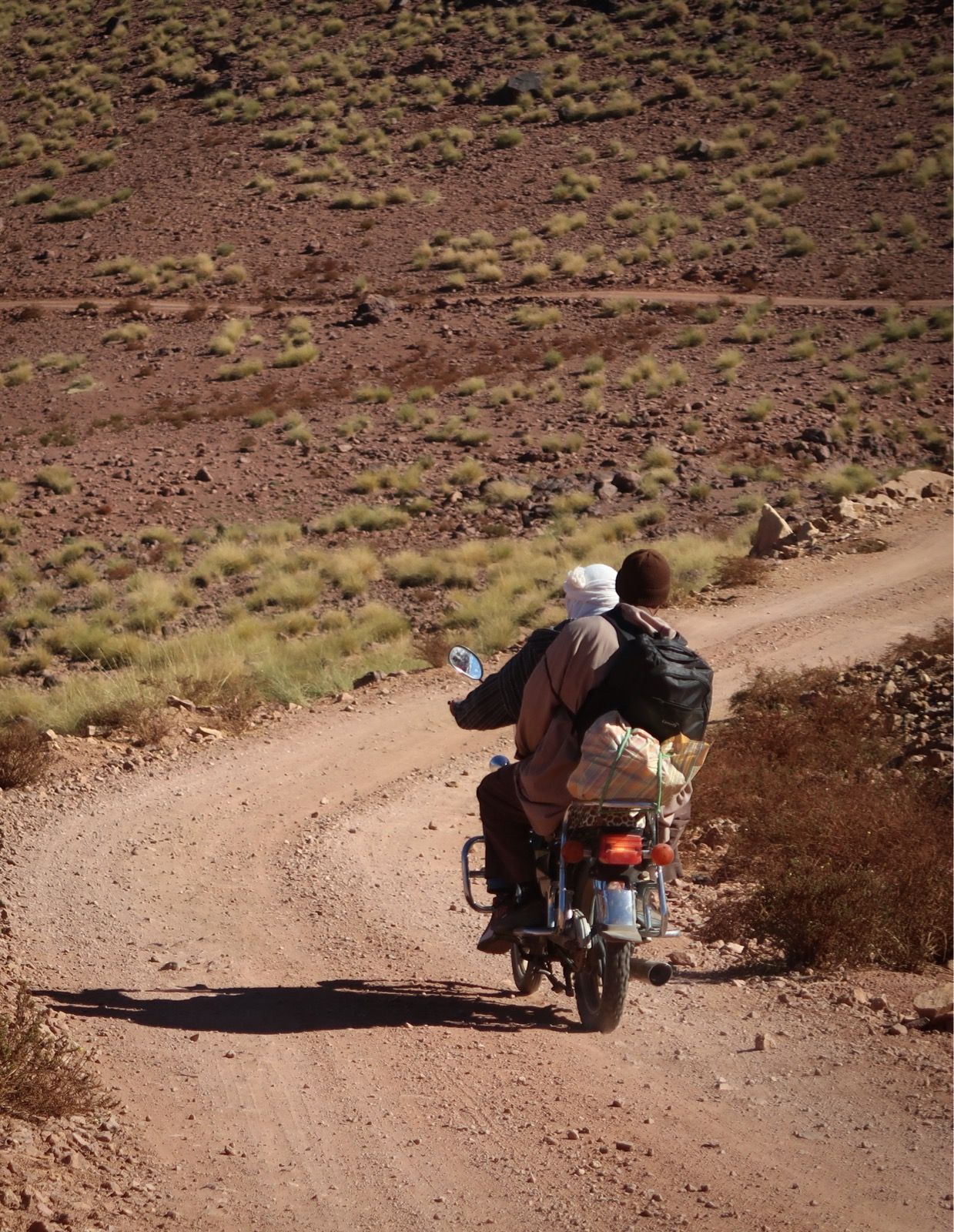


In the first 60 miles, just 3 motorcycles went by.

Lots of big climbs and descents.

The omelette brought to me by Brahim.

Brahim.

I wish I could upload this ride to your mind. It was exquisite!

On the other side of the mountain, it is different. People are different too. Will have to tell that later.

Finally got to the road and saw… Bike lanes?!? Normally this would be good, but a Slight fear of tourism (trained kids) kicked in.

An example of the water jugs where I left money (this one was not on the mountain, though)

Video showing how it is.

At least the camp site is nice!

Strava Comments:


Mark G.

Very nice campsite view. One of my favorite movies(because of the premise) is Brainstorm. In that movie they do develop a way to record experiences and then share them with friends.

Gordon L.

Your photos do convey some of the beauty and challenge of the trails, but undoubtedly it was much more so when actually there. Glad you had such a great day.

Tracey A.

I just love the shower!
You are having such an adventure and it seems that you are no longer sick! That’s a blessing in itself. ❤️

Boris F.

I like the thought put into giving, so that is has meaning. Looks amazing there!

Janet W.

I liked the shower video, but not the idea of using the shower. I love your stories and your finding peace with deciding when to give or not. My favorite is your campsite photo! What a view and what beautiful desert experiences especially with Brahmin at the lunch tent 🏕️

Sօʀƈɛʀɛʀ 🅅.

Look em’ in the eye and get your change back!

Jennifer G.

What stunning scenery! Brahmin’s meal looks fantastic. And I like your secret water fairy story.

Warren G.

Wonderful landscapes & stories!

Ann L.

That omelette Brahmin made you looks very delicious. You are meeting so many interesting people!

Tony B.

I like your judicial decisions about giving money! Without being too political… we could use some of that decision making in our country. Love your campsite. Look forward to seeing your daily adventures. I’m enthralled.

Mark B.

You were so gracious with handsome happycat Brahim’s hospitality when it came to food & shower. Yur pics of him & his feline (probably his only abiding companion amid all the humans who come & go) also lend poignancy to his story.

Stan H.

Ah but you are uploading your rides to our minds! And our imaginations fill in the rest! And that is a gift you give us, since we have pens and candy.

Brian L.

Tony Ballard – no worries at all about politics. You might be the only one who caught my allusion to this topic in the write-up. I feel like there may be some parallels between the poorly thought out giving by tourists here… and the situation to which you refer.

Tony B.

💯 🎯 very observant.

Ride Stats:

Elapsed Time Moving Time Distance Average Speed Max Speed Elevation Gain Calories Burned
08:45:07
hours
06:06:26
hours
107.24
km
17.56
km/h
51.44
km/h
1,645.90
meters
3,657
kcal


– Day 101 : Thumbs Up! [top]


It’s a completely different Morocco now.

Oh how sweet it is to be off the tourist trail this morning. Today while I was eating yogurt, several women carrying sticks on top of their heads stopped to talk. The eldest woman reached out her hand, motioning towards my 2nd unopened yogurt. Her manner seemed different than the kids, so I handed it to her. She examined it carefully, rotating it like a Rubiks Cube. Her hands were covered in light brown tattoos – maybe henna. It almost seemed as if she had never seen a yogurt cup before, and after some careful thought, she smiled and handed it back to me.

The younger bespectacled woman looked to be in her 30s. She looked like a black mother of Jesus with a baby blue head covering. Her name was Dariya, and she smiled brightly trying to say something. I pulled out my phone, and as soon as the older women saw it, they recoiled rapidly as if I were wielding a light saber. They bumped into each other like clumsy new born puppies, somehow managing to maintain the balance of the objects on their heads. I’ve noticed this almost every time I withdraw my phone… and I know why it happens: the camera. I always make slow movements and hold the phone flat in my palm as I show it – at attempt to signal that I’m not trying to steal a photo – but the reaction still happens.

I would love to bring you photos of these people and their attire. The men and the women all have such unique dress. In each town, the women dress very differently… but more on that later.

I held my phone towards Dariya so she could use the translator. She grabbed my flattened hand with the phone and pulled it close to speak boldly into the microphone. I resisted the temptation to jerk back. When would she realize that men and women aren’t supposed to have physical contact in public? She didn’t let go until she finished speaking. Just to be safe, the next few times, I just handed her the phone… but I realized that not everything you read online about Muslim culture is correct. (I think it is safe to assume they were Muslim, as all were wearing the Hijab). This makes me feel better, because a big mistake I keep doing is pointing with my finger and also using the thumbs up gesture. I read online that this means “up your butt!” – so I was a bit relieved to see Brahim also giving me thumbs up yesterday… (and, no, you snarky commenters, he wasn’t trying to say “up your butt, Brian”).

Dariya concluded our conversation with “May God bless you; happy to meet you; God bless you”

Speaking of yogurt, now that I know the secret code for “carbohydrates” I always get the sugar-free stuff. Each time I withdraw the yogurt from the (rarely cold) fridge, a big ruckus ensues. I was warned three times today alone, “n'y a pas de sucre!!” (No have sugar). This became story-worthy when one guy today rushed out from behind the counter, grabbed the yogurt from my hand in a panic, and replaced it with a sugary one from the fridge. “Sucre! Sucre!!” He exclaimed. What is it with these people and sugar? I swapped it back and showed him my finger stabber as if that were an explanation. He nodded in understanding. Perhaps this is also why the Rubiks Cube woman returned my yogurt cup – maybe she wanted the sugared kind.

Powered by yogurt, I met another Mohammed (not joking) on a bike. He rode alongside me; he was moving quickly and asking questions. In minutes, we were in a pack of school children – all riding their bikes to school. There were bicycles everywhere today! Our co-ed peloton consisted of 20; I got the feeling that Mohammed was showing off his “new friend” to his classmates. They were all friendly, using the few polite French words they knew. Then we came to an incline, and Mohammed said something that sounded like “see Bob!” I had no idea what that meant, but he gave me the Lance Armstrong “look” and I knew it was race time. He narrowly beat me to the top with my 80% effort. Ahhgh, Achilles. Whether it be my niece and nephew on the slip and slide, or Moroccan children on bikes, kids really know how to break me to pieces.

I’m not exactly sure how the school schedule works here. Sometimes I see kids in school. Other times, across the street from the classroom where I see kids studying, boys are leaning in the dirt, playing with bikes. I stopped to help a kid named Ali with his broken derailleur. I know that some of my audience isn’t familiar with bicycles, so let me anthropomorphize the condition of this machine: This bike would be a cancer survivor who decided to do one more parachute jump, but as he did, he had a heart attack on the way down because his chute didn’t open. He happened to crash in a mine field, and in spite of several exploding on him, he managed to crawl to a town, and became this kid’s bike. I surveyed the patient, recognizing that there were a lot bigger problems than just a broken derailleur, but I gave Ali my tool to work on it. He quickly figured out the screwdriver part, but I had to put the pulleys in and thread the chain correctly through the assembly. I went to my bike to give him a replacement nut that I saw was missing, but then they found the original in the dirt. Upon completion, he jumped up, magically rode a brief circle, came back smiling and asked me for a Dirham for helping him. Ok, it wasn’t all good today, but I’m glad I kept my spare nut now.

Further South, the dress changed. You probably already know what hijab 🧕 is; it’s a general term for the covering over the hair in the Islamic world. In this Southern reach of Morocco, I began to see the more strict “Burka” This attire makes a woman look like she is piloting a tank. You know there is a little person inside because you can see two eyes peering out the thin slits like a periscope. Because they look like artillery tanks, you don’t expect them to be friendly, but plenty of these obfuscated women waved at me today; I have no idea if they were smiling.

All in all, it was a great day. Hot and dry. My only complaint is my Achilles, which continues to nag… and the omnipresent wind from the South West. Historically, wind should be coming from the North, but apparently Qebui didn’t get the memo. 4th night camping under starry skies.


Photos:


If you guessed “Mohammed,” one pen for you!

Riding to school with the kids. At one point, we became an echelon peleton of 20 or 30 kids (and me).

Bikes everywhere today.

Helping Ali work on his bike.

Opted for more pavement and less dirt today. Zero cars and my bike was a creaking wreck after All the dust yesterday.


Strava Comments:


mary P.

I look forward to your days accounting.

Dean G.

I imagine the stars at night must be incredible

Tracey A.

I’ve really been enjoying all of your stories and am finding I can hardly wait for the next day’s episode! 🥰

Janet W.

You have really traveled a long ways to the south, almost to Algeria! It’s interesting how the people look different now, comparing Brahmin from yesterday and Mohammed today. It looks like the “hang loose” hand sign is positive! Have you tried using that yet? I hope you can find a good campsite tomorrow and stop early to get more rest. Love having video chats everyday!

Ann L.

I amazed to find out even the invisible Brian has an Archille’s heel. Hope it gets better soon. Such interesting stories.

Vicki C.

Glad you had this day! Wishing more with friendly faces and maybe a bit more rest for the achillies

Mark G.

Wow! Wow! What a day…and LOTS of mes too. BTW do all those street lights work? Mohammed seems to be dressed for a cool day. Thank you for the photos of the day and camp

Sօʀƈɛʀɛʀ 🅅.

Enjoyed the story of the sick bike repair and a bike sprint race.

Ride Stats:

Elapsed Time Moving Time Distance Average Speed Max Speed Elevation Gain Calories Burned
09:27:44
hours
06:37:46
hours
143.34
km
21.62
km/h
47.73
km/h
563.80
meters
3,174
kcal


– Day 102 : Camel Time 🐪 [top]


Morocco is many different countries in one; today I began to dip into to the edge of the Sahara desert. This is just a sampler because after this, I’ll head back up to the last mountain range: The Anti Atlas Mountains. So far, you have joined me for the Riff Mountains, the Middle Atlas, and most recently the High Atlas. After the Anti Atlas, we will be taking a break from mountains for an incredible 1900 miles.

Thanks to those who have written me personally about Algeria. To assuage your concerns, even though I can see their land from here, I’m not crossing that border. It may surprise you, but Algeria and Morocco have exactly zero open land borders since 1994. This is from the aftermath of “the sand war.” People can find all sorts of things to fight over, huh? In spite of this rivalry, I did have quite a bit of interest in visiting the Northern portion of the country (the South is mostly just unrideable sand dunes like I’m experiencing here). An American can request a visa for $250 USD, and it seems like if you get the visa, you should be able to travel independently (without a tourism operator). Even though I have been amongst Muslim people for over 2 weeks now, I continue to be interested and curious in learning more. You will notice I haven’t mentioned much about the various permutations of the religion yet – I’m still working out my thoughts. Anyway, Algeria was on the list, but it slipped down a little bit when I learned that they banned the Barbie movie. I’d been meaning to see that.

Today is a good opportunity to talk more about the ride instead of the people. I spent almost the entire day alone in the desert – pushing my bike through deep sand in places, but also happy bumbling around at a rapid 10 mph over washboarded and rocky tracks. It’s only been 15 days, and unbelievably, I’ve done less than a third of the miles I have planned for Morocco. The subsequent miles promise to go faster once the terrain gets flatter (and hopefully the winds come from the typical North/East).

So far, I can recommend Morocco as a bike touring destination; the drivers are good and even paved roads are usually empty. The drivers have a penchant for driving in the middle of the road. This is perfect when they are coming from behind, though a bit less desirable when meeting them head on. The majority of people have been friendly and welcoming. Morocco’s economy benefits greatly from tourism, and you can see that many people are doing well “enough” – though it could always be better. Many locals know this and treat tourists very kindly. In the epicenter of each touristic spot, the kids are well behaved; it’s just the surrounding “sphere of influence” where I encounter the problems. Conversely, tourism is practically non existent in Algeria – quite likely due to the fact that their economy is supported by oil money. For this reason, I suspect I would really like it there a lot.

You have a multitude of route choices until you get to the Sahara – and you can “choose your elevation” based on the temperature and time of year. November is turning out to be a good time here with night temperatures of 30-45F. Day time temperatures are 80-100F – but it’s a dry heat, so tolerable by me while moving.

Cycling is “easy” in Morocco in some ways. Lodging – ranging from camping to luxury accommodation – is available in many places – even tonight in a seemingly remote corner of the desert, I can “camp” in a so-called Berber tent with water and they will serve me food. I say so-called because Berbers are not ONLY nomadic people. Did you know that Ramesses II, the third Pharaoh was Berber? Interestingly, the Berbers were originally Jews or Christians, but once they were conquered by the Arabs, they converted to Islam. There are about 35 million people who call themselves Berber, the majority live in Morocco and Algeria with a 2/3 1/3 distribution respectively.

“Berber” comes from Greek and means “barbarian.” Like many historical names nowadays, there is a trend towards using the name “Amazigh” which means “free man” – probably referring to the nomadic roots of these inhabitants of Northern Africa. I had a pie-in-the-sky idea that I would meet some “real” nomads in the desert and join them for tea in their tent. But guys, it’s 2023 and you gotta fake that stuff now. The real nomads are probably distanced from anywhere I could ride a bike with 2.1” tires. But that is Ok. I’m going to have dinner now at my luxury camp in the desert, look at the stars, and enjoy the Pink Floyd music emanating from the tent of the only other family here.


Photos:
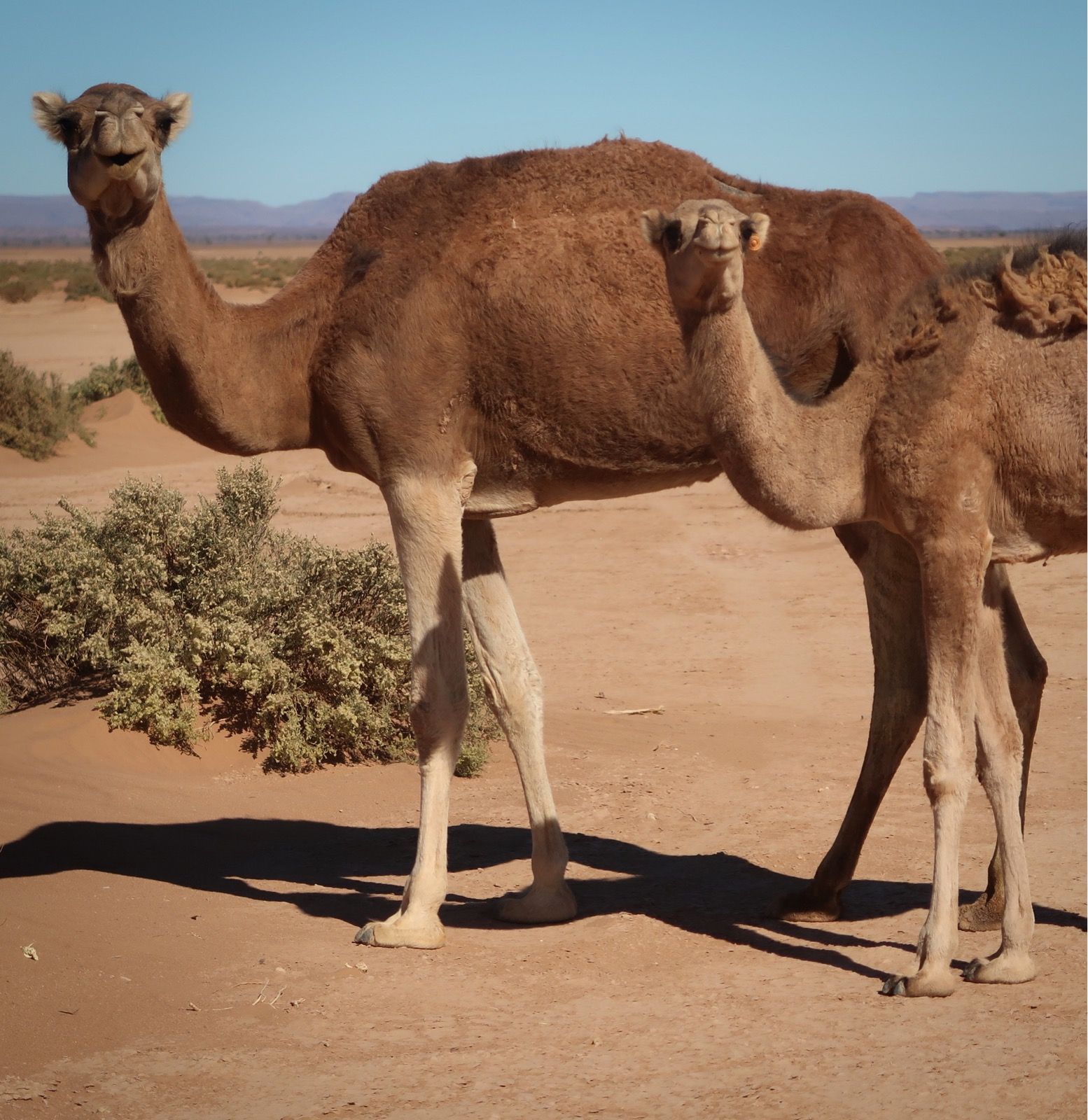


I saw camel milk for sale today! I’m excited to give it a try – some weird internet people said it cures diabetes 🙄. Don’t say I haven’t tried everything! Anyway I was happy to be able to just ride up to these camels. I thought, “wild camels?!” But then I saw the pink tag in the ear of the little one. So maybe these belong to someone.

I want to see the Barbie movie, but might have to wait until I get home.

Today, there was some pushing.

It got up to 100F today (on my non arm-protected GPS). Last night it got down to 44F. How is that for a swing? In the heat of the day, I saw these “leaves” but then realized it was the soil peeling up.

Did I mention there was pushing?

Glamping! Even you might think it is glamping. There is electricity (night only) and they brought me this tea WITHOUT sugar and WITHOUT me asking. Just so you know, the usual amount of sugar added is all that to a small cup. Really.

My tent got bigger! It’s touristic, but I’ll take it. There is water here. There is one family and one couple here besides me.

View from “camp”.


Strava Comments:


Ali G.

Great pics!!!

David L.

Not much of of a road in places…are you using gps mapping to stay “on track?”

Ken Kienow // A.

You’re on flats! Is that new?

Janet W.

Laura and I found your camp, Erg Chigaga, in Google Maps. You must have been happy to see this oasis in the desert after 50 miles of sand and rocks. I’m enjoying learning so much about Morocco from you stories, and our nice video chats! I toasted the vine yellowed old eggplants from our garden and they are delicious!

Boris F.

I applaud your moxie. remote stuff!

Judy I.

I love how travel expands and shrinks the world at the same time. The desert is endless, yet your tent neighbors are playing Pink Floyd. I once sang along with the locals to Bob Marley in a village in central China. And so many people from different countries have sung “Hotel California” to me when I tell them where I’m from! 🤣 (I can think of worse associations!) Loving your journey. Hope the camel’s milk works! 😉

Dean G.

You could slip in a photo from Mars and I don’t think I’d notice.

Tracey A.

What a wonderful camping spot and Pink Floyd makes it perfect.

Tony B.

Another amazing story! I hope your Achilles is ok with pushing a bike through the sand. Seems like it would bother it. I find your travels and stories very fascinating. I think I’ve said it before but it bears repeating!

Ann L.

How cool to just come upon a couple camels! So interesting they banned the Barbie movie there. Glad you had a nice camp to rest at after pushing your bike through sand earlier.

Scooter R.

Wow! What an epic adventure! Love the videos. Curious how you are route planning, Brian. I noticed you passed through a Strava segment today. Btw – A typical camel can drink 53 gallons of water in three minutes! I guess you are carrying a bit less than that 😉

Nancy A.

That’s a lot of sugar lol. Sand dune pic is beautiful

Gordon L.

Amazing experiences and photos

Jennifer G.

Beautiful pics and stories, especially making the camels look cute.

Paula G.

Funny how everyone interprets ‘beautiful’ differently. You say it is beautiful there and you are loving it. The desert looks so endless and deserted. I find mountains, trees, bushes and water so much prettier. I’m so happy that you are loving it though. I wonder if it was ‘dark side of the moon’, that you heard from Pink Floyd. That would scare me if I heard it at night.

Mark G.

Thank you for the videos – really nice to see your smile and get a virtual feel of the terrain and the experience. That glamping tent is primo…I am wondering if the other family is on a vacation… traveling

Sօʀƈɛʀɛʀ 🅅.

Where’s Brian now? Waaay way out there!

Ride Stats:

Elapsed Time Moving Time Distance Average Speed Max Speed Elevation Gain Calories Burned
07:35:59
hours
05:23:08
hours
83.50
km
15.51
km/h
54.17
km/h
1,177.00
meters
3,026
kcal


– Day 103 : The desert is always browner on the other side [top]
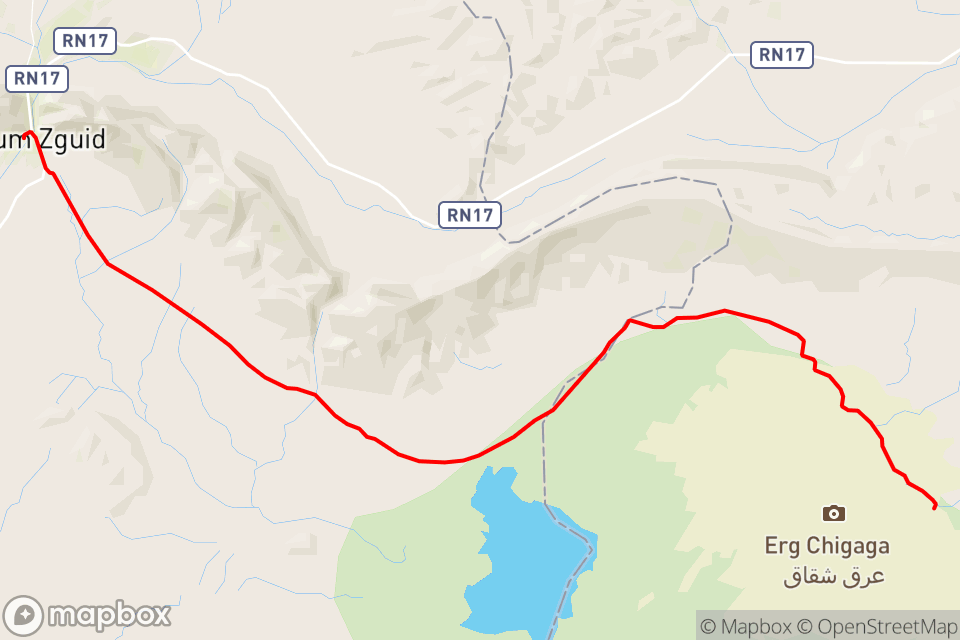

Although I laud the bicycle in how it connects me with the locals (people see me and want to talk), a bicycle can also be pretty isolating. Last night, besides the one small Moroccan family playing Pink Floyd songs, there was also a new couple near me. I knew they were “new” because Ted kept touching Celina after pretty much anything he said. They had met in bible study during COVID – so that means online, kind of. They have been together almost a year. He had worked at Stanford at the linear accelerator, but love (and 12x more paid vacation) brought him to Germany. We sat on robust pillows set on rugs under the gleaming stars; our amazing dinner illuminated by flickering candle light. It was wonderful to speak English, laugh at jokes instead of awkward moments, and swap stories. We talked for hours. I let loose and ate the potatoes and cold eggplant, dosing insulin to the hilt and my mouth burning from my eggplant allergy. Ted may have something a bit more challenging than me: a nut allergy. He had his epi-pen out and they confirmed over and over that the food had no nuts. He said, “if I eat nuts, EVEN WITH the EpiPen, I still need to go to the emergency room.” I could see why they confirmed 20 times with each dish, because as glampy as this place was, emergency services were not on the menu. He said, “I’ve almost died 6 times, but each time it is a little less scary.” To this, I could relate.

But back to the isolating part of bicycle touring. I don’t mind this too much, but I notice it all the time. You ride your bike for hours every day – sometimes mostly in solitude. Once you arrive at the destination, you’re often too tired to do the main attraction. At the Erg Chegaga dunes, the two things to do are to sand board down the mountain, and drive around in an ATV. After a long day of pushing a bicycle through sand, the idea of walking up a sand mountain to slide down doesn’t have that same type of appeal. I’m OK with that. The isolating part is that after these trips, people ask, “did you X, Y, or Z?” It’s nice to have some “common ground” to discuss… but no, I didn’t do the ATV, the camel ride, or the sand boarding. “Well what did you do then?”

Well, how about I tell you what I did today!

I started in the cold morning, pushing my bike through sand for two hours achieving nearly 9 miles in that time. Breathing was measured and through clenched teeth to avoid inhaling the flies which were taking lots of little walks around my face like it was an amusement park for flies. They wandered around the edges of my mouth and eyes. Dozens of flies would ride on my body as if I were some sort of desert-fly Uber. No, they don’t leave tips – just annoying tickles. Public Service Announcement, flies: You have wings. My land and sand bound body is not the best way for you to get somewhere. Every time I stopped, I became fly headquarters. This led me to wonder: does every cubic meter of air have 50 flies buzzing around, waiting for me to arrive? Do these flies follow me after I swat them all off and ride away? How do they universally appear just one second after I stop?

I saw no people or cars for many hours. Then, on the horizon, a slow moving motorcycle appeared. Something was moving up and down on the motorcycle… it was Fabian – on a bicycle! My third cycletourist encounter of the trip! The first words out of his mouth were in English, “That was just some of the best riding I have ever done in my life.” Fabian was one of the very few people I’ve met while traveling who I immediately knew I liked a lot. If we lived in the same town, we would be best friends, seeing each other every day. I liked His glowing and happy demeanor. He said he was from the Dolomites, born of Italian and German parents, “but that’s a long story, so it’s all I’ll tell you now.” We talked and talked, and on several occasions, he apologized for his bike-nerdery. I guess he didn’t know who he was talking to. Luckily, he has a WhatsApp. I think that he too has a good section ahead of him.

Many hours later, I met two men waking 3 camels in the desert. One man spoke a few words of each French, Spanish, and English. He tends to “chevre” 🐐 (he went “baaaaa” to make sure I knew that word). He sometimes takes tourists on the camels too. He asked me if I had seen the other cyclist (Fabian). Wow, that was hours ago! If you think pushing a bike through the desert is slow, camels are slower. They seemed like they were truly equipped to be out in the desert for eons, and judging by the wrinkles on their faces, perhaps they already had been. I’m starting to look like that.

Finally, a cell phone tower appeared on the horizon, meaning civilization was ahead. In town, I had a great time chatting with the owner of the only open store in town. Many men came inside to get in on a part of the translation business with the stranger – each helping with whatever words they knew. The shop owner got right to business: “What do you think of trump?” The men all leaned in to see my response, suddenly intensely quiet. I gave a thumbs down, reflecting not only my opinion, but what I also thought was a safe bet. Wrong! I bet most of you guys don’t know this, but there is maybe kind-of a country just South of Morocco called “Western Sahara.” I say “kinda” because Morocco thinks this land belongs to Morocco. Other countries recognize the independence of the Sahrawi people who live there. Guess who recognized Western Sahara as part of Morocco? Mr. Trump. And Biden is trying to reverse that, which is why the guys on the store eagerly gave Biden a thumbs down! We all laughed; it was in good fun. But now I know that I’ll be safe giving Trump a double thumbs down after I cross the next border!

All in all, this was a great two days of very challenging “riding”. If I were to do it again, I would come back on a full suspension, coil spring fat bike and ride the sand instead of the rocks. Of course, I think that because that’s exactly what I did not do. The desert is always browner on the other side.


Photos:
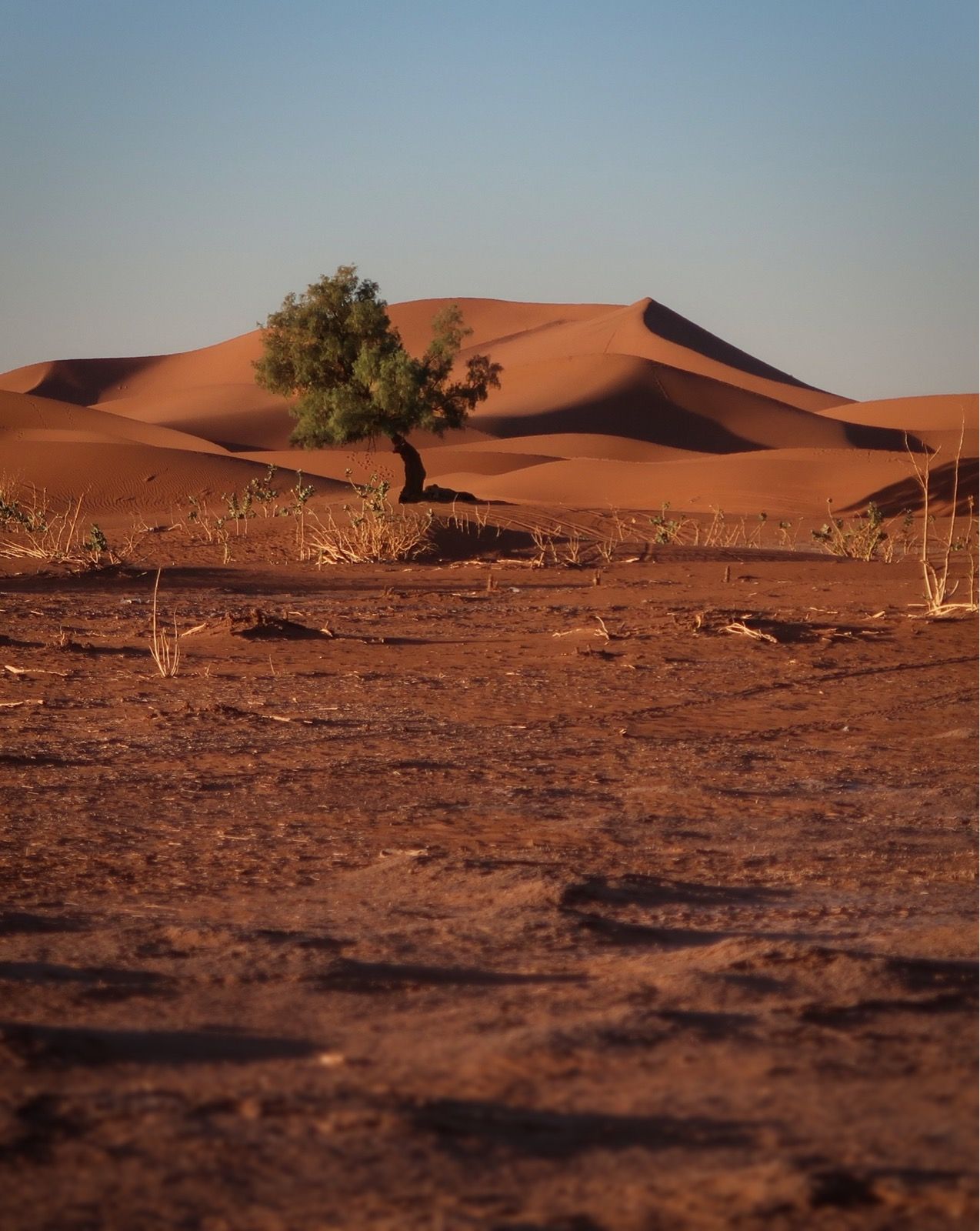


Cool and beautiful in the morning!

Explaining the route.

That is a gazelle over there!

Discussion of Fat Bike joy.

Zig zag!

The yellow brick road.

Fabian with his long haul trucker.

The last 20 miles were almost entirely on what I assume were camel trails. I had planned to ride the “road” but this was much easier.

I found another well. Didn’t actually need any more of the water that tasted like it had 5tbs of baking soda added… so I fetched a pail for the thirsty looking donkeys instead.

These guys are prepared for desert life!

Some boys outside the store said, “monsieur ! Puis-je le vélo?” As they made the pedaling motion with their hands. This is my kind of thing! They all took turns riding my bike, and then when I pulled out my camera to photo them on the bike, they all wanted photos of them making peace signs. No talk of pens or candy. They loved the bike and were intrigued by the suspension. Happy times.


Strava Comments:


Mark G.

Another great day in The desert. It is interesting what qualifies as a road; pretty cheap to build those desert “yellow roads” I suppose without GPS it would be like back in the day map reading and compass work.

Boris F.

Makes me want to write more – very good!

Carol D.

“Emergency services were not on the menu.” Such clever writing Brian. Both of you on your dietary limitations/ recovery needs!

Ann L.

Amazing how different life is there, donkeys and camels randomly appear. Sounds like you and Fabian are kindred spirits. I’d be afraid those kids would take off on your bike and keep going. Glad that is not the case, they are just curious to ride it. That last pic looks like Oh Little Town of Bethlehem with the stars ⭐️

Tony B.

Watch out for trick questions about American presidents. Politics are always a touchy subject no matter what country you are in.

mudworm ~.

Your story telling never disappoints, Mark Twain… sorry, I mean, Brian Lucido!

Janet W.

Did the donkeys drink the water? I hope so. And glad you got 2 big bottles in town to gulp down. The videos really add to your stories, like “what it was like out there”. I still can barely imagine it, but I’m glad you are. It suits you! Miss you but love our daily chats!

evan F.

Thanks so much for taking us along!

Paula G.

I hope you and Fabian stay in touch. Who knows, maybe he will show up in CA some day.
Your perseverance pushing through the sand amazes me!

Sօʀƈɛʀɛʀ 🅅.

Great write up. The prose about the flies was funny to read, but obviously not to experience.

Scooter R.

Amazing. Thanks for the route finding video. Maybe the yellow bricks aged into brown sand.

Ride Stats:

Elapsed Time Moving Time Distance Average Speed Max Speed Elevation Gain Calories Burned
08:59:14
hours
06:12:54
hours
91.18
km
14.67
km/h
32.63
km/h
1,280.00
meters
2,554
kcal


– Day 104 : Seeking Yoda [top]


“Voulez vous une pain?”

“Oui!” I reply, and he reaches into the big plastic bag to produce a round bread that looks like a personal pizza crust – without any topping. He slaps it on the dusty counter, squishing at least two flies in the process.

“Autre chose?” He asks.

“Oui, 200 grammes d'amandes,” I reply.

He digs his cracked hand into the bag of almonds and measures them carefully on the scale; approximately 200 grams worth.

This is how I get my food each day, over a counter top. If you use hand sanitizer, you’re going to need to bring the Extra-Strength stuff to Morocco. It’s the antithesis of Spain, where customers were not allowed to touch the produce – you had to find an assistant to don gloves, then weigh and label your veggies in the produce section before you brought them to the checkout. That sort of hassle made me eat fewer veggies.

Once everything is piled on the countertop, the calculus begins. And it IS calculus.. I watch as they punch numbers, making good use of every available button on the calculator: The multiplication symbol, the division symbol… the AC button is a frequent favorite. Eventually the calculator is held towards me with a surprise number each time. Usually it is much higher than I would have expected; sometimes it is lower. Usually I just pay it, but today I questioned the numbers. The man had also written some numbers down on paper, so I asked, “How did 68 on paper become 84 on the calculator?” He explained that it was simple, “I used centimes”. I figured this was some previous Moroccan currency with an exchange rate of 1.2, so accepted his answer. Later,I looked it up later on Google. No, that word means “cents” as in: There are 100 cents in a dollar. 🤔

The first part of my ride was on an extremely rocky road. If you’ve ever been to the Irish Hills, imagine the rockiest section of that. For 30 miles. When I finally got to the road, the military had closed the next section of trail. Good riddance, as I had been thinking of taking the road anyway. This must be Morocco’s Area 51, or baring that, the place where they keep the alien bodies and the cast for Star Wars.

Todays ride definitely looked like the set for Star Wars. For the first time, I noticed that these camels looked just like At At’s. The day I arrived in Morocco, I thought that the men with the long hooded robes looked like Obi Wan. I looked it up, and yes, Star Wars even integrates elements of Islam. The name “Jedi” comes from “Al-Jeddi” (Master of the Mystic Warrior Way). I even rode by a town last week with a name similar to “Tataouine”… well, heck, tonight I’m in Tata, which is kind of close. I’m waiting for a Jedi to appear. Hopefully it will be Yoda; he’s my favorite.

Speaking of Yoda, I figured out a way for you to remember the capital of Morocco today. Do you already know the capital? If not, just think this: Yoda looks like a frog, and frogs go “ribbit”. That sounds enough like the capital of Morocco, which is “Rabat”.

Tonight was going to be my 6th? Night in a row in a tent. I came to a campground and the kind man offered me an already set up tent for $5US. I prefer my tent, but agreed. Next thing I know, he’s poking his head in to offer me tea. Then he upgrades me to a room for no extra; video’d. I decided to make the video due to the audio – so you can hear what it sounds like here. Janet gets to hear this during our phone conversations each night – so thought I’d share with you too.


Photos:
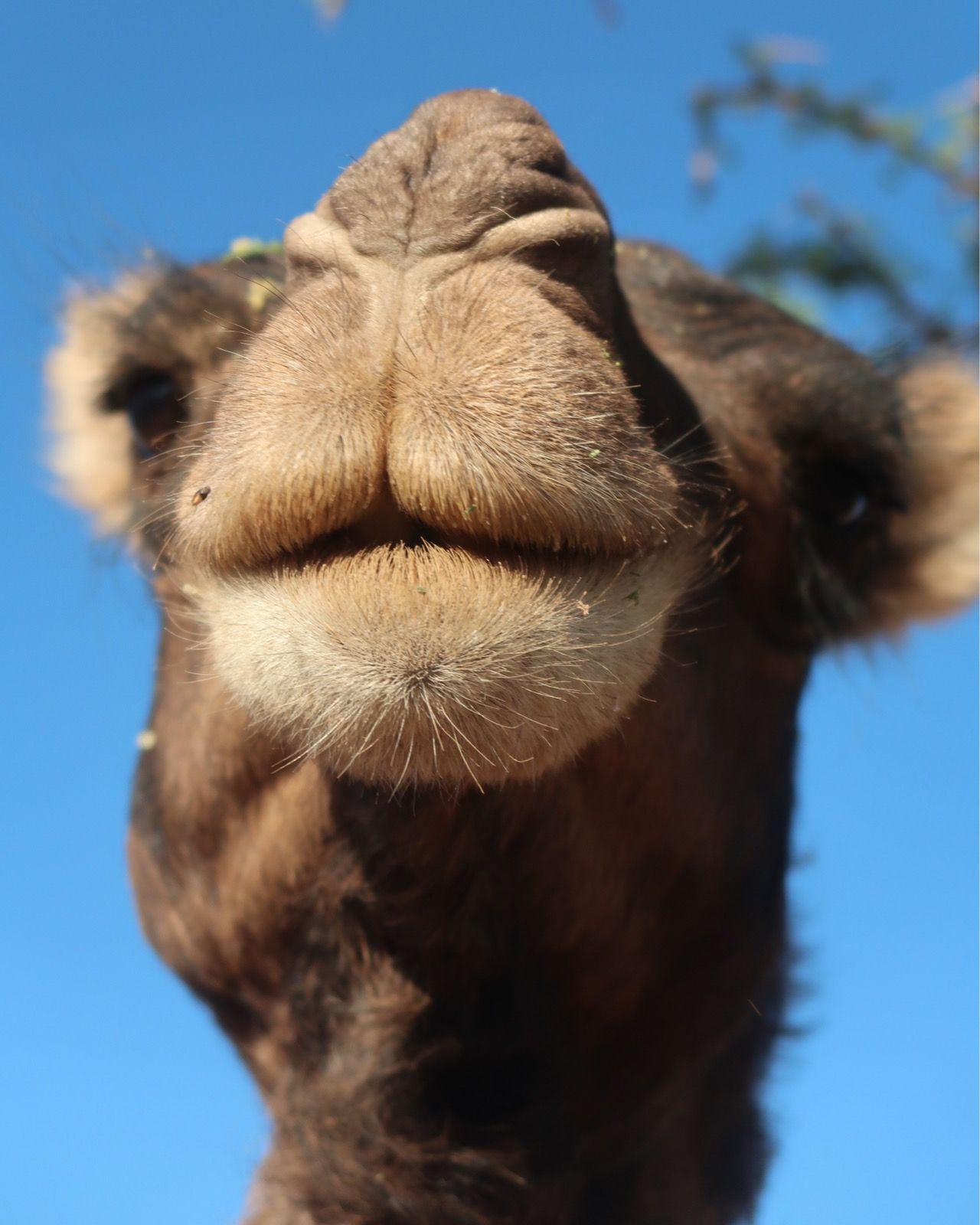


I dub thee “Camillio”

Last nights camp.

Why did I take this photo? The first 30 miles were ones I’d rather forget!

Me and my kitty friends

Lots of rocks. Ugh!

Does this look like a scene from Star Wars?


Strava Comments:


Corrine L.

So fun to see the difference between the weather you are experiencing and what we are experiencing here in interior Alaska right now.

Janet W.

You did have an eventful day with your kitty and camel friends. That rocky road would be tough going for so many miles, but nice scenery! You got an upgrade, and I hope your new mattress is firm. Good sleep and rest up for the Anti Atlas Mountains.

Kelly C.

Have you tried camel’s milk?

Carol D.

Jedi. Never thought of this but it’s pretty obvious in hindsight.😳

Ann L.

Camillio has a cute face! Definitely looks like a scene from Star Wars.

Jessica M.

Of course the cats will come for lunch….you are eating their food!! Prayer time 5 times a day?

Mark G.

The Adhan…. sounds soothing. I didn’t realize camels roamed around in flocks/caravans all wildish.

Stan H.

That’s a lot of camels! It’s hard to see where they find food. I like the last video of your “upgrade”.

Glenn S.

Yoda…yodea in Hebrew is “to know”. Probably something very similar in the other Semitic languages.

Ride Stats:

Elapsed Time Moving Time Distance Average Speed Max Speed Elevation Gain Calories Burned
09:04:47
hours
06:47:39
hours
129.35
km
19.04
km/h
40.36
km/h
918.30
meters
2,676
kcal


– Day 105 : Under a Moroccan Sun [top]
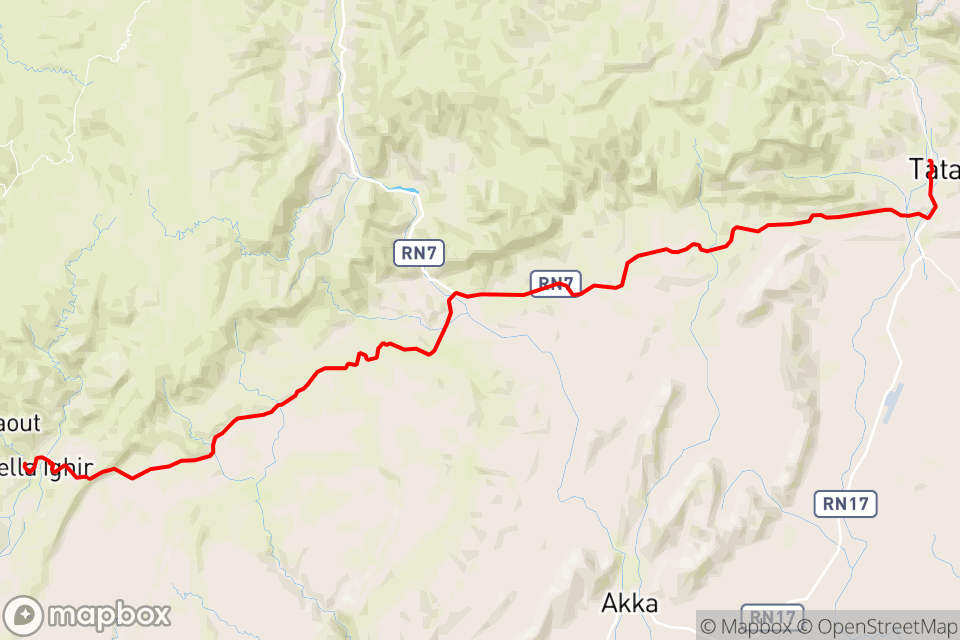

“Is you mom still with you?” Asked Ahmed as he poked his head into the doorway.

“No,” I replied.

“Well, you can maybe give this to your sister, then,” he said as he withdrew a carefully guarded crocheted purse, about the size and shape of one of those pizza crusts with no toppings that I told you about last night.

I really liked Ahmed, as we had talked in his good English about his time spent in Virginia and even going to the twin towers in 1998. He had a sincere and generous manner about him. I felt awful saying, “thank you so much, but I have no space for this. Thank you.” It is true, too. Between all my diabetes stuff and the fact that I have a 3 person tent (a vestige of the trip with Janet), space for food and water for my long hauls in the desert takes precedence. But how do you refuse a gift like that? He looked sad. I considered accepting his gift and then leaving it with someone else. In retrospect, that probably would have been best – but as you guys know, I’m still learning how to “do” Morocco, taking a lot of missteps along the way.

The next 8 hours of riding were excellent. Good surface, in spite of this unusually heady wind. The route I took only exists because of a mine, but the dirt was hard packed and no rocks as a result. About 25 dump trucks passed me during that time (only about 5 per hour, so not bad). Each and every one of the trucks would stop as to not engulf me in a dust cloud. They smiled and waved as i plodded by. One truck even went to the opposite side of the road and flashed his lights – just so I could go upwind of his dust cloud!

And then I got to town where I bought food – the same stuff again for $5 instead of $15… a third of the price when only the + key is being used. As the adversities of the tourist zones are beginning to diminuendo in my mind, I’m returning to that state of happy harmony with Morocco that I had on the first days being here.

In spite of my Achilles, I’m having to do these long hauls to get water. 55 miles of dirt without water today. Also, since there aren’t any campgrounds out here, I decided to give myself a bit of luxury tonight. Normally, when wild camping, I will shower with one liter of water. That is the bare minimum to get a decent nights sleep. At the end of the day, I had made it to a town, and looked in the dumpster for an empty 4 liter bottle, and quickly found one. Since I couldn’t find a spigot in the dusty town, asked a shop keeper, “aviez-vous l’eau, s’il vous plaît ?” (Do you have the water please?) while pointing at the empty bottle. Not the perfect sentence, but he seems to understand and takes the bottle into his shop. He returns a few minutes later saying “l’essence ! L’essence!” (Gasoline, gasoline). “Oh crap!” I thought. He probably thought I had a motor bike and needed gas. He shows me the bottle, it’s full, and he is sniffing it; holding it for me to sniff too. I thought, “now I have to buy this gallon of gas.” But then I saw the separation of water and oil. I realized: someone had used this container for gas in the past! He was warning me, probably thinking I planned to drink or bathe with it. He suggested a solution, returning with a small scoop of white powder. I didn’t understand that! But then he returned with a better solution – he filled up a clean 4L bottle. “Merci beaucoup !!”

Everything wasn’t 100% perfect today. As I was pedaling off with my gallon on my back, kids started harassing me. They chased me asking for my water bottles, money, grabbing at me and my bike. I said, “no”. They continued to run along me, grabbing and saying “donnez-moi !” (Give me!). I don’t know where this came from, but after two polite “no’s” I suddenly ROARED, “NO!!!!!”

My! You should have seen the shocked kid’s faces as they ran away from this evil monster. I’m going to confess a secret: That felt DAMN good yelling at kids. Wow. I’m glowing with a feeling of empowerment.

The other bad thing is that I went to change my insulin cartridge, and found not one, but TWO of the cartridges had shattered and leaked all of their precious contents to the dry desert air. I had been riding that insanely rocky terrain a couple days back.. and even though they were padded to the hilt, it was no match for that terrain. What dummy made these things out of glass? Anyway, I lost 50 days worth of the insulin I use for eating. Luckily, the insulin I use for living is all still intact. The good news is that I think I can get more here in Morocco – albeit not the exact same stuff.

In Summary: Brian gets joy from screaming at kids. The good guys don’t rip me off – and get less money as a result. The best guys, instead of taking, they try to give.. What a strange world we live in, huh?


Photos:
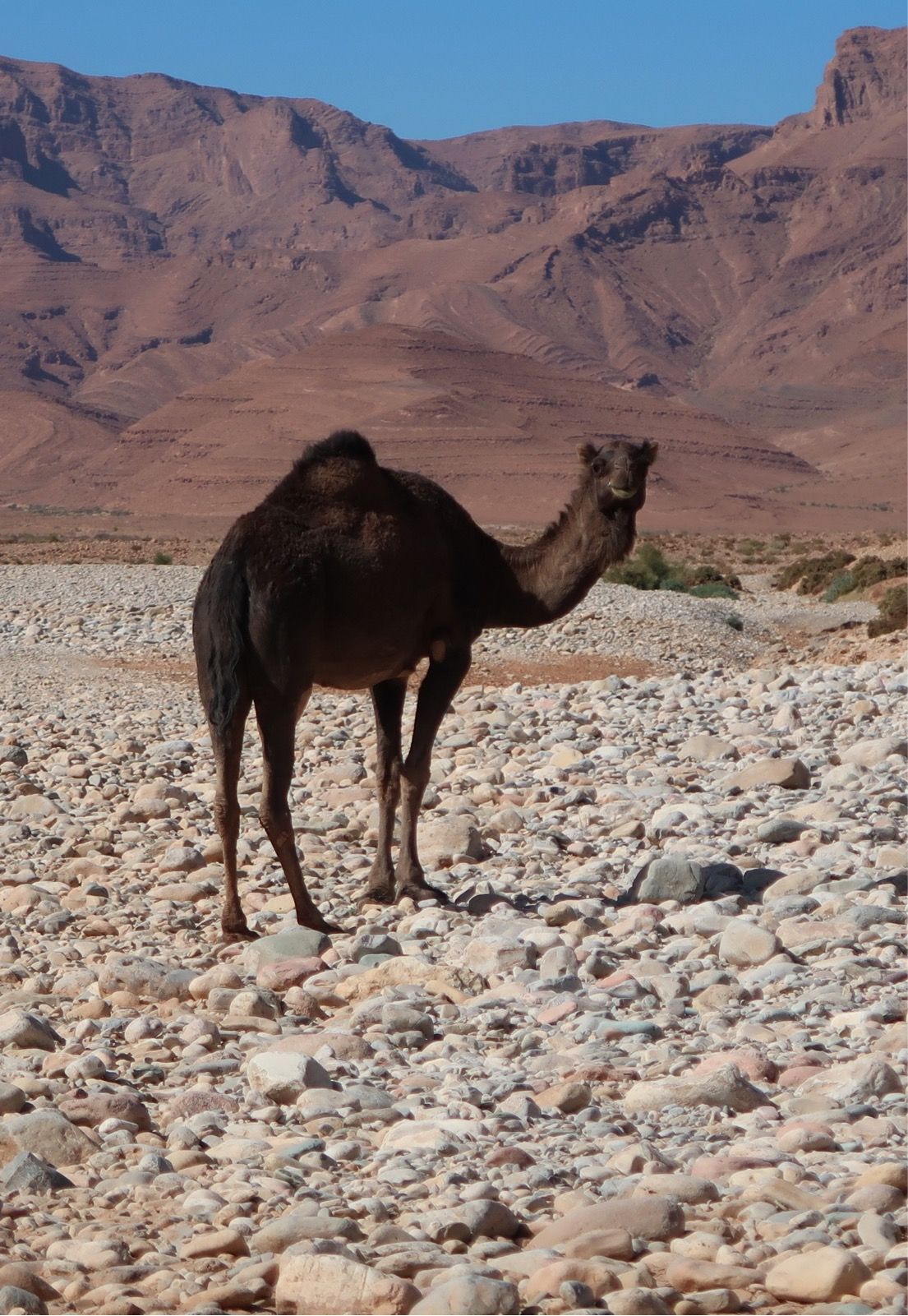


At least there is some company out here!

Maybe it says to watch out for donkeys, goats, and camels. Or maybe it says something funnier? All Arabic readers, this is for you!

I tried helping by climbing up there, but you would need a saw to cut that rebar. I couldn’t think of anything better. They had put a very long stick in the window too (for the cat to ascend), but it didn’t want to do that. They went next door and there was some yelling with the woman who answered, but I think they may have gotten keys to a back door to release the kitty more conventionally.

Precious precious liquid… lost. I think I can get more before I leave Morocco.

Clandestine camping. I haven’t wild camped here much due to fear of children finding me. It took me 30 minutes to find this spot and climb over many rocks t make it as hard as possible for someone to come here.

Strava Comments:


Judy I.

Sorry about your insulin, and I hope you can find a suitable replacement. The crocheted purse story was kinda sad. Maybe next time you can mail it? For now it’s the thought that counts, (and thoughts are so much easier to store!)

Janet W.

Usually people come through for you, or if they are “adjusting the numbers” it’s not by much and you don’t mind. Then it’s easy to look at the positive side. I’m glad those persistent kids got your message loud and clear, even if they still bug the next tourist that comes along. Thank goodness you think you can get more mealtime insulin soon in Morocco!

Ann L.

Congratulations, you now qualify to be a parent (not that you want to be but, sometimes kids don’t get it until you really make it clear). Sure hope you can find some insulin in Morocco that will work for you!

Ali G.

It says “National Rd number 7. Look out for wild animals all along national road number 7”

Brian L.

Thank you for your comment Ann Luce . When you put it that way (about being like a parent), I feel a lot better. Thanks!

Brian L.

Ali Glenesk – thanks! It is so impressive that you can read Arabic; it seems so difficult. Do you speak it also?

Ali G.

Brian Lucido no / very badly! I used to! It’s not harder than other languages once you get over the hurdle of learning a new alphabet

Tracey A.

Brian Lucido Thank you for welcoming me back after I accidentally clicked on the follow button 🙄
So very awful about your insulin I really hope you can purchase a suitable replacement! I’m glad you finally yelled at those kids, I think they deserved it.

Paula G.

I thought the sign was like something that Sesame Street used to do. “One of these things, does not belong here”. Clearly I was wrong because all of those things belong there.

Ride Stats:

Elapsed Time Moving Time Distance Average Speed Max Speed Elevation Gain Calories Burned
09:26:27
hours
06:35:13
hours
113.83
km
17.28
km/h
50.53
km/h
1,571.90
meters
2,915
kcal


– Day 106 : Greedily Gorging on Gorgeous Gorges [top]


After selling me some food, the guy said, “Le Maroc est tranquille, non?”

“Je ne comprends pas,” I said (I don’t understand).

“Le Maroc est calmé,” he tried again.

Oh! tranquil… calm. “Oui,” I replied, gleefully understanding.

He grabbed my hand to shake it, but pulled me into an embrace like old bro-friends do. I’ve been getting a lot of manly Moroccan hugs here. As nice as they are, they’re a poor surrogate for Janet hugs. I hope she isn’t jealous, though.

Meanwhile, a small girl had been standing at the counter. In Arabic, she said, “peace be with you; god bless you,” then fist bumped her heart. The man smiled at her. “Welcome to Morocco,” he said. It was a scene out of a Moroccan fairy tale. I beamed a big smile and headed off to the next gorge.

I had spent the morning casually riding up the Ait Mansour gorge. Originally, I had planned to ride up and over the Anti Atlas, but last night I discovered another gorge called Igmir. I got a little greedy for gorges and decided to add on a second gorge today. I’m glad I did because both were equally, if not more beautiful than the well known Dades and Todra gorges I visited during the stint in the High Atlas. The beauty, though, was complemented by the relative absence of harassment. Just good and peaceful riding.

But the day wouldn’t be without some strife. As I was ascending from a tiny village, a man used his girthy body to successfully block the narrow road. “give me money,” he demanded in French. I replied, “why?” He put is hands to his mouth in the eating motion. I looked him in the eye, smiled, and then gently patted his protruding belly.

“No.”

An onlooking kid with a bike smiled and laughed at the pat-pat. Even the guy kind of laughed, presumably because he knew that he had made a weak case. I’m almost reluctant to tell you some of these stories, lest you get the idea I’ve become an ass (or maybe already was one). I’ll emphasize once again that I gave to hungry people in Spain, but so far here, I haven’t seen anyone who seems to fit that qualification yet. Plus, with everyone touching me and my bike, it seems normal to make physical contact with strangers. Daily, people jump in front of my bike with their hands out (or interlocked) to stop me.

Late in the day, I tried to escape two kids, but they were too fast. I gave up – plus I needed to stop for water. They surrounded me and started opening my bags, “what’s in here? A camera? Give me a phone! My brother has a phone and I need one too.” Their French was surprisingly good – with verbs other than “give me.” These kids couldn’t fool me, though, because thanks to my rear view mirror, I had seen them taking photos of me with their phones on the way to the spigot. Each time I turned around to smile for the camera, they would hide it, pretending like they weren’t videoing. This new level of impunity, though – opening two of my bags – has got to stop. Luckily, they lost interest when they saw sardines in one bag and wires in another.

So that should paint a picture of how and why I must journey for 30 minutes to select a wild camp. I’d happily pay the $5 for a wall to protect me from perpetrators… but I haven’t seen camping or hotels in the last 145 miles. The rules of camping are that it must be impossible to ride your bike to the site. If you can ride, then someone else can drive or ride. You must be seen by no one on your way to the site. Just as it is with flies, if one lands on you, many more will come quickly. I ended up finding a trash dump with a burning pile of trash. But rather than camp in the dump, I crossed it completely and camped on the other side.

Was the shop owner right? Is Morocco really tranquil and calm? Like most things in life, the answer isn’t always clear.


Photos:


Last nights camp – sufficiently hidden.

Ait Mansour gorge.

How to harvest dates. I ate a bunch too! As I get more and more depleted, I can eat more carbs with less insulin. Just gotta keep on moving.

Michel… a bike tourist from France. Only here for a few days, but sounds like he comes to Morocco often for bike touring.

Ait Mansour gorge. Put it on your list if you come to Morocco.

My favorite part of this sign was Lego man “Jack” in the bottom right. Why is he there? Least favorite part was the 9km… I decided not to rattle and roll that far over dirt to see the rock drawings.

Heading down to the Igmir gorge next. Buffeted by very strong winds from ahead and some from behind.

Pure pulchritude

Washing clothes is easy in the desert – they dry in the shade in less than an hour. Unfortunately, you need t be swift when you see water. I got my backpack ready. Pulled off the clothes and when I saw the kids coming, threw them in the pack and rode away.

Camp for tonight.

Strava Comments:


Ann L.

Spectacular scenery. Those gorges are gorgeous. I like hearing how happy it makes you being there. Cool about the dates. Talk about fresh off the tree!

Doug C.

Always enjoy going through your photos. An oasis in the desert is always attractive. The switchbacks recessed in the hillside were also very cool.

Janti of the J.

Pulchritude is a descendant of the Latin adjective pulcher, which means “beautiful.” Pulcher hasn’t exactly been a wellspring of English terms, but it did give English both pulchritude and pulchritudinous, an adjective meaning “attractive” or “beautiful.” The verb pulchrify (a synonym of beautify), the noun pulchritudeness (same meaning as pulchritude), and the adjective pulchrous (meaning “fair or beautiful”) are other pulcher offspring, but those terms have proved that, in at least some linguistic cases, beauty is fleeting

Carol D.

‘Gorgeous’ gorge.

Paula G.

Without that water there, I’ll bet nothing would exist. Life looks very simple, yet complex at the same time. Such a different way of life from what we know.

Janet W.

Each day is more beautiful than the day before! You’re experiencing everything you hoped for – and more. I love the little towns and palms in the canyons – welcoming oasis’. Your tent tonight isn’t hidden. It must be remote enough to be kid free.

Ride Stats:

Elapsed Time Moving Time Distance Average Speed Max Speed Elevation Gain Calories Burned
10:06:12
hours
06:40:07
hours
116.73
km
17.50
km/h
68.34
km/h
2,136.00
meters
3,939
kcal


– Day 107 : The day I hated Morocco [top]


The day started off well. I had just finished my cold instant coffee, and despite a flow to the contrary, I had “windy.app” prediction of a tail wind.

Pushing into the crescendoing wind with quite some might, I realized that by crossing the trash dump a second time – with all the shattered detritus – I had damaged my tire. I added more sealant and carried on. On the 5th stop to inflate the tire, I finally discovered it was a sidewall cut – this is why it hadn’t been healing. I managed to use some of the shoe repair glue left over by Janet, and a Park glueless patch to seal the deal. This worked.

In stopping so much, I was a little surprised that none of the 12 vehicles that drove by stopped to ask if I needed help. This was a remote stretch with only about 6 cars per hour. In Spain, solitary octogenarian women would stop to check on me if I was having a snack – and now I had my wheel off. I find it particularly interesting because everyone is VERY interested in me when I pass through town – just not when I’m broken-down-looking in the desert, I guess.

With the tire repaired, the fight against the wind was a smidgen easier now. I made it to a tiny village with a pharmacy and went in to ask about my insulin. I showed him what I needed and he produced something that would work – for $11.50 US without a prescription. Not too bad considering my receipt for 5 pens of this stuff in the US says, “Congratulations! You saved $1,600 with your insurance.”

He watched as I used the pen to make repeated injections into an empty vial I had been carrying. Pretty non-standard stuff here. I tried to explain that space is at a premium in my kit and that I would be “going to Africa.” I think he understood, and he let me use packing tape to wrap and protect the fragile vials. I was relieved that I could buy insulin even in a small town! He only had one, though… so I may try and buy another later.

I suffered into the wind through the bleak desert. At least the road had no cars on it. Then I heard a noise. I turned back to find 5 puppies dying in the hot sun on the side of the road. A sack nearby suggested to me that someone had dumped them here – over 40 miles from town. It was so sad to see the poor dried up creatures – still living and squeaking. Their tongues were out, and two of them looked like they were about to expire soon. It wrecked me. I thought, “It is impossible for me to help FIVE puppies. I pedaled on, crying, and trying to console myself by saying, “this is natures way.”

I was over a mile away when the pain was just too much. I realized, “If I leave them there, I am just as evil as the person who dumped them.” With tears streaming down my face, I retraced that hard earned mile and got out an empty sardine tin and filled it with some of the little water I had remaining. No, this isn’t impossible. It would be hard, but not impossible.

At first they wouldn’t drink, they were so dried up. I forced them into the water and they all drank a little. Enough. I wrote to my sister Michele who is an animal lover. She was awake at 5AM, and immediately got on the task of contacting places in Guelmim – 40 miles away. That way, I could work on pedaling them there while she did online stuff. This would take a huge burden off of my shoulders because trying to get a response plus back-and-forth communication is difficult even when you’re not in a hurry and riding a bike. Michele said, “Are you keeping them warm?” I laughed, “it’s 90 degrees here!” With the drying wind blowing 15-20mph in my face, this was going to be about as tough as anything I have done.

I stopped whenever a car passed (not many). I tried to flag them down for help. Only one Moroccan slowed to 2mph, but when they saw what was going on, they accelerated away quickly with a diesel cloud. A French couple finally stopped and said they could not help, but gave me 500ml of water and petted the puppies for a minute.

I began a series of 40 minute rides with long yogurt breaks. During the first leg, they were so still, I thought they had all died in my backpack. Once I got them to eat the yogurt, though, they perked up. By the 3rd session, they were robustly more alive – playing and squealing with each other. The yogurt was like magic – though now it was all over their fur. This drew more and more flies each time and quickly began to smell awful. I flagged about 12 cars. No one stopped.

I finally got them to Fask. Here I hoped to find a driver. My sister was closing in on a Vet! Meanwhile, I explained the situation to the guys at the dusty gas station. There was a lot of laughing and one man said a lot of stuff and pointed to a female dog in the parking lot. I wasn’t sure if he was saying, “look, there are homeless dogs here. Don’t bother” or maybe “see if that dog will nurse these puppies”. Her nipples were all bulging, so I presented one of the puppies to the mother dog. She sniffed it for an entire minute… and then walked away. Even she rejected the puppies. I got out my yogurt, hoping that the cuteness would inspire someone to help. Indeed, a weathered man in a long robe came and crouched beside me. He handled the puppies deftly, poking their faces in the yogurt pile – helping to keep them from smearing it all over their bodies. I liked this one gentle and caring man who looked like the Marlboro man on his 100th birthday.

My sister finally got me the contact and an address. She got me in touch with an English speaking vet. I only had 14 miles left to ride – no one would drive me – so against my Achilles’ will, I pushed at race pace into the defiant wind. Once the sun set, I realized that my sister was right about keeping them warm. I could feel their bodies warm against my back. They were perfectly behaved in that pack, waking every 40 minutes or so for food. Maybe the gentle rhythm of pedaling was like their mothers womb. Once it got dark, I shed more tears… but this time tears of joy. It was becoming a reality. These puppies really were going to live another day.

The vet agreed to have his assistant stay after hours. True to his word, the assistant was still there. He took the puppies and put them in a little enclosure and called the vet. (The assistant did not speak English, but the vet did). Vet promised me in perfect English, “I will find them a good home”. The assistant then began writing a series of numbers on paper. $100 for vaccines, $80 for food, and $70 for shelter (guessing on that last one). A total of $250 that I don’t need to pay now.

I’m going take tomorrow off so I can settle this. also, my Achilles is truly wrecked from that effort. Meanwhile, I need to decide if I want to pay them $250USD. Do I trust them to find good homes? I discussed it with my sister and we are both going to sleep on it. WWYD?


Photos:


My weathered body is cracking.

Windy said tailwind. Instead I get 20 to 30 mph headwind all day.

Here, I was allowed to do a cartridge refill at the counter of the pharmacy using an insulin pen. Definitely something the pharmacist had never seen before – but it works!

The repair of the sidewall slit.

There is water in that tub, though you can’t see it.

After an exhausting day and multiple camping nights, I finally got to a city with lotsa Food! It’s be a long hard run this last week – physically and emotionally.

December 3, 2023 Puppy update. You can still adopt one!

December 14, 2023 Puppy Update. You can still adopt one of the four!
🐶

Update December 29, 2023

Update December 29, 2023

Update January 12, 2024 – still looking for a home. The puppies have a “new friend”

Strava Comments:


Jon H.

Puppy savior! You have a heart of gold.

James P.

Oh my gosh, it was so amazing of you to save them. Hope you reach a decision you are comfortable with. Maybe see how the puppies are doing in the morning and then decide?

Ann L.

Those little puppies just broke my heart. I’m right there crying with you. You have such a kind heart. Such a sacrifice to save them. I think the vet is an animal lover and will do his best to find them homes. I’d pay the $250. In the big scheme of things it’s not much money and will give you peace of mind that you truly did all you could to save them. It breaks my heart what animals have to endure. What kind of evil human being just leaves them to die. Such cowards. You did good my friend.
I am glad you were able to find some insulin. Im also glad your tire issue got resolved.
It’s a hard life there and people have to take care of themselves. That is probably why no one stopped or help. You will come back a changed person for the best I think. We are all rooting for you. Keep your spirits up.

Gordon L.

Tough, tough day for sure. A wonderful thing you (also your sister) did for those puppies. I’m glad you’re at a place now where you can rest for a bit.

Sean C.

Brian, I like your combo of adventurous, grit, kind hearted, and practical all in a days ride. Assuming $250 doesn’t put you in a bad spot on your Africa trek, I would lean towards paying and I would never look back knowing I did what I could.

terri W.

Reading this with 😭. You’re truly a kind soul! I believe in karma and you must have earned a special dose! What an amazing effort between you and your sister! All in wild 💨. The puppies are adorable. 🙏ing that they find a good home.

Matthew D.

Thank you for saving the puppies! Can we send you a small donation to help in their cost?

Joe B.

What a positive and inspiring thing to read on Thanksgiving. You put new meaning into ‘going the extra mile’. Hope the tears turn into heart comforting smiles as you continue your journey into Africa.

Corrine L.

What a good deed you did today! yes, if we can send some money to help, I’d be happy to do so.

Matt K.

Wow Brian! You experience some crazy adventures! What an amazing deed! I’m sure that yogurt was similar to milk. It had the protein, but yes too much isn’t good. Incredible!

Julie K.

You’re an angel Brian – you did the right thing! Heck give me your venmo and I will chip in $100 if you think the vet is for real going to help the little pups.

David L.

I will match Shred Chic.

Janet W.

Allah has something special planned for you and those 5 adorable puppies. I think each of the pups will be adopted by a family with young children who will learn to be kind to bicycle tourists (like you) and animal lovers (like Michele). 🐶

Carol D.

Thank you for doing the hard but right thing saving those dumped puppies. Very tough for you given your situation riding and low on water and any food they could handle. I’d be happy to donate as well. 🐾

Cheryl J.

What an amazing crazy day! You were the kind stranger that saved their lives. Hope you get a chance to recharge with a lighter spirit. 🐾🐾🐾🐾🐾

deb B.

How much $ do you need? I’ll contribute! Now you can rest tomorrow and feel better for the days to come.

Nancy P.

Agonizing story and happy to contribute.

Janet G.

You earned you angel wings today. What a heart-rending story.

Ian G.

😍 good luck tomorrow, glad everyone here has a good heart ❤️. Tough stuff

lisa M.

Please keep us posted…I’d be happy to help as well. Vaya con Dios 🤙🏼🙏🏼🕊️

Holly H.

I’ll donate too. They are very cute.

Stan H.

You were already my hero, now this!! 🙏 I Venmo’d you a small contribution.

Sօʀƈɛʀɛʀ 🅅.

Happy Thanksgiving Brian. It’s unhappy a lot, though sometimes it isn’t. Thanks for saving life. In China, where and when I visited, they raised dogs to eat them. I found that out when I tried to let them in my grandfather’s village. The locals scolded me. It’s not much different than eating a nice plump turkey.

Stan H.

….but I realize money isn’t the only issue. It is who to trust them with in a place where you know nobody, and it isn’t practical for you to stay long enough to see it through. One would hope the vet could be trusted, especially since he promised they would go to good homes. Are dogs kept as pets there as here in the US?

Tracey A.

Brian Lucido you are an Angel and if those pups make it they owe it all to you. I hope they get a good home, such sweet little babies.
I think that people become vets because they love animals and this vet will do his best to keep his promise to you.
Happy Thanksgiving to you, stay safe.

Mark G.

✅Count me in on these donations. Brian’s VENMO is @Brian-Lucido. My donation and the other’s in this thread to cover it and use any extra for a well deserved luxury. David Ludwigson Shred Chic Holly Harris deb bond Corrine Leistikow

Chris N.

It worries me to see you so emotionally stressed. Rest and recalibrate. Make good decisions and move forward. All will be well.

DogMeat Q.

Omg Brian, how utterly agonizing! You of course did the right thing by rescuing them and getting them to a vet! I would have to believe the kind vet will find homes for them and if you can afford it pay. Be well my friend!

Braden L.

Heavy!! You turned around and followed your heart, so much respect Brian!! $20 is on the way.

Brian L.

Thank you guys for your kind and generous thoughts. To answer Stan’s important questions: Dogs are not very common here. In fact, I have been chased by a total two dogs in 3 weeks. In Latin America (such as Peru) it could hit 50 chases in a day. Cats are common here instead. I have been exchanging messages with the vet all morning. I feel good about his integrity, though I won’t be able to meet him (he is in Agadir because his father in law is having intestinal surgery). In our messaging, he started to offer a lower price without me asking. In the US, $250 would be tight for one dog, let alone 5. Since some people have already contributed 160, it will be easy for me to pay the rest now. Especially since I’m getting a good feeling about this vet. Wish I could meet him. In exchange for the payment, I asked if he can send me photos of the puppies in their new home(s). He said that he will care for them for 2 months with this amount and get them strong. Also he agreed to send the pictures. I will go over today and check on them to make sure they are being looked after and pay them for the care. Thanks again.

Brian L.

Ok, guys. I got several very generous donations. You can stop now; we quickly have raised $230, and I’ve got to put in my share!! So please, thanks. For everyone who was so kind. Thanks to Stan Hooper , Janet Wagner , Mark Glenesk , Paula G , Nancy Prier, Jon Herman , Sanja Peter i have asked them to be accountable and send me pictures of the puppies. I asked them to clean them (they said twice a week). They got yucky with the yogurt. Thanks again to everyone who so generously helped out.

Nancy T.

Thank you for your sacrifice to save the puppies. It was a wonderful story.

Julie K.

Brian Lucido – that’s wonderful news!! I offered $ and then missed the train and still feel the need to give something that you can use for maybe an extra motel night or something. I feel your share was a ton of effort in transportation and an aching achilles.

David L.

Sent $ via Venmo this morning before I received your message to stop…I’m sure there will be other opportunities to use the money! (fyi:the Venmo sender is my wife’s pottery studio).

Brian L.

Ok.. this is ridiculously nice of everyone, but now I have more than the actual cost. I’m going to math out the overage and refund the over-donators. David Ludwigson – please see if you can get a refund… you might have sent to someone else, because that one did not come through. Thanks also to Shred Chic and deb bond. I know you guys all care about these puppies, and we did it! But I don’t deserve or want excess thanks so much.

Papi C.

❤️

Warren G.

You have a wonderful heart Brian. Thank you for being true to yourself and bringing this lesson to us ❤️

Lesley B.

What a tremendous thing you’ve done! Thank you for sharing your story. There are mechanisms in place for people in W. Europe to adopt dogs from countries such as Morocco. Makes me hopeful that your pups will find good homes.

Jessica M.

Start a Go Fund Me Page and I’ll donate to the dogs!!

Jessica M.

Happy Thanksgiving! You did the right thing! Thanks for sharing your stories and ride with us. It means a lot to get to see your trip!!

Ride Stats:

Elapsed Time Moving Time Distance Average Speed Max Speed Elevation Gain Calories Burned
10:27:35
hours
06:29:07
hours
133.49
km
20.58
km/h
41.84
km/h
1,099.00
meters
3,549
kcal


– Day 108 : Guelmim Errands [top]


I’ve been trying to explain to Janet what it is like here, and I keep coming back to extremes. The good people are really good: bright and welcoming smiles and big hearts. And the bad people… well maybe I’ve been typecasting the bad ones; coming down too hard on the money/candy grubbers as you will see:

I just found a Moroccan guy named Aboubakr on Strava who is 10 days into a bike tour of Morocco. He is from Guelmim (where I am now), and I was writing to him for help finding a bike shop. He is not here right now, but he saw the same French cyclist (Michel) who I saw a few days ago! Aboubakr wrote on his Strava, “Three joyful kids approached asking for candy, spreading smiles that truly made my day.” Whaaaaa?

Why have I been fighting this? It suddenly occurred to me that a simple change of attitude and behavior could flip my experience 180 degrees. Am I making my own “badness” out of Morocco? Probably. Why?

I think it is because I’m hung up on two things:

Number One: These kids have managed to learn “candy, pen, money” in French, but they never say “please” (in any language, including Arabic). That gets me too – but maybe it is just my culture? Is just saying “give me…” ok in other cultures?

Number Two: I bring from my own culture that giving handouts is “bad.” Yet, yesterday, several of my friends just handed over money to me – and a lot more than the value of a giant bag of candy. I didn’t deserve these handouts! People were willing to give me more money than the actual cost of the puppy care. Why? I didn’t ask for anything, yet people rapidly just gave. Should I just give to the local people here? Where do I draw the line? Who “deserves” giving? Who doesn’t? Definitely the rock throwers don’t deserve anything… but what about others? Am I leaving a trail of problems for those who follow in my footsteps if I give just to make my own day better for me?

Anyway, I didn’t have to deal with any of that nonsense today. In fact, I thought from the map and the layout of the city that Guelmim would be a depressing spot in the desert. Instead, I really like it here – so far a genuinely good time. I went to a bike shop for to ask about sealant for my tires. “No way you will find that!” He announced. Later, I saw the same man at the grocery store and you know how there is that thing where you see someone twice, but in a different place? That familiarity, however brief, somehow catapults your relationship into the next level of friendship. He asked questions about the tour, as did other nearby locals – with zero snake oil anywhere to be seen.

Meanwhile, I went to pay Ayoub (the vet assistant) for the puppy services. My main concern was that the puppies wouldn’t get good enough care here. I made sure that he agreed to send me photos of the puppies being cared for, raise them for 2 months, and then send photos of them in good homes. I checked in on the little guys in the morning, and it really did make me happy to see them. I don’t consider myself to be an animal lover. I’ll confess that I have thrown rocks at attacking dogs, kicked ramming goats in the head (saved my mom’s life once from a goat), and (more recently) yelled at children that were behaving like wild animals. But I gotta say, if I had been coming home within a week of meeting Mila, I may very well have figured out how to bring that dog with me.

I insisted that Ayoub wash the puppies. They looked kind of uncomfortably dirty – still with yogurt in their fur. He sent photos (attached), giving me good confidence that they are being loved.

I’m taking naproxen for the Achilles, and it already feels a lot better. The weather window for “comfort” in Sub Saharan Africa has a tiny aperture – I’d say November 20 until February 1. I hate to blow one of those precious days, but I think that taking tomorrow off too will pay dividends in the next leg. Thanks again for all the kindness and generosity you all displayed in yesterday’s activity. Your help made it much easier to ensure the puppies received care moving forward. Everyone who commented participated in driving that in the right direction. Thank you.


Photos:


My room opens up into the center of the hotel. They let me put my bike there in the hallway

In Morocco, they do not have plastic grocery bags. These are made out of the same stuff as landscape fabric. “Je n’ai pas besoin du sac” is too foreign of a concept, so I often take the bag anyway, fill my bike bags, fold the bag up and return it. They invariably laugh when I do this – but stow it away for the next person. Today when I did this, a man who I had met elsewhere in the city came running out with a coin ($0.10) – it’s for the sac! Apparently they charge for these 😂

Here are some of the washing photos he sent.

Now they are clean and looking good! The product of your good will and generosity. Puppies say “thank you!”

Strava Comments:


Stephen Mark R.

Days off can be as rewarding as days on. Great trip. Loving following.

Nancy T.

I spent an enormous amount of time yesterday making a difficult vegetarian dish for Thanksgiving and didn’t have a chance to read your post until this morning. I believe your actions with the puppies to be one of the most inspiring and encouraging things that I have read (and watched). It really makes me believe in the grace of humanity, it was a truly a selfless act. Thank you for sharing. I hope that your achilles heals quickly and that the puppies find loving homes.

Ann L.

I think maybe you are more of an animal lover than you realize! So relieved to hear the puppies are doing well and there is hope that they will find good homes. Hope your Achilles feels better with some rest.

Scooter R.

Those are the luckiest puppies in Morocco. May they all live long, happy lives. Yesterday sounded like a lot of stress on the body. Good you are resting and hope the Achilles heals quickly!

Corrine L.

Hope your Achilles feels better after a day of rest. So happy to see the happy puppies!

Judy I.

I love the polka dot puppy! 🐶😍

deb B.

Please use any “leftover” $ for other gifts of kindness that come your way on your adventure

Julie H.

Brian, I love what you did for those puppies. Today I shared your posts from 11/23 and 11/24 with my co-workers (you probably remember that I’m a veterinarian). My co-workers also love what you did!! You were called “the sweetest man in the world” after one of my colleagues watched the video of you with them in the back pack. You saved 5 lives and showed love and compassion to vulnerable beings who were left to die. You made a difference in this world

Sօʀƈɛʀɛʀ 🅅.

Is puppy love your Achilles heal? Good medicine for all.

Janet W.

I like how you are ‘always thinking’. There is always another side to every thought, especially after unexpected new experiences, that might not have been pleasant. I’m glad you read Aboudt’s (sp) bike-packing viewpoint on the children he met. And LOVE seeing the puppies clean and fluffy!

Matthew D.

So happy to see you and the puppies doing well, great idea and challenging to keep pushing to a positive attitude, but sounds like you’re doing really well there!

Ride Stats:

Elapsed Time Moving Time Distance Average Speed Max Speed Elevation Gain Calories Burned
01:19:20
hours
00:33:31
hours
4.87
km
8.72
km/h
29.33
km/h
219.00
meters
233
kcal


– Day 110 : Atlas Unplugged [top]


Today’s ride is an inflection point in the journey – both geographically as well as climatically. I left the last remnants of the Anti Atlas Mountains behind this morning, along with the very dry desert air. Yes, it’s 1900 miles of flat desert ahead, but the Atlantic influence can also be felt. Gone are the days of washing my cycling kit after dark at 7pm and having it be dry by 8pm. I will miss the dry heat, but my skin and formerly chapped lips are correspondingly relieved. For my North American Friends, geographically, I’m parallel with Guerrero Negro / Chihuahua in Mexico.

My expectation was that today’s ride would be bad – I had been searching for an alternative route through the desert (as opposed to the lone paved highway). Satellite imagery revealed two possible routes that paralleled the pavement – but you can never be sure what you will find on the ground in places with sand dunes. Some sections looked like they could be 1mph pushers. I made some fake strava segments and zero people had done any of the stuff I had been considering. Moreover, the “bike shop” guy said it was impossible. I had some intrigue to conduct a scouting mission (even though I knew the scenery would be the same)… but there is also this precious weather window that I’m paying attention to. In the end, the main highway between Guelmim and Tan Tan was excellent riding. First, it was a Sunday morning, meaning almost no vehicular traffic. Second, the entire 70 mile stretch is 4 lane highway, but because it is under repair, the cars are only allowed to use two of the lanes. This meant that I had my own 30 foot wide, independent and paved bike path to relax and just enjoy the ride. Which I did until that 8-12mph head wind picked up around 1pm.

This morning, I went to do one last check on the puppies, but unfortunately the vet was closed early on Sunday. I’ll miss those cute little fur balls. I had expected to dislike Guelmim, but instead, I liked it a lot. Because today was on a highway with zero intervening small villages, I saw almost no children. Just as in Guelmim, the couple of people I met in Tan Tan were also welcoming and friendly. These experiences continue to solidify my belief that tourism can pollute local people; my favorite locales are often just the boring and regular places.

I pulled over every 10 miles to check and adjust blood sugar, drop a pin, and eat or drink. During one of these stops, a van pulled over, a guy jumped out and broke a 1.5 liter bottle out of its 12 pack shrink wrap. He came running over a small gulley and insisted I take it – without me even asking. Most passing drivers gave thumbs up.

Later, I saw a guy sitting behind his parked truck. I thought maybe he had broken down, so I stopped to offer him water or help. He looked at me befuddled. “Maybe he doesn’t understand French?” I left him with, « c’est bon? »? « Oui » he replied. in my rear view mirror, though, I saw him get up and walk around the truck to stare at my receding bike with a puzzled look. A few minutes later I saw another truck pulled over. But this time I got it. He had his prayer mat out and he was bowing up and down in bare feet. It wasn’t Yoga time. It was prayer time. Yeah, I may have caught that other guy right after his prayer.

One thing that I had been meaning to report was the paucity of people I have seen praying. I hear the mosques almost every day – even when I’m in pretty remote locations – but until now have hardly seen anyone on those mats – and today I saw a dozen. Maybe there are regional differences in devotion, or maybe it’s just that this is a good excuse for the truckers to all simultaneously take pee breaks. I haven’t been in a highway like this with truckers until today, but a cyclist could get 5 brief respites from traffic on a daily basis if they simply go to muslimpro.com and download the schedule. If you didn’t know: There is a official prayer schedule, and it changes every day in relation to the sunrise and set.

Today’s prayer schedule is as follows:

05:19
06:38
12:08
15:16
17:38
19:00

Wait! That is six prayers. This would be perfect for my friend Nancy Prier who always has to do “bonus miles”.

Interestingly, I noticed that everyone I saw was also quite adept in their knowledge of the cardinal directions. I think I need to know that for my wind analysis (though the reality these days is that “the direction you are heading dictates the inverse of the wind direction”). Every time I saw someone praying, they had a perfect rhumb towards Mecca. The best pray-er of the day was a man with a horse drawn carriage parked on the side of the highway. The horse patiently waited as he knelt and bowed several times. The arches of his bare feet arched tightly. Of course, a photo of this picture perfect moment was desired, but not sought; you’ll have to use your imagination.


Photos:


My own private bike path!

These are the guys who stopped just to give me water.

Tonight’s camp.


Strava Comments:


Boris F.

surprisingly, you are the second person I follow that’s been through there in the last month or so. the Paris- Dakar Bike Dreams trip goes that way.

Brian L.

Boris Fölsch – surprisingly or unsurprisingly. I read that 160 people do this Sahara to Dakar route on bicycles per year. Not sure how accurate that is, but it’s about 1 person every other day on average. I expect to meet others. From here to Mauritania (800 miles) there is pretty much one way to go on a not-fat bike. There may be one other way, (kind of) – but doesn’t take you anywhere useful. There are 2.5 choices of routes in Mauritania, but I will discuss that later.

Boris F.

makes sense, given the geography, This is a most ambitious undertaking!

Chris N.

We’ve had several devoted Muslims work at the plant. All had apps which tracked when to pray and which direction Mecca was.

Janet W.

People from all over the world have a way of connecting and communicating in positive ways. They don’t need Google but it helps! Cool the solar guy read your review and wrote back!

Brandon B.

Man doing all this is something- much less with all the Bg challenges- I’d love to correspond via email when you are done your journey as I’ve really hit some walls in my Diabetes and adventure journey- Be well and adventure on!

Mark G.

Thanks for the water guy screen shot. BTW – I am starting my “Brian is teaching me new words” list. I added two today. Those white camel statues are coool.

Ann L.

So interesting how often they pray. Also it’s not every day you see camels 🐪 marking road directions. Nice about the guy giving you water. Definitely an interesting area very different from our culture.
How is your Achilles after a rest?

Brian L.

Brandon Baker – why wait? I’ll send you my WhatsApp.. do you use that? I doubt if I can help make the “walls” any easier.. but I can listen to diabetes talk 24/7. You should get my WhatsApp in just a minute.

Brian L.

Ann Luce – thank you for asking. It was better in the morning, but now back to the way it was. Kind of like your knee, it might take a while. Glad to see you posted your knee was better recently.

sean O.

I hear you about how “tourism can pollute local people.” I haven’t done a ton of touring, but in two trips to Argentina/Chile, I found the touristy Carretera Austral far less rewarding than an improvised route along the east side of the High Andes through a bunch of small towns. This observation will definitely be central in planning any future tours.

Paula G.

The people there are undoubtedly more friendly and helpful, due to the prayer that they practice. Not to say that we are less friendly if we don’t……but it certainly can’t hurt. You went a long way today!!

Ride Stats:

Elapsed Time Moving Time Distance Average Speed Max Speed Elevation Gain Calories Burned
09:35:49
hours
06:55:42
hours
157.28
km
22.70
km/h
61.99
km/h
814.80
meters
3,601
kcal


– Day 111 : The Petty Pilferer [top]


I had to stock up for another long haul in the desert. I found a one-stop shop – behind the counter there were my usual food picks. In front, half a dozen men were sitting and drinking tea. In front of that, a few dodgy looking guys in the street – the first I’ve seen in Morocco.

Usually I’ll go to one of the many cafes for an espresso shot because it is one-and-done, but today I opted for tea. For one thing, I like the way tea makes me feel – I don’t know if it is the other chemicals or the additional hydration – but the tea buzz is worth the cost of having to spend time drinking the extra volume.

Tea also gives me the opportunity to sit, observe, and momentarily participate in the local life. Across from me, a lone young man sat by himself with his tea. He had voluntarily helped translate my French to Arabic for the guy across the counter as I pointed to the items I wanted to buy.

When you get tea here, you receive a pot, two glasses per person (one upside down) and a huge block of sugar. I watched as the 3 men at the table to my left poured the tea from 20” above into the first glass. Next, another high altitude pour into the second glass. The block of sugar is then placed into the pot, and the two glasses are decanted back into the pot. After a brief waiting period, this process can be repeated. I read online that the height of the pour signifies your respect for the other people with you. A bride in an unwanted arranged marriage might do a low pour, for example. I was drinking alone, so as I copied their behavior, I decided to respect everyone around me with a modest 6” pour height – “respectfully” not baptizing my neighbors with hot tea.

Before I could get too engaged in the pouring project, one of the dodgy guys from outside walked right up to my table. He mumbled something, but then made a face that I could understand clearly. It was kind of a puppy dog face, which reads “I need something, can you help?” He was doing a pretty good job of moving my heart, but I could see the lone young tea drinker behind him kind of rolling his eyes. His face read, “oh great, here we go again.” I looked back and forth between tea-eye-roll-man and puppy-face-man, and before I could take any action, puppy-face-man pirouetted and stepped to tea-man’s table. He grabbed one glass of tea from the table, and one of tea-man’s loaves of bread; promptly walking back out front of the store to enjoy the meal. Tea-man made a face of disgust, but he still had one round loaf and one glass of tea at the table. You can do your own analysis on what just happened.

Back at the 3 man tea table, there were stacks of that round bread I have been telling you about. As puppy-face-man exited, a new man entered, pulling a bagged bottle from inside the lapels of his coat. I peered carefully – was this contraband alcohol in Morocco? The man uncapped the mysterious bottle and poured a thin syrup into a small dish at the 3-tea-man table. It looked like a blend of honey and olive oil. The men began to dip their bread in this substance – just as another guy emerged from behind the counter wielding a fancy tray with a carefully decorated crepe-thin omelette as a centerpiece. They would share the bits of the little omelette, mostly filling up on the hunks of bread dipped into the honey oil.

I sat back and sipped my tea and contemplated how unifying this is. You probably think I’m going to say it’s unifying that they shared the little omelette… but no: I’m thinking of the shared human experience. Possibly a world apart from this ramshackle store, in the USA, one could go to an opulent restaurant and similarly fill up on bread and oil; the “real meal” being a highly decorated but very small token centerpiece.

Juggling these thoughts, I rode off into the side-headwind, optimistic that the flow would eventually become favorable. The first 55 miles, they were still building a new highway, meaning that I always had my own designated paved bike path. That was good. I stopped in a small town at mile 55 and bought more supplies. The young man amplified the music and danced behind the counter for me. “C’est bon?” He smiled asked over and over. His dancing was kind of distracting and made me nervous for some reason… it took a long time for me to point out the foods because he kept dancing between retrievals. I thought he might grab me and make me dance too. I took the items outside to pack the bike, and I could see the man in the pharmacy smiling at me, patting his heart, and waving. It feels like these guys just want to spread the love or something. I get so much friendly attention from men; I wonder if it has anything to do with the male-female restrictions here.

Unfortunately, the wind was mostly a side wind – acting as a headwind in some places – but a tailwind too. Then, I got sick a third time. I don’t keep statistics for this, but if I had a chart for number of times vomited per days in the country, Morocco would rise to the top. Concurrently, I developed hypoglycemia – 47mg/dL all in a pretty forsaken place (but luckily the ONLY place with bushes I saw all day). Imagine being required to force down food to avoid going unconscious – right after your body just rejected the previous meal. Bad stuff. Plus, the Achilles screams at me all day long. My body felt like a wreck. But through what felt like a miracle, the sugars absorbed, I eventually was able to continue rolling, slowly becoming stronger again. By the time I finished the ride, the nausea was gone – only to relapse the moment I stopped. Ugh. Sometimes I wish I could repair this body like a bike or a computer.


Photos:


That water is all that separates the respective land masses upon which Janet and I stand..

For 55 miles I had my own paved bike path again.

A little turnout to see « the hole of the devil »

At the hole of the devil, I found 4 dogs. Three puppies you see here and a mom. This was a remote spot, but I think that other people had helped these guys (the cut open water jug made into a bowl was dry, but already there). I gave the dogs water and sardines. Interestingly, the mom dog did not take anything – let the 3 puppies have all the food and the water.

Down down… I’ve been eating more and more bread – because there isn’t a lot of food available that I can carry on a bike besides yogurt and sardines. Also, with these repeated big days, I’m able to burn carbs on very little insulin. Unfortunately, my body rejected the stomach contents, making for a nasty hypo.

Casamar. In 1879, the British North West Africa Company took over Tarfaya as part of the “Scramble for Africa,” and turned it into an exchange center of trade in order to trade with commercial caravans coming from Timbuktu (yes, it’s a real place in Africa). In 2014, Morocco launched a project to restore the building. Not sure if they started that yet or not. 🧐


Strava Comments:


Carol D.

In some ways you’re like the dancing man Brian. You somehow skillfully dance around all these relentless broken body challenges, especially the diabetes. Amazing.👍🏻

Mark G.

Longest ride so far? I enjoyed your written “painting” of the morning tea. Get well soon….again.

Menso D.

Are you just hoping that the screaming Achilles goes away on its own while you tick off 100+ mile days?

Ann L.

Quite an interesting story about the tea! Hope you feel better! That darn Achilles. Menso de Jong does have a point. I’m sure if I rode all those miles like you do my Achilles would be hurting too. There you are again helping out the dogs by giving them water. They look fairly healthy otherwise.

Janet W.

So much more happens during each of your days than for me here at home. I like how you are taking each opportunity to learn about Moroccan culture – and then experience it immediately! I really hope you can sleep well and be done with that stomach bug. Miss my 🐻 !

David L.

You are now a committed dog lover!

Martin G.

I think the dancing guy would have wigged me out a bit from your description. Hope all is getting better on the food front.

Judy I.

Another great post, more dog kindness. 😍 But about your ankle: There’s a way to use kinesio athletic tape to support your Achilles tendon. It keeps you from stretching the tendon too much and re-injuring it. (You could watch a video then DIY.) Not sure where you’d get the tape. Duct tape might work. (Or just ride shorter days? 😉)

Jessica M.

Big ride!! Do you think the tea (moreso the water) makes you sick?? Glad you felt better and completed a big day. Sorry your Achillesis screaming! Glad you didn’t spend the extra moves dancing to worsen the Achilles!

Brian L.

Jessica Malone – the tea was good and hot. I’m pretty sure it was some butter. The guy didn’t have butter for sale, so he refilled my tub from some open box he had. It tasted a little « off ». The two times I threw up, I think both were from rancid oils. Each time I was better in 12 hours (like now). The other times were « further down ». I used cipro for that. Trying to buy only packaged food.. but part of the joy of travel is trying to eat to local foods. Gotta be really judicial in when you try stuff!

Brian L.

Menso de Jong – hope. Yes. Stranger things have happened.

Ann L.

Brian Lucido have you googled Achilles tendon? Suggestions include stretches, icing, ibuprofen and the one you can’t do very well (rest). Also have you felt for a lump in the area? That is a sign scar tissue is building up. Take care of yourself my friend.

Stan H.

Big day! I marvel at your tolerance for pain and discomfort. 🦸🏻‍♂️ Yet your musings on your interactions with locals are so…human and relatable. Good health to you!

Sօʀƈɛʀɛʀ 🅅.

Do you ever weigh yourself and calculate BMI on this trip Brian? It is a metric I’m sure you are tracking. That was another big day of riding.

Ride Stats:

Elapsed Time Moving Time Distance Average Speed Max Speed Elevation Gain Calories Burned
10:49:49
hours
08:23:23
hours
193.96
km
23.12
km/h
40.13
km/h
683.90
meters
3,870
kcal


– Day 112 : Shrinkage [top]


Morocco has been shrinking. At one point, the kingdom of Morocco included the land that is currently Algeria, Tunisia, Libya, parts of modern day Spain, Mauritania, and Egypt. Now-a-days, it’s much smaller, and some would argue even smaller than certain maps portray.

According to the United Nations, I entered into the non-self-governing territory of “Western Sahara” today. If you look at a map, some will call this Morocco, others will call this section “Western Sahara”. This disputed territory has the honor of being the least densely populated “country” in the world. That’s a plus and a minus for the touring cyclist. On one hand, it means low traffic and nuisance from unwanted tent visitors. On the other hand, it means long distances between food and water. Like up to 120 miles on the main paved road.

The border crossing was uneventful; in fact, I missed the unsigned border. This means that logistically, WS is easy for me. Same currency, same SIM card, no passport stamp, etc. This Western Portion of the territory that I am in is currently controlled by Morocco. In 2020, the US temporarily became the first country in the UN to say that Morocco was the boss of Western Sahara (this was in exchange for Israel and Morocco agreeing to “be buddies”, which they did). You may remember I mentioned this in reference to “Trump – thumbs up”.

Speaking of Trump, during his tenure he managed to build about 455 miles of wall to block the Southern “invaders”. For comparison, in Western Sahara, there is a 1,700 mile long wall which I will not be going near, until the far South when I cross into Mauritania. It’s the second longest wall in the world after China; it’s called “the berm”. I constantly wonder about these global land disputes – but this one in particular. It’s sand, guys. Add this to the list of things I don’t understand.

Western Sahara is divided vertically by this wall, so this side still feels like Morocco, with some minor observational differences this first day: First, less French. North, most signs would be in French and Arabic. Here, the French has been dropped somewhat. Second: military checkpoints along the road. I’ll upload a photo. Each of these buildings is within sight of the next one on the horizon – enabling them to monitor the most land with the fewest people. One or two men would always be standing alert outside in uniform – watching the road. Each had dogs, and almost all of those chased me – unabated by the military men. Remember, I had hardly been chased in Morocco proper. Each building had military outfits drying on the clothes line. Just to be safe, I took this photo while riding, and when the building was between me and the watching man.

I’ll tell you more later about Western Sahara. Let’s do a wrap up on Morocco. I spent 25 days in the kingdom of Morocco, and would have happily spent the full 90 days allowed to Americans. Would I go back? Yes. For bike touring, it’s a top destination: lots of good scenery, mountains, deserts, and oak woodlands. The people were great – some of the most friendly I’ve encountered anywhere in the world. Drivers were excellent, almost always giving me the entire lane and waiting until it was safe to pass. Even paved roads had very little traffic. Prices are very accessible. For the non diabetic with a more robust gut than me, the food is excellent when prepared for you (though “grocery store” selection is extremely limited). Accommodation is easy to find, though you might need to come with a high level of physical fitness due to the (sometimes) long distances on difficult terrain. A variety of tour styles can be pursued here, including credit card road touring (well, ATM and cash touring). French was useful only at a very basic level: shopping / hotels. The richness of the experience would have been 100 fold better if I knew how to speak Moroccan Arabic (which differs from the Arabic on my phone). The best tours I’ve done were in parts of the US and my recent tour with Janet to Southern Mexico / Honduras. I still cherish the many 45+ minute conversations we had with people and what I learned about their lives. This is the most enriching part of any journey (in my opinion) – but it doesn’t always come easily. In Spain and New Zealand, although we spoke the languages, the opportunities were rare. Conversely, in Southern Mexico and Honduras, people loved to deeply share their personal stories, struggles, anything. Here in Morocco, I got the impression that these conversations were just waiting to happen – because patient people would try to communicate in their limited French. Had I known Moroccan Arabic, 90 days probably wouldn’t have been long enough to ride and REALLY talk to people! I felt my French was better than that of about 85% of the people I met – and my French is crap.

If I were advising a friend, I’d say: Bring a fat bike with at least front suspension. Go from September 15 to December 15st. Go online and look for a list of “top places to go in Morocco” and make sure you avoid the PERIMETERS of ALL those places. The touristic centers are OK; I think because there is some education to “not harass the tourists.” The sphere of influence is big, though. I would suggest to spend more time in the Anti Atlas. I would recommend Tetouan for the cosmopolitan, Fes was better than expected. Definitely go to Erg Chegaga (fat bike). Ait Mansour for a gorge (instead of Dades/Todra). Explore higher elevations in September (the cold in November made me skip a couple high elevation sections). I might recommend to bring candy, because that might be my only complaint about Morocco – harassment. Even though you would be perpetuating the problem for the next guy, your own life might be better. Luckily, you probably won’t see anyone in actual need of food, just kids trying to bum whatever they can off of you because it is a “fun game”.

Hope you enjoyed today’s post and learned a little. I took it easy today because I am “staging” for the next leg. If I want to have water at camp, I need to carefully organize the next 10 legs or so. This is because the distance between water resupply can reach up to 120 miles. That may sound like a lot, but it all depends on the wind. If there is a headwind, I may have to wait out “jumping” to the oasis. With a tailwind, 120 miles is no big deal.


Photos:


The flag of Western Sahara. Of interest: it looks a lot like the flag of “The State of Palestine.” Just subtract out that star/moon. Kind of interesting that these two similar flags are both involved in land disputes.

In 2008 the ferry going from Fuergrventura (Canary Islands) to Tarfaya got wrecked due to bad weather. Here it is.

Welcome to Western Sahara! No sign or anything!

Some people might not like it. I like mountains myself – but I love riding my bike so much that this flat stuff is fun for me to – but that is contingent on the cooperation of the wind!!!

Here is the military building I was telling you about. Each was humble, and had what looked like a camper out back (all had that thing you see on right). All had dogs, a guy (sometimes with gun) and all had the laundry drying.

Approaching civilization!

A sardine fishing boat from Iceland: Que Sera Sera (what will be, will be). It was a very successful boat, until one day it was found abandoned here. The crew all gone. 🧐. They were using the sardine fishing as a guise to launder cocaine money. Or did the captain die from toxic gas while conducting illegal fishing here. You decide the true story.


Strava Comments:


Ann L.

Interesting synopsis of your travels so far and your thoughts about the area.
Those military building seem so strange with a laundry line and RV outside. I also noticed a lot of litter in front of it?
When the wind blows are there sand storms as well? Quite flat miles today after your recent past posts.

Mark G.

A place where you can be a Local Legend with one ride. Ann Luce I was wondering about the sand storms too.

Janet W.

I learn more about Morocco every day. You always make the extra effort to research what you’ve seen. It adds a lot. Did you have to stop at any of the military check points? Only one 61 mile Strava segment! So happy to see you and video chat every day!

Anne F.

Thanks for the updates! Stay hydrated.

Brian L.

Ann Luce and Mark Glenesk – the wind isn’t strong enough to make a bad sand storm. That can happen for sure. These are just “nuisance winds” haha. And Ann, yes, that is trash. More than usual for Morocco. There is definitely trash here, but it is much less than places we have been in Latin America.

Ride Stats:

Elapsed Time Moving Time Distance Average Speed Max Speed Elevation Gain Calories Burned
07:54:38
hours
05:20:41
hours
118.28
km
22.13
km/h
42.05
km/h
166.10
meters
2,347
kcal


– Day 113 : All we need is just a little Patience [top]


I’m getting a little sad because I think I’m going to miss Morocco. This morning as I was fighting the pre-noon headwind, a car honks, pulls over, and hands a 500ml bottle of water out the window. That was good because I had carelessly left town for a 100 mile ride with only 750ml in tow. I saw the Spanish flag on the man’s Jacket and asked, “Hablas español?” He said, “no, Sahrawi people!” “People” – probably the only word he knew in a foreign language. Their car was packed full of 6 or 7 people. They smiled and drove on.

The Sahrawi people are the the nomadic people of this disputed area called Western Sahara. The name derives from the Arabic word, “Ṣaḥrā” – which means “desert”. You got it… when you say “Sahara desert,” you’re saying “desert desert”

A little bit later, a truck driver parked on the side of the road flagged me down from behind his truck. I stopped and went around back. All the 18 wheelers here have these little fold out cubbies on the side that seem to serve as a mobile countertop. Atop his platform, he had a stove; he invited me to sit and have some tea. Unfortunately, the sugar had already been added. It made me sad to turn him down – he spoke only Arabic – but he still really wanted me to come have tea with him. What would we have talked about?

A few hours later, a family having tea on the side of the road wanted me to stop and join them. People will just pull over in their vehicles to have these roadside tea parties. Given the frequency of these invitations, I am certain that I will be joining someone BEFORE they add the 300grams of sucrose.

I gotta say that as difficult as it is to manage type 1 diabetes, the impact on social interactions might be the worst part. Having to pre-dose insulin and then wait to eat… it destroys the spontaneity that makes life beautiful. I can potentially drink the sweet tea, but have to be judicious about when and where – especially when exercise and remoteness are involved.

The wind began to change from a side-headwind to a side-tailwind. My speed increased from a patience-requiring 12 mph to a brisk 22mph. If you ride 10 hours, that means you can cover an additional 100 miles in the same amount of time. That is hella significant now that the jumps between civilization are 100 miles.

I’ve passed some 70 police checkpoints during my time in Morocco, but it wasn’t until today that I was asked to stop. Twice, in fact. Because of the conflict between Morocco and Western Sahara that I told you about yesterday, Morocco really wants to make sure that the tourists are safe. They asked me many details about my itinerary, the time of day I would be each part of the next leg, and where I would stay. They didn’t want me riding after dark. I got a little suspicious when then they asked for my phone number. But, they were being really nice and patient. I gave them my WhatsApp and asked, “Why do you need my number?” They came back with, “for your safety on the road,” as they kindly patted me on the back. You could tell by the looks on their faces that they were sincere – and doing this for me.

These kind of interactions are why I say that I’m going to miss Morocco. Yes, there were some nuisance kids that I called out earlier in the trip… But I’m constantly impressed with how patient and helpful the majority of people have been here. I feel like a turd for only knowing 5 words in Arabic, yet people are always so tolerant and never ever act annoyed, impatient, or anything negative.

People in the US are generally pretty nice, but if I knew only 5 words of English, I think it is safe to say that I would have pissed off at least one American during the course of 26 days.

Something to think about tonight: How does it come to pass where entire countries have a certain way of “being?” I guess you act like what you see. I wish I could bring a little bit of Morocco back home. Well, maybe I will: Smile big at people and be more patient.


Photos:


This truck was coming down the road at this angle. The rear tires were all turned so that the truck drove consistently like this, forcing it to take more than a single lane. I have no idea what the purpose of such a trailer would be!

Welcome to Boujdour. A narwhal and an ostrich. Maybe the first thing I couldn’t find the answer to on Google.


Strava Comments:


Judy I.

This is such an interesting trip! I wonder if turning the wheels helps in some wind conditions? Like an echeloning paceline?

Boris F.

not an answer. to the narwal riddle but interesting, nonetheless https://en.wikipedia.org/wiki/Cape_Bojador?wprov=sfla1

Mark G.

😃

Chris N.

For my education: Is Moroccan tea more or less sweet than Southern American “sweet tea?”

Janet W.

I was wondering the same thing as Judy Isvan about the big truck and wind resistance. Laura and I like the baby camel 🐪 and in the middle of the road! Au revoir to Morocco. It’s always fun to enter a new country even if you miss the one you left. ♥️

Jim M.

When I was in the Middle East with the Army, I found the most useful phrases were “mashallah” used to express a feeling of awe or beauty regarding an event or person that was just mentioned and “inshallah” used to refer to events that one hopes will happen in the future, having the same meaning as the English word “hopefully”

Jim M.

First one basically means that God caused it to be and the second means if God wills it to be…this is a common way of seeing events in the Arabic / Muslim world and seemed to gain some instant trust….

Joffrey P.

Crosswind adaptive trailer!

Manucher P.

The Arabic word for diabetes is سکرئ (sak-karee). Maybe that will help. I guess the centering bolt of the truck is broken. Imagine riding on a bus with a broken one. I have done that.

Osman I.

When I was a foreign student in America, I was impressed by the wide range of “being” instead of the singular ways of most countries. We can always use a little more Morocco here, so I am glad you decided to bring some with you.

Jennifer G.

Reading your posts is like school, except way more fun!

Osman I.

Some fire egines with extra long wheelbase have steerable rear wheels to allow them to make sharp turns in tight corners. I wonder if this trailer-truck has that feature, but either broken or used incorrectly. I love the wind yaw cancellation theory, but I don’t think that air drag reduction would be a primary design objective for this type of vehicle. I love the idea for a tandem bicycle, though.

Osman I.

Another possible explanation for the trailer’s crab angle is that the cluster of “rear wheels” form such a long wheelbase that they have to be aimed aimed separately, but in this case something was broken.

Paula G.

I have submitted the truck picture to Tony for his advice. I think the ostrich and narwhale are just things they got at a clearance sale. Oh….Tony just answered. He said ‘That trailer has the ability to steer, enabling it to be more maneuverable. It’s likely manfulctioning.’
I agree….your stories are like learning in school, only more fun!

Rush T.

I think Morocco will forever be a part of you in the best way possible. And isn’t Morocco lucky, we have sent our best possible emissary to represent us, haha!

Jim S.

I haven’t been following every day, but when I read your posts I am filled with excitement and awe. You do the most incredible journeys. How true it is that Type 1 takes the spontaneity out of roadside tea parties! I am curious about your insulin. Are you still keeping it in a thermos with ice, and has any gone bad? Cheers Brian!

Brian L.

Boris Fölsch – thanks for the link and trying to research. Yes, definitely interesting history here. Chris Neary – I’m sorry; don’t know the answer – but I can offer forth that from a chemistry point of view, the tea made here is probably on the verge of super saturation – suggesting that Southern Sweet tea is probably equal at best.

Brian L.

Anne Farrell – I think you solved the puzzle!

Brian L.

Jim Malone – thanks! Yeah, I mentioned hearing those words on the first or second day here – because the familiar Spanish “ojala” derives from inshallah. However I still can’t use it in an Arabic sentence!

Ride Stats:

Elapsed Time Moving Time Distance Average Speed Max Speed Elevation Gain Calories Burned
09:26:29
hours
06:49:33
hours
168.83
km
24.73
km/h
42.26
km/h
196.00
meters
3,135
kcal


– Day 116 : You gotta make the moment last [top]


The guy walked up to me at the gas station with a big smile. “Est-ce que c'est une caméra?”

“Huh?”

“caméra…. ici”. He pointed to the bolt that holds my rear shock on.

“No,” I consoled him, and to prove that my shock bolt wasn’t recording his gas-station-shenanigans, I did a little shock dance bouncing the shock. He smiled and walks back to his two buddies, laughing and punching them. I’m pretty sure that one of them thought my shock bolt was a camera. This is a new one.

Before I embarked on this stretch of road, I thought it was something to “just get done.” It’s flat, and I’m a mountain scenery kind of guy. But in my heart, I realize that I’m really just a “love to ride my bike” kind of person. Admittedly, I’m only 4 days into probably a 14 day Sahara crossing, but this stuff suits me well, even if it means enduring shock bolt conspiracy theories.

I know it will become more remote further along, but about every 50 miles there is some sort of gas station-like-place where I can get water and entertainment from the people resting during their epic drives. I can also get mid-day tea… something I shouldn’t be doing (caffeine), but it’s a nice hydrating treat.

I’ve been trying to savor this section. Janet and I have been packing in these tours. That is great because I feel like we have been making the most of the precious minutes of life. The disadvantage with moving fast is that as soon as we get home from one trip, I’m designing another – leaving little time to “process” the previous one.

Morocco has required a little bit more processing than usual; there’s more “newness.” Also I met a lot of new people in the first 3 weeks. It is really really nice now to have some quiet time to let those experiences bounce around in my head a bit. Maybe this leg feels a bit to me like what a vacation on the beach would feel like to someone who likes that sort of escape. Getting to see Janet on video calls every day is the icing on the cake.


Photos:


Getting hidden for a camp

At the other entrance to town, it looks like a swordfish, not a Narwhal!

Atlantic Ocean. This morning was very humid thanks to 2 days of wind from the South. Also, quite a bit of rain (deep puddles) evaporating. Winds came from the side or head most of the day. 12mph for me during those times. And 20mph when it came from side-behind. Forecast for next 4 days looks much better, though.

So, Garmin’s time zone map is off for Western Sahara. I guess so few people ride here that it hasn’t been reported. I did a sync on my phone this AM to try and correct it. I watched as my 830 switched from 9:30am to 10:30am to 8:30 am. Kind of rotated through those options several times during the sync. After satellite connectivity, they both went back to being an hour ahead of the real time shown on my phone (internet verified).

So, this is the gas station. A battery powered pump filling up an 18 wheeler. Have any of you ever jump started a car? You know what happens when you connect the clamps? After this photo, I gave myself a little distance. The 18 wheeler was some sort of tanker. Hope it was tanking camel milk and not gasoline.

I’m enjoying the ride!

I have been getting puppy updates every other day. Here you can see they have already grown! Bad news, though. On the left hand side of the cage, you can see that one of them is sick. He was one of the two that looked almost dead when I got there. They are going to care for him, but it’s not certain he will recover. 😞

My secret camera 😂!

There are these interesting rocks that I used to keep the wind from blowing up into the tent. I found some seashells, and was like “wow! Snails and seashells in the desert!” Then I remembered the ocean is like a mile away 🤦‍♂️ Now that I think about it, these “rocks” look like old coral 🪸

Strava Comments:


Jessica M.

I want the white puppy!!

Brian L.

Jessica Malone – and white puppy wants you! WhatsApp is +212 670-999673 they speak English (the vets, not the dogs). Not sure how international puppy transfer works, but in 7 weeks, they will be going to someone. Could one go to you?

Jessica M.

Brian Lucido that would be fun, but likely impossible! Thanks for saving them!! Keep up the adventures!

Ann L.

Sad about the the sick puppy but the other 4 sure look robust. Jessica Malone that white one with the black spot markings is super cute and I’m sure will find a good home.
Brian Lucido so glad your video calls with Janet are working out.

Brandon B.

All of this is astounding to me

Carol D.

The puppies are looking good!

Janet W.

I’m so glad the vet is sending you updates on the puppies. The 4 sure are full of energy! I really hope the little one recovers. The scenery there is more interesting that I expected, and your campsite has a great view – of rocks. Love our video chats every day!

Chris N.

I figure within 10 years an action camera will be available within the geometry of common bolt sizes.

Judy I.

Cameras are everywhere now. I can see why those guys were suspicious. Wouldn’t it be cool if you could bring one of those puppies home? Best souvenir ever…🐶

Laura W.

Puppies look lively and full of it! What a blessing…

Osman I.

It’s great that you saved the puppies. The man may be pointing to the body of the shock, which may look like an expensive telephoto lens sticking out of the bag, loosely held by the strap. The 18-wheeler probably uses diesel fuel, which doesn’t ignite from a spark.

Mark G.

Lots of time during the day for your language school, favorite podcasts, contemplating, and planning the links to create your segmented round the world tour.

Ride Stats:

Elapsed Time Moving Time Distance Average Speed Max Speed Elevation Gain Calories Burned
09:09:10
hours
06:46:02
hours
155.74
km
23.01
km/h
37.22
km/h
314.70
meters
2,955
kcal


– Day 117 : On the road again [top]


Last night, the wind from the South / East abated and did a U turn. The tropics has been delivered to my tent fly on a curtain of air – and you could really feel it. You could smell it too (luckily you don’t have to) – for the first time since leaving Spain, I noticed my underarms had gotten a little stinky. The dry air seems to preclude the need for deodorant. As the sun set, the tent got so wet that raindrops fell inside; the result of a 67 degree dew point and 65 degree air coming in from the North.

Things change quickly out here, and by morning, the soaked tent was completely dry. Back to our regularly scheduled programming! But I have a fresh reminder of how much I prefer the desert over the tropics.

I had read that this section was super remote, but have been happy to find a place to get water and tea every 45 miles or so. I came into this with the expectation that it would be remote (and difficult as a result), but the people who wrote that must not have cycled in the Southern California deserts where you can easily ride 120 miles with zero services. Maybe if we stopped to pray more in the US, we’d erect a few more stations. The gas stations here have dedicated rooms with little prayer rugs or mats.

Today was the first time since I began the flat stretch that a driver didn’t stop to offer me water. Not that I’m expecting it, but drivers continue to be friendly and polite usually giving the full lane, waves, and thumbs up. My human contact is exclusively at gas stations now, but the people are largely jovial and curious about the trip. I continue to enjoy this section immensely more than I thought I would – perhaps the benefit of setting low expectations! It feels hedonistic with all the tea stops and good pavement.

The winds have been tough for camping; I didn’t sleep optimally last night due to the noises of the tent. The 3 person tent is proving to be beneficial, though, as I can sleep on the middle – further from the moving sides. Sand management is a time consuming project, as my electronics and diabetes kit are struggling a bit (the port where I put the test strips is crunching – occasionally refusing strip entry, the glucometer zipper is struggling to open and close, the finger stabber is having trouble, and the clicking mechanism on my insulin pens still works, but resists movement periodically). The AQI was 142 this morning. In spite of this, I reveled in the beauty and isolation of last nights camp; watching the shooting stars for quite a while – wishing Janet were here to also enjoy the nice spot.

The following portion goes into some negative stuff, and I suggest you stop here if you don’t like bad thoughts or are reading to children.

Surprisingly, I haven’t been asked for any of my fiche cards since Boujdour. I had read that there were many many police stops through Western Sahara for the safety of travelers and because of the conflict. Tourism is very important to the Moroccan economy, and in 2018, two backpacking women were beheaded by Jihadists. I think that this inspired heavy security that has since faded somewhat in the last 5 years.

The other sad news is that the sick puppy I mentioned yesterday died today. I appreciate the vet being in touch with me daily. I’ll post a happy video of the remaining four. I like to tell myself that his passing was better in their care than it would have been otherwise. I am sad that this happened, but I still feel happy that he was amongst his vibrant siblings when it happened.

Thanks for reading. Tomorrow’s plan is another day like today!


Photos:


Last nights camp. A happy place.

Tea time and some eggs. I feel like I’m living the high life.

I saw some “thermales” (hot springs) on the map and made the effort into the intense wind to see them. I always love hot springs. But instead it was an ugly firehose where you could spray yourself with hot water. Didn’t look too fun. Oops. But here is a picture of the area nearby!

Tonight’s camp. Even though I am nestled tightly below a dune with rocks, it is still a bit windy down there.


Strava Comments:


Santosh M.

Magical night! ❤️

Janet W.

The coastal scenery (and the tail/side winds) you’ve been enjoying is marvelous. I little like Baja without any vegetation. I like seeing your tent site. I’m glad we chatted for a minute despite the wind, and happy we got to talk earlier during your tea and eggs break. So sad to say goodby to one of the little puppies. The vet is taking good care of them. I love how they are sending videos.

Dean G.

Impressive distance

Judy I.

So much land and so much sea but so few plants… Love the starry sky and of course the four strong hungry puppies who owe their lives to a passing cyclist. 😍 I wonder if that is camel’s milk?

David L.

Awesome pace

Corrine L.

Love the night sky photo. And happy puppies slurping, too!

Osman I.

Too bad one of the puppies didn’t make it, but it looks like the survivors are having the time of their life. Each one even has their own bowl!

Nancy T.

I’m jealous that you can see the stars. I would love to live where i could see stars. I’m sorry about the puppy that died. I think it quite remarkable that only one puppy didn’t make it considering the trauma that they endured. Kudos to you for saving four of the puppies.

A B.

Amazing

Ann L.

That shell in the desert pic is so cool and I am amazed how red those clouds are! Also so many beautiful clearly seen stars, it’s just incredible.
I agree it’s better that little pup passed away in a caring environment rather than starving on the side of the road. The others seem to be thriving. Love the one wagging its tail on top of its siblings head 😂

Berta G.

Fantastic sky shots! You wouldn’t never know the air was that bad by looking at the sky

Mark G.

You’re Brave💪

Ride Stats:

Elapsed Time Moving Time Distance Average Speed Max Speed Elevation Gain Calories Burned
10:02:10
hours
07:38:55
hours
218.38
km
28.55
km/h
46.65
km/h
556.30
meters
3,386
kcal


– Day 118 : Change your LAttitude [top]


Remember those Corona Beer commercials from the 90s with the tagline “change your latitude?” I actually reference that commercial in my mind most days so I can remember which one is latitude and which one is longitude. Corona beer is South of US (Mexico) so change your Latitude is North-South. I use this “mnemonic” a lot with my work in GPS file repair. Today, I made a significant change in latitude: I crossed the Tropic of Cancer. Bonus tip: the way I remember the difference between the Tropic of Cancer / Capricorn is by thinking: there are more people on the Northern Hemisphere with cancer (more people in general), so the Tropic of Cancer is in the North. You might think this is is macabre, but you’re going to thank me next time you get a blue card in Trivial Pursuit.

I’ve been changing latitude quickly. Latitude lines are only 69 miles apart, while longitude lines depend where you are on the planet. If you were at the North Pole, you could run through all 360 longitude lines in a second by doing a little circle. That wouldn’t be so easy at the equator. Conversely, if I ride 138 miles due South, I can cross two full lines of latitude in a day like yesterday. If there were a flat paved road from the North Pole to the Equator, you could knock off a hemisphere in 45 days at that rate. Makes it seem like it’s a small world after all, huh?

In that sense, it is a small world… one with limited resources. I look around me in Western Sahara, and it doesn’t always look like there are many resources to go around. Water has to be trucked in. Outside of towns, electricity is generally off during the day. My 120 miles today were quieter than ever, making for superb cycling, but limited commerce, as it was a 1.4 degree of latitude jump (100 miles) between resupply. In spite of the limited resources, Moroccans have been munificent, giving of the things they do have in abundance: Smiles, tea, man-hugs, and patience.

Tomorrow, I am leaving Western Sahara (Morocco if you prefer) just in time for my SIM card to expire. I am patting myself on back for the exquisite timing.

Speaking of patting yourself on the back, you should be doing this too if you were one of the people who simply THOUGHT helping with the puppies. It means you are a kind and thoughtful person who is willing to give what you have to help. So how can I give back to Morocco? I think about this a lot during my rides, and I know I’ve mentioned this before in Latin America with coffee and bananas, but by buying Moroccan olives, and olive oil, Moroccan dates, and (if in Europe) Moroccan fruits and veggies, it’s possible to give to some of the people. Admittedly not everyone. And yeah, the money might go to go to kids wielding big sticks… but it’s going to be the ones using them to whack olives and dates out of the trees. Not the kids using sticks and shrubberies to block the road and demand a cadeaux 🎁.

Maybe it seems like buying these foodstuffs is a drop in the bucket?

I equate it to voting.

Transoceanic shipping pollution?

As people have better financial situations, they gain the latitude to have smaller families.. decreasing the population burden (and thus pollution) on our little planet.

Ok, enough soapbox. 🧼

Speaking of soap, I washed my clothes last night at my dry camp in the desert. “How is this possible?” You might wonder. It turns out that one can reliably find water in the desert alongside the road. I’d estimate that I could find about 1 liter every two miles. The majority of littered water bottles I found along the side of the road still had quite a bit of water remaining. Of course, there is selection bias, as the lightweight empty ones blow away into the vast Sahara. Pro Tip: That is not liquid laundry detergent in the yellow ones.

I gathered a couple of bottles right before heading to camp, poured them into my dry-bag, and threw in my cycling kit for a wash. Even had enough water for a rinse.

Tomorrow I cross into Mauritania. As my latitude changes, so must my attitude. Sticky skin, sand in zippers, flies for company… but in spite of that, tonight I got a golden nugget: It was the first time on a week I’ve sat on a toilet seat. 🚽 Luxury!


Photos:


Today I crossed into the tropics.

Remember this beer commercial from the 90s? Latitude is N-S, like Mexico is South of USA.

Here is what it looks like down here in Western Sahara.

An example of the useful litter I find every day. Making use of it too!

After over a week of using toilets like these, I got a break tonight. By the way, this one is above and beyond cleanliness-wise compared to the majority of such toilets I’ve been encountering.

Strava Comments:


J&K S.

I’ve been surprised and impressed by the quality of the paved road, day after day. Need to get CalTrans to take a look.

And equally surprised that its not covered by drifting sand.

Overall, we’re really enjoying riding along with you!


Ann L.

Great timing on your SIM card and leaving Morocco. Wonder what’s in store on the next leg of your journey. It’s like starting the next chapter in a book.

Janet W.

Good luck for a quick and easy border crossing tomorrow to Mauritania. I know you have more adventures coming up! So happy we can video chat almost very day! The Tropic of Cancer is not very tropical. 🌴

DogMeat Q.

Toilet seats are NOT over rated! Good luck on the next chapter!

Megan M.

Hi Brian. I recently started following your trip, although I’ve been hearing about your and Janet’s adventures for some time from my partner evan freeman​. I lived in Mauritania for several years, as a Peace Corps volunteer and later on as UN WFP staff (both in the south of the country). It’s been nearly 20 years since my last stint, so i don’t likely have too much useful info to share (there was no road between Nouadibhou and Nouakchott in my days). But after living, working, and/or traveling in upwards of 35 African countries, it is the one that remains closest to my heart. I wish you a safe and rewarding trip. Please feel free to reach out if there are any insights i may be able to offer.

Brian L.

Megan McGlinchy – seems like I’ve been following your footsteps a bit! Janet and I enjoyed following your tour in New Zealand last year… I think you guys did the “best of” too. Happy to hear that Mauritania was a positive experience for you too!

Stephen Mark R.

Squatting aint so bad

Brian L.

Megan McGlinchy – also, where did you work exactly? Any projects you did that you would like to see 20 years later… maybe I can drop by.

Megan M.

Thanks for that offer, Brian! My Peace Corps village was quite a ways off the beaten path so there isn’t an easy route to get there by bike (I often opted to illegally cross the border to/from Senegal where there was a road about 10k away). I remain in contact with my village family so it’s been nice to hear updates on the projects we did together. Similar to Morocco, Mauritania can first appear a harsh place (environmentally and culturally; expect calls of “toubab” from the kids in the larger towns), but it’s also where I’ve received extreme kindnesses and hospitality. Consider crossing into Senegal at the Diawling and Djoudj national bird sanctuaries (Mauritania and Senegal sides, respectively), west of the main border crossing in Rosso. But you’ll want to make sure they are open (and to bikes) since there is not much else out there. The island of St Louis in Senegal is a great stop. The Cap St Louis was a favorite place to stay, but that’s pretty dated information!

Brian L.

Megan McGlinchy – I’m thinking of crossing at Matam, Senegal. Definitely not Rosso. Although I’ve been on the “beaten path” the last five days, that is only because it’s the only option. Further south, more obscure options that I desire exist… what is the name of the village? Maybe I’ll swing by. I wasn’t planning on St Louis either… do you really think it is worth it? I feel like I’m happier in places where they haven’t seen tourists yet. Maybe that doesn’t apply in Africa where I’ll stand out no matter what? Oddly, my map does not have those bird sanctuaries on it. I’ll try a different map after I send this.

Megan M.

Oh, wow! Most travelers, if they go through Mauritania at all, stick to the Nouakchott-Rosso road. I was a PCV in a small village in the Trarza region called Saldne Medina Fanaye. It is across the Senegal river from Fanaye Dieri. I lived in Kaedi when I was with WFP. I believe there’s still a WFP sub-office there if you pass through on your way to Matam. Unfortunately, the Peace Corps hasn’t been in RIM since 2009; the volunteers’ regional houses would have been great places to stay. I do like Saint Louis for its liveliness and beaches, but a trip into the interior of Mauritania and Senegal will definitely be more memorable.

Megan M.

My email is [email protected], if that’s an easier way to communicate. Raki Ba is also the Pulaar name that people in my peace corps village will know me by. 🙂

Mark G.

Nice when we realize a toilet seat is luxury…been there.

Mark G.

Love reading the Megan McGlinchy (Carson City, NV) comments. Nice to have the tips from a Local

Brian L.

Megan McGlinchy – I had a chance to look for “Saldne Medina Fanaye” and found nothing. If it happens to be near my loosely plotted route, I’d like to go there. If anything to send you some photos. My reasons for travel are not to go see the tourist destinations; those always let me down because of the way that tourism changes the local people. As a generalization, the people in the tourist industry gain wealth that is disproportionate for their community. This seems to frustrate the majority of locals who are not involved, which causes angst (and rock throwing in my cases). So having a “destination” provided by you better aligns with the style of my journey. It may not work out, but if you can help me find the village, I’ll give it a try.

Megan M.

Hi Brian, it sounds like you’ve had an adventurous few days from Atar. You won’t find Medina Fanaye on a map, but it’s right across the Senegal River from Gourel Salnde. Try this link: https://maps.app.goo.gl/PZ2c4jkp7YB1tm7z6. The easiest way to access the village is from the Senegalese side, via the road that runs the north of the country (an area called Fouta Toro). It’s technically illegal to cross the border there and there used to be a police officer posted in the village. I can try to find out if that’s currently the case. While this wasn’t the case when I was a volunteer, it looks like the road from Rosso eastward *may* be paved now. There’s a branch of the Senegal river that goes between the road and Medina Fanaye (about 5 km away). Do you have a general plan of where you are going from Tidjika? The farthest east I’ve been on the “Road of Hope” (that goes to Nema) is Ayoun. The road was so bad that the cars drove next to it rather than on it. But it looks like a lot of road work has been done in the past 20 years (thankfully!).

Brian L.

Megan McGlinchy – I found it thanks to your link! That is 100 miles further west than I planned to go. Although it is more difficult with supplies and amenities, I am enjoying being further East – so now that I know your old village, I probably won’t go that way (though the winds seem to want to blow me in that direction!). Everything is flexible. When people say, “the roads are bad,” I gravitate! I’m on a full suspension mountain bike. If cars are forced to 15 mph by a bad road, it is safer and more fun for me. Plus, I’ll often pass cars on these types of sections. I think I have a 100 mile waking trail planed for Senegal. On the map it is shown as a national highway 😂 , but in the satellite, you can see it is a double track / single track. Thank you, and I’ll let you know if I change my one and go to your little village!

Megan M.

I assumed my village will be off your route. You’ll experience a similar vibe to my village in Senegal. I used to feel like I was going “to Mauritania” when i had to go to Nouakchott or Rosso. Your observations that relations, both intra-communally (between genders) and with outsiders, relax as you move south is right on. The Moors are known for their hospitality, but it’s a very closed society. Meanwhile, my host mom would tell people that she breast fed me as a child, to indicate she saw no difference between me and her other children. 😄🥰

Ride Stats:

Elapsed Time Moving Time Distance Average Speed Max Speed Elevation Gain Calories Burned
08:37:24
hours
06:41:30
hours
195.92
km
29.28
km/h
48.88
km/h
566.00
meters
3,355
kcal


– Day 119 : The Pugilistic Private [top]


“Quelle est votre nationalité?”

“Je suis américain; je viens des États-Unis,” I replied.

“États-Unis? Je ne comprends pas!” the soldier replied, starting to look aggressive. How could he not understand “United States?”

“États-Unis,” I said again. Saying I’m from the United States always worked in Morocco. Usually getting a big smile, a heart bump, a bro-hug, or at least a handshake with a “Welcome to Morocco.” Now I was getting physical contact, but the guy in fatigues was lightly punching me backwards – like he wanted to start a fight. He put is face 2 inches from mine. I could see the blackened roots of his teeth – he looked like a sick horse in there.

“États-Unis de quoi? Je ne comprends pas!” Now he really looked like he was going to fight me. How could he not understand what I was saying? Was I the first American to pass through here? He began to flail his arms around repeating “United States of what? I don’t understand!!”

Luckily, a younger guy in a headscarf came to my rescue. He put his hand on the shoulder of the angrily dancing soldier. They spoke in Arabic, but from the body language, I read him saying, “cool it man, give this guy a break!”

This gave me time to think about what was going on. Even though I understood his words, I’m still a little insecure in my French. Especially when a guy with charbroiled gums is looking to fight me. Then I remembered the joke from Latin America. “The United States” is the only country in the world without a name. America refers to the “Americas” (North America; South America). This bully really wanted to inculcate that point. With the help of the calm assistant, I managed to hand him one of my fiche cards and move past the barriers.

He forgot to say it, but: Welcome to Mauritania.

That didn’t even happen at the border; it occurred about 20 miles into one of the many security check points where I am handing out those little fiche cards I made in Morocco like a good little boy. A fiches is a copy of my itinerary, job title (Biologist), passport, entry and exit dates, etc.

The border crossing was fairly smooth. Stamping out of Morocco was a breeze with the typical patient and helpful people. After 33 days in Morocco, I felt I could do no wrong. No matter how stupid the question or how bad my language skills, people would always help. I have fear – even in my own country sometimes – of just walking up to a stranger to ask for help. In Morocco, the only fear in approaching someone is that you are going to probably get invited to your 5th tea of the day. If Janet and I are ever in Spain again, I will try and talk her into going to Morocco. One month is the minimum; 3 months wandering there would be good.

I had heard that there would be “fixers” swarming you on the Mauritanian border – people who (for a fee) will guide you through all the entry steps. As a result, I was a little tentative when people approached me, hustling me into this room and that… but in the end, each of these guys was official, and although there were many steps to entry, it went as professionally as it could have in the little rooms filled with non-smiling sweaty people, flies, and sand.

Notable issues were the thing attached to my eyeglasses – which they wanted to confiscate for being a camera – until they discovered it was a mirror. The other issue was my bicycle. He kept saying I needed some sort of permit, and I kept saying it was a “Un vélo; une bicyclette”. Just to make sure, he sent another guy outside to make sure it didn’t have a motor.

Unlike Morocco, which is free entry, Mauritania requires the purchase of a visa for €55, so about $2 per day if I stay the fully granted 30 days.

There is supposedly a 3 mile “no man’s land” in that disputed area right at the end of Morocco. People make a big deal of this section online. They show photos of blown up cars and detritus. They talk about the land mines flanking the route and say things like “I hope I can find the way across.” But the reality of it is that there is a road that trucks can drive; one mile is rocky and unpaved. They must have cleaned this place up, or the travelers were exaggerating, because it was not anywhere near as extreme as I had anticipated.

Getting money is the next project. I had a lot of Moroccan money and had a medium-fun time negotiating with the money changers. They weren’t as jovial as the ones in Latin America. But like Latin America, once you pause and start dealing with one changer, a few others come swarming. It is interesting, as they seem to be competing with each other (hey, this is MY guy!). The swarmers like to participate too, and if you start asking for a better rate, they pull out their calculators. Oddly, after a rate is agreed upon, the other guys in the circle will pitch in a few small bills that the main guy doesn’t have. They don’t seem to do an accounting of this either.

I was a little dismayed to find that GoogleFi doesn’t work in Mauritania (they promise it does). I let it try and connect for a while during my ride to see if it would activate – but it didn’t. This meant the adventure of buying a SIM card. I had a MOOV store on my map and went there. It was a little slot in between buildings – wide enough to accommodate a portly and enshrouded woman on a folding chair – and nothing else. Compared to the trash strewn road, it felt safe enough to enter; It seemed like they might have a card in there – there were 3 carelessly strewn across the cardboard “desk.” She couldn’t help and pointed behind me. The swaddled mad had already walked around the dead animal heads to solicit my business. He turned out to be pretty nice; I trusted him to sell me a black market SIM card. I couldn’t buy from the lady in the store because I don’t live here with a residence card. The black-market cards have pen marks all over them, are faded and scratched; I have no idea where they come from, but it did work unlike GoogleFi.

That is enough for now; I got what I need to give you a post!

After a brief and enjoyable lull, I think that Mauritania will at least be rich in stories. Hopefully good ones. Inshallah.


Photos:


The green represents Islam. Same with the star and moon. ☪️. The yellow is for the sands of the Sahara, and the red is for the blood shed…

Still in Morocco. Nice people bumping their hearts at the gas station, welcoming me to Mauritania, even though they are Moroccans on the Morocco side of the border.

🍣

It’s tuna this time – labeled in boxes. Not cat food! 🐈

Bicycles have many advantages, including cutting in line and feeling guiltless.

This is the 3 mile section between Morocco exit and Mauritania entry. It’s the section with the horizontal lines.

Ok, you’re not supposed to be filming at borders. I didn’t film inside of the buildings (even though that was more interesting)… just to give you a bit of an idea of what it feels like.

💂‍♀️

My first pass down this street; the chaos, the honking.. I asked myself, “what have I done?” I came back later on foot and felt more comfortable the 2nd time around. It was lots of stimulation like the day I entered Morocco, except the stimulus in Morocco felt more positive.

I try to respond to people in the street; I am hoping to have good conversations when I meet people who speak English Spanish or French. But here we go again with “Flus” (give me money).

I got a hotel for tonight. It’s nice enough inside, though 2 or 3x the cost of what I was doing in Morocco. Around the corner, there is even a place to put my trash 🤦‍♂️

🏨


Strava Comments:


Russell D.

Wow thanks for sharing

Janet W.

I’m glad we got to talk and that you’re starting to get used to Mauritania. Now I kinda wish I had decided to join you for Morocco, since you liked it so much! At least so we could be together!

Sօʀƈɛʀɛʀ 🅅.

An engrossing narrative. Good luck!

Judy I.

I was riding through a rural area today with trash spread along the road and I was angry, like what a-holes tossed their fast food trays and wrappers on this pretty road?!? Then I read this. Yikes. I mean, I could go clean up Lewis road in a few hours by myself, but this is a really big job…😞

evan F.

Awesome sauce.

Mark G.

Wow!! Great read. I would definitely want you as a wingman if travelling/adventuring in t

Mark G.

…..in Western Africa; or any place actually

Mark G.

I loved the videos. Wondering about the guys with suits on and their luggage. Goats seem happy.

Ann L.

Welcome to Mauritania 🇲🇷😉

Ann L.

The really bizarre thing about my previous comment was I had not looked at your pics or video yet where you say “welcome to Mauritania” it just seemed like the thing to say. So I have a question about the land mines. Why are they out there?

Paula G.

I have learned so much from you and Janet on these trips. I have to say though, I’m glad I’m not there.

Will H.

What pack do you use for the middle of your frame? I’m looking to do some bike packing and the one you have should fit on my 2019 Epic.

Jörg Jorge George Giorgio G.

Twelve years ago, I was in Morocco with a female friend, also for cycling, and often in the hinterland. It eventually became not only annoying to be followed by children, pelted with stones, and robbed but also dangerous. The police were arbitrary and once took our passports away for 2 hours. We stood on the road in the middle of nowhere, not knowing how to proceed. Once in the mountains we entered a café and suddenly all men stood up and left the café because they estimate women who are entering a café as whores. They don’t want to be seen with whores. My lesson is never to travel to a country ruled by dictators or mullahs again. I had the impression that Muslims are envious of us free people and also see us as cows that can be financially milked. I enjoy adventure when traveling, but I don’t like being in countries whose constitution is based on the Quran, which Muslims interpret in a way that suggests I, as a free thinker, could be persecuted and killed.

Brian L.

MTB Hanna – custom bag by rockgeist. Greg is owner. Good company. They custom make them from photos. I would change mine though. I’d like it wider and fill more space. Message me using new Strava messages if u have questions

Ride Stats:

Elapsed Time Moving Time Distance Average Speed Max Speed Elevation Gain Calories Burned
09:55:25
hours
06:33:17
hours
153.77
km
23.46
km/h
50.09
km/h
471.60
meters
3,377
kcal


– Day 120 : Nouhadhibou Exploring. [top]


Today I decided to prepare for the Iron Ore train from Nouadhibou to Choum. There are only 3 long paved roads in Mauritania, so I plan to take this train due East so I can then begin riding South again – on one of the other roads. I made a map of the 3 possible roads and labeled them A, B, and C. Route A is the more commonly used route by cyclists. I imagine “A” would be straightforward? Route B is used by cyclists who are willing to tolerate the train (more on that in a bit). Route C, I can find NO evidence of anyone cycling. There is at least a 200 mile stretch of no civilization along this route…. But maybe I’ll find discarded water bottles? Anyway, it is “supposed” to be paved (but partly covered with sand). At the border yesterday each agent asked my itinerary, and said that this plan is impossible. But, giving me hope is the fact that I have communicated with some people on Facebook two of whom said they drove it in the last two months. I may have to push through some sand, but they didn’t make it sound like much. Fingers crossed. This route appeals to me because it has more topography, and I am interested in seeing some of the places in the middle of the country. If it doesn’t work out, I can always turn back and do route B.

Anyway, about the train: it’s designed for carrying iron ore from the heart of Mauritania out to the shipping port where I am now. It is not designed for travelers in any way, BUT, they let you ride on top for free. You can go 300 or even 400 miles into the desert if you can endure sitting on iron ore (in the opposite direction of me) or inside the empty carriage (like I plan to do on the train’s return trip to the mine). There is no real schedule, so it has the potential to be a long day of waiting and discomfort. It is supposed to be extremely dirty, sandy, windy… so I went to buy some throw-away clothes. I need to get a blanket still – because it gets really cold at night. A number of people have done this as tourists, and there are at least a couple dozen YouTube videos about “hitching a ride on the most dangerous train in the world”. 😂 In almost all cases, they make it sound like a grueling trip. My only hope is that they are exaggerating the strife – like the thing about the “no man’s land” that I went through yesterday. Maybe I have a higher tolerance for dirt and dust being a cyclist? We will see. I don’t really want to do it, but I DO want to go to Atar and the surrounding area. There is a single passenger car on some trains. Someone sent me a photo of the lone toilet in the passenger car where they cram in dozens of people who sleep on top of each other.. I think sitting inside the dirty bin for 13 hours sounds better.

Every day in Morocco, I woke excited about the day, and I was happy 10 percent of the time, and extremely happy the other 90 percent. Today upon waking, I had a bit of that new energy, and decided to go face the city again. I washed my clothes, went to town and after visiting 5 stationary stores, managed to get some new binder clips (for hanging clothes). I had lost two in the sand at camp the other day.

Next job was to get money. I went to ATM after ATM… most had been sand blasted (and thus blank screens). But some were working and accepted my card – but did not dispense money. I was getting a little desperate, as you might imagine, so when I saw a “Guichet automatique” (ATM) sign – but no ATM, I looked inside the accompanying bank. I told the guy what I was looking for, and he handed me off to another guy. I kept getting passed off until someone took me down corridors to a cluttered and dim fluorescent-lit back room. There was a man dressed like he was some president from the UN sitting behind a desk with little flags on it. The rest of the room, people were slouching on cardboard boxes. A tray of tea was coming out with foamy sugar bubbles in each little cup. The men took their glasses, and one of them offered a glass to me.

“Um… is there an ATM here?” I asked in French. The president guy pointed to his left and said a bunch. Since I was pretty sure I wasn’t supposed to go explore more corridors to his left, I said thanks and went outside, assuming he meant left: Down the street.

In general, people here have been nice enough; I think that coming from Morocco, it is a more dramatic change than if I had come from Spain or US where people are more reserved. I did meet a guy named Mamoudou at a street corner. For some reason, he had a good vibe, and best of all – he spoke Spanish… well! This meant we could have a meaningful conversation. He told me he was actually from Senegal (making me have hope for the next country). He explained that he was “working” on this street corner for his kid. As we talked, people came by and stuffed small coins in his hand. He was fully engaged in our conversation, meaning that the people passing by were grabbing his hand, putting in small amounts of money, and walking away. I guess they knew him? He didn’t ask me for money, but we ended up talking about diabetes. His arm had been amputated; he revealed the stub. I asked him if he was type 1 or 2. He said that he didn’t know. He doesn’t take insulin – so I pronounced him type 2. I showed him my meter and he says he wants to get one. I don’t usually give people money on the street, but when I got the $80 USD excess donations for the puppies, I decided to tabulate the overage in my spending sheet and distribute it judiciously amongst people I like and feel need/deserve help. He very much appreciated the small gift. For sure this is a drop in the bucket, but I thought I’d let you know where the funds are going. Honestly, I would have preferred to buy him a glucose meter or food than hand over cash. Unlike giving in the US, though, I think it is a safe bet that he won’t be buying something self-destructive like alcohol. We exchanged WhatsApp numbers and tonight he made the effort to send me a voice message saying thanks. Good guy!

Next job was to buy clothes. I found a used clothing seller and asked about the prices. It is tricky here because the currency got revalued in 2018 due to massive inflation. They basically removed a zero. So, i got a bunch of 500 Ouguiya notes at the ATM. Each 500 is worth about $13.75 USD. The problem is, many places you go, they quote prices in the old currency. So, the guy told me 1500 for a used T-shirt. That’s like $40! Just to be clear, I showed him some money and he said that 150 (minus one zero) is ok. You gotta make sure, though! My hotel is quoted in the new currency at 1200 (so the tshirt would have been more than a hotel room). He had to go down the street with my 500 Ouguiya bill to get change. He finally came back, and as is often the procedure here, you are handed a single bill for change. Nowhere near the amount of change you’re expecting. A long-feeling wait ensues (with my hand still out). Then another bill is added to the pile. We wait again. I look at him with my hand out. Eventually, another bill. Then a coin. Now I have my change. But as an experiment, i linger. He starts to put another bill in my hand. Before I can smile and refuse it, he snaps it back. Was he trying to cheat me, or just reaaaaaaly slow at math? Maybe he was slow at math, because I lingered in front of the store to record my spending, and his kid came out to say, “Bonjour”. Then he came out to talk to my phone app “May God bless you again (in Arabic)”.

I went to find the train station, but instead found a dirt lot where people were scraping the ground. Goats were meandering. Some people sat scraping stuff in front of little shanties. I saw two fit and sporty looking young men picking bits of rusted metal out of trash. I saw a guy peeing on another pile of trash. I saw a car run over a tire in the road – and it got stuck in front of his car as he pushed it along making a small burning rubber cloud. I went to snap a photo, and then he stopped. A guy from another car stopped too – and pulled the tire out for him. So, there is a smattering of humanity here too.

The day was a mixture of good and bad. It exhausted me talking to all these people, and by 1:30PM , I retreated to my room to eat my $3.00 US cans of tuna and try and figure out where this train station is.


Photos:


Where is the city dump in Nouadhibou? It is anywhere you want, my friend. Anywhere you want.

🗑️

Getting something productive done.

A map of the 3 long (probably) paved roads in the country, and a discussion of my route plan.

🗺️

Who needs a car lift?

Mamoudou.

Many of the ATMs were destroyed by sandblasting. I persisted and after visiting ?? 7 ??, I finally got one that worked. I took out a bunch of money. Thought better of it, and took out a bunch more!! Things are extremely expensive here (for me). Cans of tuna are costing me $3 each. A Diet Coke was $5 – because he charged me twice. It is hard to have the energy to persist in every single transaction (and you have to buy different stuff at different stores) so sometimes I just let it go.

🏧

My new throw-away clothes for the train ride.

This is a photo from inside the passenger car that was sent to me by a Facebook user – she recommended sitting inside the bin instead.

Strava Comments:


Jonathan K.

Great story as always, bro enjoy the journey !!

DogMeat Q.

I like the traveling outfit!

Deb J.

Your daily adventures, photos and commentary are my daily treat to read (especially while I’m sitting looking at snow covered mountains)! Thank you! I’m so happy to know that you can connect with Janet so often! Liking the train travel attire as well. 😘

Stan H.

Brian Lucido the Explorer: Route A is too easy. Take Route C, the one no one cycles! But I know you have reasons for your choice. I am wondering, however, about the route once you get to the end of C. Will you head west again? How is that road?

Brian L.

Stan Hooper – well, I know a little about “C”. For one, on the topo map, it looks a lot more interesting. Also, I have been in touch with a couple of people who have driven it. On the satellite, you can see sections that are paved. The other sections are covered by sand, so the hope is that it has been cleared. I Guess that is a crapshoot. At the end of “C” you come to the Eastern end of Senegal. This allows me to avoid big cities like Dakar. I THINK it will be more to my liking out there. The route gets complex after that – trying to strike a balance between remote villages and amenities (towns). I’m trying to get to the mountains in Guinea.

Dean G.

Not too far off from the cultural adaptations Lewis and Clark faced. So impressed by your exploration and fortitude.

Jessica M.

Great adventure!! Route C sounds like your kind of route. Jim and I were talking about the train ride – do you have a buff or hanky to cover your mouth and nose for the iron ore train ride – Jim even said “moist” so it catches dust. Also to sit on something that won’t let the iron splinters get into your skin. Just our tidbit advice! Keep it up and thanks for sharing your days.

Janet W.

May God be with you on the train tomorrow and may he change the predicted headwinds into tailwinds again. I agree route C is your style. It’s a long way to Senegal, but the little oasis towns look welcoming.

Ann L.

Wow, can’t wait to hear how the train trip and route c go. Such a different way of life there. It’s really mind boggling.

Mark G.

Love the “throw away” outfit. Maybe they’re keepers for a bit.

David L.

I’m wondering what the words on the t shirt mean

Sօʀƈɛʀɛʀ 🅅.

David Ludwigson “Buff City Soap” made daily or something like that. It’s in English in the mirror.

Ride Stats:

Elapsed Time Moving Time Distance Average Speed Max Speed Elevation Gain Calories Burned
03:02:15
hours
01:34:28
hours
14.73
km
9.36
km/h
41.51
km/h
73.50
meters
780
kcal


– Day 121 : Iron Ore Train Day – Part 1 of 2 [top]


The thing I worry about most on these trips is flying. I know that statistically, that is foolish: an accident with a vehicle is much more likely… but i have so much dread of flying i worried about Janet until I got a message from her that she had landed safely at LAX. I’ll confess that the only thing I have been dreading more than the flight is this train ride. I’m not super worried about the safety (though that is a consideration, as it derailed last week). Im worried about the dirty discomfort for many hours… and the possibility of damaging the bike during the loading and unloading process. Oh, and I’m worried about people grabbing stuff off the bike and running – cuz I have heard that happens (I tied the zippers shut with twine).

I’m excited to take the train too, though, as it gains access to a (probably) nicer section of Mauritania. Nouadhibou was pretty crummy in my opinion. The probability of seeing a smile was about equal to the probability of someone stopping at a red light. Both happen sometimes. Of course, the red lights were rare: it seemed like all of the traffic lights were full of sand like the ATMs, and most were not working.

This morning, I had that renewed and excited energy: ready to see some stuff.. so I rode South to Cap Blanc – in the Banc d'Arguin National Park. It is a marine reserve with an interpretive center. This area has the largest remaining colony of Mediterranean Monk Seals (about 270). A big epidemic wiped most of them out in the 90s.

I loved getting out of the nasty city and took a side trip to a small town called “Cansado” (tired, in Spanish). Wow! About half the people in the street were picking up trash. There was a garbage truck driving down the street. It was CLEAN. This made me happy – to see people actually taking care of their town. I wonder if they just drive the trash over to the streets of Nouadhibou and dump it there? People smiled. I rode around the dirt streets, but just said “hi” to people (didn’t want to spend too much time due to train plan). South of this town, in the reserve, there was almost zero trash. It was nice and uplifting. I saw a group of 20 military guys walking – following slowly moving truck. They were friendly. When I passed them again on the return trip 45 minutes later, they were still moving. I guess this was some sort of hike training?

And then I rushed to get to the station by 2pm. A guy said the train comes at 4pm and leaves at 5pm. I will be happy if that is how it works out!


Photos:


The town of Cansado. Clean streets with trash collection and even a place to put your trash. I wonder if they just drive the trash over to the streets of Nouadhibou and dump it there?

The route out to the Cape. Nice riding if you have a full suspension MTB! No cars and beautiful peace.

At the cape itself. I did not see the endangered Monk Seals.

Here is the train station! There is an actual waiting room inside. There are about 50 seats that were all empty. I was sitting on one, and a guy came in to sit down. Out of the 50 seats, he chose the one closest to me. Then he lay down across the seats, his feet nearly in my lap – and started coughing. It’s almost as if he didn’t want to be alone. After he coughed again, I moved to a different seat. Luckily he wasn’t so lonely as to follow me.

Strava Comments:


Mark G.

I’m glad you went to Casado and saw a different type of humanity. I am wondering about trees. Are there many if any non irrigated trees? The Arctic is also a desert (cause the water is frozen so long) and in Kotzebue there was a small tree with a fence around it titled Kotzebue National Forest.

Sօʀƈɛʀɛʀ 🅅.

I wonder;does the Iron Ore Train actually move iron ore form one place to another; what kind of equipment carriages, tractors, engines, gauge etc does it use, what the topography is like that it traverses, and what sort of people travel in the train, and why? Bon voyages Brian.

Sօʀƈɛʀɛʀ 🅅.

There is a litter problem in Santa Clara County that is getting worse.

Ann L.

Nice to hear you found an area where people are actually picking up the trash.
So weird how the sand messes up ATMs and traffic lights. You think they would devise sand proof ones.
Hoping and praying all goes ok on the train for you. Looking forward to hearing about it.

Janet W.

I’m happy your train journey is underway. That was so cool when you called for a “visual only” showing of you in the moving train car – all wrapped up in your sheet. Bon voyage! So glad you’re feeling positive about your journey again.

mary P.

Good luck on train ride. I have truly enjoyed your journey each day.

Nancy P.

If I were a painter 👩‍🎨 I would paint that first photo of the boats 😊. I see the train station but no tracks. Are they visible from this view?

Megan M.

I never made it to the northern reaches of Mauritania in the 3+ years i lived there. I’m looking forward to your dispatches!

Ride Stats:

Elapsed Time Moving Time Distance Average Speed Max Speed Elevation Gain Calories Burned
03:06:50
hours
02:41:09
hours
51.50
km
19.17
km/h
33.10
km/h
239.90
meters
1,279
kcal


– Day 121 : Taking a Bicycle on the Iron Ore Train. [top]


My first instinct was to get my own private ore bin; and easy option because the train is 2 miles long and there are not many people. Fortuitously, I changed my mind. I saw a guy with lots of stuff and thought I would help him load. If I needed help with the bike, maybe he could help me. He was friendly and spoke a little French. He was quite skinny and had tons of bags, and a broken refrigerator. He told me his name, and I tried to say it 3 times – and still forget. So from here on, he will be referred to as one-tooth – because he only had one visible tooth.

The multi-mile long train pulled to a stop, and before I knew it, one-tooth had lithely leapt into the bin. I began handing him packages, but in a moment, two more young men arrived. One got into the bin with one-tooth, and the other straddled the adjacent cars like a rock climbing stem-maneuver. A third person helped me hand up one-tooth’s packages. What the hell was all this stuff? Before departure, One-tooth sat crouched, shoveling dirt and sand into a bag. If I didn’t know any better, I’d say he was a crazy guy – portaging all these bags and detritus. You will soon learn that he wasn’t crazy: He was a professional.

After seeing images of the ore bins, I had mentally rehearsed the maneuver I would make to get my bike into the bin. Right arm over the top tube, grasping the down tube, I climbed up the first rung of the ladder. The plan had been to quickly grab the next bar with the free hand – relying on inertia to keep me from falling off, kind of hopping my way up. Real life was a little different than the rehearsal. For one thing, the weld was broken on one side of the second high-up hand rung. Would it hold? And the more important difference: in my visualization, I was the Incredible Hulk. In real life, I was the Incredible Idiot who still thinks he is in his 20s. I jumped back down with my bike and instead pushed it up towards the young guy who was straddling the two cars. The strength of this young man was humbling; he easily lifted it from my hands at a back-breaking angle and hoisted it over the rim of the bin. The guys inside grabbed it and it disappeared from sight. “Well, that is done,” I thought as I started handing up more bags of what appeared to be garbage. Next, we teamed up awkwardly with the broken refrigerator, my arm going into one guys’ crotch.

Once everything was inside, I walked to greet my new bin-mates. The other 3 guys were Mohammed, Mohammed, and Mohammed. They reluctantly shook my hand as I went from person to person to introduce myself. Were they messing with me about their names? Maybe, because I later heard One-Tooth call one of the guys Hasan.

One-tooth already knew a little about me because we had talked a bit in French before boarding. I could hear him telling the 3 Mohammed’s that I was American. But I don’t think they were too interested. For them, this was a different kind of journey; more of a routine than an adventure.

This trip has been good for me. Normally I am pretty reserved, but when you’re inside an ore bin with four other guys – about to share the same pee corner, and one of them is barefoot… you think “what have I got to lose by trying to talk to these guys?”

But these are hard men. Every time they ride this train, they give up a part of their body breathing this dust. Some work in the ore mine so we can have things like cars and (if you still think “steel is real”), bicycle frames. They take the train to visit family in Nouadhibou, then go back to work or little huts in the bush. After having been to Nouadhibou, though, I question if maybe they prefer being in the mine.

One-tooth kept busy for most of the time. First, he took the bag of dirt he prepared and made flat piles of dirt in two of the corners. One became the pee corner. The other was his cooking cubby, where he set about building a coal fire. I’m not so good at starting fires in easy conditions, so I was impressed when he got a fire going in whirling 38 MPH winds.

He cut up meat, vegetables and boiled water. He invited me to sit on one of his bags of clothing for comfort. They offered me tea, and later on, food. The cooking process took nearly 3 hours, and One-tooth was constantly occupied tending to this-and-that. We hadn’t been talking much, and when they drank their tea, it was expeditious. If this had been a place for socialization, I would have shot the extra insulin for the sake of the camaraderie. Even though they had dour expressions, they waved at the passengers sitting atop the ore when a train came by in the opposite direction. They would flicker their flashlights at the occasional huts we passed in the night; the people outside the huts would reciprocate.

Nobody washed their blackened hands to eat, but as the sun set, they all oddly got together to wash hands around a bowl. Next thing I knew, they were all praying in a rhythm of up and down bowing and standing.

One thing I hadn’t prepared for was practicing how to wrap a headscarf. It looks easy but it isn’t! Especially with a 38mph wind. If I had to do one more thing to prepare for this trip, it would have been to learn that. I still don’t know how to do it well.

As you know from my previous post, this was something that I had been dreading quite a bit. The people on YouTube who made this out to be so extreme… well, I think they exaggerated a bit – or maybe they happened to have a rough experience? My train departed and arrived precisely when expected. That easily beats out Amtrak in the USA.

As the land took a golden hue, I began to tear up, swamped with emotion – I couldn’t believe I almost didn’t do this! Writing to guys trying to get a truck to drive me – senselessly burning additional fossil fuels so I could be comfortable? Now, I was riding through a place of daydreams, song lyrics, and movies. Combining that sense of beatitude with the feelings of relief about my worries sent me down a path of deep emotion. This trip is fricking awesome.

NOTES FOR CYCLISTS CONSIDERING TAKING THE IRON ORE TRAIN WITH A BICYCLE IN MAURITANIA

Since I’m now mirroring my strava posts on my blog, I thought I would give some tips on bringing a bicycle on the iron Ore train in Mauritania.

1. Tie a 1 or 2 meter rope around your head tube. This will aid on the raising and lowering process of the bike.
2. Consider practicing tying a headscarf. The locals did not have any protection, but some had bad coughs – before even boarding. Be sure to bring something to protect your lungs.
3. I bought throw away clothing, but the ore did wash off clothes easily (I donated them to the auberge in Choum for the next people). Contrary to the internet hype, it rinses right out.
4. Electronics, on the other hand should be protected. My camera is having lots of trouble – causing me to miss some great shots. Also, my diabetes meter and stabber are in dire straits.
5. I strongly recommend teaming up with a local who looks experienced. Better yet, find someone who you can help load their stuff. They will help you in return with your bike. Also, even if it isn’t a socializing environment, I think it will be more friendly with others.
6. Solo female travelers: If you’re uncomfortable being in a bin with only men, I saw at least two (accompanied) women board the bins.
7. Do not let the internet descriptions of this being “hard core” scare you away. If you have come from Western Sahara on your bike with winds (and wild camped with said winds), it’s like that, except you don’t have to pedal. It’s not the extreme trip that some people make it out to be.


Photos:


Looking for someone to team up with. How about that guy?

Diabetes takes no vacations, including in the ore bin. Every time I took a shot, I drew hard stares from my bin-mates. I hope they didn’t think I was doing recreational drugs. No one asked. The ore dust damaged my meter, and this morning I had 15 minutes of worry when it would not work. Luckily, a lot of blowing got it fixed, but strip insertion is gritty. Also, my finger stabber doesn’t retract any more, so I have to bang it several times. I have 100 units of contaminated insulin in there too. It is cloudy with floaters, but still lowers my sugar. The problem is that the chunks are plugging my needles. Normally I use my needles about 140 times before tossing, but now they work only once. That won’t work long term, but I’m using a large bore syringe to suck the insulin. This is taking more time and is very inconvenient… and it gives people more time to stare and think I am a druggie.

They had a better refrigerator method next bin over.

See all those bags? What is in them? They all seemed to belong to One-tooth (the guy without the shirt). I helped him load these and he and his buddies helped with my bike.

My attempt at a headscarf

Time to make dinner!

The desert was gorgeous as the sun set, making me emotional.

We stopped maybe 10 times into the night to load and unload people and stuff. This train is for iron ore, but it is offering free transportation as a sort of good will.

One Tooth.

What the bins look like when full. This direction looks more difficult to ride on top, as you cannot get out of the wind. Plus, more dust.


Strava Comments:


Jennifer G.

What a unique adventure! Thanks for the photos of the ore bins. What was one tooth transporting in all his bags? Curious about your destination. Looking forward to tomorrow’s post!

Tony B.

Fascinating story!

Janet W.

So happy to get your video chat call today! You are one who ‘does his research’ and I think that is why you decided to take the train. It was the best way to get to the real desert in real Africa. Your experiences with One-tooth and the Mohammeds were better than your ‘train trip ideas’. I’m glad you enjoying the journey each step of the way!

Mark G.

Wonderful post! For some reason I had pictured an enclosed box car with a top – BUT now I see, what a memory for a lifetime day. All this information will come in very handy when I take my next open box train ride.

Paula G.

I was thinking the exact same thing as Mark. Now I can see why you were impressed with one-tooth’s fire skills. I also thought the train cars would be covered. So nice that everyone helps each other. What goes around comes around.

Mike H.

Just wow… sharing this one with some friends. Incredible stuff Brian!

Todd A.

One of my favorites of all your posts! Very special in many ways. I get the emotion wave.

Corrine L.

What an adventure!

Carol D.

What an experience Brian. Wow!

Ann L.

Wonderful to hear it was a positive experience and not like you were dreading it might be.

Judy I.

Great photojournalism! I can almost feel the wind and taste the grit, but I’m glad I signed up for the vicarious edition! Thanks for bringing all of us along. Love that starry sky from the train shot. 🌌 😍

Janti of the J.

Regular old Lawrence of Arabia stuff!

lisa M.

Wow. And your images are especially poignant…love the solitary older gentleman…

Jessica M.

Great photos!! Was that your true heart rate??

Sօʀƈɛʀɛʀ 🅅.

Wow that’s good! I wonder what noises the railway makes. Clickety clack screee clickety track.

Ride Stats:

Elapsed Time Moving Time Distance Average Speed Max Speed Elevation Gain Calories Burned
11:03:18
hours
09:40:49
hours
438.79
km
45.33
km/h
69.05
km/h
1,267.60
meters
5,140
kcal


– Day 122 : Dreamline [top]


It’s rare to meet an English speaker, but a friendly guy named Mohammed started asking questions about the bike at the train depot yesterday. He distinguished himself somewhat from a run-of-the-mill Mohammed by saying he was “Mohammed Abdul”. We discussed my nationality, and he asked:

“Why is the United States killing the Palestine women and children?”

I tried to explain that I didn’t think the US is doing that, though we both agreed that the US is actively giving money to Israel. He said, “But the USA is the judge.”

Is the USA killing women and children? It is hard to discern culpability in these complex networks of money and weapons. I don’t really know; there is so much I don’t know. For sure, I’m not going to change the world by trying to convince M-Abdul that the USA is innocent.

Because he spoke English, this topic of discussion was possible for us at a deeper level… I wonder if this is what much of the Muslim world believes? Maybe this is why that border guy was bullying me over “The United Stares of WHAT” the other day.

“Jesus was from Bethlehem. Mohammed is from Jerusalem,” he continued. “Israel is the place for all the religions to be together.”

I know you’re not supposed to talk politics or religion, but I’m always eager to listen to what people have to say. To get people to feel comfortable talking, I won’t discuss my own beliefs much. For me, I don’t care if you want to call him/her “God,” or “Allah,” or “The over soul,” or “the universe”. In all cases, it’s belief in a power greater than you. And If God doesn’t humble you, nature sure as heck will.

Oh yeah, nature served me a piece of humble pie today with the winds, mostly from in front. I met a 26 year old touring cyclist named “Giorgo” (sp?). We rode together for at least half an hour at his pace. I always like talking to young bike tourists; they have such natural curiosity and enthusiasm about what they are seeing. I think mid-20s are the most inspired years. Giorgo and I shared our likes and woes about what we have seen. He told me how he had seen foreign tourists coercing children to pose for the camera by offering them gifts and candy.

“It’s like they are zoo animals.”

He continued, “The tourists come to Mauritania, take their pictures and then get shuttled away in a van and say, ‘I saw Mauritania’”. He wasn’t mad; “I’m going to need some time to process all of this,” he concluded.

His “zoo animal” comment really hit home. He’s right. Although I hadn’t witnessed the practice, I know that is what has been happening, otherwise, why would I have all these odd requests. Today a little girl and two boys approached me when I walked out of a store holding food. All three said, “cadeaux” (gift; just the noun). Since these kids looked a little disheveled, I handed the girl my 4 pack of (sweetened) yogurt. She pushed it away with a look of disgust, instead pointing at my water bottles, my pump, my bag, and repeating “cadeaux.” What is a girl without shoes going to do with a bicycle pump? The store owner promptly came out and shooed the kids away.

It was hot and dry; Giorgo had at least 5 liters of water that I could see. I only had one, so we exchanged WhatsApp and I accelerated into the wind. Along the way, from behind, I recognized a skinny guy with very short gray hair. It was One-Tooth from yesterday! He was working in the dirt, measuring something with a rope and 4 other guys. I slowed down to turn around. I could see a dozen kids running towards me from ahead to ask for a gift as I made the U. I tapped him on the shoulder to say “hi.” He turned around, and I recognized his face. He smiled and suddenly I saw at least 5 teeth. Crap! This wasn’t One-Tooth! All the guys were like “WTF?” But Five-Tooth was genial. I explained in embarrassed French, “pardon me, I thought you were the other person.” Five-tooth was as cool as his doppelgänger, “What is your nationality?” He smiled. The kids arrived just in time to watch this exchange in bewilderment. I apologized some more and rode off. Not one kid grabbed me or said a word. Perhaps I have found a new strategy!

In the final leg, I saw a donkey running towards me on a side road. He was quickly pulling a cart with jugs of water. Far behind him, a young man with a bright yellow and green soccer outfit was chasing the donkey. The man looked like Usain Bolt, but the donkey was winning. I dropped my bike in the sand, and since the donkey was coming right towards me, it was easy to head him off. I grabbed the cart from behind and tried to dig in. Instead, it turned into a waterskiing ride (except on sand – fun!) This extra drag slowed the donkey enough that Usain could catch up. He said thanks (I assume), making some clicking noises with his mouth. That seems to be a thing in Mauritania that I forgot to tell you about: some people make these clicking noises sometimes whenever they talk. Not sure what that is, but I am sure that this post is too long. So, I bid you Good night!


Photos:


There are just a bunch of small buildings and mud huts when you get off the train at 3am… so Ari and his brothers made a welcoming auberge. He offered tea, I asked for no sugar. Like everyone in Mauritania so far, he said, “it is impossible.” They give you a bag of Lipton instead. Since he spoke English, was nice, and I was paying him for the room… I kept asking, and he finally agreed. You drink 3 cups, each brewed separately (meaning it is a time consuming process). He saves the first brew to add a bit to each remaining pot. It gets complex with the sugar thing. He’d pour me a little glass, but then have to repeat the foam pouring (you pour back and forth between the glass and the pot many times to generate from)… he’d have to repeat this for his cup – adding copious amounts of sugar.

When talking to Mohammed Abdul, we used the Arabic translator for the more complex messages.

Giorgo. Did I mention he speaks Arabic and English? He is amongst the bike tourists who’s style I really like. I like the reasons he is out here, and his observations, and his “no plan” approach. A bit jealousy his Arabic skills.

Much of the way, there were tiny mud huts like this or thatched ones.

This is why I wanted to come out here… mountains!

So this huge bag is for water delivery, I think. Water is tough to get out here. The campground I’m staying at tonight has a switch where you activate a little pump.. but the water isn’t stored anywhere, so you have to turn it on any time you need to wash your hands.

Strava Comments:


Stan H.

Great stories, Brian, and good catch on the donkey. I wonder if the clicking while speaking is the same as depicted in the movie “The Gods Must Be Crazy”, which was set in Kalahari Desert of South Africa.

Stephen Mark R.

You’re right to avoid contentious subjects. Conflicts have a present and a past that we often, or never, can fully see. Without doubt, the perspectives of others are every bit as valid as our own. There is plenty of evidence on both, or every, side. In the end, your travels attempt to transcend cultural, religious and political differences. It’s a challenge. Few people ever put themselves in the position of lone traveller in foreign lands, exposed as only walking or cycling can do. It’s a big life and you are certainly experiencing it.

Ali G.

Mohammed Abdul is right the US is absolutely culpable giving unconditional foreign aid to Israel (more than any country in the world) and vetoing UN resolutions critical of Israel. The US is absolutely funding massacres with our tax dollars, the US is an exception in the world in supporting Israel (the majority of countries recognize Palestine), and I don’t think it’s about religion at all, it’s about power and racism.

Janet W.

I think it can promote understanding to have friendly conversations about politics in other countries. The news doesn’t often show what citizen think. In my Spanish class in Málaga in October my young Moroccan classmate said that Israel wouldn’t be attacking Palestine now without the help of the US. I agreed with him and said I was sorry. Brian Lucido, I really like the map video and am happy to see the road that’s missing from Google satellite. I see why you live it out there!

Mark G.

I am surprised at the amount of cell/data/Internet service that seems to be available to you. I am wondering if it considered a free utility for citizens.

Tony B.

My world view was turned upside down by a coworker who was Muslim. When the Iraq war broke out she would come into my cubicle and just about crying and complaining about how Americans are killing innocent women and children indiscriminately by bombing them. It was not what Americans were seeing on TV! It’s what she was seeing on her channels and what she heard on radio. Her views was that our money was the ultimate corrupter and made us global bullies. At the time I made a flippant comment about money talks and BS walks. I so regretted that statement because you can see what is happening in Gaza. The pursuit of oil back then made us have strange bed partners. We needed peace in the Middle East for the oil that greases our economy’s wheels. With our now booming domestic oil capabilities that has changed how we have to treat the Middle East. It should hopefully change our international relations to more humanitarian purposes.

David L.

The thatched room with a bathroom is amazing. You must have felt like you were at the Four Seasons! I assume this must be a tourist destination or stopover of some sort.

Stan H.

Following along via Gaia World Imagery. I see the route from Aoujeft to Tidjikja is paved, but with some blown sand. About 200 miles in total, with a lake(?) about a third of the way to Tidjikja, and a settlement Ain ec Cefra about half way. Looks awesome!

Sօʀƈɛʀɛʀ 🅅.

Brian, your post was not too long for me. From here, to me, politics is something few discuss openly in mixed company anymore. It’s not good. Privately in groups I find I can express my views and opinions, and I base them on facts. But even among groups where I presume (and I admit presumption is never a good resort) there is often unspoken dissent. Anyway i remember in Switzerland I made friends with a family and had supper where the patriarch asked me some pointed questions about Ronald Reagan who was elected at the time. He made many excellent observations and predictions all of which came true, and I was supposed to answer for the USA to a large audience at a dinner table. Being put in the spot, I merely attempted to mollify them with superficial remarks that hid my views which were pretty much identical to the patriarch because I didn’t want to inflame things even more. Well here we are today in a neo gilded age, made even worse by many factors. I try to avoid politics at work and make little to none postings on the internet myself. We probably realize that making stereotypes is a flawed rhetoric, but culture finds the device useful for simplicity. We lose nuance, and a lot more. Riding to work this morning I thought about praying to Mecca as a practice. That’s as close as I’ll get for now.

Jessica M.

That was a beautiful room and bathroom!!

Judy I.

It is so difficult to represent the United States while bicycling abroad. It was easier when Trump was in office because I could blame him, shrug and give the thumbs down sign, but who do I blame now? Not sure if learning to pray to Mecca is going to help Sօʀƈɛʀɛʀ 🅅 but I agree we need a new path.

Ride Stats:

Elapsed Time Moving Time Distance Average Speed Max Speed Elevation Gain Calories Burned
05:57:48
hours
05:01:45
hours
114.44
km
22.76
km/h
40.00
km/h
465.60
meters
2,767
kcal


– Day 123 : Atar to Tidjikja part 1 of 4 [top]


Lying in my tent, a variegated red sunrise began to unfold, making me think now would be a good time to get out and take a picture of the colorful light. That moment, I heard the water pump (that you manually have to activate) come on. The guy who worked at the little camp was washing up at the sink. A minute later, he was kneeling on a mat next to my tent, singing “Allah, Allah, Allah, Salamalaykum.” Really, that is all this Eastward facing guy would sing over and over. Rather than disturb the moment with a photo, I just sat there and enjoyed the melodious morning.

Bowing before the desert sunrise on a mat and singing… That’s a great way to start the day; and it kept getting better. I went to go buy some groceries and the guys invited me for some tea but I told them that I couldn’t drink tea with sugar. This time, they said no problem – making a special pot of tea without sugar for me over the coals on the store’s tile floor. Can you imagine being in Vons or Albertsons and crouching around a little fire with a teapot on it? They passed me a cell phone playing a video in Arabic. In French, they explained either that “Tourist Season has begun in Mauritania” or that “French Tourists are coming to Mauritania.” Either way, they seemed to love this video. They brought out a junky bicycle and held it next to mine and said, “c’est la meme chose.” (It’s the same thing). They kind of giggled. I didn’t know what to say. So I just agreed, “Oui, c’est la meme.” You can see how elementary our conversations can be at times.

I was doing an out-and-back to see the oasis at Terjit. Along the way, I surrendered 3 of my fiche cards (those passport photocopies) to the friendly military guys. On the way in to the oasis, a guy had graced me with an award winning smile, asking if I wanted to buy some dates. I said “no, thanks”. On the way back, he asked again; his smile so big and welcoming, I decided to stop and ask if he could sell me some water. The man looked like a black Albert Einstein, sans mustache and about 60 pounds lighter. He had a welcoming perma-smile and teeth jutting out in every direction. After I bought the water, he got even more excited – saying we should have some tea. I went through the sugar thing and he said he would make a special pot just for me. He ran to his house – bursting with excitement. This is going to be a big deal guys; tea sans sugar is sacrilege here.

Another guy had been slouching nearby in the dirt. While Einstein was fetching the pots, this guy patted a nearby mat suggesting I sit next to him. He looked a lot like Robert Redford with some modifications… it would be as if you had left Mr. Redford out in the sun with no food for a week… and he was having a bad teeth day. His name was “Huelda-Ali“ and he spoke French very well. Hope I spelled his name right. He said he really wanted to build a store for selling stuff – but it was difficult and expensive. He had a down-to-earth nature about him, and asked a little bit about my trip, told me all the places I could go nearby, and confirmed that the road to Tiyikya was paved and in good condition. I asked him how old he was, but he did not know. Maybe 30 or 40’he surmised. I thought he might be 50.

I guess if you don’t know your age, you can’t “act your age,” which seems to be working out fine for these guys. It is a pretty tranquil life when you get excited pointing out that one bike is the same thing as another bike.

After that deplorable start to Mauritania in Nouadhibou, I thought I wouldn’t like it in this country… but I love squatting in the dirt and sipping tea with all these friendly people. Yeah, and so much caffeine might play a role too.

I asked if I could pay for the tea. They said, “The tea is free.” I had already pulled out several coins and “accidentally” left them on the mat. Before I could ride away, Huelda-Ali saw them and said “you forgot it”. I said it was for them for being so good. Einstein jumped up and tried to give me a big bag of dates. I used the diabetes card to exempt myself from the gift, and he settled down. Good people here.

At the next hut, I decided to get some bread and canned veggies. This woman didn’t have so much French, but I got the feeling she understood. She talked loudly at a little girl and pointed down the dirt road. Since I didn’t see any bread in the store, I got the feeling that she had ordered the 3 year old girl to get bread. Meanwhile, I squatted on the dirt floor of the hut with the woman as we drew numbers in the sand. If you had been watching, you might have thought we were in the process of splitting Yugoslavia up into 7 nations. But no, we are just working out the price of the can of veggies and two loaves of bread.

You may remember that I said the currency had dropped a zero in 2018. In “advanced” stores (like ones that have a cash register and a floor that you can’t write on with your finger), they quote the price using the numbers you see on the bills in your hand. In other places, such as this thatched hut, they quote the pre-2018 price with an extra zero. I can see how you can’t go wrong with starting high. How many tourists, I wonder, have paid $30 USD for two loaves of bread and a can of vegetables?

The little girl returned; in her arms, two baguettes formed an “X” across her body. They were as long as her, nearly touching the ground. I hoped that none of the snot dripping down her upper lip had fallen onto the bread. I had paid the lady for what I thought was the can and the bread. But before she would hand over the bread, she asked for a second payment. Clever; Whatever.

I finally made it to Aoujeft. This is where the 200 mile section with no services would begin. I went into a store to get 5 liters of water and lots of food. A robed man walked in and said, “Hello, Brian Lucido”. WHat?? He laughed and said, “it is a miracle, no? I know your name.” He peered over the top of his sunglasses as if he were Magnum Pi in a white gown. Then he showed me his phone – with a picture of one of my fiche cards. “We are watching you,” he grinned.

Well, when there is only one road, there is nowhere to hide!

After Ajoueft, it was nothing. No cars, just me and the sand and the road. A tiny village with some huts appeared. Because I am so far behind on Strava, I’ll have to backfill this story later, but basically I was able to get a couple of liters of water from the “splooge” remaining in an irrigation hose that I uncapped. This is the desert, folks.

I’ll end here. This day was a lot of fun.


Photos:


Oasis between Atar and Terjit

🌴

Example of the huts people live in. I will be learning more about this in a future episode!

A good road with a bad wind.

This is at the exit of Ajoueft. It is where the adventure begins: no services for the next 200 miles.

*posting from the future… the services in 200 miles are “spotty” (power outages and cell service is a flicker, meaning a lot of patience required to get this post out 4 days later)

⛽️

This is how I keep my insulin cooler (sorry the audio is so bad). I find these littered water bottles and pour out the remaining water onto my sock for evaporative cooling. Posting from the future, though, I would later learn that the litter that I have been depending on would “dry up” (haha)

🔥

I found these irrigation hoses and uncapped the end. A little water dribbled out – enough to make it through the night.

This is the solar well that runs the pump. You can see that the well shaft is covered and narrow. I didn’t want to hurt anything and the sun was down… which is why I just went with the uncap and dribble method.

Hidden from the wind… which would turn out to be key in a few hours…

💨


Strava Comments:


Janti of the J.

The Milky Way must be amazing out there

Tracey A.

I’m so happy you are enjoying yourself and meeting so many kind people! The sunset is beautiful!

Megan M.

I’m so glad you are experiencing the special magic of Mauritania. So few people

Janet W.

You’ll always be happy living the simple life – a new country with a beautiful desert campsite and friendly generous people who make tea! So happy that this practically deserted 4 days was your favorite so far – and that you’re back in internet-land so that we could video chat 2 times today!

Nancy P.

Nice to see you again 😊

David L.

Keep the progress reports coming…I’m hooked!!

Mark G.

I am very much looking forward to a sit down tea with you Brian.

Nancy P.

I’ve definitely been drinking more tea 🫖 lately. Rooibos to be specific (South African red tea) but not sitting in the dirt and definitely without the amazing experiences we enjoy reading about 🙏🏻☕️

Stan H.

A bad teeth day! 😂 Do you have any idea who Magnum PI in the white robe was?

Ann L.

That sunrise is really incredible!
Who knew tea was such a big deal there, especially sweetened? I guess in that environment caffeine and sugar help keep people going.

evan F.

This is the best thing on Strava.

Ride Stats:

Elapsed Time Moving Time Distance Average Speed Max Speed Elevation Gain Calories Burned
09:47:38
hours
06:47:03
hours
122.93
km
18.12
km/h
53.29
km/h
905.10
meters
3,304
kcal


– Day 124 : Atar to Tidjikja Part 2 of 4 [top]


(I have decided to change the names of the people in today and tomorrow’s story so I could feel comfortable telling you everything).

I wanted to get an early start because the wind had been tranquil for the first 3 hours yesterday; I figured the same pattern would repeat today. Today when I woke, the wind was very strong, and it crescendoed dramatically once I started pedaling. With all my effort, I could go 7 painful miles per hour. To see where I was going, I peeked through one squinted eye; the other closed. At this speed, I did not have enough supplies to make it to the next known town, still 180 miles away. I saw a large puddle and took the muddy water – figuring I would filter it later if things got dire. 45 minutes and 5 miles later, I saw a concrete water tower. There was an old jug that had been cut in half and had been used for mixing concrete. I broke the rock out of its mold, and fashioned a bucket on a rope. The water inside the tower was only 1 foot deep, but enough! I gathered as much water as I could from the nearly empty tower. From that height, the wind felt dangerous. Normally, I rely on “fast and light” to get out of bad situations, but with the water weight and winds, I was heavy and slow. I was getting kind of scared, as this was starting to feel like a survival situation.

A few arduous miles later, I came to a tiny village. People were living here, so I figured, “if they can live in these conditions, so can I.” Inside a tiny shack, there was a robed man and a little store. The building seemed ramshackle, but it provided a remarkable amount of protection from the wind. He was friendly and sold me some bread. They invited me to sit on the floor for tea. As the wind raged and the sand flew, I started to realize: I’m not going anywhere today. All morning, adults came and went, they would shake everyone’s hands, including mine, jabber for a while about something, and then carry on. Children constantly gathered at the door. I was having trouble communicating; the tall and skinny shop owner spoke some French, but the Bedouin people here don’t usually speak actual Arabic, meaning my app was of little use. One guy came to say hello, and he spoke clear and fluent French. Being so desperate to communicate, I stood up to talk to him – my French miraculously improving 10 fold as I dumped upon him my logorrhea of why I was here and what was going on. He explained some to the others.

Then Rashid came in to charge his phone; there is one solar panel in this village, and Rashid probably had the only phone. For some reason, when he talked to my phone, everything made sense. I asked him why. He said, “I am fluent in the Arabic language; here we speak a dialect, which is why you have strange translations from the other people.” Suddenly my world was brightening. Rashid and I could have long and in-depth conversations using the app. You could tell that he was educated, intelligent and experienced with handling the phone. I know this sounds so trivial to you, but when you’re in a small hot tent with 6,000 flies, sand blowing everywhere, dozens of children and a constant rotation of robed men (and some women came and sat with us too), having a person who can explain it all is monumental.

Rashid kindly took me under his wing, and would tell others what I was saying. They could all understand a little Arabic, but not much compared to him. We talked about all sorts of things; I can’t tell you everything, but I’ll try and tel you a few interesting excerpts.

Rashid said that he is 30 years old. Next year he will be marrying his cousin. I wanted to make sure I got that right, and he said, “yes, I am marrying close: The daughter of my uncle”. I asked him if he was in love, and he looked up and with a shy smile said, “yes,” in English.

That may have been too close of a question, but he had previously said “You can ask me anything” I asked if my questions were too personal and he said “la, la”, which means “no” (by the way, “nam” means “yes”). I would eagerly await each new message as we passed the phone back and forth, learning yes and no gave me a head start on the answer.

It became apparent that the daily schedule here goes like this: Lie on the ground and drink tea with your friends and family. Walk over to the next tent and drink tea with your other friends and family. After that, wash hands, do a little prayer, and then go to another tent for tea…. We sat in one tent which was buzzing with hundreds of flies, rattled by the wind as dust swirled about. Children came and went to buy little candies. No one seemed to notice a black beatle the size of a walnut scuttle across the floor and hide under a pair of flip flops. Two different women sat on the floor and talked to me; one even removed her head covering and shook my hand that way where you clasp the other person’s hand from both sides.

Rashid took me to the tent of his grandmother. His grandmother and uncle live here because they prefer the Bedouin life, but his parents live in the city. I walked around the room with Rashid and shook hands with two unknown men and his gregarious uncle, Mehedi, who was constantly smiling and giggling. I liked him a lot; he smiled and laughed at everything. Rashid’s grandmother was slouched on the floor in a Jaba the Hut position. As I walked over to her to reach out and shake her hand, Rashid and another man jumped to grab me as if I were brandishing a knife. I never saw anyone move that quickly here. Shaking hands with granny was obviously wrong. I passed Rashid my phone to apologize. He understood, and said something back about “the holy prophet, men and killers”. I should have taken a screenshot so my Arabic reading friend Ally Glenesk could decipher the true meaning.

We sat around the cous cous bowl, and his uncle eagerly offered me to eat. They went to find a metal spoon and washed it – special for me. I told them, “I will eat like you.” We washed hands from a tea kettle and I decided to “let it go.” Yes, I will drink watered down camel milk from the shared fly-encrusted bowl being passed around. The only way for me to be here is to dissociate myself from myself. I had to flip an “off switch” in my mind several days ago, and just go with the flow. Did I make mistakes? Hell yeah. Eating cous-cous with your hands is not easy. They pack it into a ball grabbing some of the surrounding fish and veggies, popping it into their mouth as a single ball unit. No matter how tightly I packed, it just crumbled into my lap. No worries, though, his uncle picked the bits off of my legs and shorts and tossed them back into the communal platter. His giggle put me at ease.

The afternoon became hot. We lay on pillows and rugs, often in silence. Waiting. They excused themselves for a prayer sometime around 4pm. The kids were polite, a little curious, but did not talk a lot. I did try to make people laugh by telling jokes, but humor is difficult here. They did like it when I said “Rashid must be friends with the Apple Company because he is the only one who my phone understands.” They also liked my quip, “You don’t need to do a pilgrimage to Mecca: Allah is blowing it straight to you.”

Whew, Allah jokes are OK.

After that, they all wanted to know how far Mecca was, so we got out the map and it’s about 3500 miles away. I reckon the sands of Mecca take about 100 hours to arrive at this wind speed.

Rashid would come and go; I kind of clung to him like my lifesaver. He understood everything I said, whereas communication is vague but doable with the others.

My favorite part was when night fell. Rashid and I went to his house which was better than some of the others. The east facing wall was made of concrete block, fortified against the wind that almost always comes from that direction. The other walls were supported by sticks, wrapped in chain-link, with fabric held tautly over the structure. We and lay on our stomachs in the dark, passing the phone back and forth. It was like a sleepover party illuminated by a tiny battery powered LED. I asked him all sorts of questions about his family, the religion, his favorite soccer player (Cristiano Ronaldo) – everything.

He expressed great interest in coming to the United States. He wants to work for 10 to 15 years, save money, and then come back here. It’s a dream that Janet and I heard often during our travels. He hopes to accomplish this by marrying an American Woman.

Wait, what?

“Aren’t you marrying your cousin,” I thought, but didn’t ask.. this is probably a “little” cultural difference also.. plural transcontinental wives. I accept that some cultures do that. I kept a poker face so we could carry on with conversation about Islam, values, and lots of good stuff. It wasn’t until late that I started to notice that he hadn’t asked a single thing about me. No one here in Mauritania has had much curiosity about me or the outside world. I’ll often get two questions; where are you going and where did you come from. Apart from that, no other inquisitiveness about anything. Since I had been asking him so much about his family, and we were taking about how alcohol is prohibited here (and so is Marijuana, (but they smoke something different called “?Marjane?”)), I decided to tell him:

“My mom died very young from alcoholism; it is good that alcohol is prohibited here because it can be unhealthy.”

I expected him to say something about my mom, but instead he continued with the importance of adhering to the rules of Islam. He didn’t miss what I said because I mentioned her again in my next reply.

I so much wanted this to be a story of the kindness and generosity of the Bedouin people who I stayed with for 24 hours. And it still kind of is; they were kind to me. But as the evening started to come to a close, Rashid said, “Can you help me? I need you to give money to my grandmother.”

I had already been planning on offering them a 500 Orguya bill (enough to buy 50 loaves of bread as long as a 3 year old girl is tall). I really appreciated sheltering from wind, and I also enjoyed their company. That has value to me, and if the value to them is monetary, that is fine.

I almost left this part out of the story, but I think it has relevance to help you understand Africa. I try to keep these stories concise. Although the only thing Bedouins have in greater abundance than sand is time, I know that YOUR reading time is precious.

I asked Rashid, “how much do you need?” He pulled out his phone calculator and said “$150 USD”. I began to think about the day, and questioned if any of it was genuine. After all, he had not shown any reciprocal interest in my life or anything. Is that maybe a cultural thing too?

I told him that I wanted to give them money anyway, thanked him many times for their hospitality, and passed him the 500 note I had been planning to give them tomorrow. I apologized that it wasn’t as much as he wanted, and he understood.

I’ll stop there and let you mull that one over. They were nice enough. Maybe I should have given more. I always want to give to the kind people who won’t accept it – which makes me want to give them more. Should I have given Rashid more? 150 USD seems like too much – and I know that it would not have been equally distributed amongst the villagers (another story altogether). Do I want to perpetuate the notion that foreigners are traveling ATMs? So many moral dilemmas to consider here.

I ended up spending the night sleeping on the floor like everyone else. The floor is dirt, covered up with sandy rugs, a thin sleeping mat, and a pillow that feels like it was made from shrubbery. My stomach regurgitation problem was severe – probably due to drinking 12 cups of tea. I took a few walks outside of the hut; no worries of waking others over the sound of fabric rapping in the wind.


Photos:


Sandy sunrise. You could look directly at the sun for several hours in the morning and evening.

What is was like out there before the storm.

Just in case, I grabbed water from a muddy mini-lake. Didn’t need to use it because I found a water tower later.

Here is the lake where I got the water. This guy had been blown out. I went to right him, but then realized it was a bad idea. What the heck is this? Maybe it had stingers? I flicked him back into the water.

A village before the one I spent the day in. This one seemed to be abandoned.

Lowering a heavy bucket full of water – not easy with the wind! It kept banging into the side of the tower.

One of many interesting translations.

I hung out in the little 7’ x 7’ shop for a while. The man would use the balance to measure out food. The counterbalance was a 500g bag of sugar, or a 1000g bag of cous cous. He repeated this over and over for each customer.

I asked Rashid, “Are you saying I am stinky?” After he said this. In the US, that would be a joke, but Rashid was serious and took me to the bathroom. One of the kids in the tent had been farting SBDs… but it wasn’t me! Rashid took me to the toilet hole and I was done quickly. I felt the need to explain, “I only had to pee” (so he would know it wasn’t me farting in the tent!)

🏕️

Eating this cous cous was not easy. Before I took the photo, there had also been some fish and a tiny amount of veggie on the platter. You grab a bit of each, then ball it up tightly with the cous cous. I’m not good at it yet.

The day was like night.

I snuck a video so you could get a tiny peek at what it was like inside of here. There are probably 4 other people on either side of me who you cannot see. I am in the back corner of the building here. It’s tight quarters.

🏠


Strava Comments:


Mark G.

What an absolute fabulous read, in all ways. I hope you stomach has a better time in part 3. BTW…you could have told “Rashid” “maybe the person that smelled it dealt it” 🦨💨

Dirk D.

Great reads indeed Brian, your adventures out there; beats most travel shows/travelogues on tv and the likes. Tough dilemma there in the end I agree…

Ann L.

Very interesting story. Glad you were able to post again. Was starting to worry when we had not seen anything in a few days, then Janet told me she had heard from you.

J.L. D.

Amazing the adventures you embark on

Janet W.

I feel like Allah brought you together with Rashid and his family and friends 3 days ago. You were riding option C, the most remote route, across Mauritania exactly for this reason, to meet Bedouin people. Most travelers wouldn’t have the curiosity and openness to exchange stories all day. I’m glad you’re getting to experience the real Africa, and I’m glad you gave Rashid the money. Everyone needs it and they were very generous.

Sօʀƈɛʀɛʀ 🅅.

The Bedouin version of ass, grass, or gas, no one rides for free.

Ride Stats:

Elapsed Time Moving Time Distance Average Speed Max Speed Elevation Gain Calories Burned
13:14:24
hours
01:50:55
hours
24.59
km
13.30
km/h
45.05
km/h
214.80
meters
1,867
kcal


– Day 125 : Atar to Tidjikja Part 3 of 4 [top]


It was still dark when I woke. The fabric began flapping louder in the Harmattan winds. The Harmattan winds blow over Western Africa during the dry season, and are sometimes called “doctor winds” due to the damage that the 5% humidity and particulates can do to your health. It produces a dust cloud that extends out into the ocean and can be seen from satellite.

I needed to eat early because my blood sugar was too low, so I turned on my headlamp and began to spread margarine onto some bread that I had packed.

Rashid was awake now and he squatted near me. I could barely see him in the dim LED light. I offered him my bread and margarine, and he made a little butter sandwich. I told him I was very grateful for his hospitality.

“I am Muslim. It is my duty to help others”

Does that sound familiar? I’ve posted it at least once before, but whenever I have said thank you for something big, people always reply that it is their “duty”. For my non-Muslim readers, when you help others, why do you do it? Where do you feel that urge comes from? Is it out of a sense of duty? Maybe it is just semantics, but duty makes it seem like an obligation, whereas I feel like my desire to help comes from somewhere else.

It was time to say goodbye. The winds outside were still raging, but everyone had agreed that there were tiny villages and tents – not on any map – where I could get water and take cover. If I hid from the wind another day, I’d be leaving Janet hanging without notification even longer. There were still 180 miles to go before I would have any communication with the outside world. Remember, this was “Route C” with no prior information, except a satellite image showing 30 percent of the route buried in sand. Everyone promised that the road was open.

I remember learning as a kid that when you meet someone, you should stand up as a sign of respect. Somewhere, in the back of my head, if someone stays on the floor to shake you hand it “feels” disrespectful. I said goodby to a few people lying on the floor; in their culture, I don’t think this means disrespect. I bought some more sardines and bread, and said goodbye to the omni-smiling and giggling uncle. He was my favorite one here.

As I pushed hard into the wind, I noticed something was different. The Achilles pain was suddenly 5 percent of maximum instead of the 80 percent it had been last few weeks. How had it healed overnight? I don’t think it was the camel milk (which by the way did not cure my diabetes). It could be due to me trying to emulate the contorted postures of my tent companions. I noticed yesterday that when people sit, they tangle their skinny legs up into such odd positions; as if they are doing yoga on their floor. Often, they will bend their hands backwards (farther than I can do), their palms easily making a 90 degree angle with their forearm. As I copied them, and listened to their conversation, I would massage my Achilles. This morning, the lump was gone and the pain almost entirely vanished. I could finally pedal harder now – and strong cycling would be necessary.

As I set off this morning, a Mercedes drove past me. It would be the one and ONLY car that passed me “going my way” during this 10 hour ride. Let that sink in for a moment. Why does this road that you could ride on a road bike even exist if so few use it?

I guess it is how supplies are trucked in, but apparently nothing comes in on a Monday. At the little store yesterday, I was able to find the same food seen everywhere else: Candy, bread, margerine, dates, sardines, tea, water, rancid peanuts, sugar, and cigarettes. If I had a stove, the remaining options are macaroni, shriveled carrots, tomatoes, and Mother Hubbard Squash. If you put all the options together, it’s complete nutrition. I don’t know where the little piece of fish in yesterday’s grab-plate came from, but it had bones like the fish in a Tom and Jerry cartoon meaning it wasn’t from a can of sardines.

Margarine seems to be the only concentrated source of fat I can find. It is probably unfit for human consumption right off the shelf, but after it melts into a bag in the desert heat and re-solidifies during the night, it certainly converts into something toxic.

As a fat adapted athlete, I am having trouble finding the fuel I am used to; fat is in scarce supply, which is why I buy margarine when I see it. I’ve been buying bread to make up for the shortfall in calories; It’s yet another thing from home that I am having to “let go.” Mid-day, I felt that awful margarine nausea coming on. Because this is the 3rd time I’ve felt this way, the cause was obvious: the margarine becomes rancid when it melts. I poured the golden oil from my bag into the desert sand. Luckily, I didn’t throw up this time, but had hypoglycemia again with the nausea.

It was a day of hard pedaling into the wind, but finally at around 4:30 PM, the wind slowed to a reasonable ~12mph. It seemed like the majority of my progress was made in those last hours of the day.

As it got darker, a substantial building appeared on the horizon. I set my tent on windward side of building (hidden from the road, otherwise I would have preferred the leeward side). Tent people saw me, and within 30 minutes came to check it out. They sent some kids to fetch the village chief. He arrived in his clean white robe with two golden stripes, inspecting the situation. One of the smiling teenagers ebulliently pointed at their own tents and made the sleeping symbol. I think he really wanted a sleepover party. I was so exhausted from last night (the regurgitation, not the people) that I kept doing sign language indicating I would rather stay here. Plus, I had spent so much time battening down the tent. I had even put rocks inside all around the edges to bolster it against the wind. It would be a lot of work to dismantle. The chief gave his approval, and the “interpreter” gave me a “thumbs up” and a smile, meaning I could stay. It was all very pleasant with their smiles. The only intelligible words exchanged between us were, “c’est bon” and “shukraan lak” (thank you). I decided to adopt the hand-clasping handshake from the woman in the Bedouin tent yesterday as I went around to thank each one.

The wind remained relatively calm for the next 8 hours of night. It concerned me that Janet would be worried after 3 days without communication, and today’s effort had taken so much out of me that the idea of doing the remaining 70 miles to cell service in just one day seemed formidable. I knew I had to push, but I was frankly loving being off-grid in the desert… in spite of the physical hardship.


Photos:


Another little village. They usually look abandoned, but if you stop and look carefully, you can see people walking hunched into the wind.

The view from where I slept.

This route actually does have a lot of good scenery. Lots of rock formations – close and afar. Unfortunately, I couldn’t see much of it. I’m documenting this route, though, so other cyclists know it is possible to ride. If you somehow manage to find a 4 day window of still air, it has the potential to be one of the best rides you’ve done in your life. My experience is probably more typical (at least during the cool dry season). The winds seem to blow constantly, ruining the view, and slowing you down immensely if you are traveling from North to South.

💨

Like trees that have moss on the North facing side, the painted poles indicate the prevailing wind direction. From the East. You can see how the sand has etched away the paint.

💨

My entire diabetes kit is being destroyed by the grit. My needles plug after the first use. I can no longer use the pens as intended. I must draw up with my larger bore syringe. That too is clogged, so before each use, I must work to unclog it. The meter port must be constantly blown out. The finger stabber needs to be banged on a rock each time so the spring will retract for another use. I think about a Type 1 child here. Even if they could surmount the cost of 1 days worth of diabetes supplies, how would they ever get it to work? Sorry if this saddens you, but for a child here, I think death is the only possible outcome for a child diagnosed here.

💀

As the winds slowed, the air cleared a bit for some photography.

🌬️

Camp behind the wall!

Strava Comments:


Janet W.

Thank you for your concern about me being worried on your long desert crossing. Even though I knew you were fine, I did worry a little – because it was a long way with no internet and strong winds. I was happy to text with a few friends who were thinking about you. So glad your achilles is feeling better! I hope it still is. More massage sounds like a good treatment. The desert and it’s people are full of stories and beauty.

Mark G.

Using my “Where is Brian” link I had fun checking and combining it with Google Earth to explore. “Do unto others as….” is kind of like a kind of duty/commandment. For me…being helpful is just joyful and healthy for all. Yes, we were all a bit (not yet worried, but )wondering your whereabouts. Now….. another person would be a different story. BTW have you had enough suffering yet?😂. Is Nirvana close by? BTW#2 I thought the Bicy had a satellite connection, just wondering.

Brian L.

Mark Glenesk – I had to get a new Bivy after New Zealand (maybe rain?). So I started this trip with a new one. It broke after one day of use. I had Bivy ship a replacement to Morocco at great expense, but they forgot to put my name on it. Because of that, I could not pay the customs fees. It would have cost another hundred plus dollars to put my name on the shipment and I would have had to go to the type of city I’m trying avoid and wait a few weeks for the name transfer to complete. So I am carrying a broken Bivy all across Africa to get replaced under warranty when I get home.

Brian L.

Also, Mark… that map with the points is my own creation – set up so I can send it points with my bivy or my phone. I use the phone to send points when there are cell towers, and bivy (when working) to send points when there is no cellular. I knew I was going into a remote area, and should have announced that it could be a few days. I would have gotten it done it in a day and a half; no one in the +8 time zone would have noticed one delayed post. But, with the wind, it took four days…

Mark G.

…..ah yes I remember the Bivy story now. Knowing the location and knowing you; no worries except waiting for my next installment of the grand adventure.

Ann L.

Great news about your Achilles feeling better. I bet the rest, massage and “yoga” like stretches all helped. That is sad about the diabetes and kids. You are probably right. I don’t see how they would survive, it’s so difficult for you with your own supplies to manage your diabetes there. Yuck about the margarine. That is a real dilemma about getting good fat to eat.
Janet Wagner was being brave about not hearing from you. She knows you are a survivor. It’s great to know you are experiencing such fascinating stuff.

J&K S.

Have you got a sense for what these folks in the countryside do for a living? Some are likely raising goats, camels, etc. Some are likely farming (we saw the irrigation infrastructure). Some are merchants, selling food & supplies.

A lot of people have a lot of time on their hands, though I suspect having a special visitor like you changes their routine a lot. And I’ve understood that hospitality is an important cultural and religious feature of Islamic countries, so your experience rings true to me.

Have you seen any evidence of a formal source of “employment” anywhere in the countryside?


Brian L.

J&K Shaw – excellent questions. For a living, the people have goats that roam amongst the tents. These have some monetary value, as does their milk. Also, there was some date growing in the oasis; dates travel better than milk. but remember that both require transport to a city to make any money. I think the best way to think of it is not from an income perspective, but instead from an outlay perspective. The people have almost no expenses. They live in tents made from salvaged materials. They don’t have cell phones; if they did, they wouldn’t work. There is no electricity bill, car payment or tv. The only expenses are food, and if you eat certain foods, that is minimal. If you don’t work and don’t exercise, you hardly need any food. I should emphasize that the only person who changed his daily routine was “Rashid.” This was not a special visitor day. I saw the same behavior in each village – and even in the more connected places; people spend the majority of their time sitting around, and going back and forth between prayer. Im glad you asked these questions because I think that maybe I should explain that aspect better to convey the realities here. The people with a shop have the most money. They are almost like bankers because that is the only place where money goes within the village. Usually tiny amounts for candy and carbs. The little vehicular traffic I saw was pickup trucks packed with goats. So this must be how money comes into the little village; they sell their goats. There seemed to be a little camel herding as well; I have seen camels tied down to trucks – but not on this stretch. The milk is sold in towns. It’s not much income, but enough to subsist.

Sօʀƈɛʀɛʀ 🅅.

Always interesting. It’s Xmas Day here for me and I’m trying to catch up on your peregrinations Brian, but I’m afraid I will have to pause here for now so as to get on with things here. Humanity makes sense sometimes, and the rest of the time it doesn’t. I hope you are still feeling better with that nagging achilles. Camel milk, wellness in a cup, that could be a profitable health enterprise in the USA! That is sarcasm, a little. As for the dusty fly infested hut yoga I concur. The last couple of months I’ve been using the time that I spend using an electric toothbrush, twice daily, squatting like a SE Asian denizen to stretch and strengthen and improve posture because I saw enough videos on YouTube to convince me to give it a try, and the toothbrush time gave me that opportunity daily. Well I can’t say if it really helps but so far it hasn’t hurt and I’m am getting very comfortable with it – at which point does it become unhealthy? Anyway, as one spending occasional time in a tent it is important to be able to live in a small space and have the body feel okay with it. The other night we watched a movie called LEAVE THE WORLD BEHIND, which apparently was produced in part by former president Barach Obama, in which a small part had a drone which dropped thousands of red Muslim sheets of paper propaganda on Long Island NY. The Arabic script wasn’t translated for us in the movie which leaves the television audience like me homework, ie internet search to figure it out. Upshot – psyop. As Allah wishes it. Ciao

Ride Stats:

Elapsed Time Moving Time Distance Average Speed Max Speed Elevation Gain Calories Burned
10:02:01
hours
08:04:41
hours
153.98
km
19.06
km/h
53.48
km/h
2,101.00
meters
3,960
kcal


– Day 126 : Atar to Tidjikja Part 4 of 4 [top]


I had camped near a very tiny village consisting of about 5 tents. After putting away my tent, I began to flatten my fish cans to pack out – crushing them into five flat discs with a rock. As I was finishing, Mohammed, Hasib, and Ahmed walked over to check me out. Right away, Ahmed wagged his finger “no”. He pointed at my cans, and then pointed at the desert. I was pretty sure I knew what he was saying, but let him persist. He made the “give me” motion, and I handed him the stack of cans. He tossed them like 5 frisbees into the desert, quadrupling the amount of proximal trash. There is hardly any trash here because packaged food is expensive. When 1000 calories of freshly baked bread costs $0.10 and 200 calories of canned tuna costs $1.00, it’s easy understand the lack of litter.

Mohammed must have been 17 years old. His beautiful face was as dark as the midnight sky. I say beautiful because he had a munificent smile that never disappeared. Hasib and Ahmed looked to be about 7 or 8 years old. When I got their names, I wrote it on paper to verify the spelling. When I showed it to them, they looked confused – they didn’t even know how to read or write their own names.

Hasib and Ahmed looked to be brothers with their olive Mediterranean complexion. Clearly they were not related to the older Mohammed. Nevertheless, the three held hands affectionately as they talked to me. It looked like one of those “big brother / big sister” commercials from the 80s, except that the skin colors were reversed and the affection was not staged.

Mohammed understood Arabic from my app quite well, and he translated to the two boys. I loved watching how he interacted with them, and how they looked up to him and trusted them. It was adorable.

Down the road, I saw a broken down Jeep. It occurred to me to make a little joke video which I will post here. It took a while because I had to do two takes in an attempt to muffle the wind noise. It was barren sand dunes as far as the eye could see, so I jumped when two slender women approached from behind. Where did they come from?! They were both as tall as me, but 50 shades blacker. I’m seeing different genetics in the South of Mauritania. I’m also seeing different behavior. After so much contact with only men, I’ve gotten a little afraid of women – especially after the (almost) psycho-killer handshake with granny two days ago. I spoke to the women using the Arabic app, but I do not think they understood me. I pantomimed photographing the abandoned vehicle, and they nodded in understanding. Their clothing was so clean, how do they do it? I’ve never seen anyone washing clothes here, and there isn’t a shower in any of the tents. It’s an unsolved mystery – especially because I took a bottle shower yesterday and still have sandy boogers all over my arm coolers. It’s a bit embarrassing to look so filthy.

An hour or so later, three women approached me while I stopped. They were giddy; giggling at the clown that had arrived in tight clothes. They asked me something about my chest (maybe “are you cold with your zipper down?). They had a few words of French but no Arabic. I get that the older woman is their mother. The boldest sister seemed to be asking to ride my bike. She tries, but the bike is too big. It is hilarious; the three roar with silly laughter. So different of an interaction compared to further North.

The sisters grab their breasts and feign a cough. Then, they point at mother. I had noticed that the mother had a rattling cough. Did she have lung cancer? Breast cancer? Given the AQI, it could be the former. Given the breast grabbing, possibly the latter. They pointed at my bags and made the eating sign. I said, “ nouritoure?” (food?) And the bold sister says “oui” (yes). They laughed when I pulled out the last of my food: Two cans of sardines. They laughed even louder and said “sardines!!” Who is this clown? Nevertheless, the mother accepted them and pointed at my other bag and did the same sign. I showed them that all I have left Is clothes and tent. They accepted this. I actually did have a secret stash of dates but needed that for any glycemic emergency on the 6 remaining miles to Rashid. That will be a hard earned hour in this wind.

As I came close to civilization, I was a sad to be leaving this section. A pack of 20 boys came running. Fear filled my heart – I couldn’t run away because of the wind. They ran alongside me and yelled “Bonjour monsieur!” No rocks, sticks, or ask for gifts. Just smiles and cheers. The way it should be.

I am not going to laud this route for the quality of the riding, at least in the conditions that I experienced. In still air, this route has the potential to be one of the best rides you have done – but in the wicked conditions I suffered, it is feasible that 99% of humans would have given up – presuming they could. Of the ~8 vehicles that passed me in 4 days, they were all full of goats or people – even people on top of cars.

Ironically, although I suffered nearly every inch of the path, it was one of the best things I’ve done: PRECISELY BECAUSE OF the hardship. The slowing winds forced me to interact with the villagers.

I know that my decision to ride here is erasing ink from the right hand side of my life’s timeline. Between blood sugars unhealthily vacillating between 40 and 240… and breathing in this sub-micron sized dust, I am withdrawing heavily from the bank account of my time to be alive.

I remember being with Janet after she ran her one and only 50 mile ultra marathon in Utah. I hugged her when she finished and she began to cry powerfully. I said, “why are you crying? You just finished! And you finished well!” She said, “sometimes when you do something that is so hard, you get very emotional.” At the time, I couldn’t really remember having felt that way, but the visual of her experience stuck with me.

I’ve shed more tears in the last month that I have in the last 3 years. But none of them have been tears of sadness, really. They have been these tears of powerful emotion, accentuated by the hardship, followed by the relief. It’s ironic, because the more life I erase from that inscrutable timeline, the more I FEEL alive with powerful emotions.

This 4 day stretch of Mauritania was totally unique. Not one kid opened my bags to look for candy. With just the one exception of “Rashid,” no one else asked for money, gifts, or photos. His request (though not the amount) was justified The one request of food from the women felt different – especially considering they actually accepted real food. I had finally found an unpolluted chunk of Africa where I could just focus on mostly genuine human interactions.

If you are reading this on my blog, using it as a route guide, I really don’t care too much if you throw your polluting cans into the desert. But please, PLEASE don’t pollute the people and treat them like zoo animals like what has already been done in so many other places along sections North of here. Please meet them on equal terms.

There I go again, dripping tears on my cracked phone screen. Better stop here.


Photos:


You could look straight at the sun. The dust layer is not super thick; if you look straight up, you can sometimes blue sky directly above you.

☀️

And then out of nowhere… ghostly road work in action!

If I wanted a ride, I think it would have been possible. The wait would have been very long – perhaps more than an entire day. The very few cars in my direction were loaded with goats and people. This one even had a guy on top!

🚗

Just a video of what it is like here.

Only 60 km to go. But that will be 6 hours.

I admired her effort to try and ride the bike. The further South I go, my interactions with women have changed dramatically. Now they laugh at me instead of veiling their faces. This isn’t to say that 100% of my interactions have been one way or the other; just heavily skewed in one direction up North, and the other further South.

🟰

This afternoon, the boys grabbed my bottles and helped fill them with water; seeking nothing in return. I hope it wasn’t bad, but I gave them a token amount of money for their “work.” This is such a delicate balance, but I figured it is ok to give for work – and keep the amount reasonable as opposed to giving gifts. But I have been thinking about this A LOT. I’ve been thinking that the next time I encounter a “people polluted” area of gift beggars, I might just try and hand out candy – for my own enjoyment. After all, they have already been “ruined,” and I would like to experience the joy of passing out little gifts. I reserve the right to change my mind, though!

🎁

I spilled a bit of water accidentally and noticed that on a minute it had collected a lot of sand! I decided to make a video demonstrating this effect. Now I can visualize what is happening inside my moist airways.

🫁

Just a silly video. When I did a handstand, my phone fell out of my pocket and shattered the screen protector. Is that protector #4 ??

📱


Strava Comments:


Mark G.

Thank you for the videos and the thoughtful philosophy. So what about a future person riding in the opposite direction? With a sail. The photo with the helpful boys is so beautiful – fancy footwear too

Tracey A.

♥️

Ann L.

Thank you for so eloquently writing your story. Such heart felt emotion in your words. I must admit I have some concerns about what toll this journey is taking on your body. But it’s good to know you are aware of the risks and feel they are worth the experience.

Tony B.

I mirror what Ann says 👆 above! It definitely puts things in perspective especially around this holiday season.

Janet W.

It’s easy to shed a few tears of happiness while reading your posts. You painted an uplifting photo of the three boys you met. Their close relationships really came through in your words. I’m glad all your effort against the winds was so worth it, and glad you’re resting on a day off now.

Stan H.

The richness of your last four posts leave me at a loss for words, Brian. I’ll just say I’m glad to hear from you after four days of silence (though I finally began watching your dots thanks to Janet). You are a remarkable rider, writer, and “righter”, if you will, trying to do the right thing as a visitor in a culture so far removed from ours. I’m proud to have you as our ambassador.

Boris F.

Beautiful writing, these last few posts, especially. Very engaging. The idea of being able to let my guard down enough to do what you’re doing is pretty challenging. Navigating that liminal space between one side or the other being exploited in some way and finding human contact; that’s pretty compelling.

Megan M.

I can confirm that grabbing one’s breast is a symbol for “mother.” That was something I definitely had to unlearn doing when I returned to the US. 🙂

evan F.

I love that you are so open about the struggle to find the right way to visit another culture. Especially when the income disparity is large, I also never feel confident that I know the right way to behave. I’m not sure there’s a perfect answer, but we must keep asking the questions.

Sօʀƈɛʀɛʀ 🅅.

Walk like an Egyptian! This probably sounds droll, but when I was a kid and saw Planet of the Apes I cire

Ride Stats:

Elapsed Time Moving Time Distance Average Speed Max Speed Elevation Gain Calories Burned
10:49:45
hours
07:20:54
hours
111.67
km
15.20
km/h
38.76
km/h
1,785.00
meters
3,154
kcal


– Day 128 : Fishing With Ręd Wãne [top]


Maybe you guys remember Ręd Wāne from Episode 96:

https://www.brianlucido.com/11-12-2023-lmdiya-day-96-the-wisdom-of-youth/

He was the tall majestic looking peripatetic teen I met walking in the desert studying poetry. He had a perfect olive complexion, tight curly hair, and a big smile. I liked him, but maybe put him on a pedestal because here was this guy studying poetry – right on the boot heels of kids throwing rocks at me.

We have remained in touch and he messages me every three days or so with “Hello my friend, how are you?” Frankly, our conversations seem a little vapid if you consider where we started. Intrigued, I ask about his studies, and once he told me how the poets used their poetry as a weapon. I had been wishing he would have elaborated on this, but so far he hasn’t.

Yesterday he wrote me and asked if I could buy him a computer. I wrote back and said, “How can I buy a new computer? I am in Mauretania now.”

He wrote back, “Send me money.”

I wrote asking “How much do you need?”

“1500 dirham” (which is US$150).

I informed him that, I was unable to send money to myself (and I have been trying all day) let alone being able to send money to him. But I will think about it. It is probably possible if I have time to do more research; Morocco may be easier to send money to than Mauritania.

I thought long and hard about what I should do. My first reaction was to unfriend him and block him. But that didn’t seem right; I do respect this guy because he SEEMS like he cares about educating himself.

At the same time, I’m adamantly against just giving “hand outs”. So, I wrote back to him telling him that I appreciated our friendship and I hope that we can still remain friends – but I did not think that this was the best thing to do. Then I sent the Christian parable “If you give a man a fish you fed him for a day; if you teach a man to fish, you have fed him for life.”

I checked online, and it doesn’t look like Islam has that parable, most of what I found asked whether or not fishing is Haram or Halal. Haram means “prohibited” in Islam; Halal foods are ones that are allowed. Easy to remember because “Haram” sounds like “harm”.

Anyway, we are now in talks. I mentioned “fiverr” to him as a way to make money (my brother-in-law uses that to send people birthday cards) – people perform various services online in exchange for money. $5 USD goes further in Morocco than it does in the US. Ręd Wāne was not amused: “I don’t have time for that; I need to do my studies.”

He says he needs a computer to study because his teachers are on strike. I suggested he use his phone, but he said that the memory is full.

We did a lot of back and forth. How can I help this guy – but without “just” giving him money? I’m happy to spend money to enrich lives, but worried it will not go to the right place.

Also, now I have a challenge to live up to: You can’t just rattle off an apothegm, “teach a man to fish” but not actually teach anything. I’ve been trying to offer suggestions on how to earn money online, mostly because that is what I know, and it seems like it could be lucrative in Morocco.

I also want to see him demonstrate some sort of his own initiative…

———-

In other news, I saw a post on Facebook from my niece Amber about her son Connor. He was faced with the question, “Show 2 strategies to prove that 9 x 8 = 72. I have included a screenshot of his clever answer. I believe this is the type of “thinking outside the box” that we need to give Ręd Wāne…

Also, Connor read through some of my Strava posts, and that somehow inspired the poignant question, “Do people in Africa know how to play rock, paper, scissors?”

I decided to do a test. Without any words, I went up to one of the kids surrounding me and went bump-bump-bump-scissors. Yup; they knew exactly what it was and started joining in!

Thank you, Connor, for your inquisitiveness. Your good question made me have a fun day, and now we also know that kids in Africa play ✂️ 📄 🪨 !


Photos:


I think this is a kangaroo mouse? I think they have these in Carizo Plain? Anyway, I’ve got them here making noises all around my tent. Gotta be careful with the food. This one is sleeping.
🐭

Mohammed. He was a good rider – he rode “no hands” and was even able to bunny hop my fully loaded full suspension – without toe clips. I don’t think I can do that!

🚲

I gave my camera to people and they just snapped photos. The culture is so different here from further North. Just having lots of fun with all the people who come curious and smiling. Made for a great day today.

This part of Mauritania has been friendlier than ever. Lots of smiles and all the police checkpoints have been good too. I handed over 7 fiche cards today. Glad I made 24 copies!! The officers invited me to eat a meal with them twice (macaroni) and one guy even invited me to stay the night, which I declined. The police all speak good French, meaning that even with my bad French, we can talk.
👮‍♀️

The mountains of Mauritania. Bet you didn’t think there were mountains here. They aren’t big, but now that the air is clearer, they are great to look at.
🏔️

Connor’s math quiz. Correct answer!

Connor wanted to know; the answer is “yes” – kids here play scissors, paper, rock.

Light winds and my Achilles pain is all but gone. Super happy.


Strava Comments:


Janet W.

Your scenery shots of the sand dunes are beautiful, especially with clear views now. I’m glad you looked at Facebook and saw Amber’s post about Connor’s school project. I’m going to look at FB now, which is a rarity. He’ll be happy to learn that kids in Mauritania appreciate rock-paper-scissors too! Kid are cool the world over!

Ann L.

So glad to hear your Achilles is better. Isn’t it amazing how much happier we are when the pain goes away.

Gordon L.

Wow, your posts are gripping and thoughtful – provoking lots of thought. Been reading each one, though I haven’t commented much. Your photos are great too. The first one, the “highlight photo” of this post is a killer, just amazingly beautiful and poignant.

Brian L.

Janet Wagner – Connor is always making me laugh. He is so cool. Ann Luce , yes… you know a bit about feeling better after injuries! It’s amazing. Gordon Luce Thank you for reading; it means so much to me that people read these ramblings. They are long and take time to read. Thank you for the gift of your time.

Mark G.

A century and a Super Day! That kids shirts looks like a combined Adidas Nike, fantastic smiles all around, gorgeous sand dunes shot, Conner’s teacher is cool. I think poetry man could very easily use his phone or another phone. Phones(without a sim) are very powerful computers and very cheap. I have 3 extra small computers (like many people that keep their old phones). All my little computers have lots of memory. I can mail him one if he wants.

Russell D.

Thanks for sharing the inspiration as it flows through you. How can you not ramble in your state? You are certainly so stimulated with such a great adventure.

Paula G.

Connor is going to LOVE that you included him in your post!! I’m glad that we know ‘rock, paper, scissors’ is known throughout the world. Your ‘ramblings’ are teachings that we all enjoy. I like the fact that you go on and on, because you explain everything in such detail. You are a person who wants to make the world a better place…..and on this trip you are exceeding at that. Maybe in a small way, but in a big way to those you have graced.

Sօʀƈɛʀɛʀ 🅅.

Maybe this has something to do with the lyrics in the Sleaford Mods song Stick in a Five and Go.

Ride Stats:

Elapsed Time Moving Time Distance Average Speed Max Speed Elevation Gain Calories Burned
09:28:47
hours
06:22:37
hours
161.14
km
25.27
km/h
61.72
km/h
785.00
meters
3,061
kcal


– Day 129 : Allah can wait [top]


I love the way that people’s eyes light up when I tell them that my name is Brian. They always think it is “Brahim.” I used to show my passport, but they get so deflated when they see Brian, that I’ve decided to just be Brahim. Allah certainly won’t mind this peccadillo. But he might mind me interrupting prayer time…

I was having a persistent low blood sugar – one that couldn’t be cured with a bag of dates, two loaves of bread, and candies. I was beginning to worry that I’d run out of sugar when a little store by a tiny mosque appeared. I ran in to get some little donuts and cakes; Mohammed beamed with excitement that “Brahim” was there. He was at least as friendly as everyone else who I have met the last two days. I was packing my bike when I saw him sitting on the floor through the doorway – motioning me to come drink tea with him. I was still shaking from the hypo, so this seemed like a great idea: Full Octane Tea. I joined him as we sat on the floor and passed the phone back and forth, sipping our tea.

Mohammed began to look a little anxious. His own phone was on the floor and he kept checking it. Suddenly he got up and ran out the door to the little nearby mosque. I could hear him get on the loudspeaker and start singing for a few minutes. I figured the party was over and returned to my bike.

Mohammed ran back, and no, there is time for more tea! I was fine with that. When I asked what he was doing, the translator reported back that he was a sheikh. As I do with most people who I talk to, I mention God blessing them; usually the last sentence. I love to watch them read the text and then smile broadly as they get to the end. God seems to brings us together.

Temperatures peaked near 95F today, so I made a lot of water stops. At one, I bought 4 bottles of water and consumed 7/8 of one before I got engaged in taking to a bunch of friendly guys. We had been taking a while when I noticed out of the corner of my eye, a woman sitting on the ground motion to her kid. The kid comes over and brings her my 1/8 full water bottle. It had been quite a while since I had done anything with it, so I think she thought I was done. She uncapped it, and swilled the remaining liquid. I’ve seen this with sugar drinks before, but not water.

I’m glad I made 24 of this fiche cards and 20 copies of my passport. I’m giving 8 out per day along this route. Overlanders complain about all of the military checkpoints, but being on a bicycle, I do not mind. It’s nice to take a break, and almost all of them are friendly, joking around, and want to invite me to a meal or tea. Bikes stop a lot easier than RVs. Today, a guy announced that we have the same birthday, except he is one year older. The military guys all speak French well, and unlike some of the villagers, they know their age and birthday too.

Speaking of being invited to meals…

Since people are always on the ground, I didn’t notice this at first, but the guy running another shop where I stopped to buy water had something going on with his legs. He had feet, and I didn’t want to stare just so I could tell you the mechanics of it all, but I think his calves may have been just a few inches long. He got along quite well, his eyes as high as my bellybutton. Since everyone crouches here anyway, after I bought the water, I crouched with him as he carefully packed some hard boiled eggs. He had a great smile and asked, “will you come eat with me?”

It pained me to say “no.” Something around him smelled like fresh human poo. I kept trying to blame it on the eggs… but no… there was poo nearby. Maybe on him.

This may sound bad to say, but I suspect you guys might not have a feel for how dirty it is here because I don’t just go around taking pictures of all the squalor. Outside of cities, near the Bedouin tents, for example, there is a semblance of sanitation. Kind of like if you were camping at home with the most basic supplies. In the cities, however, it’s a different story. Drivers careen down the streets made of potholes and dirt. Trash and dead animal carcasses can be seen (and smelled) on the side of the road. If you enter a shop, it is usually 10 feet wide and 10 feet deep with no interior lighting. Sometimes the shelves behind the counter have some food; sometimes they are stuffed with trash. The people lie on the floor of the store; usually amongst the trash. The only thing on the floor that isn’t trash (besides the bodies strewn out like slugs) is a little tea preparation station. Usually consist of a tray, teapot, at least ten glasses, a bucket of rotting compost (where they pour the used tea leaves, but also other organic material that draws flies). The people often stay on the floor when I enter, so I’ll just open the refrigerator myself. Sometimes there is a lot of exploded stuff in there, but often times it is OK too. Today I retrieved a pristine 4 pack of yogurt from the war torn fridge; nothing else looked edible. It’s not always like that, but I’ve been to plenty of places that match that description.

All on all, it was another great day of riding, with tailwinds and lots of friendly people. 100% of the people who solicited my attention today were genuine. I had ZERO requests for gifts or anything. Since leaving Nouadhibou, Mauritania has been really good about this, and I feel more and more confident to stop for long periods and just chat it up with about 20% of the people who call out for me to stop and talk. There isn’t time to talk to everyone!


Photos:


Last nights camp. Great spot, but it had these spiny thorns that have stuck with me. Kind of like prickly pear spines. Ugh.

If your truck breaks down, just park on the highway. I’ve stopped to help a few people do repairs. Usually I cannot help (except by providing comic relief) but yesterday, I did help some guys get their lug nuts off by using the jackstand as an additional lever.

I give people my camera and they take lots of “ussies” but they are always pretty crummy and out of focus. This one from my camera was terrible, but better than the stuff on their cameras. I ran it through a (free trial) photo repair program. Wow! It is amazing what that software can do. Right after he took this photo, my camera broke from all the dust exposure. The lens was stuck in the out position. I fretted and tried all sorts of things for 20 minutes. It wouldn’t fit into my Jersey pocket well either. Finally I dropped it several times from a height of 1cm onto stone. This dislodged the problem dust and I could use the camera again. So much stuff is breaking from the dust!

🎥

Sometimes, I’ll get my shower water from these huge bags. I’m not sure how they are filled – by trucks or well pumps, but this is where people come to get their water. In this region, I haven’t see a single home with indoor plumbing.

This is Mohammed‘a tea station. He’s the one who went out to the mosque mid-tea party. Far left: a burner to heat tea. Those are our foamy glasses. The bucket is for disposal – lots of rot in there. Behind the bucket is a sugar tin. The cell phone device has the prayer times on it; probably serving no other purpose. Far right, the kettle contains washing water – you pour a little in your cup, put your hand on top of the cup’s rim, swish, and then dump into the bucket. Then you share the tea cup again.

🕌

Tonight’s camp. The only thorns are the ones left from last night.

Strava Comments:


Janti of the J.

Love the camel in the back of the truck like a big dog!

Stan H.

Great video montage. I watched it several times and saw more each time. Really gives me a sense of what you are seeing!

Gregg B.

102 miles. Nice. Tailwinds are so much better than headwinds.

Scooter R.

Fascinating

Ann L.

Really interesting stuff! Definitely a different way of life than we are familiar with. I remember a friend once said to me she felt like people didn’t need God here because they have it so good. In places like where you are God/prayer and tea seem to be a comfort and help the people cope with how hard life is. We are very spoiled here in the USA.
That camel 🐪 in the truck video seems so surreal. But there I’m sure it’s a common everyday occurrence. Glad you are enjoying the authenticity of the people. The stars ⭐️ at your campsites look incredible.

k K.

Thanks for sharing. The stories are fascinating.

Steve C.

I dig that guy pedaling so fast to get your attention 🤩

Janet W.

Yes, three cheers for the bawling camel in the pick-up! You stopped just in time to avoid crashing and landing on top of him. A lot of everyday life goes on in the streets. I like your new name Brahmin.

Ann L.

Janet Wagner I just looked up the name Brahmin and found out it means prayer or universal soul. Nice!

brian W.

Love the cinema verite vibe. Bravo.

Paula G.

I also got a kick out of the guy who rode his bike past you so quickly. I love how you just mosey along and don’t try to beat any of them. A lot of your pictures remind me of when we were young in the 60’s, and drove our jeep through Monument Valley in AZ. It was nothing but pristine sand and rock formations. The Navajo children would run out to see our jeep, and try to sell us candy. Such a different way of life.

Mark G.

Yes, Paula G but I bet Brian was tempted to “push the pedal down” for a bit

Sօʀƈɛʀɛʀ 🅅.

Appreciate the description of squalor. Wow

Ride Stats:

Elapsed Time Moving Time Distance Average Speed Max Speed Elevation Gain Calories Burned
10:06:23
hours
06:20:46
hours
165.31
km
26.05
km/h
44.02
km/h
232.90
meters
2,582
kcal


– Day 130 : Mauritania Factoids [top]


Today was a shorter ride day so I could spend time preparing for Guinea – two countries away. The visa process is complicated, expensive, and demanding – so I need to do it in advance. I figured I would need a rest day to do it on the Raspberry Pi, but managed to get everything together via my phone.. and it is submitted! 🤞 hope for approval, because the section I may be most excited about for the entire journey is the Guinean Highlands.

Only a few more days of Mauritania, the 14th least densely populated country in the world. Western Sahara (also on this tour) is arguably the least densely populated in the world – and I liked them both. Hmm, does that say something?

Even though Mauritania has a lot of land per person, they are famous for being the last country to end slavery in 1981. Supposedly, it’s actually still going on illegally, though I can’t say I observed that. Only about 1500 people per year came as tourists to Mauritania before COVID, though that number has increased the last few years.

The lack of visitation is partly due to former terrorist activity (some danger still exists just East of where I had been cycling). This may explain the plethora of police checkpoints that I have had to submit my fiche cards to.

Here is a list of the primary National Treasures:

1. Parc National du Banc d’Arguin – home of the monk seal colony (the ones that you didn’t get to see, and neither did I). – Episode 121p1
2. Iron Ore train – which we saw in episode 121p2
3. Chinguetti – A town with historical manuscripts. Today there are five libraries left in Chinguetti containing some 1,300 Quranic manuscripts, as well as civil records including contracts, bills of sale, and legal judgments. On occasion, the crumbling texts are gingerly inspected by scholars who still visit the site to study Islamic Law. Preservationists have attempted to relocate the collections or set up restoration programs locally, but the libraries' private owners resist. UNESCO has awarded Chinguetti and other nearby ancient settlements World Heritage status.
4. Eye of the Sahara. Also known as the Richat Structure – you can see it from space. It was originally thought to be an impact crater, but later determined to be of Earthly origin.
5. Terjit – oasis, which we saw in Episode 123

I have uploaded photos from the internet of #3 and #4, which I did not visit. My reasoning for skipping the Eye of the Sahara is that you can really only appreciate it from the air. And Chinguetti has the reputation of people mobbing tourists with their wares.

The capital is Nouakchott. Now that you know that the “Eye of the Sahara” is in Mauritania, maybe you can remember the capital by thinking « nuke shot » (you know, I like a nuke was shot into the desert). If you think of a better way to remember, let me know.

The latest data I could find had 66 percent of Mauritanians living on less than $5.50 USD per day. I lived on about $13 of food per day. That was eating “expensive” canned food when I could; also buying a good fraction of my water.

Well, that is about all I can relay about Mauritania so far. I think it is 1-3 more days here before Senegal. Hopefully you have been enriched a little learning about a place that maybe you couldn’t have picked out on a map beforehand!


Photos:


One of my favorite campsites of the trip. Notice anything different? Yes, dead grass. We’re leaving the Sahara desert!!

African sunrises are pretty good, thanks to all the dust.

My room at an annoying hotel. I had to spend an hour discussing this and that with the owners. They kept coming into my room to close the window or move the shades. When I went to go shopping, the guy says, “Where are you going?” I told him to “buy things” and he keeps trying to make me go to a restaurant. oh, and the power went out, and my room only has cold water (but he let me use a shower in a different room) Weird owners. Maybe you can see why I prefer to camp!

This is a nasa photo of the “Eye of the Sahara”. Pretty cool, but I’ve seen photos from the ground and it is not so exciting. Doing 100 miles on dirt each way… just didn’t seem worth it.

Photo from the libraries in Chinguetti. You can learn more online.

Strava Comments:


Ann L.

Very informative narrative, thank you Brian.

Janet W.

I read about Chingueti when I thought you might be visiting there. It’s said the sands are encroaching on the town and may engulf it someday, along with the tourists. I hope the ancient documents are never lost! I see your bike inside your room. I thought you promised your controlling host you would leave it in the hallway. Good job! I know you like firm beds so those floor pads must be comfortable. Miss you!

Tracey A.

Thank you so much Brian, I just love reading your daily posts!

Paula G.

I think I had only heard the word Maurataina, so you have definitely taught me something!

Mark G.

Yes! Now I know NukeShot is capital of sunny MoreTanYa. Thanks for taking us on the journey

Sօʀƈɛʀɛʀ 🅅.

The Richat Structure is a fascinating thing. There’s a large amount of fantastic speculation about it these days of an unscientific nature. It was first seen in 1965 by Gemini astronauts. Brahim, you are a terranaut.

Ride Stats:

Elapsed Time Moving Time Distance Average Speed Max Speed Elevation Gain Calories Burned
06:45:44
hours
03:34:19
hours
89.18
km
24.97
km/h
46.29
km/h
90.30
meters
1,603
kcal


– Day 131 : It made a difference to that one… [top]


A man and a boy were walking on a beach full of starfish drying in the sun. The boy kept throwing starfish back into the ocean to save them. The man said, “There are miles of beach and hundreds of starfish! You can't make any difference.” The boy bent down to pick up another starfish and threw it into the surf. He smiled at the man and said, “It made a difference to that one.”

With that as your preface, here is what happened today.

First, I read that Lukas, the other type 1 diabetic I mentioned on Diabetes Day ( https://www.strava.com/activities/10218914282 ) has arrived in his destination of Togo. He is a T1d who is cycling Western Africa. They are testing the local people for diabetes, and yesterday they found a boy with a blood glucose of 470. Without this effort, the child’s diabetes likely would have never been discovered, and he probably would have just died of unknown causes in a couple weeks.

“It made a difference to that one.”

Lukas’ story lifted my heart, so the day was off to a good start.

Now that I’m at the border with Senegal, things are different. The men are tall and muscular; many women are my height, lithe, and slender, their legs the diameter of my wrist. The tea parties are over, and along with it, most of the smiles.

A boy of about 8, wearing a rastacap called out to me. He was smoking. “Bonjour,” was all I could say, even though people here know little French. He looked so adult the way he handled the cigarette. Apart from the fluent military guys, no one seems to speak French or Arabic in this region. (See language map I just uploaded). No humorous conversations passing the phone back and forth – just blank stares, and occasionally people who wave back when I smile and wave.

I stopped to buy bread from a street vendor. A dozen kids surrounded me; all with their palms facing upwards. They were all thin: maybe due to genetics, but also maybe due to lack of food. I passed a few of the boys some of the bread that I just bought, naively thinking they would share the loaves with the others. Instead, the 3 started chomping down on their loaves without saying anything; the other kids still waiting for their pieces.

This act did not go unnoticed, and kids came running at me from all directions. I shoved the remaining bread under the strap on my bar bag and squeezed past the crowd to run away.

I guess “It made a difference to that one.”… maybe.

This day was tough. Besides seeing all the depravity, trash, and probably hungry children, I had a very dusty headwind on a mostly dirt road so bumpy that the bottom fell out of my bottle cage. Luckily, the elastic hair strap kept the bottle in there.

This type of begging was different. It wasn’t kids just messing with me like in Morocco; I think these kids really did need help – but I cannot help all of them; and a loaf of bread really only buys them another day at best.

Although shop owners generally shoo away kids, today when a man came inside the shop and just stood next to me with his palm out, the shop owner actually gave him a small coin. He continued to stand besides me, an inch away, waiting as I worked out what I wanted to buy.

I didn’t take many pictures today because the only beautiful thing is the people. Everything surrounding them is rot and trash. I generally try to keep my camera put away around the people unless they are already taking selfies with me.

The people are beautiful, even if some of them have disheveled clothing. I noticed a number of boys with whitish powder on their faces. I wondered if that was “a thing” or maybe it was just dust.

Luckily, when I got to Kaedi, some of the smiles came back and I had a couple of short chats with teens in various spots. While I was buying food, I could hear a boy saying to another boy to say to me, “don argent”. (trying to say give money). The younger boy would repeat the incorrect French, smiling. A girl stood and watched everything as three other boys tried to talk to me. I couldn’t hear what one was saying, so I moved to get closer – he jumped and ran away – causing everyone (including me) to laugh. He was quite a grasshopper, because this happened 3 times!

Although the town looked pretty deplorable with all the trash, I didn’t get the impression that the kids in Kaedi really needed anything like the kids I met earlier in the day.

I hate leaving most of these little starfish out to dry, but at least it make a grain of sand difference to those ones near Bogue. That’s what I’m going to tell myself, anyway.


Photos:


An abandoned hotel, I think.

If you were wondering what camels eat. Well, that is what they eat here. I have no idea what they eat in the Sahara.

I gave out 6 fiche cards in the first 14 miles! I had been drafting off some trucks – 10mph into the wind solo….but 20 or even 30mph behind a truck. Unfortunately, military checkpoints and closed pavement throttled my drafting.

At one checkpoint, I had been drafting a truck. The police detained me, but not my wonderful wind blocking truck. Grrrr! I answered all the questions before he even asked, which made him seem to want to waste more of my time. Finally, I got frustrated and just bolted away. He already had my fiche and the answers to all the questions! They can’t chase you down because they don’t have a vehicle! I did catch my draft, but it was because the road was closed like this. Miles and miles of the road today were like this… where vehicles drove on the side of the road. I am guessing they are working on it?

Cars drive along the side of the road because it is mostly closed. I could ride on the pavement when it existed, but had to dodge the rocks that were carefully placed every 12 feet to keep cars off.

Just your typical roadside scene. That one guy is in the typical Jaba the Hut pose.

Drafting whenever there was pavement. The vehicles can’t go to fast because of the potholes; but I don’t worry too much because of the full suspension. About 25mph behind the truck and 17 behind the harvester. The diesel and dust were awful, but easier than the wind.
💨

A river crossing. First water on the ground in quite a while.

Tonight’s camp amongst cows and something snorting that sounds like a pig.

I knew it sounded different here! Poular is the language now.

Pulaar is a Fula language spoken primarily as a first language by the Fula and Toucouleur peoples in the Senegal River valley area traditionally known as Futa Tooro and further south and east. Pulaar speakers, known as Haalpulaar’en live in Senegal, Mauritania, the Gambia, and western Mali.


Strava Comments:


terri W.

A huge “Ditto” what Glen just said. Sitting in Auckland international airport right now looking around at the affluence we take for granted every day. I don’t see any slender people at all.

Janet W.

It’s true, whenever you, or anyone, helps one person it makes a difference. It’s sad that some children are in need. Now it’s very real, when you see and try to talk to the children in person. I’m glad you’re reminding us. I like the Shakira song This Time for Africa with your truck drafting video and the flashing hazard lights!

Jennifer G.

Your days of meeting people and countries of such contrast make interesting reading, thank you! And beauty surrounds you most often!

Jessica M.

Hi Brahim! Glad you can draft! You make a difference in our lives sharing your stories and in so many lives as you travel!!

Mark B.

Brian Lucido You MUST render / compile each of your epic trips’ Strava posts series into a 1-stop-shop multimedia travelogue online in a blog you have set up for the purpose– maybe even publish a book, with profits going to help those very children.

Ann L.

I’ve always loved the star fish story. “Not all of us can do great things. But we can do small things with great love.”
― Mother Teresa-
You are doing the best you can Brian.

Stephen Mark R.

You’re entering a region with water. There is a lot of food in Senegal and Gambia yet people can still face hardship. Contentiously, no differrent to USA in that regard. The colonial past is not that distant and begging can be a problem. You will find plenty of French speakers in Senegal and plenty of English speakers in Gambia. In the latter, people will hold out their hands and say “toobab”. It means “2 shillings”.

Stan H.

Congratulations on crossing the Sahara Desert by bicycle via a difficult, rarely traveled route! I read 6,600 people have summited Mt. Everest. How many cyclists do you think have completed your route across the Sahara? Maybe one hundredth of that number? Or fewer? In your starfish story, what I take from it was that the boy wasn’t sad that he couldn’t help all of them, but he was happy for the ones he could help.

Sօʀƈɛʀɛʀ 🅅.

OMG water on the ground and a river! Drafting video clip is interesting too.

Ride Stats:

Elapsed Time Moving Time Distance Average Speed Max Speed Elevation Gain Calories Burned
09:31:19
hours
06:24:05
hours
120.37
km
18.80
km/h
51.54
km/h
286.60
meters
2,931
kcal


– Day 132 : Bienvenue au Sénégal [top]


Yesterday was one of my toughest days emotionally. Thanks you to those who wrote upbeat comments retrieving me from the depths of despair. It seems like there is something yucky going on between Bogué and Kaédi. The road was awful (and mostly dirt), there were dozens of (albeit friendly) military checkpoints, the people were dejected and impoverished. Also, I saw dozens of old signs for Oxfam and USAID…

I wonder what came first, the foreign aid or the destitution? How does an organization like Oxfam identity these small regions where people need help? If you just look at the Rondavel huts, scattered trash, and roaming goats, you wouldn’t be able to differentiate this section from any other in Mauritania; The only difference was the abundance of the foreign aid signs… and the despondent faces. What happened? I’ll leave you to ponder that, because today we moved on to a more positive place.

Starting at Kaédi, everything has been great. Fantastic, really. The quiet campsite was bereft with thorns, but my sleeping pad survived. A lot of headwinds to the border post, and once I arrived, I got to practice some of that patience I’ve been working on. They needed to summon “Le grand patron” to let me out of Mauritania. He took his sweet time in arriving – but in the meantime, I befriended an English speaker named Aly who took me to a small building where I could change money while waiting for the big boss to arrive. Whenever I meet someone who speaks English, they are my instant-hero. I bathe them in grateful compliments, because even though my French is improving, it is still crap. And how do these guys learn such good English in just 3 years? Humbling.

Big boss was the black version of the sloth at the DMV in Zootopia. Every action required several seconds – picking up a pen involved careful examination of the pens current position, followed by maneuvering methodically to retrieve it. Kind of like a child might carefully control the crane at one of those arcade games where you drop the claw to pickup a stuffed animal. His reading glasses came on and off and on. Each time, carefully being pushed up his broad nose, only to be removed later, painstakingly folded up back into the case… preserving them for their next use 40 seconds later.

I finally got into the boat amongst many friendly people. By the time we were across the river, everyone knew which countries I had been to and where I was going. People are gossipy-talkative here! The boat ride was a breeze.

Once in Senegal, things started to get amazing. First, the passport was stamped without hesitation or questions. The man grabbed my hands and smooshed them onto the green back-lit panel. When you had to climb over sleeping dogs and trash, and a goat is nibbling your t-shirt, it takes you aback to be simultaneously using a digital fingerprint scanner.

Zero fuss, and I’m in. Free of charge too, because Senegal doesn’t require visas for US citizens.

After some friendly marriage proposals, I headed to a town to stage for a (probably) 3 day off-grid ride starting tomorrow. (I have updated the proposed route on the tracker).

In town, the second ATM I tried worked; supplementing my changed currency. Plus, the Central African Franc used here is also used in Ivory Coast, Togo, and Benin. It’s kind of like the Euro of this part of Africa.

In the SIM card store, I was doing well in French until the woman asked something I didn’t understand. I finally gave up and whipped out the phone… “if you go back to the USA you come here for me to take me with you,” she said. I guess this was kind of like another proposal. I know I mentioned that I was always surprised to talk to women in Morocco or Mauritania… but now i talk to the women more than the men; it’s like a switch flipped. Plus, guys and girls alike have been smiling and joking around. Seems like they have fun here in Senegal.

I think that first day in Mauritania set my standards for infrastructure nice and low (power outages, no Googlefi, broken ATMs, 36 military checkpoints, slow paperwork, spotty internet, confusing currency (10x price sometimes)) which was helpful to make it through the rest of the country. I’m very glad I went there, but coming into Senegal with no B.S., working ATM, no price cheating, smiles and joking, and a warm reception…. That takes me to my happy place.


Photos:


Flag of Senegal. The green is to represent Islam. Hey, these colors look like Rastafarian colors. Are Rastafarians Islamic?
🇸🇳

My visa for Guinea got approved! This is supposedly a difficult visa to get (mostly due to their website, I believe). Anyway, i am happy to have this. There is one more “hard to get” visa (Ivory Coast)… for that, I have to go to a big African City. Yuck. I would go around Ivory Coast, but Mali and Burkina Faso are both “Level 4 do not go” status right now due to violence and kidnappings. I’ll take my chance with the traffic in the big cities v.s. the “no go” warnings.
⚠️

The last few days, my tires have been riddled with thorns. You can just see some here, but three times as many were in there and have broken off, leaving the sharp part. Same is true for my sandals; they sound like tap dance shoes when I walk. Thank goodness for tubeless!!!!!

Camel branding.

This was crazy. I pass all these kids, pull into the store, and 50 kids (all the ones you see here and more) gather tightly around the small opening. I parked my bike outside and could not see it – but the kids are interested in me… the guy in tight Lycra looking goofy. They don’t even look at the bike. They are just curious; no nonsense, giddy with laughter (seemed they were laughing at me, but that is OK). When you’re being laughed at, no matter how much you know it doesn’t matter what they think, having so many people laugh at you does get under your skin a little bit. The poor shop keeper had to help shop them away when it was time to leave.

Photo of the Mauritanian immigration office, which you’re not supposed to do.

Here is the official border crossing to Senegal. Just gotta catch that boat.

On the boat! Just walked through a couple feet of water carrying the bike, plopped it in, and go! Easy as pie! Asked a friendly guy on the boat who to pay and how much on the other side. He said 100 XOF for me and 100 XOF for the bike. But on the other side, the guy wanted 500 XOF. No matter, that is $0.88 USD… over charged, but still affordable!

💰

Thanks, buddy!! This guy kind of explained the boat and border to me.

Please take me with you! I already got a few marriage proposals today. Sticking with my lovely Janet! 🥰

Would you ride a Scrapper?

You guys know that I am not a big fan of handing out cash. I think it causes more problems than it solves.. but lately I have been taking cues from the shop owners. When people come to me with their hands out, I’ve noticed shop owners pass a small coin. I decided to start doing that. The amount of money is nominal – even for the recipient… but i respect the shop owners; they are almost always nice and I know that it takes work and effort for them to set up and run a shop. It’s one of the better jobs around here.


Strava Comments:


Janet W.

Welcome to Senegal where the people and goats are happy! That’s great news. I’m glad you are looking forward to your next remote crossing where tourists rarely venture. You’ll love it!

Jennifer G.

I think of Africa now as the continent of contrasts, so much variety in relatively short distances.

Brian L.

J&K Shaw -I’ll look at that. I should mention that at least a couple people in Mauritania, including police, told me they are going to the US (one next month). The plan is to fly to Mexico and sneak across the border.

J&K S.

I think the current statistics are that more than 50% of people illegally crossing from Mexico are not from Central or South America, so your story about people in Mauritania planning that sort of thing rings true.

Brian L.

J&K Shaw – There must be something that i don’t know too. The US has work visas available, and while there is a cost, it is MUCH lower than paying a “coyote” to take you across. Of course, legal entry is much safer too. That was sad in the story you posted. It’s amazing that 1/3 of the people survived actually.

Mark G.

Thank you for updating the tracker. It is amazing how different things can be across a literal line in the sand.

Paula G.

Happy people make for happy Bahim. I have to say that I would have been flustered with all of those people rushing up to me.

Ann L.

If those ladies that proposed to you knew you had Janet Wagner waiting at home for you, they would know they don’t have a chance 😉

Sօʀƈɛʀɛʀ 🅅.

I would ride the Scrapper!

Ride Stats:

Elapsed Time Moving Time Distance Average Speed Max Speed Elevation Gain Calories Burned
07:45:08
hours
04:44:50
hours
80.69
km
17.00
km/h
50.45
km/h
623.00
meters
2,357
kcal


– Day 133 : The Path to Furthermore [top]


I had been kind of excited about today’s route. I could see on the satellite that the so-called N7 (National “Highway”) was an unpaved route that took me to an even more remote part of Africa. The rougher the dirt road, the more the outside world stays away – just what I seek.

I stopped by a few little stores this morning, and I don’t know if it was the coffee, but I was just overwhelmed with how happy I was to be here. It’s only been one day, but I really like the warm reception. People seem very relaxed and informal. I’m getting used to guys leaning on my bike now, but maybe not yet used to the woman who without asking, grabbed my wrist to examine my watch and started dragging her finger across the display, probably thinking it was a touchscreen. Rules that we have about physical contact at home are absent here.

I did something a little different today. Remember how I said I was going to experiment with gifting? I went to another friendly store in Ogo, and for the first time, asked for “bon bon” (candy). The guy looked around and grabbed a 24 pack of individually wrapped cookies. Good enough, and if no one asked for gifts, it could serve as hypoglycemia remedies on the estimated 3 day journey instead.

The road varied between gravel, single track trail, sandy road, and hard pack. It was fun to see new vegetation and birds! You could hear chirping songs whenever you stopped, and they came in glorious colors: bright greens and blues. I stopped to try and photograph a few – even though the camera is inadequate for wildlife photography.

Tiny villages appeared. Not one car all day, but a few motorcycles passed. These settlements were composed of round mud huts and thatched roofs. The people were full of smiles. The women here have this thing they do to their lips where they are dyed darkly and bulging. Some women had piercings on their faces too. In a way, it looked like a Halloween costume – but that kind of costume that is so well done that it’s just a little scary and a lot pretty. The eager smiles help with the later.

Most of the day, I was alone. It is not a densely populated area by any means. When I did see people, they were usually herding goats. About an hour before sunset, I could see a village on the horizon – a place to get water for the night. I rode through the dusty double track, weaving around huts to the sound of children cheering. The water well was along this road; centrally located. Many people were already there, some filling big jugs that they would load onto donkeys to bring to their homes; some just watching the spectacle.

I feel a little bad asking for water, but they willingly gave it, letting me go ahead of some ladies with big jugs; I only had two relatively small bottles. By the time I had filtered one bottle, the entire village seemed to have surrounded me. Children were the closest, with adults attentively shadowing in the background. The kids were all cute and smiley.

I started to ride and say goodbye. They speak Pulaar here, but I said “au revoir” anyway. The kids ran after me, and the adults were suggesting I sleep here with the head-on-a-pillow sign language.

I smiled and thanked them and moved slowly as the kids cheered and ran alongside. They did not need to run fast as my tires bogged in the sand. You can only be in a good mood in this type of environment.

From a side trail, a slender man who looked like a tall black Jonas Vingegard headed me off. He spoke more French than anyone so far. He wanted me to sleep here. I acquiesced to their kind invitation.

The village is divided up into several “sub communities.” Imagine a small fence around a dozen huts. That little “corral” is one micro community. The cattle are brought into the same circle as the people at night. Right next door, you will have another circle of huts within their own fence. I was tentative about staying with the 100 kids blocking my path, but Jonas (I got his name, but cannot pronounce or spell any of the Pulaar names meaning we will call him Jonas) guided me into one of these circles. Only about 30 kids came with us inside the “corral”. I assume these are divided by familial relations?

He showed me a place for my tent, and as I set it up, he departed! I was scared now, as I couldn’t really talk to anyone else. Feeling a little out of place, I sat on a nearby flat donkey cart and smiled at the kids who surrounded me. Adults would periodically come by to introduce themselves, but mainly it was me and the kids.

The group diminished to a dozen kids as the night fell. They were behaved and extraordinarily patient. They would say words and make hand movements and faces; trying to teach. They did not seem to know tic-tac-toe when I drew it in the sand to their uproarious laughter. I understood them when they said “NASCAR” and made the vrooom vrooom sound. I was a bit surprised they knew about this. I also understood “telephone,” and “luminere,” but it was mostly sign language and laughter. They were astonishingly patient. The half-moon illuminated our little circle. The kids gained confidence and crept closer and closer – eventually onto my lap. One even put his head on my knee.

I noticed four small fires within this corral – adults sat in 4 separate circles and chatted. I’m pretty sure that they had just adopted me as tonight’s babysitter! I was with a dozen kids on the donkey cart without a campfire!

Adults would walk by; it seemed like new people constantly were coming and going. When an elder who spoke French walked by, I called out in the dark, “can you help me! I don’t know what the kids are saying!” He chuckled warmly, nodded his head as if to say, “they’re your kids tonight, sucka!” and slipped into his hut.

I kind of wanted to sit with the adults, but there wasn’t much point given I don’t know a word of the local Pulaar language. The kids probably had more patience with this imbecile who had no words anyway. The boys sitting on my lap touched my arms and felt my leg hairs – touch is just normal here, so I just “let it go,” trying to adapt. They were trying to say something and I finally figured out that they wanted me to take off my glasses. Once I did, they all said, “Merci” (thanks) in unison. What is it with my glasses that kids don’t like? My nephew Connor asked me to take them off too once. Some older girls approached from behind on several occasions. If I turned around, they would go running, which made everyone laugh. Kids generally aren’t shy here, but these girls seemed to be.

The boys started saying “Bonjour cadeaux” – not that they were asking for gifts… it felt more like they were trying to say, “this is what we say to Toubabs” (White people). That gave me a dangerous, and perhaps selfish idea…

I counted the boys and looked around. The adults were all focused on their individual fireside circles, and there were no other kids visible in the dark. I slipped into my tent and grabbed exactly the number of cookies as kids that were surrounding me. I plopped then down on the donkey cart, and the kids knew right away what to do: Grab! But it was good. The kids who got two or three right away gave the extra to the kids didn’t have any. Each kid ended up with a cookie pack.

The temperature was perfect, wind down, and the moonlight reflected off the Mylar cookie wrappers. Without any prompting from an adult chiding, “what do you say?”, once they had taken a few bites, the boys all refrained, “Merci.” (Thank you). I was enjoying this moment immensely. When each finished about half their package, they offered the rest to me!

Now these kids were melting my heart.

I encouraged them to eat the rest for themselves.

It’s the first time I’ve handed out sweets on this trip, but man, I can see why people do it. A twenty-something came by and jokingly asked if I had a bon bon for him.

It had been several hours now, and I had one little problem. Where is the toilet? I found the chuckling elder and spoke French. “Where is the toilet?” I asked. “Can you show me?” (I didn’t want to go into someone’s hut – especially in the dark). He mentioned something about water, and he took me to a slightly private enclosure – not unlike our outdoor shower. It had a small concrete block – presumably for standing on and pouring water over your head. I thanked him – and took my shower there. But where the heck is the poo hole? I decided not to drink much or eat my canned veggies tonight, just in case!

After several hours as babysitter, I excused myself, and while walking to my tent, I got the answer to the NASCAR mystery. Someone had a little solar battery powered TV. I could see the faces of the other village kids illuminated by the flicker of the tiny screen. In clear, well enunciated French, I could understand the news talking about the explosion at the oil refinery in Guinea that happened two days ago. I knew that these kids couldn’t understand any of the words, but they were nevertheless enthralled by the images that I couldn’t see from my angle.

Despite the remoteness and vast differences in culture, this place did not seem all too unfamiliar. It was a unique experience for sure… but it had the feel of a rustic family-camp in America where families bring all of their kids and let them play. The only difference being that this is everyday life here. It was 10:45 pm when I escaped to my tent to write this down. With the TV noises in the background; no internet connection, and no distractions.


Photos:


A splash of color! Things have changed a lot since the desert!

Blue sky!

This is the “National Highway 7”

The road devolves into a myriad of paths and trails. Mostly, it was a good surface, with enough for a car (though I saw none). But at times it became vanishingly narrow.

The famous Baobab tree!

So many beautiful birds! Too bad I don’t have a wildlife camera!
📷

Water for people and for the animals. It comes from wells that are very deep.

Another amazing bird with long tail! Lots of color and surprisingly nice sounds around.

I had to fix my pedal. This does not make me black enough so that the people won’t call me “Toubab” (white person)

That is one of those symbiotic birds that pecks the bugs off the horses. Some horses would be clustered with the birds.

Tent sweet tent. They offered the hut, but I preferred my tent.

As you know, I’m very sensitive about photography. My camera is damaged in so many ways by the dust of the Sahara (light metering, lens retraction, buttons) that I take the risk of giving it to the kids to play with sometimes. I flip the screen up to “selfie” mode so they can see themselves. I was talking to their teacher as they screamed and shouted with the camera. He spoke some English (but like all of my “saviors” he had to run somewhere – the mosque in his case). When I was in my tent at night, I reviewed the cornucopia of blurry photos, and then found this little gem that they had taken! Some of these kids were the ones that patiently tried to talk for hours to the dumb Toubab that didn’t understand anything.

Of course, they brought me a spoon! Haha
😂

Strava Comments:


Ian G.

A handful of my friends read all your write ups. great on so many human levels. The stories are a window into the broader world. Also those earthen homes are incredible and probably didn’t cost a dollar to build

Janet W.

I see that you, and the families in towns off the beaten track, are totally enjoying each other! You all are learning and sharing experiences that can only happen today. And maybe tomorrow too, in the next little town! Love the photo of the smiling children. National hwy 7 is delivering a true back road experience! Those colorful bird shots are great, even tho taken with your dusty camera. The little one’s feet are off the ground. Looking forward to talking to you tomorrow when you get to Tambacounda.

Mark G.

As most of your days, this is one to be forever in your life. ❣️

Mark G.

Fabulous photos! The kids’ usie is, as you say, a gem.

J&K S.

Brian – I know that you sometimes buy bottled water, but in the places where you refill from a well or one of those giant bladders, are you expected to pay? Someone must surely pay to make the water available and I wonder how that cost gets covered?

DogMeat Q.

I love the beautiful tree and of course that photo of the kids is precious!!!!

Nancy P.

My greatest fear…where’s the bathroom 🚽 😳

Megan M.

Some Pulaar basics (these won’t necessarily work in Northern Guinea which is a different dialect of Pulaar): how are you? = no mbada? I’m good = ko modum. Are you well? = Ada selli? I’m well = mbede welli. Thank you (very much) = a jaarama (no feewi). Where is the toilet? = Holto latrine woni? Good night = ballen e jam. Where is (town)? Holto woni (town)? I need water = rokkam ndiiyam (in full transparency, this actually translates to “give me water,” but it’s not rude. You can add “tinno” for please, but that’s not commonly said). You can also ask where is the well = holto woyndu ndu woni? What is your name? = holno mbiyete daa? My name is Brian = mbiyete mi ko Brian. I am American = ko mi ameriknaajo.

Megan M.

This one is the most important. Next time a Pulaar person serves you tea. Take a sip then say “Ina wuuli, ina welli, ina yette ha!” (It means, it’s hot, it’s good, and it’s last name is ha!” I promise you it will be a big hit. 😀

Ann L.

Those are some spectacular looking birds 🦅 just amazing. The kids pic is so darn cute, they could not have posed better for it!

Jessica M.

What a beautiful picture of the kids!!

Brian L.

Megan McGlinchy – thank you for those phrases! This language seems especially hard, but I am going to write those down and put them on my handlebar to try and learn during the day. By the way, can you understand spoken Pulaar? I surreptitiously used my voice memo app to record a few minutes of the boys talking on that donkey cart on the outside chance that I would one day know what they were saying. If you can, I’ll upload for a translation!

Brian L.

J&K Shaw – you ask the best questions. No mention of payment has been made. You are right about the water bags in Mauritania- there must be a cost. I never saw one being filled, so I don’t know where it even comes from. Now in Senegal, it is wells. DEEP wells. So deep that they use donkeys to pull on the long heavy ropes. Once the well is built, I assume it is “free water” in perpetuity. The cost of the original well… maybe the locals got together and paid? Maybe an aid organization came and built the well? Probably depends in each village. A well is an amazing gift, though without one, it would be nearly impossible to live out here. In Morocco, I’d sometimes leave coins at the water provided when it looked like a good idea. Now on Senegal, that isn’t possible. Crowds surround the water. If there is no crowd, there is no water (because they remove the ropes when not I use). I cannot practically pull out money in these situations… who would I give it to? I’d get mobbed. It is so complex.

J&K S.

You’re a savvy traveler and you are alert to expectations, so not paying for water seems like the right response in those situations. But water is life. And those deep wells are key. I support a water development charity- water.cc – and the wells they drill in many parts of Africa are quite deep and need heavy drilling rigs. Factoid- When they drill a well, they make sure it is on land that does not “belong” to anyone in particular so that no one will be able to claim it is “their” water. – Kevin

Brian L.

J&K Shaw – that is the right way to do it (via a responsible water development charity). To me, it seems like life is good here, and that is largely due to these wells. Thank you for adding this information to the conversation!!

Megan M.

Brian Lucido I used to speak Pulaar fairly well but I’m rusty, to say the least! I can give the voice memo a shot. Maybe I’ll get some words here and there.

Brian L.

J&K Shaw – when trying to visit that site, I am blocked. Ironic they would block a West African IP. I’ll break out the VPN later.

Ride Stats:

Elapsed Time Moving Time Distance Average Speed Max Speed Elevation Gain Calories Burned
09:44:23
hours
06:20:06
hours
109.30
km
17.25
km/h
31.58
km/h
247.10
meters
4,209
kcal


– Day 134 : The Emperor’s New Clothes [top]


I don’t have a good explanation for you as to why I’m having the time of my life in Senegal. If Janet and my niece and nephew were also here, I could feel perfectly happy using up the full duration of this visa.

I woke to the faint sound of women singing. The sound was soft, distant, and soothing. You may think of Arabic people as being the only Muslims, but Islam is strong here amongst the Fulani people of this region. We greet each other with the same “salam aleykoum” (peace be with you), which I’m pretty sure is Arabic. It would be like you saying “hola” as if it were English.

Inside my tent, I stuffed my sleeping bag listening to a rhythmic “pop-pop-pop” that started coming next from various pots within the corral. Like last night, people formed small squatting clusters, and using tree branches like potato mashers, thudded the bottom of the pots. It was before sunrise, and small fires had already been lit. Surprisingly, although this was female dominated task, a couple men were sharing in the cooking duties.

I was offered coffee; they use the same shape teapots as in Morocco, only they three times larger. No mention of tea.

You know that I’m super careful about proper giving, so I called the (apparent) elder aside for a private meeting. He was the one who chuckled last night about my predicament understanding the children’s words. Since this was a difficult concept (and I wanted to get it right) I relied upon the phone to tell him my thanks, and ask him to do me a favor: Would he please take a gift and distribute it evenly amongst the children in the village? I explained how I didn’t want to give directly. I didn’t want “Toubabs” (white people) to be seen solely as gift givers or ATMs. He chuckled and understood all of this. I trusted him to evenly distribute; after all, he had generously brought me food last night – complete with a spoon.

Even if it doesn’t go to the kids, the money will probably go to good use. I noticed that below his clothing, he had a growth the size of a volleyball on his back. It’s a delicate topic, but I didn’t want to turn these innocent children into beggars, and going via the village elder with an agreement seemed the safest way to responsibly attain that goal.

The day would only get better.

In the next village, I needed some water. As I turned to enter, I noticed a small crew hand-erecting the base of a tower. Red and white painted poles lay on the ground. A bit of sadness washed over me – the characteristic color pattern of a cell phone tower. Modernity would soon be here too – in a place where I was having so much fun due to the precise lack of such connectivity.

Kids formed a cheering circle. I let some of the older people ride my bike. Even the oldest guy in town hopped on; he might have been 60. Some very friendly folks begged me to take photos of them while the guy was riding the bike. This wasn’t a “photo for money” request. The man said, “please, take a photo of my family” and he gathered them up and they posed. I have no idea who-was-who relationship wise, and even though I ask over and over, the names in Pulaar are like nothing I have ever heard before. They escape me the minute I hear them, so everyone remains unnamed…

Since I can’t spell his name anyway, we will call the older man riding my bike “Alvin.” You will see why in a moment. Alvin came up to me after passing the bike to the next teen waiting. He grabbed a bit of his indigo-blue gown, showing me a torn hole at the bottom. He said many things in Pulaar, and though I didn’t understand a word, I was certain that he said my bike ripped his gown and now I owed him money. He did not appear upset; almost humored. I quizzed all the teens around me in French: “What is he saying?” On a delicate matter, it’s best not to make assumptions.

One of the smarter guys in the group pointed out: Maybe ask one of the cell phone guys. Great idea! I said let’s go. Once we started walking, Alvin held my hand affectionately; the way I would hold Janet’s hand. It felt weird, but I’m embracing this new life. All the kids tried to hold my one remaining hand at once and we marched through the dead weeds like the cast of the Wizard of Oz going down the Yellow Brick Road.

At the tower, amazingly, there was a young guy who spoke English! But he did not speak the language of my hand-holding friend with the ripped gown. I asked my new English speaking hero (we will call him “Clark” like Clark Kent), “Can you please tell me what this man is trying to say?”

The young Clark climbed down, and said he would need a third translator – also working on the tower – to translate Pulaar to an intermediate language before he could translate to English. Several minutes of discussion later, he explained the 4 person translation path.

We held our high court out in that meadow, and elderly Alvin made his case. Before I received my translation, the entire village and cell phone crew were already laughing at him mockingly.

Clark seemed like a great guy. He laughed as he translated: “He says your bicycle ripped his gown and now he needs money for new clothing”.

His gown was already ripped in other places.

I asked, “How much does he need?”

A few translations later: “15,000”

I asked my English speaking hero: “Do you think I should do it?”

Unhesitatingly, he laughed, “YES!”

I opened my wallet and pulled out the cash (about 26 dollars worth) and said to Clark as I put the cash in Alvin’s hand, “please tell him that he needs to distribute this evenly amongst the villagers.”

Clark smiled broadly. He loved being a translator. The moment the translation got to Pulaar, the entire crowd roared cheering, kids jumped up and down. Clark and I high-fived.

Alvin looked happy too. Even though everyone had laughed at him, and he now had more than 40 witnesses knowing the terms of the agreement, he seemed delighted to grab my hand and take me back to the village. We sat together on some boards as the village circled the two of us like they were witnessing some sort of important meeting. We were no longer able to communicate intelligibly because Clark was back at work on the tower.

Well, I won’t bore you with the rest of the details, but this was certainly a fun day. I met many more villagers, and each time I witnessed this amazing joy amongst them. Senegal, this section at least, has been the superlative of happiness; I can safely say that I’ve seen nothing like it anywhere.

Before I left, I shook hands with dozens of kids. Small hands, big hands, soft hands, dry cracked hands, wet hands, sticky hands. An unbelievable variety of little hands. I’m currently listening to a Peter Attila podcast on the importance of diversity in the micro biome… So, let’s do this shit!

Oh, and the bicycle… it had been out of my sight for a long time with people taking it for joy rides. When I got it back, 4 of my bags had been opened – but nothing was missing. I’m guessing the kids were searching unsuccessfully for candy. I mounted the bike and plied through the crowd. Something was wrong with the rear brake. When I got out of sight, I tried to fix it… befuddled for a moment until I extracted the culprit: a frayed piece of indigo-blue fabric stuck in the caliper.

Alvin!


Photos:


All the kids demanded photos. I’d take one and they would grab the camera to see the result and laugh at themselves on the screen. The girl on the left was particularly sweet. In one particularly large village, I was mobbed by 50 children. There is usually an older person around, and I talk to them. The kids were all screaming “cadeaux”. I said to the approximately 20 year old guy, “I only have 8 cookies left, but there are 50 kids.” He shrugged and said to give it to them anyway. I handed him the bag and the kids mobbed him. Only 8 out of 50 kids got anything. The girl on the left was one of them, and she continually came back to thank me during the rest of my time in the village. It was very sweet.

The land is changing and starting to show off its color.
🌸

Although I’m not too enamored with what this dust does to the lungs, I do appreciate how it makes the mornings so beautiful.

⛅️

Winds. Mostly side wind, sometimes from behind. In general, it helped me travel the sandy road faster.

This one is for Stan Hooper. What creature could it be!?

100 percent doable on a full suspension MTB… a fat bike would be great too.

There is “Alvin” headed to adding a rip to his gown.
😆

Baobab tree. Supposedly people eat the seeds from these trees. According to Paul Saladino… as a “last resort”. That may be true, as I haven’t seen anyone eat them yet, and fruits were still hanging on the trees.

Loving the colorful birds, and wishing for a wildlife camera. These have great forked tails. Also have seen bright green birds, yellow ones, and iridescent navy blue birds.. but so far no “postable” photos yet.
🐦

This is the man who begged me to take a photo of his family. He was so proud of his family! There were so many kids (I cropped them out for this particular photo, but may share later). The ratio of adults to children in these villages is 1:4 or something like that. Somewhat interestingly, it seems uncommon to smile for a photo – they are exploding with laughter except for the moment of photos when they get really serious. I liked this man’s pride for his family, even though I do not remember his name 😞 I need a pen and paper and not to be in the midst of being mobbed by children!

I am very grubby! But I love dry and dirty (just not humid and sticky). The ascetic life here suits me; subsisting on simple foods, well water, and living in a tent. It’s enough to make me happy.
😃

It would be difficult to follow this highway without a GPS. Trails head off on a myriad of directions into the bush.
🛻

I think this may be an ant hill. As high as my head!

This is the guy who shrugged… So I handed him the bag of 8 cookies for 50 kids. Joke’s on you, brutha!
😛


Strava Comments:


Stephen Mark R.

Epic.

Ali G.

Love this update 🥰

Joffrey P.

I think that’s a termite hill, but maybe ants.

Chris N.

I’m struck by how everyone must accommodate the lack of easy communication to be more understanding of one another.

An unexpected benefit of communication barriers.


Jessica M.

I am glad you are embracing your surroundings, literally!

Tracey A.

Thank you for such a wonderful story! I love the photos. The people seem wonderful, I’m glad you are having such an amazing journey.

Mark G.

Excellent closing 😂 to yet another fantastic entry.

Stephen Mark R.

I foolishly put my foot into one of the vents at the base of one of those termite mounds. A nearby man rapidly pulled me back. He said that poisonous snakes can use those vent holes.

Tony B.

Awesome story! Amazing land and beautiful people!!!

Stan H.

I’ll go with African Honey Badger. At first I thought it looked like bear, but I learned there are currently no bears in Africa. The last North African Atlas bear was killed in the 1870’s in, yes, the Atlas Mountains of Morocco. A million years ago there was a sub-Saharan herbivorous bear. 🤓

Brian L.

Chris Neary – that is a really good point, and perhaps worth focusing on. Thanks for mentioning this! Kind of ironic, huh?

Stan H.

Interesting that you’ve left the land of tea and entered the land of coffee! No wonder they’re so happy! I wonder where their coffee is grown. How do they prepare/drink it?

Brian L.

Stan Hooper – Honey Badger don’t care! Realize now that the angle isn’t very good for identifying… but the size matches a honey badger better than a bear. Thanks for the ID. I’ll keep a lookout now!

Janet W.

I like how everyone joined in to discuss Alvin’s torn robe. He and the children probably didn’t know the cell phone tower guys. Everyone seems relaxed and unhurried, and willing to get involved in a fun project with the Toubab!

Corrine L.

Love, love, love all these stories.

Nancy P.

When I read your stories and look at the pictures I feel immersed in a National Geographic experience. We’re going with Honey Badger as well! Looked up distribution, tracks and taxonomy. I wonder if the natives encounter them very often 🤷🏼‍♀️

Judy I.

Love this so much, the portraits especially! That proud man with his beautiful wife wearing a sparkly top that matches her necklace. (She has many earrings and even fingernail polish!) And the children, so clear-eyed and open. If you were traveling with others I think it would be a different trip. People may be more open to you because you are alone and more vulnerable yourself. Thanks so much for sharing this. ♥️

Ann L.

So funny: “Alivin” like the naughty chipmunk in the Christmas song and the the blue frayed fabric in your rear brake!

Carol D.

What tire pump do you have Brian?

Sօʀƈɛʀɛʀ 🅅.

Thick with irony, your story laments the mobile network cellphone tower 🗼 erection, yet depends upon such a contrivance, and then the te of workers assist in translation, and finally the piece of cloth from Alivin’s cloth. Some deep meanings made visible.

Ride Stats:

Elapsed Time Moving Time Distance Average Speed Max Speed Elevation Gain Calories Burned
10:59:20
hours
06:20:38
hours
111.35
km
17.55
km/h
27.93
km/h
187.50
meters
2,763
kcal


– Day 135 : Stupid Toubab [top]


After the last two posts, you may be thinking that I’m a stupid Toubab who gives to the scammers and most of the time denies treats to the sweet and innocent children. You may think I’m hypocrite for giving out junk food after moaning that others have ruined communities by doing this. If you noticed that, GOOD. You have been paying attention, and you may not be too far off base.

Here is the deal: The last two days were really fun for me – maybe the most delightful of the trip. Handing out gifts and treats is FUN. It’s a rush. I confess that I will probably do it again. But I also feel guilty about it too.

You may wonder why I’m talking about this all the time. It’s because my life here is a string of “give me” session, punctuated by meaningful conversations with people who I really like. I decided to take a rest day tomorrow. My body is perfectly fine: It’s raring to go with a healed achilles and high level of fitness. The rest day is so I can hide out in a hotel and get a 36 hour break from people asking me for things. In some places, the demanding is intense and even aggressive. In other places, it’s entirely absent. On the last ~15 miles into Tamba, aggressive asking reappeared.

I saw something that disturbed me today.

(December 22):

It’s the day after this activity; my rest day, and I’m exploring Tamba. Have you heard of an organization called “World Vision?” As I wander the streets, SUVs with “World Vision” painted on the side are carelessly parked, blocking the sidewalk. The vehicles are crowded inside; each with 5 or 6 nicely dressed adults nom-nom-ing on Fast Food in wrappers (not McDonalds; but local fast food). The windows are all up, and the vehicles are surrounded on all sides by begging children looking in the windows, watching as the adults chow down.

I looked up “World Vision” when I got back to my room. Their mission statement is:

“The objective of World Vision Senegal is to help children and members of the community become stronger and recover economically. In addition, they strive to improve children's health and nutrition.”

The scene was contradictory and depressing, but I don’t think they were any more wrong than me when I say “no” most of the day. What do I expect these guys to do… open the doors of the SUVs and pour out food? They would get mobbed. And if they did, would it make things better in the long run?

I’ve been reading most of the day about that topic, and the research says no. In fact, several paper authors argue that foreign aid just makes things worse in the long term, backing it up with data.

For me, a big part of what I enjoy are the days when I filter well water, sleep in my tent, and eat simple foods that generated no trash. Obviously, this isn’t the definition of happiness for everyone, but I think back to “Alvin” from yesterday’s post:

Isn’t it ironic that he already has that kind of dreamy ascetic life? The desert really is browner on the other side.

Yesterday, Alvin walked away from the field beaming with happiness and cash. But how the heck is he going to split that up fairly and make everybody satisfied? Even if he succeeds, once it is gone, then what?

My point is that careless giving has consequences. The people who come to Africa in their RVs can roll up their windows and duck their heads in the metaphorical sand, but on a bicycle that goes 3mph in the real sand, there is nowhere to hide from the footprints of “make-ME-feel-good” giving. Even being hyper-sensitive to the issue, I’m a guilty party… yet I’ll do it again.

I hope this post doesn’t make you too sad. If it makes you uncomfortable and conflicted, that is great; you’re getting a real feel for what it is like to be here without the air fare! This stuff has been going on for a long time. Having it “in your face” daily just makes me think very hard about responsible giving – how do you help without hurting?

The last time I asked my 12 year old niece “what do you want to be when you grow up,” she replied, “I want to help people. Maybe a social worker.” You bet that response melted my heart. She’s one of the most empathetic people I know. When she was little and we would read book, her first questions were not about the plot; she’d point to the people and ask, “Why is he sad? Why is she happy?” It inspires me that she wants to help others at such a young age. I know my niece reads some of these entries, and it excites me to think of her wrapping her young mental acuity around these complex problems at an early age. How can we help other people, but do it right?

Meanwhile, I have no real solution. I’ll just continue to proceed as thoughtfully as possible. It may appear haphazard as I come up with some axiom as to why one person deserves charity, and another does not.

I still hand out sardines.

🐠


Photos:


Dreamy campsite.

I shook hands with each one of these good kids. Some villages, the children are so polite. As I drew nearer to the main road, though, aggressive shouts of “CADEAUX” resumed. I did not stop in those villages. The better quality road means a greater influx of outsiders, which corresponds to more agressiven behavior. Luckily, the better quality road means I can zip on past!

Thanks to Megan, I have some Pulaar phrases to try! I redrew my route today (and uploaded the new route to the tracker). We’re going remote again, because the further I am from where foreigners frequent, the happier it is. This means eschewing the tourist attractions. I had planned to go through Niokolo-Kobo national park, but the new route skirts it (actually supposedly the animals all left because of poaching, so maybe they will be on the periphery) 😆. The new route, these phrases may come in handy (thanks, Megan).

I see these wooden planks often. I asked “Rashid” about them, but didn’t get enough detail to explain how they are used. I think they are for studying the Qu’ran.

This is the fruit of the baobab. It is hard and I couldn’t break it open. I found some shattered ones with dark seeds. Today at the store, I saw they made a tea from this.

Senegal has actual bike shops. Not super modern stuff. In the city, the standard of living here feels slightly higher than Mauritania.

Just adding some quick shots of some of the stuff I read today. This isn’t meant to change anything; just stimulate the mental juices.


Strava Comments:


Mark B.

That could be the title of your entire travelogue (or at least a chapter of it): “I still hand out sardines”.

Vicki C.

And most people who eat sardines are hungry🙂

Mark B.

Sardines or tuna *in oil* are a real boost during a MTB ride!

Mark B.

Thank you for sharing that research, Brian Lucido​ — foreign aid that only “feeds 1 for a day” (giving a fish) keeps these countries mendicant forever, but if it could be mandated for real econ. devel., it would “feed 1 for a lifetime” (teaching 1 how to fish), to me the key sentence in the Abstract you shared.

Mark G.

Glad you’re enjoying the giving part in your small scale world of bike touring. On a larger scale I’ll guess that the type of “aid” matters most. Helping a group of people organize to dig a community well is very different than handing out burgers. Handouts rarely help in the large scale, but building pride and self-worth sure does.

Carol D.

I like the practical bikes in the bike shop. They look like sturdy metal with lugs, wide tires and fenders.

Tony B.

Call yourself the thoughtful Santa for the time being. I really doubt these kids have heard of Santa.

David L.

The takeaway I get from the research abstract is the aid is not reaching its intended targets, rather, it is being diverted by corruption. Placing controls on the aid is the challenge as one would normally think that the recipient group would be in the best position to determine effective distribution.

Janet W.

There is no easy answer about how to give aid to people in Africa. You’re learning and giving this a lot of thought. An important thing is that you care, and you and the families you meet, are enjoying each others company, sharing via a corporal language, as my Spanish teacher Gabriela says – with a few cookies thrown in for fun.

Osman I.

Governmental foreign aid is often driven by missionary (if not outright imperialist) intensions, so it is not pure “giving.” Charity is different, but even charity is not aimed at solving the problem of economic disparity. The effective solution would be through political, not economic, giving. If the privileged were able (and willing) to give from their political wealth, that would be something.

Osman I.

Thank you, Brian, for the link. Reading the article reinforced my belief that effective solutions can only be through political activism. It looks like your niece may be on the right track.

Brian L.

Mark Glenesk – “building pride and self worth does”. Yes!! Also, I’m in favor of the well building.

Brian L.

Mark Brux – I like that you saw a metaphor of “giving a man a fish”; definitely some irony there. Sardines it is until there is a better solution! 😊

Sօʀƈɛʀɛʀ 🅅.

Brian I liked your statement, “The desert is always browner on the other side.” Not just because it reminds me of toast

Ride Stats:

Elapsed Time Moving Time Distance Average Speed Max Speed Elevation Gain Calories Burned
12:51:16
hours
04:55:25
hours
49.85
km
10.12
km/h
31.59
km/h
97.20
meters
2,008
kcal


– Day 137 : Of Women and Men [top]


Just a few miles out of Tamba, the smiles returned. If there is one thing I can say about this journey, culture flips quickly in very short distances. That may be because the primary mode of transportation is foot – so people don’t move far and mix as much. Once you escape the cities, people have a brilliant exuberance.

Similarly, the tiny villages mostly have very little trash, and my unscientific estimate says that there is a relationship between the amount of trash I see around a village, and the size of the smiles. Each part of Senegal is a little different, but I loved everything I saw today.

I only told you the bad parts of Tamba yesterday; the begging boys and the World Vision SUVs, but there were some good things too. For example, I’ve been impressed by the relative equality between men and women. As I wandered the streets, I saw several men sewing gowns in the street. At home, I associate sewing more with women. Also, you may remember I mentioned seeing men and women equally sharing cooking tasks. My observations may be biased considering where I just came from; if you read online, Senegal isn’t exactly famous for gender equality. To my eyes, though, it looks good. It’s still patriarchal; the oldest men seem to be the “leaders” so-to-speak…. On the ground, though, the women don’t seem to be inhibited.

It was 10:30 AM when I got my first invitation to stay the night in the village. As usual, a crowd was gathered. Since we are discussing genders today, I’ll point out that several of the women who formed the cluster were taller (and probably stronger) than me. Unabashedly, they ask questions in French; they are neither overbearing nor shy. You get the sense that women are very empowered in Senegal.

Starting today, my new “treat” to bring into the remote areas is dates. I had to get water from 5 wells today, and I don’t quite know well-etiquette yet. As Kevin Shaw pointed out the other day, this water DOES have a cost. The practice of handing out gifts still seems like an immoral act to me, but as you read in previous posts, I’m giving it a little experiment.

The women were busy hoisting up the bucket, and I didn’t just want to be a mooch, so I started chatting with them and asked it was OK if I gave the surrounding kids some dates. They obliged and the kids put out their hands and I would place a single date in each little hand, one-by-one. I decided that dates are better than cookies or candy because there is no associated trash, and the packing is minimal. My hands were grubby. You can see the reaction on some Stateside moms’ faces right now. But here, everything is simple and easy. Besides, some of the kids were already waddling naked in the mud and had upper lips crusted with boogers. These unclean dates were only going to be a small fraction of the bacterial load. I carefully paid attention to who had already received – because I didn’t want to run out and leave any kid hanging. No kid put their hand back in for a second. It has struck me many times how the kids are good about self regulating, taking only their share. I’ve seen this several times now. They don’t fight either; it’s endearing. (Though they do clamor over each other in some mobs). I think the Fulani parents are strict, because any slight misbehavior gets instantly shut down. If a kid starts crying for some reason, it never lasts more than 5 seconds.

I’m very grateful for Megan contributing a list of Pulaar phrases the other day. I wrote them down on a piece of paper with the intention of memorizing them during the day… but at the very first village I tried some, and people looked at me with the WTF face. I showed them the paper, and they said that this is not Pulaar. I said, “but my friend…” At each subsequent village, the paper was noticed and discussed. It added a whole new dimension to the day, which is why I’m so grateful to Megan. Finally, an older guy who acted like a teacher (he wasn’t, but he had the knack) started trying to teach me Pulaar phrases. Megan’s cheat sheet WAS correct! It’s just that the pronunciation is WAY out there. He understood this, and we studied the sheet carefully for a long time; the crowd never grew bored. He even added to the sheet with a pen. I suspect he was one of the few people today who could really read well.

You may be getting bored with all these little stories, so feel free to stop reading if this is boring. The differences in culture constantly fascinate me, which is why these posts get so long.

At another well, I had just jumped back on the bike after filling the bottles. The village and I were conducting the regular procession back to the road, which is me riding slowly, kids running alongside, cheering or singing. All of a sudden, the kids slowed down and pointed down a side path that we had just passed.

By their expressions, It looked important.

There was an old man wearing a gown, and the kids all knew that I must meet him. I turned back and went to shake hands with the deaf man. He did a number of hand signs, and guess what; we communicated at least as well (if not better) than I communicate with most of the villagers! Ha!

All smiles, he had come out to greet and welcome the stranger in the village. Again, they invited me to stay, but it was too early.

When it finally WAS near stopping time, I came to a village with a good vibe. By now, it was obvious they would invite me to stay, and I was getting ready to say yes as we hoisted the well water. But there was the first drunk guy I’ve seen since Spain. He looked to be about 19, and he had strings of dried vomit dangling from his chin. The others were obviously trying to keep him away from me, but he kept close – closer than anyone.

I’ve come to kind of like all the physical contact and closeness I’ve had in Senegal. People will touch my skin over and over, and then examine their hands as if some of my whiteness might rub off on them. It doesn’t, so they try again.

They inspect their hands after handshakes too. If it were the old me, I’d be inspecting my hands too : Looking for boogers to wash off. What are they looking for?

Anyway, the drunk teen kept close, his yellow demon eyes giving me the creeps. Finally, when he saw an opportunity where the guardians had slipped away a little, he leaned in and asked if I could give him money. He would be the one and only person who asked for anything today out of the several hundred people who I had met.

I bolted out of there, not wanting to stick around to fill the other two bottles. Luckily, in just a few miles, there was another well with just two toddlers and two women beside it.

Good, this will be quick, I thought.

I rode up and said hello, pulling out my bottles. To the woman who was busy retrieving the bucket, I offered to help. These wells are extremely deep, so it’s a lot of work. She obliged, maybe a little reluctantly. That was when I noticed the other woman was topless and had been bathing. “Oh, crap,” I thought. Maybe in the evening, there is a time when women go to the well to bathe privately. My instincts had me avert my eyes for her privacy. Both women acted normally and the topless one was asking questions that I didn’t understand. A teen boy who I had just been talking to in the road sauntered over and told the ladies where I had come from/where I was going. So I guess it is OK for guys to hang out with naked ladies here too. With such a big change from Morocco and Mauritania, it’s hard to believe these countries share a border!


Photos:


Many of the women I meet in the small villages are my height or taller. They are always so patient with my lousy French too.

Thanks, Megan, for the phrases! They sat here and became a frequent topic of discussion!

A mostly built cell phone tower. It is probably good for these little communities. There are pockets of cell service here already, and I can already see differences between this route and the 3-day more isolated “off grid” route I did coming into Tamba. (Secretly preferring that region for that very reason).

Today’s tally was:
Zero cars.
A dozen motos.
One 18-wheeler – carrying these bags of carbon. This region is slightly more modern due to the road. It’s dirt and would be awful in a car (or an 18-wheeler), but facilitates connectivity for the people.

Wow, modern. Solar street lamps!

I was going to take a picture of an old bike fully loaded with clothes. It looked like a touring bike. But these guys jumped in front of it, wanting a photo of themselves (which was cuter than the bike anyway)

Here is a video of the people getting water for me. I feel bad asking for stuff, but everyone marches out to the well like it’s the most fun thing to be doing, so I think they get something out of it too. 🤔 You can get a feel for how deep they are.

This guy and I talked in the road. He’s doing that hand salute over the heart that I’ve been seeing a lot again.

Tent sweet tent! Bon nuit!

Strava Comments:


Mark G.

What a fantastic day, I watched the well video many times…just so fun for everyone especially to be able to share it with the visiting bike guy. Lots of pretty smiles and genuine happiness in these photos.

Judy I.

What Mark said. I need a hand over heart emoji now, but I’ll just use love eyes to show how I feel about this post. 😍

Janet W.

Thank goodness for so many wells, and for the kindness of the people in the villages. Something new and different happens every day, and it’s always good, except for the drunk guy. That was a bit sad. I watched the well video a few times too and paused it to look at the people smiling. You always have a welcoming committee!

Ann L.

The pictures and video really depict how beautiful and genuine the people are there. Your posts and stories are never boring!

Vicki C.

Im glad women seem empowered and i guess they are compared to mauritania and Gambia. Only 24% of females in Senegal suffer FGM ( female genital mutilation) compared to 67% in Mauritania and 76% in Gambia. I have to admit all the smiles seem filled with joy. I really enjoy all the details and think you are having an authentic experience- I will keep reading every word and learning so much😁

Brian L.

Vicki Carroll – right! If you read the internet, it doesn’t sound good. The internet is probably right. I’m just “passing thru”. Also, I’m intentionally skipping certain areas. Based on what I see, on this tiny slice of the country, things are good. Really good. But I have been communicating with another cyclist on the Dakar side, and for him, not so good…. Again, there could be bad stuff in not seeing here, but it kind of feels like paradise here.

Vicki C.

I’m so glad and also i think that is cultural and therefore not as horrific as it seems to us- more of a coming of age ritual though it is not as common these days. After all, we practice circumcision. Some would find that horrifying. In some ways you are a cultural detective ( with good manners and respect:) and we get to hear your discoveries.

Brian L.

Vicki Carroll – good point about the circumcision. That can’t be left out of the conversation! I appreciate you mentioning both “sides” on the same thread. Yeah, I’m just seeing a tiny tiny little sliver here; people may be on good behavior for a visitor. A longer visit would certainly reveal more.

Patty K.

Love the narrative each day to truly get a feel for the experience. One of the most striking things to me is the absolute beauty of the people, male and female and their inquisitive nature to interact with you. Whether it’s placing out a hand, helping with water, learning the language or inviting you to stay. What an incredible experience. So appreciate getting to be an observer of sorts

Kathleen L.

Merry Christmas! We will missing you you tomorrow. Love your adventure stories

Tracey A.

Oh Brian, this looks like such a wonderful day! Such beautiful wonderful and caring people!

Brian L.

Kathleen Lucido – yeah! I’ll miss you too! Thank you so much for your message (and for reading the long winded stories). I hope you have a great time at the party and when we get together, I can’t wait to hear some of your travel stories.

Paula G.

I agree with Patty. The women are especially stunning! Their skin and smiles are flawless.

J&K S.

Brian – I think the switch to dates is a nice compromise sort of solution to the dilemma of how to be most helpful or considerate, etc. And offering to help with the ropes at the well also strikes me as the right gesture that shows appreciation but doesn’t insult them. Merry Christmas and full speed ahead!

Sօʀƈɛʀɛʀ 🅅.

Really enjoyed another post.

Ride Stats:

Elapsed Time Moving Time Distance Average Speed Max Speed Elevation Gain Calories Burned
10:07:03
hours
05:56:16
hours
112.86
km
19.01
km/h
35.10
km/h
240.90
meters
3,197
kcal


– Day 138 : The camera and the damage done. [top]


Today I crossed a thermocline. After weeks of hot days and cool nights, it suddenly became very hot, peaking at 103F. Up until now, highs had been 95F each day. About 45 minutes before I stopped riding, the air suddenly changed. It suddenly felt like riding through a persons mouth. Even as the thermometer dropped below 80F, it felt hotter. Along with the humidity came all sorts of biting bugs. This literally happened when I turned a corner in the road. It was so sudden, I almost considered turning around to spend the night in the drier air, just a half mile back.

I also passed through a “peoplecline” today (that one is a made up word).

From Ogo to Bokolako, a distance of 237 miles that took 4.5 days to ride, the people were 100% amazing (apart from an interlude in the city of Tamba). Suddenly, from Bokolako to Bransan, the people were completely different. I got suspicious looks, the motorcycles no longer stopped to say hello. The difference was stark like night and day.

In previous episodes where sections like this appeared, I fabricated explanations… Tourism, Foreign Aid, whatever… This time, I’m at a loss because the route has all of the attributes of what I thought would make it good: remoteness; inaccessible by car, etc. Maybe it was the heat that zapped people? I kept my camera put away, and avoided some of the wells. Perhaps because of the heat or the remoteness, I saw more naked children and topless women by the wells.

I did stop to talk to some men who were fluffing big piles of cotton. Not knowing what the plant looks like, I had some curiosity, and one of the guys even invited me to join in on the work. I asked, “what should I do?” He pointed at the workers, as if to say, “copy what they are doing.” They were crouched around the pile, kind of fluffing it with their hands while one guys tromped around the middle of the pile with his feet. None of this seemed to be making any difference to the cotton; it just sprung back.

Like I always do when wanting a photo, I asked the guy, “can I take a picture?” He said “yes”. It felt OK because out of the corner of my eye, I saw two guys busy taking photos of me with their cell phones. I snapped the photo, and another guy walked up to me. “You can take a photo of the cotton, but it is not good if you take a photo of the people.”

After 4.5 days of people clamoring for me to snap their photos, I realized that I had gotten a little too comfortable. The guy was sincere and not upset. I respect his wishes, and cropped the people’s faces out of the photo.

This set the stage for me feeling guilty about the last few days. I reflected on how I’ve been doing all the irresponsible tourist things: Handing out sweets, and (albeit with cheerful permission), taking photos of people. It’s just another one of those internal battles I have. I don’t want local people to think, “oh great, here comes another one of those guys who treats us like zoo animals.”

I was going to talk about scarification in one of the previous posts, but deleted what I wrote because I realized that content would be along those lines. Queue up Morgan Freeman’s voice: “And here we have a specimen demonstrating the scarification practices of the Fulani people…”

When the people are laughing that I make a certain gesture, speak French like a dolt, or spill cous cous in my lap, those are OK mistakes in my book. I’m happy to laugh at myself too.

A mistake that isn’t OK is If it gets weird when the camera comes out. It’s difficult to backpedal on that one – even if you don’t snap a photo. In certain groups, the moment can be ruined – even if they are already taking photos of me! I’m glad he said something; it would have been worse if someone was annoyed, but held it in. This experience also shows that there may be mixed opinions amongst the group.

In Bransan, people felt distant and apathetic. A couple guys started to talk to me, and after some time warmed up and became friendly. Once I left Bransan, it seemed like the smiles were cautiously returning. Suddenly, I was on a relatively busy dirt road with some dump trucks. Not my favorite day, but looking forward to being in the highlands soon!


Photos:


This is another one of those termite mounds (thanks for correcting me joeffry). They are everywhere you go.

Spotted: Surface water today!

Much of the route could only be driven by motorcycles or high clearance vehicles. On a full suspension MTB, it’s no big deal! Would be trying on a fully rigid bike.

Finally some topography today.

Longer miles on much rougher roads with more climbing… the one benefit of not stopping much to talk to people. It’s funny: In Morocco, I dreaded the kids coming at me. In Eastern Senegal, it’s something completely different!


Strava Comments:


Stan H.

I like the title. 😉

Nancy A.

OMG you are still out there! Amazing 🤩 you are pretty amazing!

Ann L.

Ugh, 103 and bugs. You have to take the bad with the good. It’s Christmas Eve here, maybe already Christmas there. Probably no one thinks about this where you are? Merry Christmas 🎄

Stan H.

I understand your conflict around photographing people – I am uncomfortable taking pics of strangers. Yet your people pictures are my favorites of your posts, and they might be your favorites years from now.

Janet W.

Your eye for photography and your sand suffering camera are doing an impressive job taking photos. I want to see campsites, hotel rooms, termite mounds, I like the birds and flowers a lot, also the road photos. My favorites are the people too, especially the children. I’m glad the men harvesting cotton spoke up about no photos of people. I think they knew you were interested in learning about them. I know often really want to take people travel photos, and usually people say yes. Or there are few enough folks around that no-one notices. Even if you can’t take some shots, you’ll always have that memory! Merry Christmas!

Deb J.

Wishing you a Merry Christmas!! Thank you for all your great descriptions of the land and of the people that live there! Your photography is always an enhancement to the stories you write. Such good food for thought! 🎄

Carl N.

Thanks for your “journal.”

Jennifer G.

A Christmas gift reading your post, as always, thank you and happy Christmas!

Mark G.

…are there animals/insects that are scary to think about when you’re camping out there in the wild. Are you ever scared at night? Are there spooky noises or mystery noises that get you wondering, “Oh what’s that”?

Ryan A.

Excellent.

Paula G.

I look so forward to reading each new entry you make. It’s like history class, only I may be in my jammies and have messy hair. Thank you Brian!!

Brian L.

Stan, when that title popped into my head, the very first thing I thought was: Stan Hooper !

Brian L.

Janet Wagner – I wish you were here for many reasons… but one thing that is missing is your knack for candid people photos. You’re good at that. Mark Glenesk – surprisingly, not often. I do wear earplugs when I think there may be scary noises, though.

Ride Stats:

Elapsed Time Moving Time Distance Average Speed Max Speed Elevation Gain Calories Burned
10:16:13
hours
07:00:17
hours
133.05
km
18.99
km/h
57.61
km/h
799.00
meters
3,210
kcal


– Day 139 : Père Noël [top]


“Are you a teacher?” I asked the friendly gas station attendant.

“Yes,” he replied.

No sooner had I asked the question, when I thought, “wait; this guy is working at a gas station and today is a Monday!”

Why did I even think to ask that question? I guess that I tend to like the teachers on this trip. And I liked this guy.

“Why aren’t you teaching class now,” I backpedaled…

“Today is the 25th of December: Noel”

“But Senegal is a Muslim country…”

“Il y a beaucoup de chrétiens ici,” he replied. (There are a lot of Christians here).

When I finished the ride, I checked online, and there are 3.6% Christians here… so not exactly a lot. But it felt a bit ironic that on Christmas Day, the Arabic greeting “peace be with you” was suddenly on sabbatical. Everyone was now replying “ça va?” to my “salaam alaikum”.

From the internet:

“Although a Muslim-majority country, Christmas is celebrated by Christians and Muslims in Senegal. The capital city, Dakar, is decorated with Christmas trees and traditional masks covered in Christmas lights. The Senegalese people celebrate Muslim and Christian holidays together, as holidays are seen as an opportunity to share festivities with a communal spirit. Pères Noel, or Father Christmas as Santa is known in Senegal, is even known to appear at supermarkets in Dakar”

Moving South, starting late yesterday, people were almost exclusively greeting me with the French “ça va?”. I switched over to “ça va?” (How’s it going?) myself today.

By the way, ever since bidding adieu to Spain, I’ve had some daily déjà vu in my conversations:

Person: “ça va?” (How’s it going?)
Me: “ça va bien, comment allez-vous?” (It’s going well; how are you?”
Person, smiling brighter: “ça va?” (How’s it going?)
Me: “parlez-vous Français ?” (Do you speak French?)
Person (shaking head and smiling): “oui! ça va?” (Yes, How’s it going?)
Me: “ça va bien” (it’s going well)
Person, (you can now see their gums they’re smiling so hard): “ça va?” (How’s it going?)

After a few repeats, I now say, “au revoir” (until next time), and pedal off, not wanting him to use up all of his “ça va’s?” In one place.

While planning this trip, Senegal had been a place that was just “in the way of” the mountains of Eastern Mauritania and the Guinean Highlands. Of course, Senegal surprised me with the people in the Central and North East of the country. Those who I met were some of the most fun-loving I’ve met on any of my travels; I already miss that region. It changed my feelings of kids running up towards me because they behaved so differently from the kids in Morocco. I started to think the whole East side would be that way, but each region is entirely different from the previous. I’m having a little regret that I didn’t stay in the section between Ogo and Tamba a little bit longer. Yes, Senegal surprised me in a good way.

The side of Senegal that we did NOT see was the West. This is where you find the capital city of Dakar, Saint-Louis, and the Fathala Reserve (famous for the “Lion Walk” where you can walk with lions).

I feel confident in skipping all of the more popular attractions because of how they usually make me feel. Dakar is famous for its traffic, the cyclist who rode down that side wrote to say he had rocks thrown at him, and the Lion Walk sounded cool until I read about how the lions are drugged and that many people online advocated avoiding Fathala on the basis of animal welfare.

Tomorrow, I’ll head to the only touristic destination I’ll be doing in Senegal: Dindefelo. Natural beauty and a waterfall. From there, a quiet border crossing that can’t even be done on a motorcycle. I see some hike-a-bike in the future.


Photos:


That is the Gambia River. I’ll be skipping Gambia. Gambia is a small country that looks like an intestinal villi. It fits entirely inside of Senegal, and unlike all the countries we’ve been through so far, their backup language is English instead of French. The capital is Banjul (even I had too look that up just now, and I’ve been studying West Africa for a long time now)! I am skipping because it is flat, people speak of corruption there, and it’s $108 to enter a tiny little country.

Chaco time.

Motorcycles are the vehicle of choice here. If it’s a 2-up, I usually keep pace on my full suspension bike. I’ll pass them on the descents, and they will pass me on the climbs.
🏍️

Map of the ethnic groups in Senegal. I cycled the more sparsely populated regions of the East: Matam, Tambacounda, and Kedougou. Notice the “intestinal villi” – the white patch coming in from the left. That is Gambia which I’m optionally skipping. 🇬🇲

Don’t drink this water.

Red is Christian; green is Muslim. I thought I might be in the Christian region, based on the greetings, but there is no physical evidence of that (crosses, churches)…

Strava Comments:


Paula G.

I’m afraid if the people see your feet without your shoes, they may be scared off.

Ann L.

Surprised to hear there is a Christian population there. You are use to hiking a bike so that won’t be a problem for you!

Janet W.

Your bike looks like a real workhorse and The Gambia River gives the hillsides greenery, even before the rainy season has arrived. It’s cool Senegal celebrates both Muslin and Christian holidays – the more celebrating togetherness the better! I hope you enjoy Guinea as much as you have Senegal, and hope that hike-a-bike border crossing is legal.

terri W.

Loving these posts! So interesting and what an up close and personal incredible adventure.

Judy I.

I’ve mostly seen legs like that (extremely lean, wrapped with bulging veins) on pro racers. (The Teva tan is a unique touch!) Happy Holidays of all kinds, Brian. Now eat something! 😉

Sօʀƈɛʀɛʀ 🅅.

Hi Brian, from here it looks like it was one mother of a Christmas this year for you, and I’ll mean that in a good way. The debate about giving and charity is perplexing. Your posts make me think about how we aren’t supposed to feed dogs and cats from the table, feed wildlife in nature preserves, etc etc, and it hasn’t given me any insight yet, but I’m on the conversation with you and others here.

Ride Stats:

Elapsed Time Moving Time Distance Average Speed Max Speed Elevation Gain Calories Burned
05:42:38
hours
04:10:48
hours
85.76
km
20.52
km/h
79.20
km/h
758.00
meters
2,155
kcal


– Day 140 : Who Wants to be a Millionaire? [top]


Leaving the hotel, the air was fresh and cool. It was a good morning, seeing the Senegalese of Kedougou cycling to work. People were friendly here and by the looks of it, have invested well in their community. Each city seems to have a different standard of living, making it impossible to write generalizations about the country.

I did a “pre-stamp-out” here. Again, it was easy, though the guy lingered; I think he enjoyed having a visitor. Upon finding I was from “États-Unis,” he announced that he was going to sneak into the USA via Honduras.

Do you think it is a bit ironic that so many people who are in charge of protecting their borders are so willing to tell me that they are going to sneak into the USA? I’ve heard this dozens of times now!

I went to the Dindefelo Nature reserve next. You know that I’m always cautious visiting tourist locations, but this one was very well organized, and made for a superb visit! A local guide is required to visit the cascade. The falls used to be used as the place for local boys to recover after being circumcised (returning as “men”.). Now that this is a park, they go somewhere else to get their foreskin chopped off.

My guide, Djibril, looked like an aged Denzel Washington, he spoke some English and hiked quickly in his flip flops.

I spoke with his guide friend Ibra, who told me, “I learn about the United States in school. We study the US more than any other country, so I do not know much about Senegal; I have nothing to give.” Both guides were intelligent and relaxed; I appreciated Ibra’s introspection and how he said he had “Nothing to give,” with regard to information about Senegal. I told him why I loved his country, citing a bit about the sections I rode last week. He smiled with pride, “Senegal is easy,” he concluded.

As we were walking on the trail to the waterfall, women and children were washing clothes in the stream. A little girl saw me and said, “cadeaux”. The guide said something to her, and I asked him what the words meant.

“I told her not to do that. It is forbidden to ask for gifts.”

This is a topic I deal with every day, I confessed my inner turmoil on this. He replied:

“If they do not ask you for a gift, it is OK to give something. If they ask, it is forbidden.”

Wow. This is kind of what I have been doing instinctively. When someone yells out “give me gift!” or just “gift,” it seems selfish. But if kids are sweet and friendly, I really want to give them something (and have been doing that some recently). My only fear is that my acts might convert them to annoying pests. But maybe not. I’ve seen kids run away when adults come on the scene – they know they are not supposed to do this.

Further along, I met a guy who said he was a soldier. He had been to Sudan and Mail for fighting; he claimed the US had given Senegal M-46 weapons. Doing my best at fact-checking, I saw that these are old Soviet weapons… so maybe don’t believe everything you hear.

The stamp out of Senegal was quick. I asked the guy, “That is it? This is so easy.” He said, “why should it be difficult? We have a good life here! We must make it easy!” After reading so many horror stories about corruption at Senegal borders (requesting bribes and wasting your time), it’s a real joy to cross at this tiny border. That pretty much sums up the Senegalese way in my view: easy-going, relaxed, and unabashed.

The police guy nearby spoke French very slowly and clearly so I could understand; he explained everything, and found me a woman to exchange money with. Only problem was that she only had $9.00 USD worth, and I had to get rid of $234 worth!

The trail to Guinea was steep so I pushed. It IS possible for a 4WD vehicle to do this road (I saw one, and only one). It was an isolated stretch, so when an 18 year old ran up to me and started pushing on my bag, I was a little startled. He said he was here to help me. I told him “Je peux le faire!” (I can do it!). He grabbed the handlebar on one end and continued to walk with me. I told him I could do it… and then the wrestled the handlebar away from me completely! This wasn’t good. He seemed well intentioned. He kept saying in French, “This is difficult; I help you”. He was muscular, and this section was remote, but I forcefully grabbed the bike back. We had just come to a section that I thought was rideable – and I hopped on and powered it up.

If humans were animals, I’d definitely belong to the “run away” variety and not the “stand and fight” class. I saw in my mirror that my effort had distanced us. When I came to more rocks, I leapt off like a cyclocross racer and pushed, only to get back on to increase the gap. In my mirror, I saw him running – and faltering. He called out, “l’eau! L’eau!” (Water, water!) He looked fatigued, so I stopped. When he arrived, he was drenched in sweat. That surprised me, because I was dry. Guess living in Atascadero has some benefits!

I gave him a water bottle, and he drank… and drank… but then poured the rest of the precious liquid over his head! C’mon, buddy! By now, he was weakened so much, he no longer appear to be a threat. He was probably well intentioned, but way too aggressive.

The trail widened and came to a tiny village. I was already in Guinea for a while, but I could check in here. This is where I met with Morpheus from the Matrix. Not the real guy, but a serious looking officer who had the visage. He reviewed my papers silently. Then he asked, “did they charge you for this exit slip?” I told him no… wondering if he was looking for any possible corruption on the Senegal side. The next thing he said was,

“is 1976 really your birth year?”

“Yes.”

He peered into my face, “But you are not an old man,” he said.

I laughed.

He stamped.

“Welcome to Guinea,” he said.

And that was it! Until he later found me in the street and recommended taking the shorter route to Maliville. “For you, more good,” he said with a smile. He had kind of a mysterious way about him, but I trusted his recommendation.

Money changing was available! A police officer took me to a little hut and I gave the changer my 130,000 XOF from Senegal. That is about $202 USD. He was in the dark corner with a flashlight for a long time… counting… counting. I assumed that with the bills being of so little value, they would have big numbers. Well, when you’re trying to get to 1.8 million, 10,000 is NOT a big number! He came out with a scary thick stack of cash. I wondered, “that can’t all be for me..”. He handed me the pound of paper and said, “count it to make sure it is correct.”

Ok guys, being a millionaire is not for the arithmetically challenged. I have big hands, and they could not handle all of these bills. That was OK, because a couple onlookers and the police all grabbed some handfuls of the cash and started counting their piles respectively, confirming the original count. They handed their bundles to me, and that is how I became a millionaire.

I shoved the huge wad into my backpack and then had to retrieve confusing amounts for a cellphone card, then water, then a cellphone charge. It was a big day. A lot more happened, but I gotta get to bed!


Photos:


Cash money!
💰

In Senegal, they drink “Touba Cafe” which is 20 percent spices (like cloves) and 80 percent coffee. At first taste, you think it has sugar, but that is the spices. It costs $0.08 on the street.

☕️

No excuses. It’s not about the gym equipment you have, but how you use it.
💪

I knew I’d find Jesus eventually.

The falls. It was great being here! We stayed for a while and I swam.

The rock here is magnetic; sticks to my polarizing filter (which you can see is broken).

Now I’m in Guinea. Pretty low key crossing; just a sign along the trail.

If the money weren’t cumbersome enough, imagine charging up your cell phone with credit. I had to buy 21 of these little scratch cards so I could enter all 21 codes (plus some other codes). It took 30 minutes and a guy sat and helped me scratch off the codes. Then when I had put in enough credit, I could finally buy a cell phone plan. Imagine how much time is wasted carrying around several pounds of paper cash, counting it out, and charging phones.
🤔

It’s 10:30 pm and hasn’t cooled off yet. Uh oh.


Strava Comments:


Mark G.

LOVE the barbell set. I am probably not the only one that is amazed at your knowledge of how to adapt and buy and charge and add time to a cellphone everywhere you go. Is cash the preferred for stores and camps?

Brian L.

Mark Glenesk – every country is different, but so far, people are always willing to help. Even if I don’t understand their language, they get in there and work it out. Some providers are complex. This was easy because it was the same company as Senegal. Yeah, I got $200 cash. I’ve used a credit card 3 times since leaving Spain. Camp is free – hide in the bush. Phone card was a little over a dollar. I bought all the food I could find: a bunch of bags of cookies and 3 sardines. Also, two pieces of bread that had both already been half eaten. This isn’t like home.

Sօʀƈɛʀɛʀ 🅅.

I knew it, you’re a hot young looking old millionaire!

Mark G.

oops… Oh Happy Birthday and Enjoy Mount Loura

Gordon L.

Mark Glenesk No, you are not the only amazed one. 😉

Janet W.

I’d say a lot happened today out in the bushes! It sounds like you got new advice after the overgrown backtrack. I hope the new route really is better! If anyone can figure out how to get things done and travel in Guinea it’s you! At home here it’s a challenge for me to get ready for a mini-bikepack without your help. Miss you!

Ann L.

Wow what an interesting day you had. Nice you are on the right track dealing with the kids and gifts. How hot are the temperatures there now?

Stan H.

Your gift-giving strategy makes sense. In fact as I read your post I realized that’s exactly how I handle my cats. When they aren’t expecting it, I give or do things they like, but when they demand….nope, sorry! 🤷🏼‍♂️ It’s not that you’re treating people like animals – I’m treating my cats like people!

Mark B.

Stan Hooper Gia Datuashvili Cats *are* people, & as difficult to herd!

Gia D.

“When they aren’t expecting it, I give or do things they like, but when they demand….nope, sorry” – in fact, this is *exactly* how my cats treat me!

Brian L.

Ann Luce – it’s a lot like a July day in Atascadero. High of 104F – low of 70F. Humidity similar (at least where I am; may change). Comfortable riding until about 10AM. Lady length a bit shorter, making it a tiny bit easier than being outside all day in Atascadero.

Ride Stats:

Elapsed Time Moving Time Distance Average Speed Max Speed Elevation Gain Calories Burned
11:03:19
hours
05:31:29
hours
70.03
km
12.68
km/h
46.29
km/h
843.00
meters
3,255
kcal


– Day 141 : Follow the Yellow Pixel Road [top]


Welcome to Guinea. The first village I came to yesterday was sparse for food. I worried about the overgrown trail and returned to town to buy whatever I could. Options were fruit juice, sardines, cookies, and a couple half eaten loaves of bread. I think they gave me those “two for the price of one.” Dinner was several bags of cookies and two cans of sardines.

The new trail was much better. Even though it is a “yellow road” on the map, it’s really just a trail for motorcycles. It was rocky and fun in the fresh morning air.

Once again, Guinea is different. A couple young women saw me and pulled the buckets from their heads and ran into the bushes – truly looking frightened. Later, kids would call out to me, but when I’d stop, some would run away. Other people waved eagerly with big smiles, making me feel a sudden sonder about the uniqueness of each leg of the journey. As a generalization, people were more shy here, or at least slower to warm up.

If I tarried, kids who asked me to stop would slowly approach. Once they gained confidence, they would ask me to give them the bike. Instead, I’d take some of them for rides (pushing them while holding one end of the handlebar, their feet on the top tube, not able to reach the pedals). Most of the kids I saw today were really young.

Speaking of little critters, I saw 3 monkeys run across the trail today in 2 different spots! I have no idea what kind they are.

This part of Guinea is the section I have been dreaming about: Fouta Djallon highlands. I’d like to linger here a bit. And lingering is happening with the 1mph I did much of the day, pushing the bike up steep hillsides. Once I reached Mont Loura, I saw something I hadn’t seen since mid November: Blue Sky! The temperature was agreeable, and the air was redolent with the florabundant fragrances of spring. I felt like I was in the intoxicating poppy scene from the Wizard of Oz.

As I pushed up the rocky trail, I came across a group of teens. Two of them spoke good English. The told me they were getting the road ready for the end of the year festivities up on the mountain. They were throwing rocks from the road into the bushes. I still had to hike-a-bike this rugged section, but it made me happy seeing teens getting together and doing something for the future. My memories of “Perpetual Tea Time” in Mauritania are still fresh. The woman also came to introduce herself, and spoke excellent English. Later, I’d see her in town again, and after we talked for a moment, you could tell all the people in the street were asking her something like, “How do you know THAT guy?” Personal space isn’t much of a thing here.

When I bought my water, a crowd gathered, as usual. I crouched on the broken concrete step, my bottles in the dirt as one-by-one, I pierced the 12 x 400mL water bags to drain the liquid into my bottles. They were fascinated by my technique of using a little knife. Normally they just bite into the bag and suck the water out. To my absolute surprise, there was a trash can nearby. I’ve only seen a few trash cans since leaving Morocco. Even hotels don’t have them. You know what that means, right? I’ve been littering. It’s another thing I don’t feel good about. Sometimes I’ll unpackaged my food in front of the store, wander around pretending to look for a receptacle that I know isn’t there… until the guy who just sold me the stuff puts out his hands to take the litter. I’m pretty sure it just lands in the street in front of the store the moment I leave, but some shop owners have this courtesy. It’s kind of like how they used to take the women and children out of the room before putting the dog down with a pistol.

Right before town, a man pushing a wheelbarrow full of jackets stopped to chat. As he left he said he was going to sell this bread – hidden under the jackets. What the hell, I eat someone else’s half-eaten bread; I can eat out of a wheelbarrow. I bought a loaf from him.

But I realized I might need more; there is nowhere to buy food between towns. I saw some stacks of bread once I was in town, and motioned to buy some. Immediately 5 kids came shoving their loaves in my faces. Uh oh. I really only needed one. I picked the most humble looking boy who wasn’t being aggressive, and handed my money to him. He bashfully accepted and even went to get a piece of newspaper to wrap it. The loaves here are good: 600g and much tastier than in Senegal. When he said, “Merci” as the other boys were kicking and punching him (playfully), I knew he was the right pick.

Finally, i went to meet a retired school teacher, who runs the “Mali Tourism Office.” I learned about him from an app called “iOverlander” which is also how I know about “bad borders” where they demand bribes. It’s an app mostly for Europeans with RVs, but can be useful for cyclists too. Why visit some stranger? Why not?! I tried to tell him in French that I read online that he was cool… but I didn’t know the word for “cool,” so just said he was “good”. 😂

Good night!


Photos:


In Latin America, people always ask how much the bike costs. In Africa, that has happened 2, maybe 3 times. Instead the people are always staring at me. Starting with Guinea, though, the GPS has started to attract a lot of attention. Here the boys are crowding around my bike to check it out.

Still bush huts down low. But up on the plateau, I’d start seeing more robust buildings with metal roofs.

My morning trail of bliss. Comfortable temperatures and twisty rocky single tracks

Fouta Djallon highlands

Gotta sneak my people pics sometimes. I wanted you to see the colorful dress, but didn’t want to risk putting the women out by asking for a photo. The camera was under the bike as I was getting water.

I’d push these kids along as they rode my bike, which was too big for them.

The town of Mali appeared as if it had been “hip” at one point. Hotels were closed and so was this place. The streets are dirt and rock, populated with more trash and goats than people. There were some power lines in the middle of town; some electricity, but mostly not. It’s pretty basic here.

The main drag going into the population center. I’d like to give you a better idea of what these places are like, but with crowds, I don’t like to pull out the camera. You can’t ask EVERYBODY if it is okay to take a photo.

Water by the side of the trail. Ok! I righted the metal mug to the right and put some cash in. I like these things.

It was fun to watch these kids scramble up the truck as it was driving! The best shot happened before I got the camera out.. but biking behind a truck on a dusty road while taking a photo isn’t so easy!

How about putting the tent here?

Don’t mind if I do!
🏕️

Strava Comments:


Ann L.

Are you having a hard time keeping your insulin adjusted with the limited food choices? Seems like cookies and bread could really mess it up.
I think being called “good” is almost as good as being called “cool”. Close enough 😉
I like your candid sneaky photo of the women’s clothing.

Judy I.

Love your portraits of the kids. 😍

Janet W.

At first I didn’t realize that the children had surrounded your bike with curiosity! The bike is barely visible, but they are fascinated. I like how you wait for them to get accustomed to you and decide to be friends. Your photo of the women walking with baskets on their heads is alive with their movement – and the dust. Love your campsite on the edge – and the full moon!

Brian L.

Ann Luce – it is nice to eat bread. It’s tasty. But blood sugar is in range (70-110) 60% of time, with 1% low and 39% high. Ranges from 40-240. I can keep it in range > 90% of the time with a better diet. Exercise is a tricky part of the equation. While moving, insulin is 10 or 20x stronger, but that goes away the minute you stop pedaling to talk to someone or go downhill. 🤷‍♂️

Brian L.

Also, Ann, I should point out that even though the blood glucose is all over the map, my digestive health has improved dramatically. I’m guessing that lots of fat is probably not healthy… therapeutic in the case of T1d, but not good for other bodily systems. Just a guess, though.

Ann L.

Brian Lucido I suspect you may be onto something about the fat. That does make sense. I was wondering how your heartburn issue was.

Mark G.

Glad the digestive health is doing better. I wonder how long the Night Club was hip for?

Ride Stats:

Elapsed Time Moving Time Distance Average Speed Max Speed Elevation Gain Calories Burned
10:38:52
hours
06:33:24
hours
73.16
km
11.16
km/h
39.71
km/h
2,624.00
meters
3,645
kcal


– Day 142 : Any Heavy Fuel [top]


In case you’re wondering, Guinea Pigs came from the Andes, not Guinea. That explains why I haven’t seen any yet!

“Africa is Sick!” Exclaimed Souleymane’s friend.

“No money. No job. We have no work!”

10 days ago, the main oil depot in the capital of Guinea (Conakry) exploded. It burned for a week. Did you know about that? Did it make the news in the US?

“Africa is SICK. Now I pay 40,000 Franc for one liter of gas,” he continued. I scratched some numbers in the sand just to be sure I was hearing him right. Yes, I was.

That is nearly $18 USD per gallon, guys… in a country where the income per person is $3.23 per day. How do they do it? At those prices with that income, you’re only using a motor if you really need it. Somehow, people keep moving forward.

In spite of this, there was a fair amount of traffic on the road. It almost entirely consisted of 125cc motorcycles burdened under the load of multiple passengers or heavy dump trucks loaded with supplies; people sitting on top. The motos turn the engine off for the downhills, and on some of the steeper uphills, a couple passengers have to get off and walk for a little bit. It was largely a constant back and for the between short steep uphills followed by short steep descents.

Souleymane’s friend was a motorcycle taxi driver – on his way back from a 48 hour taxi drive to the city I left 3 days ago.

With 60 days of median income cash in my pocket (or should I say “pockets” because it takes up so much space, I nearly need another bag), you might think I’ve got it made. But all that paper doesn’t do much good if there is hardly anything to spend it on! Even though I’m a “passer by,” I still get to have a small but real taste of what it is like here.

Since there aren’t many places to buy food, today I scored needed calories on the side of the road: overripe bananas along with underripe oranges for sale. Another woman in the next village was selling hard boiled eggs on the side of the road. Score!

Villagers collect these items from their land and wait on the edge of the road to sell them to people passing by. I haven’t had an orange in 7 years, but if you want to run cool, you got to run on any heavy fuel. 🎶

Because dates double as both fuel and “gifts”, I went around to several stores looking for some in Mali yesterday. No one understands me when I say the French word for “dates,” so I always have to pull out my little cache to show them what I’m talking about. The guy said, “I don’t have any, but give me one.” He had been friendly beforehand, so my plan to increase my dates ended up reducing them instead.

I haven’t bothered to go to a hotel yet after reading reviews. If the hotel has a bucket shower, no toilet paper, you need to squat over a hole, and no electricity… well that sounds not even as good as camping because my tent has all that with the bonus of fresh air and moonlight.

I am worried about resupplying electricity, though. With the cost of fuel, it’s not like people are going to be operating generators. I’m near a big town now, so if I cannot find a hotel with electricity tomorrow, I’ll look for an electricity store – a place where people come to charge their cellphones. I saw this in some of the tents in Mauritania – powered by a small solar setup.

This afternoon, Jaleed Mali bobo (at least that is what his name sounded like) pulled over on his motorcycle to offer me a ride. I said my bike wouldn’t fit. He said, “you have not yet seen what we can do with the bicycle.” He was a schoolteacher and spoke English fairly well. Later I saw him pulled over with a huge sack of cooking carbon strapped to his moto. “I had to buy something,” he said as I waved. How the heck was he going to get me, my loaded bike, and a sack of coal all on that moto. I should have said “yes” just to see what he had in mind.

Enough stories. Gotta save battery for tomorrow!


Photos:


I’ll take the food that I can get. These bananas were actually pretty tasty!
🍌

This is Souleymane. He was chopping wood on the side of the road. He said there is no work and showed me his missing finger. You can also see his shoulder is deformed from something falling on him.

I like the mornings a lot in the highlands. Cool air and water, slightly pastel thanks to the laundry detergent.

Most motorcycles had 2 or 3 passengers today.

The wells here use this pump mechanism instead of the bucket and pulley system. It’s really interesting how these neighboring countries do things so differently. **this would be one of two working wells I saw in Guinea.

I’ve noticed that Guinea, although statistically worse off than Senegal from a money standpoint, has more elaborate buildings. The mosques here are fancier, and many of the houses have block walls and metal roofs. It is strange because when you see houses like that, you think the people might be better off.

This is Adaman (my spelling). You’ll notice that I remembered peoples’ names better today. That is because before leaving a conversation, I wrote them down. I’ll pull out my pen and ask them to write their name. People usually tell ME to write it… because they don’t know how to write themselves. Adaman was proud to sign my paper, though, and also to take a photo. I tried to superimpose his signature in the corner of the photo, but I need to save battery.

Living in luxury! Cleanish surface water to get the salt and dust out of my jersey. I didn’t use detergent, but there is probably already some in the water anyway!

Any vehicle with 4 wheels is fully loaded. You can’t see them, but when this car passed me, all 5 guys inside waved.

The ride today was 100% dirt road. A lot like riding in Henry Coe State park.

My last food stop of the day was quite a blast. Several folks tried to teach me words in Pulaar. Whenever I repeated them, it drew a lot of laughter. I get the feeling I’m not saying it right. But i did some audio recordings so I can practice once I have more power!

I snapped this before I saw what they were doing. Hammering in leaf springs. I saw 3 trucks like this broken down. One they were doing an axle replacement. The other had rocks behind the tires and a guy was sleeping underneath. Maybe waiting for parts to arrive.

Strava Comments:


terri W.

I love reading your daily recaps! We definitely take much for granted in our abundance lives. It’s really nice to see to photos of the people you come in contact with! They’re stunningly attractive, strong and their expressions appear happy. I’ve been wondering if you’ve come in contact with any wildlife other than dogs and farm animals in your travels? Safe travels!

Nancy P.

Thanks for budgeting your precious energy on us avid readers of Brian’s African Adventures 😉

Brian L.

terri willert – good question about wild life. I saw monkeys a few times toda and yesterday. A few VERy thick lizards, several varieties of unknown birds. Nothing too exotic other than that, and so far no time to get the camera out before they dash away. I did stop to photo some monkeys today. West Africa isn’t known for its animals, but the other cyclist I have been communicating with saw hyenas yesterday (towards the coast)!

Paula G.

Nothing quite like a good fresh orange. I hope it wasn’t too unripe. I can’t imagine paying $18.00 for a gallon of gas. I also feel bad for them since their vehicles break down so often. I’m sure it’s because parts are hard to get for them. I am also grateful that you save your energy for posting your journey. It is part of my daily routine to read the ‘Brian travelogue’.

Brian L.

Paula G thank you for your comment. To put the gas prices in perspective, we can’t say 18 per gallon. If you factor in the income discrepancy between US and Guinea, for an average person in the US, this would “feel like” paying $1,142 per gallon. Let that sink in a moment! Pretty much unreachable for most.

Paula G.

That’s obsurd!! I can see why they are so frustrated!

Todd A.

I’m sure Mark Knopfler would shake his head at this post.

Mark G.

As always thank you for the post and the lesson on Dire Straits’ lyrics. I guess 18$ of gas is able to make electricity worth more than 18$. Paula G thanks for the gas cost math.

Janet W.

It’s really interesting that each country is so different. It seems like it only takes 1 or 2 days for you to get acquainted. You’ll always remember these people even if you can’t pronounce their names! Your pronunciation is entertaining them!

Vicki C.

Never enough stories for us and never enough traveling experiences for you. i sure am enjoying your trip!

Jessica M.

I love Henry Coe park!! Great photos!! I love that you write or have them write their names!

Ride Stats:

Elapsed Time Moving Time Distance Average Speed Max Speed Elevation Gain Calories Burned
10:11:47
hours
06:27:22
hours
94.80
km
14.68
km/h
42.09
km/h
2,615.00
meters
3,490
kcal


– Day 143 : Charles Alpha [top]


“The American people, maybe they think some people in Africa is bad. But you see. The people here is good, no? They want to help you, right?”

I’d been taking to Charles Alpha for a while. Yeah, that’s his real name. I said, “I don’t believe Americans think Africans are bad… I believe that Americans just don’t think much about Africa.”

In my case, that was true; just in planning this trip, I learned how to locate several countries on a skull shaped continent that I had seen on a map, but didn’t know how to place for 47 years.

“It’s too bad your wife couldn’t come to Africa. Seeing is believing,” he continued.

I gave Charles a high-five on that one. I liked this guy a lot, and his English was clear and sagacious.

Charles works as a moto-taxi. “It is hard right now. There isn’t much fuel,” he echoed, like I heard so much the last few days. “We want to work, but the work is hard to find.”

I nodded in agreement. As we wrapped up a long conversation, he also helped translate for a cyclist named Abdoul who invited me to the local group ride tomorrow.

“I am sorry for wasting your time,” he said, “I know that in America, time is money. Thank you for your time.”

“Thank you for YOUR time, Charles. Sincerely!” I meant it. This guy was smart and funny.

***********

You know, since I come from the United States.. maybe I can help people with jobs here, using the American Method as an example.

Step 1: Instead of wanting to work, I think you need to not want to work. After the pandemic, we had a big problem with people not wanting to work, so the employers had to start paying more money to get people to come work. Tell your boss you don’t want work anymore, that way, they will have to pay you more.

Step 2: Also, you need to get your immigration under control here. You probably have people sneaking into Guinea at those border posts in the bush. Those guards are too friendly, making jokes and saying they are going to sneak into the US. They need to be more strict to keep out all those people who are coming in and stealing your jobs.

Another thing that worked for the USA is this campaign called “Black Lives Matter.” A lot of people in the US somehow needed to be told that. Here in Africa, almost everyone I see is black, so a campaign like that would really go a long way!

Finally… and this one is some secret sauce… next time you get some Touba Coffee and it is too hot, see if you can burn your mouth on it. I read about this guy at McDonalds….

Ok, you know I just clowning, dogg…


Photos:


Guinea has captivated me. I want to stay longer. Tomorrow, I plan to ride with the local cycling club. My time in Africa is limited by my medicine (diabetes and malaria pills), wanting to be with Janet, and by the imminent rainy season, otherwise, I could see myself spending quite a bit more time here.

People write me personally and say that I must be lonely. Africa is the wrong place to go if you’re trying to be lonely! I miss Janet, but after a full day of anything but loneliness, I like to retreat to my tent to process.

This is Mr. Alpha. After I took the photo, he asked, “When you look at this photo, will you remember me in this ugly place?” I told him all about the journal and how I take notes and try to write everyone’s name down. He liked that. Every day I meet so many friendly people, they don’t all make it into the blog. My biggest regret on this trip is not being fluent in French. That would have really opened up broader conversations with people.

As I came into Labe, I could see huge queues for gasoline wrapping around blocks and squares. Also, today I did some fact-checking at stores and pharmacies. A liter of fuel is 12,000 GNF, which works out to $5.33 per gallon. The 40,000 I told you yesterday was the black-market price out in the boondocks. The reason for the long lines is that they are limiting how much you can buy. You’re not allowed to fill extra tanks, so in the black market, people buy their share and fill the tank, and then siphon it out into bottles to sell at a profit to people who don’t want to wait in line. Time is money (not just for Americans), but if you have more time than money, your job could be a line-waiter.

Electricity! Ok, so I found a hotel with electricity. The reviews said no electricity, but it is on as I type this. It has already gone off 4 times since I’ve been here, though. I took this photo of the guys watching the TV at the shopping mall. This mall looks like it may have been nice at one point… but there is only one store (this one) left in the mall where I got a 3rd cache battery.

This is a the chaos of the afternoon. I went back when it cooled off and there were 3x the number of people! I had to navigate through crowds to try and find food. Canned veggies are $5 a can, so I decided to get more locally affordable foods: bananas, green oranges, bread, candy, and hard boiled eggs (I love that they have these on the street!). I was unable to find an actual supermarket. Also, I just paid asking price, but I lingered to watch what locals paid, and it seemed to be 75% of what I paid. It doesn’t matter, though, because the prices are reasonable for these types of things.

This is Abdoul. He rode from here to Morocco on 2018 with a German.. who paid for his return ticket on an airplane. He’s never been to school, but he managed to learn French in the street. He had an aluminum road bike with completely frayed tires and a cracked top tube. We’re going on a club ride tomorrow. Excited to try and learn more about his Morocco trip…. The two phones; one is mine as he is copying down my WhatsApp.
🇬🇳 🇲🇦

I waited my turn to get bread. The women would grab a loaf, squeeze it, inspect top and bottom, put it back and repeat with another loaf. Basically, their hands were on many of the loaves. I was an easy customer; just give me the first one and I’ll take it; they all look the same to me!
🥖

Running out of time. Everything takes so much time here. You have to go to one lady to buy oranges, another for eggs, another for bananas… each transaction, you have to suck your belly in to avoid getting run over by a motorcycle. Then, you have to deal with the infernal cash problem. The absolute largest bill you can get is worth $2.33. So you need to lay out a big wad of cash for a hotel.. and you probably don’t have the big bills either – which means 4 pockets full of cash to get a hotel room. The smallest bill, which I have too many of, is worth $0.05 USD. Things are different here.

I got a 10,000 mAH battery pack, so now I have a total of 25,000 mAH. I use 5k per day for the GPS units, phone, and light. Between those packs and having a fully charged spare phone, I think I can stay away from cities for 5 days at a time. After searching long and hard for food in the city, I realized that it’s all the same stuff as what I can get from women sitting on the side of the road (bananas, oranges, bread, hard boiled eggs, potatoes, onions)… so why bother going to a crowded city? I must add here that the people of Guinea are different than Senegal (at least for the four days since the border). So far, no begging. Like none. Friendly, but a little more shy people. I still get some cat calls, which I just ignore.

I haven’t been able to use WhatsApp, and finally yesterday, some kids explained that I need to use a VPN. DoH! Smart kids. But I think my VPN connections are all blocked too. There are probably some IPs that can make it out. I can’t use Facebook either. You can upload photos to Strava, but there must be a different URL for Strava video uploads because that is blocked too! I have been relying heavily on WhatsApp, so this is a big hit to my communication abilities. If I connect using GoogleFi, I can bypass the blocking, so I’m constantly messing around with TOR, onion browser, VPN, and Google Fi. Really learning some secrets of navigating around governments.

Every day in Africa, I add 5 or so new contacts to my WhatsApp. I like it, because a few have turned out to be awesome, genuine people – such as Mohammed of Boumia (first week in Morocco). But almost everyone else eventually asks me for a job in America. This one is particularly fun; job spelt “dgoob”. The take home message, though: people here want to work. This guy was actually an immigrant from Burkina Faso. He was working on the roads in Senegal. Here is what the internet says about Burkina Faso: “Burkina Faso is currently 2 on the Global Terrorism Index of 2023. According to the 2023 Global Terrorism Index, there is a 50% increase in deaths due to terrorism in Burkina Faso.”

🇧🇫


Strava Comments:


Mark G.

Labe seems like quite the active town. I am very much looking forward to reading about the group ride.

Martin G.

Excellent take on our recent employment culture and l too look forward to the group ride.

Jonathan ∑.

I believe a lot of Americans think Africa is a country.

Santosh M.

Glad you have the internet to post to Strava.

terri W.

So interesting to read about your daily Interactions. Living vicariously through your blog which is my new daily reading series 😊. Happy to hear the gas prices in the city aren’t as bad as the black market. Sort of reminds me of the oil embargo of 1973. Mob owned gas stations on the east coast were open every day, raking in $$$ but every other upstanding station was on alternate days. Food offerings are simple there but adequate and not unlike most travel except for not having restaurants. I agree with Jonathan ∑piros that probably many if not most Americans think Africa is one country. Sarah Palin once referred to Africa as a country and she was running for VP 😂. No matter where you are life is greener elsewhere although life does seem challenging for every day people in all of the countries. Safe travels! Sounds like you’re set with charging power now.

Ann L.

It’s interesting they have actual organized group rides there. Just seems like that won’t be a thing. I guess it’s word of mouth and the routes are just known. Will be curious what you tell us about it.

Henric M.

As an avid cycle tourer I’ve done my share of developing low income countries. I’ve never really felt unsafe in any of them. But even with that experience I’ve avoided Africa because of this perception of lawlessness and rampant violence…much of that created by watching too much CNN BBC etc. Thanks Brian for taking the time to write about your personal interactions with lots of good people…stuff that never gets on the news.

Dean G.

Had me going for a bit there……

Janet W.

I’ll bet you enjoyed the group ride and heard more stories about life in Labe. Having enough work would be best, but spending time on your bike with the ‘new guy’ is a close second – or do both!

Paula G.

I would like to know what your blood pressure was as you were navigating the busy city. Your ability to adapt to the culture differences, money differences, and wifi (or lack thereof) differences amazes me. When you get home, you may be looking for things to figure out.

Brian L.

Henric Meldgard – thanks for your message. For complete transparency, your perception is partially correct. I’m carefully threading the needle between “bad areas”. I’ve seen how regional behavior can be.. and I think it is the same for violence. Parts of nearby Mali and Burkina Faso have terrorist activity – that is even spreading to neighboring countries. The North of Togo and Benin might be affected, which is changing my itinerary. Also, Mauritania was nice, but if I went any further East, there are problems and risks of kidnappings. South Sudan, and several other countries have violence and security risks as well. It’s not all peaches and pie. Sometimes it seems like people who live near (or have lived through) these types of issues are especially happy when things are “better.” Maybe that is because they know how bad things can ACTUALLY be.

Ride Stats:

Elapsed Time Moving Time Distance Average Speed Max Speed Elevation Gain Calories Burned
10:02:50
hours
03:30:20
hours
35.10
km
10.01
km/h
51.43
km/h
306.90
meters
1,997
kcal


– Day 144 : Bike Shop Blues [top]


Yesterday, Abdoul invited me on their “shop ride.” I’m sure he told me all about what we were going to do, but I understood little with his Guinean accent overlaid on his street French. At one point, I thought he said we were going to do 160km. They all had road bikes, but I didn’t know of any pavement, so I figured I could keep up on my loaded touring bike.

Our group was 6 people, including the “team captain,” Mohammed Ali. One of the riders was late to arrive, so Abdoul pulled out his phone to show me a short video he had saved on his phone. It was the finish of stage 10 at the 2022 Giro d’Italia being announced in English. We watched the 20 second clip together as Eritrean cyclist Biniam Girmay sprinted ahead and took the win. He was the first black man to win a grand tour stage.

Abdoul cheered as Biniam crossed the line. I felt shivers down my spine; I couldn’t help but absorb his emotion and admiration for this cyclist from the other side of this continent.

I remember watching that stage with Janet, and pantomimed what happened next: When Biniam was on the podium opening the champagne bottle, the cork hit him in the eye, taking him out of the race. We laughed at my awkward charade, but we both knew that Biniam wasn’t able to continue the Giro after this freak accident. When that happened, I thought, “Can’t Africa get a break?”

And that is a lot like how our ride started: Mamoudou’s crank fell off after a couple hundred meters. He pedaled with one leg down the rocky road, disappeared into some vendor stalls, and a minute later someone had fixed it for him. Even if the tools and parts here look like they were scavenged from a dumpster at home, people can quickly cobble things back together.

One rider asked me if my bike was carbon. I said yes, and he said in English, “Carbon is not security,” he pointed at my head tube, “I have carbon vélo. It crack, I hurt my head!”

I noticed that the top tube of Abdoul’s aluminum frame was cracked all the way around. Well, if you’re going to be mountain biking on a road bike, you might as well bring a junker. The sidewalls of his tires were completely shredded; I expected that in 160km, there would be some flats.

It became apparent that I had misunderstood the distance when we started riding rocky sigletrack. I easily slipped to the front during the descent with my full suspension. The guys kept arriving, laughing.. talking about how so-and-so just crashed. Haha. One of the guys pulled a roll of tape out of his pocket and began taping the handlebar back on to the stem as the other guys laughed at his misfortune. He was laughing too. I might have been the only one NOT laughing… these bikes looked dangerous.

But never mind that; we were approaching a climb. Abdoul has the competitive gene, and I took his bait as he looked over his shoulder, sprinting up the climb. This was a race, and he wasn’t going to get any mercy from me. I gave it full gas. How was his cracked frame sustaining his 800 watt input? He leapt away quickly, but I slowly started to close in as he tired… but then he launched another attack! He beat me to the top. My legs burning, I couldn’t help but notice that he and the other 3 guys weren’t even out of breath.

With a lactate burner like that, I was happy to learn that we were only doing 16km, not 160. They took me to a cool waterfall.

There, one of the riders who knew a few words of English asked me, “can you help me race in the United States? I have the strong legs, and the mind.” He pointed to his head. He was supposed to do a time trial today, but opted to ride with the group instead (probably because I was there). At that point, I really did wish I could help. Look at what these guys are doing: Their heroes are the pro racers (they knew all the big names). They are riding bikes that were meant for smooth pavement on baby heads, sharp rocks, and single track. Everything is cobbled together, frames are broken, yet they laugh when they crash and take the riding seriously. They’re all fit. This is their passion.

After the ride, we went to the shop. It was opening time, and Abdoul and Mohammed Ali ran the shop. They went into the dark room and pulled everything out front to hang on the door, or rest on the stoop. It was a cornucopia of materials retrieved from the dumpster behind an American bike shop. Even the spare parts were broken; I imagine they were going to “part out” the parts.

Amidst the clutter of salvaged parts and patchy dreams, you can see in these riders a relentless human spirit to push forward. To dream to be a racer, in spite of the odds. Hey, it’s tough odds for all of us at that level. I admire those who dream big and work hard. I like their passion for cycling and how they “make it work”, and of course like that they invited me to ride and showed me a waterfall I never would have found otherwise!


Photos:


Left to right: Abdoul, Mamoudou, Mohammed Ali (team captain).
👨‍✈️

I stopped along the way to get a picture of the monkey. Normally, I’d crop it so you can see just the monkey… but then I thought, “readers maybe need to see what it is like here.” I don’t think people are litterbugs; it’s just that there isn’t any infrastructure for trash removal. In the tiny villages, the litter layer is quite small. I suspect that is because packed stuff costs a lot of money. Vegetables in a can (for example) are $5 USD… or an average Guinean’s earnings for 1.5 days. Meanwhile, bananas and oranges (with biodegradable wrappers) are much cheaper.

This would make a nice bike for Eroica.. but I think it has some safety issues. Price the brakes, front axle extending beyond the nuts, and the brake levers.. and the taped on handlebar….

These guys did very well riding rocky single track on pretty skinny tires and road shoes/pedals!

Abdoul was super fit, and welcoming. I really wish I spoke French better. He’s a super cool guy.

Had to stop to photo these 3 kids walking down the road.

Bike 130 (in the back of the 3) – check out the top tube. Or the tires. These guys could hammer too.
🔨

When the shop opened, they put many of these piles out front. Parts that could someday repair a bicycle.

It is forbidden to pee or throw trash on this wall. But if you REALLY got to go, it costs $8 USD.

Strava Comments:


Janti of the J.

❤️

Boris F.

So much untapped human potential! This seems like a nice way to connect.

Stan H.

So great that you took a break from your bike tour to….go for a bike ride (er, race!) with the locals. So many great athletes will never be seen on the world stage. Those bikes on those roads! Proof once again that it’s the captain and not the starship.

Tracey A.

What a beautiful post and such a talented group of cyclists who really deserve a chance.

Carol D.

Such a fantastic story today on the bike shop ride. They have great motivation and are fine athletes riding through some tough conditions. David says their bikes aren’t that bad! Just not high end. They’re certainly resourceful!

Braden L.

Wow, so cool Brian! I bet experiences like this give you more lift to keep exploring.

Paula G.

You mention that Abdoul is very fit. I think they all look very fit. If only they could get the funds to compete with the known bike riders. And the beauty of the women. They could become wealthy models. It makes me sad for them, but from what you say, they are all happy. I guess it’s all in how you choose to accept what you’ve been given. I am happy to have been born in America, and have the comforts that I have. But if they don’t know the comforts we have, they can’t miss them. Kind of a mind screw. I’m just happy to hear you say that almost everyone has been very kind and welcoming to you.

Brian L.

Braden Lloyd – if I spoke French better, I’d stay here longer. These guys are fun, but i exhausted my vocabulary 😞 Carol Dyer – David is right; the frames that weren’t cracked had some potential. I was more focused on the safety issues ⚠️

Brian L.

Paula G – you bring up lots of points. I don’t want to speak for everyone I’ve met, but it is probable that people show their “best side” for the visitor. They don’t have to do that, and it is an enormous gift to me. Of course, I interpret uncontainable smiles as happiness, but with TV and the internet, people certainly know there about inequality. Your point about “how you choose to accept” is a great point that applies to everyone. I think people are amazingly adaptable, and these guys prove it by keeping those bikes going and by their high level of fitness.

Tony B.

Beautiful story and inspirational to say the least.

Ann L.

Waterfalls and competitive racing up hill, perfect fun for you! So interesting how and what these guys ride. Kind of amazed they even wear helmets but good thing with the skinny tires on that terrain and the crashes. Wish there was a way we could sponsor them to compete.

terri W.

Wow! What great attitudes and efforts and on dirt! We need to take up a collection to get these guys some safe bikes to ride! I wonder what the cost of shipping to them?

Todd A.

A very memorable day Brian. For them as well as you!

Pinkypants W.

I love hearing your experiences, Thanks for posting, and the photos as well.

Brian L.

terri willert terri willert – thank you for mentioning this. Your suggestion crossed my mind as I pedaled away from the shop. I’ve had to be careful about interactions, as many come with ulterior motives. These guys (especially Abdoul) just wanted to show a stranger a beautiful place in the mountains. A waterfall; my favorite! How did he know? I feel like such good character should not go unrewarded; I’ve been juggling the complexity of the issue in my head too. It would be fun to get him (or even the team) safer bikes. But as you know, once the bikes are ridden a while, they need parts and repair… and then we are back to square one. Meanwhile, I’m trying to communicate with him. I have Abdoul’s WhatsApp, and I am able to bypass government restrictions because of American GoogleFi… but I haven’t managed to use the local SIM+VPN to access swaths of the internet – so he isn’t getting my messages (one white check on WhatsApp). Just tried to do an old fashioned text message, which might work – but only until I leave the country. It’s tough for these guys… and not fair that good people have to jump through so many hoops to be able to just go out and ride or message their friends….

Judy I.

Very moving story today. These are our people, they know our pleasure and our pain. I find having love of the bike in common to be a great bond, despite language difficulties. Maybe there is a way to donate gently used gear to guys like this. We have done it with riders in Cuba… So glad you are sharing this story with us Brian. ♥️

Mark G.

Love, love, love this post. Their kits are nice – lookin’ sharp and fast.

Janet W.

I did realize that these guys were part of a real bike club! They could be cyclocross champions with the rough dirt roads they train on every day. You’re making some friends who share your passion!

Ride Stats:

Elapsed Time Moving Time Distance Average Speed Max Speed Elevation Gain Calories Burned
03:13:43
hours
01:48:47
hours
22.39
km
12.35
km/h
62.99
km/h
294.90
meters
1,199
kcal


– Day 145 : Les Ivrognes [top]


The Fouta Djallon highlands are aweome. I decided to zig-zag through this section and savor it. Ivory Coast is the next country. It’s a ways away, but in order to be allowed into the country, I need to go to an Embassy in Conakry or Freetown (Sierra Leone). I’m pretty sure that I won’t like Conakry, and Freetown has only one known positive, which is that I’m in communication with a guy I met on Strava named Tenesie. Oh, and in Sierra Leone, they speak English.

Near the falls, I met a guy named Barry who spoke nearly perfect English, but kept saying he only knew a little. I’m desperate for English communication, and squeeze as much out of these conversations as possible. When I asked for a photo to remember him by, he seemed reluctant. I asked why, and he said, “maybe someone will see my ugly face.” Of course, his face was not ugly, but I kept the camera in my pocket anyway. Later, he asked, “What languages do you speak?” I replied, “Spanish and English.”

He got really excited, and started speaking perfect Spanish too! The polyglots of Africa are truly humbling! We went on and on in Spanish, but BAD NEWS! My Spanish is completely jacked-up from doing French for 2 months. I kept interjecting French words. Barry could switch between languages easily. My brain feels like a cheap 30 minute cassette tape from the 80s where if you wanted to record a song from the radio, you had to overwrite the previous songs (You know, the one you stayed up until midnight waiting for the dj to play your song request!) How I wish I at least had a 120 minute cassette-tape-brain! 🧠

Anyway, now Barry wanted a photo of us, so we got a selfie on his phone and maybe he will send it. If he does, I’m sure everyone will say how good looking he and the people of Africa are.

I was backtracking from the falls on an isolated stretch of dirt road, when a woman in a wheelchair sprinted out from under a tree. She looked ready to win a heat in the paraolympics. I knew she was coming for me, so I stopped. Her face looked like my grandmother who passed away 25 years ago.

She said, “Argent! 40,000”. (Money). Those would be her only French words. I could see the whites of her eyes were dark yellow. Maybe she had hepatitis? She wasn’t drunk. I decided that I’m not going to single-handedly end begging, so I gave her enough money for a day or two of food, and a handful of candies. Then she pulled up her skirt to show me her scaly legs. I asked, “diabetes?” I was feeling bad about the candy, but she had already called out to a nearby girl and gave it to her. I learned her name was Mariame from another woman who walked by.

You might be wondering why I said Mariame looked like my grandmother. Was my grandma black?

Until I got the group photo from yesterday, I had forgotten that I look so different. You never see yourself, so if you’ve been somewhere for a while, you just start to assume you look like everyone else you see. Another weird thing that has happened is that the way I remember people in my head after meeting them is color-independent. That is a tough one to explain; you will just have to believe me or test if it happens to you by coming here for a while. It might account for why I saw my grandmother in Miriam’s face.

The day wasn’t perfect, though. I was sitting and drinking water out of a bag when I could see a man stumbling towards me. He started grabbing my arm and poking my side. In Senegal, I had come to really like the friendly human contact, but this guy, I wanted to squirt my water bag in his face. Guineans are much more reserved than the Senegalese so far, and they don’t usually touch you. I’ve even been left hanging a couple of times on handshakes or high fives that I’d grown accustomed to in Senegal.

Anyway, the drunk guy wasn’t getting a response from me, so he suddenly grabbed the other water bag from my lap! I figured he could have the $0.05 bag of water, but instead, he ran with it to harass a nearby kid. He kept trying to get the poor kid to take the bag of water!?! The kid didn’t want to have anything to do with him, but we exchanged knowing smiles behind the pest’s back.

A couple of villagers said something to the effect of “knock it off,” and the guy returned my water in a huff and marched off. Later I gave the kid some candies for his troubles. I’m back to candies since I can’t find dates anymore.

I’ve been buying hard boiled eggs everywhere I go. It’s amazing this is a readily available option on the side of the road! An ebullient woman was explaining to me that if I wanted 10 eggs, it would be 30 minutes to boil them. My lack of French, while disappointing for me, does add a lot of fun to everyone else’s day. She was very patient, and a crowd gathered. I got out my phone application, and she thought that was hilarious… but she spoke perfectly into the phone. The villagers and I were all laughing when THIS town’s drunk person appeared. He wanted a go with the phone, but couldn’t hold it right. It kind of stopped being fun when he arrived. You can tell the villagers don’t know what to do with the inebriated; they try to be polite, but I think they are letting them get away with too much harassment.

Well, good evening to you! (Bon soir). Since I’m mentioning it, there must be some kookoo French teacher running Guinea’s French program because people say, “good evening!” to me all day long!


Photos:


I always want to take photos of the different things people carry on their heads. I’m constantly amazed at how they make it look so easy.

Saala Falls. I had no idea what to expect here, so you can bet I got pretty excited when I came around the turn and saw this! It was huge!

I got out my camera to take a photo of the blue car coming.. a novelty because everything out here has been motorcycles.. then a second, more interesting car was right on its heels!

These are the water bags; 400 ml each. A little less plastic waste when the well is closed (or broken). The wells in Guinea all use pumps instead of buckets. The tops are sealed by concrete. Sounds good, right? Most of the pumps are broken. It’s like having electronic shifting on your bike – a clever invention… until it stops working. I’ll take the luddite rope and bucket back, please!

When I ride by, the women often smile big and respond to my “peace be with you” with the same greeting. But then they eagerly say a bunch of other stuff. I just recently learned “jamaama” which is hello. Often when i stop, the women will try and teach me a few words of Pulaar by saying the French word and then the Pulaar translation. This is Amine. I’m getting better at remembering first names, but everyone here has a two part name. She was heading to a wedding. I think today is a popular day to get married.

It’s very forested here.

Cool cat! I was impressed he could balance that load on the rutted road.

These giant ants are pretty creepy when they crawl on you.
🐜

Happy to be camping again. Actually, the hotel was good. The power was on most of the time, hot water always… after worrying about hotels here, at least that one was good.

Strava Comments:


Jennifer G.

Thank you for sharing your life with us all these days. It’s an enjoyable half hour with discussion follow up with Mark. Hope the new year brings you great joy and continued adventures.

Ann L.

You definitely don’t spend your NYE like people here do, lol! That waterfall looks just amazing. Your pics and narrative are so interesting.

David L.

Love the red/pink outfit the guy was wearing with the bike.

terri W.

Happy New Year! 🎆 Another year filled with adventures! Thank you for sharing yours with all of us! 😊 I love the photos of the people you come across. So expressive, beautiful and colorful. Safe travels!!

Mark G.

Happy New Year! I think your language skills are incredible! Inspiring for sure. BTW thanks for teaching me “lvrognes”

Janet W.

You made it to one of your tour “destinations” – the high plateau mountains of Guinea! It seems that every where you go the people are good and eager to get to know you. Sharing just a few words is enough to make it rewarding for you and for them!

Ride Stats:

Elapsed Time Moving Time Distance Average Speed Max Speed Elevation Gain Calories Burned
09:49:43
hours
05:48:43
hours
96.59
km
16.62
km/h
43.48
km/h
1,132.00
meters
2,901
kcal


– Day 146 : Tourist Time [top]


I woke in a sweaty paralysis. My face was tingling and lips were numb. In the evening, my blood sugar had been 187, and even after a mega dose of insulin, 90 minutes later, it was higher. I dosed again and went to sleep. Luckily, I had put candies in my pockets because it seemed like an eternity just getting the sugar out of the wrappers. Time gets very slow for me when I’m hypo. After 3 candies and some recovery time, I measured 41. I’m lucky I woke up.

After this incident, I went out of my way into the town pf Pita – determined to get food other than bread, oranges, and bananas. My diabetes control has been awful since arriving in Guinea. I spent over an hour visiting many stalls.. and managed to get a jar of olives. I finally gave up and bought bread and oranges… but then as I was leaving town, the gas station had canned veggies!! I paid $5 each per can for two veggies and one fruit. Together, that is almost half the price of a hotel with electricity and a flushing toilet. There were also fried dough balls, potatoes, onions, fish, and rice at the market, but I have no stove, and sardines + bread is nutritionally equivalent to the fish and rice everyone here eats.

Today’s agenda had some exciting places to see; Doucki, the home of “the Grand Canyon of Guinea” and a large waterfall called Kambadaga Fals. I was excited. In the afternoon, as soon as I got to the last section of double track leading to the vista, a pack of kids came running. “c’est ici!” (It’s here!) They yelled over and over as they drew near. When they got to me, they jumped up on me and the bike like monkeys on a ladder. In an instant, one kid was sitting on my seat pack, dropping it to the tire, another on my seat, me straddling the bike, a girl in front of me on the top tube, holding both grips as if she were the driver. Another kid climbing up my bottle cages on the fork. Other kids were scrambling around us as the “passengers” shouted, “Allons! Allonz !” (Let’s go!). I kept telling them “no” as more scrambled to dogpile us. No adult was around to help me, I finally had to peel them off like cockroaches, two kids falling down in the process. They laughed, luckily, because after the “Emperor’s New Clothes,” I could imagine a tab accruing.

Mindlessly, I bolted down a nearby narrow trail. It was slightly downhill, so I could make distance as they chased.

And then it dead ended in brambles.

They came running, and I was trapped. Like a cornered animal, I turned to face them and roared, “NOOOOO!” It even echoed, I think. The kids went running, and I took a side trail to try and get back to the road and avoid them. But then more kids came from another side. They grabbed the bike too. I sprinted as best I could on the rocks, only able to finally escape thanks to downhill.

Alone, and on borrowed time at the viewpoint, I snapped a photo of the haze. You couldn’t see anything. I checked the satellite view for an alternative escape. I found one, but had used up too much time. The kids arrived and grabbed my bike, trying to take it back to the road. I wrestled it from their grasp and sprinted. Again. Up a rocky hill. I’m getting lots of VO2 workouts here. Although everyone here is a natural athlete, so far, I haven’t found anyone with exceptional endurance. So if I pedal hard enough for long enough… and don’t come to too many rocks, I can eventually escape these mobs. There is always one boy who lasts longer than the rest. If I took notes, I could become a “hidden talent” advisor for the Olympics.

When I got back to the intersection, I immediately had my answer to this behavior that I hadn’t seen in a long time: Two white people walking with their guide. I haven’t seen white people since Atar in Mauritania – 2 countries back.

The couple was Max and Leticia, and it was exciting to meet them! Just to be clear, I’m not blaming them or anyone else for the attack; it’s just that I constantly see this miscreant behavior around touristic areas in some developing countries.

Max is from the UK and works for UNICEF and Leticia does aid research; they both live in Dakar, Senegal (the big city in the West that I avoided due to traffic). They have been working there for a year now. Leticia spoke good French.

They told me that Dakar is the “hub” for all of the aid workers and journalists in West Africa. They emphasized that there were a lot of journalists. I think it makes sense, as Dakar has amenities that the rest of West Africa lacks. It was the one place in all of West Africa where I thought I could maybe get parts for my modern bike.

I asked them if they made lots of friends having been there for a year. “No, it is difficult with the Senegalese; they aren’t very friendly,” she said. Max rolled a joint and began smoking as she continued, “There is a lot of segregation there. We like to go to bars to socialize, and they like to socialize in their homes.”

I warned them about the kids ahead and asked if they experienced this on their travels. “No.. but we’re always with a guide.” I think that “child protection” is what you’re paying for when you get a guide here. And I don’t mean you’re paying to protect the children. The local guide here, Hassan, charges 50 euro to walk with you to the viewpoint that I rode to. Max and Leticia are on a circuit where the guide takes them many places. She acknowledged that they never met the person they paid… and the actual guide certainly receives only a fraction of what they paid. She paid attention to inequities, given her line of work.

The other day, I wrote to Vicki Carroll from Senegal, “it kind of feels like paradise here.” I meant that when I said it… but as you can see from Leticia’s comment, it’s not an accurate representation of “Senegal,” but instead a reflection of this cherry-picked route designed to avoid certain areas that are “also Africa”

Unfortunately, I blew it today on the route. As I headed towards Kambadaga Falls, some people would say, “give me money.” I told you that didn’t happen much in Guinea, but I guess it’s only because I had been to non-touristic places up until now. At the river, I saw women dressed up like models. Their makeup was perfect, and you really would have said they were beautiful. How did they get here? So clean and fancy on this mountain bike trail?

There was a rope across the road. I was told 20,000 admission to the party that was going on at the river I needed to ford. One guy walked up and accidentally told me the real price (10,000), and the other guys got upset because they were going to get double from me. I had already pulled out my wallet just to get past them, when I got irritated that the 20k guy was trying to scam me. A drunk guy with a ski mask over everything but his eyes walked up, and grabbed my bike and jerked it around roughly saying he would guide me for 20k. I said, “I am not lost, I just need to cross the river. It is not fair for you to charge me for a party that I’m just trying to go past.” The guy who mentioned the 10k real price (probably the only person not stoned or drunk) talked the others into letting me go, and I finally crossed the river with people everywhere. I had been half considering paying and going to the party to “experience Africa,” but when I saw all the alcohol and smelled the marijuana, the decision to carry on was the right one for me. Then I saw two forlorn looking white people at the party! 4 foreigners in one day! I just said “hi” as I pushed the bike past. The girl coaxed a smile.

Two ~15 year old boys found me on the trail leading away from the party. They were dressed up nicely in hip clothes. The one who was smoking said, “donne moi argent.” (Give me money). I said “pourqoi?” (Why?). He repeated, “donne moi argent.”

I’d had it. So many people today being rude. I let go, “Tout le monde me dit donne-moi de l'argent donne-moi de l'argent donne-moi de l'argent donne-moi de l'argent.” (Everyone says to me ‘give me money, give me money……’). They stared at me like I was some crazy old man, which I’m probably becoming. When I ended my tirade, the kid who hadn’t asked for money smiled and said, “ça va bien?” (Usually I interpret that to mean “it’s going well?” But I just typed it into my phone and it translated to “Are you alright?”). These kids really were dealing with a lunatic.

I’m not proud of how I acted there, but it’s just part of my long list of confessions. Littering – indirectly by handing it back to shop owners… and even directly some times when no other option exists. I’ve corrupted some kids by giving them candy… perpetuating begging by giving money to some people. Stiffing other beggars because they don’t say “please.” It’s just a sloppy inconsistent mess.

I looked forward to the peace of night and continued up the trail. Party-goers descending with 3-4 well dressed adolescents per motorcycle. And then a big Land Cruiser was stopped filling its tanks from jerry-cans. 4 Germans! The count is now 8 foreigners seen today. No wonder all the demands for money! Again, these Germans were great to talk to – and two of them were super experienced Africa travelers. I half considered returning with them to the waterfall viewpoint. Oh, right… with all the chaos, I didn’t even tell you about the waterfall! It might not look like much in the photos, but it was amazing! Like Saala falls yesterday, one you can only appreciate its magnitude in real life.

Thanks for reading all of that!


Photos:


Ousmane would be one of the last people I met before stumbling into the tourist area. He has ridden to Doucki, which would be harder on his re-welded women’s bike without suspension.

The little sheep roam everywhere with these sticks on their necks. You have to be careful they don’t run near your spokes!

When your road turns into something only two wheelers can do

The Grand Canyon of Guinea. I think it would look much better without haze!

Max and Leticia.

That is the plateau I’m dropping off of. I’m half way down and it is already quite a bit warmer.

Most of the ride today was best done on full suspension. It was quite rocky most of the way.

Kambadaga falls.

I didn’t cross this bridge!

Maybe camp here?

Ok!

Strava Comments:


Tracey A.

Happy New Year Brian!

Ann L.

Your day sounds a bit like “Mr. Toads 🐸 Wild Ride”! I don’t blame you for your frustration and being fed up with some of the people.
The falls are beautiful and that bridge looks way too richety to try. Your camp site looks peaceful. Good place to process and decompress. Glad you got your blood sugars sorted out (somewhat). Question about the sheep with the sticks on its neck. It appears a farmer must tie it in place so they don’t roam too far?

Mark G.

WOW – What a day! I didn’t even leave my house. Kambadaga falls looks pretty nice.

Patty K.

Was just going to say exactly what Mark Glenesk said!!! What a day from start to finish! I cannot imagine having kids climbing all over me like that. And I think my “No!” would’ve materialized much sooner out of pure panic.

Jessica M.

Happy New Year! We are glad you woke up, too!! Sorry about your DM…impressive you just move on and push through. The begging does get old, I remember it from India too. Thanks for the stories!

Paula G.

Waking up in a paralysis and feeling numb?!?! That’s a scary way to wake up! I’m just glad you found the canned veggies. Stay healthy!

Janet W.

I’m worried about your hypos, even though you are managing them the best you can – and doing a good job despite limited good choices. The effect of tourism on African countries certainly is far from optimal. It’s a complicated problem. Seeing it firsthand and and telling us is important. You’re doing your part by being there for whatever happens. Be careful! So happy to talk to you today!

Sօʀƈɛʀɛʀ 🅅.

Happy New Year and another day in the life of Brian. Read it all and holy moly that was greuling. Weird scenes extrapolate from the tourism. Those falls are pretty and big!

Brian L.

Jessica Malone – Tell me more about this begging in India… do you think it is “need based?” In Africa, I have met a little bit of need based begging – and I’m happy to give to hungry people or handicapped people (even still in contact with one on WhatsApp!) When people accept offers of food, I know they need something. Is that how Is? This teen (using him as an example) had sharp clothes and he could afford to buy whatever it was he was smoking, and the first words out of his mouth were “give me..” The funny thing is that he actually stuck around to listen to my lecture too. When the other kid asked if I was alright, I felt kind of stupid. I’m thinking it’s part of the culture. On the other hand, I’ve seen instances where adults turn a corner in the midst of these situations, and the “beggar” runs away – knowing they aren’t supposed to be doing this.

Stephen Mark R.

It’s a tough job and inconsistency is inevitable. Your doing great.

Vicki C.

I think you should give yourself a little grace- I’m inconsistent every day because sometimes, I’m tired,scared happy, adventurous, etc and all that affects how i behave (with strict principals, careless generosity). You started your day with a miracle( an exhausting one) and carried on successfully. And you gave those kids something to think about. I think They asked if you were alright because they could

Vicki C.

could see you are a person who cares deeply and works hard. I think that was an important moment for them.

Ride Stats:

Elapsed Time Moving Time Distance Average Speed Max Speed Elevation Gain Calories Burned
10:13:51
hours
06:24:10
hours
86.97
km
13.58
km/h
48.13
km/h
1,857.00
meters
3,507
kcal


– Day 147 : Spice is the Variety of Life [top]


I had just come within view of the waterfall cliff that was today’s objective. Through the haze, you could see the faint sliver of a waterfall cascading down.

Lately, I’ve been meeting a lot of people who have lived in Sierra Leone. This is great because it means we can have conversations in English. One of those people was Challom, who happened to be sitting right there. *I think that is his name; he signed my note “C.M.Bah”

I told him how beautiful I thought this place was.

“This place is not beautiful to me,” he remarked.

“How could you say that?! You have the mountains all around you, and a perfect climate!”

“It is not beautiful because I live here.”

I gave up on trying to convince him. “When you come back, I will be here,” he said.

Today’s waterfall was a good one. The entire day was good; people were back to being friendly, and zero people were at the magnificent waterfall. I spent a while reveling in its splendor and fine mist.

Upon returning, Challom was still there with his smirky smile. He wanted me to come see his house. We talked a while, and eventually he said, “I want to be your friend.” He said it in a way that was endearing.

I said, “ok! Now we are friends,” kind of like how you may have made friends on the playground at school.

He said, “can you give me something to remember you by?”

He seemed so sincere, that I was bummed i don’t have anything extra. I said, “I have some candy, but after you eat it, you won’t remember me anymore.” He persisted. He wasn’t asking for money; just a trinket of some sort. I took him seriously and started looking at my bike for ideas. Suddenly, I realized that I had an extra blinky light that I had found on the ground in Morocco. He seemed pleased with the gift.

“Now, please take my picture,” he said somewhat formally. This was for me to remember him by.

It was kind of cute. We exchanged WhatsApp, and I was looking forward to sending him the photo – only to find that his number is not on WA.

*******

A guy going the other way on a motorcycle loaded with sticks stopped me to ask if any other cyclists were with me. He was worried he might knock them with his wide load. His full name was “Amadou Camera Belly.” I told him that the belly part of his name meant stomach in English. He was not aware of this (he only spoke French). This is not the first time I’ve met people with English words in their name. With some of the foreign names I’ve seen such as “Rayovac,” “Dorcas*,” or “Dikshit**,” I can’t help but wonder if some malicious English speaker came on the scene and introduced these words as names.

Anyway, I would have left Amadou Camera Belly out of the story because he ended up being one of the many people who thinks I work for the USCIS and can just get him a visa. He spoke slowly in French, using hand gestures to make it all very clear. He said that I need to ask my father (hand pointed to the sky), and my mother (grabs both of his nipples and jiggles them) to help him get this visa (or something like that). Well, thanks, Camera Belly for giving me a few good laughs!

Other than that, the day was mostly uneventful. In the first 2 hours of my ride, I covered less than 6 miles. The hunt for food is extremely time consuming – almost a quarter of the day is spent going from stall to stall in the various villages, hoping I can get something different or healthy. The people here are not starving; they are generally well fed… but it seems they get all of their calories from rice and deep fried dough balls.

* Dorcas was the Greek name for Tabitha, a biblical figure who is seen as a saint in both the Catholic and Eastern Orthodox Church.

** The meaning of Dikshit is : Initiated, Dedicated, Provider of Knowledge, Initiated into a Religious Order


Photos:


Getting food is time consuming! Over an hour this morning, and another half hour at least this afternoon. Here, she is boiling eggs for me in a plastic bag. It takes 30 minutes. Also, the ones on top are gooey like gelatin because they didn’t cook. It gives me time to sit and chat with the locals, at least. Note the use of an automobile wheel for the fire pit. Reusing materials in any way possible is seen throughout the country.
🥚

This is what people here seem to live on. Rice with a bit of spicy stuff on top. Maybe some fish at times. Not much variety for them either. Whenever I go into a dark shack to shop, they say, “what do you want?” I want to say, “anything but bread and sardines!” But that would be a little prissy, wouldn’t it…

Fueled up! Loaves of bread in the backpack, sardines in the frame bag, and oranges and eggs in the feed bag. It’s actually complete nutrition, so I shouldn’t be complaining. The calories are primarily in the bread, though. Sardines and oranges, and even eggs are all pretty low on energy.

Along these roads, you will frequently see cars like this.. or repair projects happening in the middle of the road. I often see undercarriages completely disassembled… these silvery shiny shafts that are supposed to never see the light of day… completely exposed to the motorcycle dust flying everywhere. Usually 5 guys working on the project… parts all around them. I’d take a detail photo for your curiosity, but it seems rude to take a photo of someone else’s misfortune. (At least if they are sitting there in front of you)!

Yet another amazing waterfall! Chutes de Dittinn.

C.M. Bah.

Periodically, I see these cafes. But I haven’t really seen any open ones yet.

Camera Belly!

There’s a lot of ingenuity here. If somebody at home did these door hinges, you would call him MacGyver. But if somebody here does something like this, he’s just another Mamadou. By the way, Mamadou is a boy’s name not a girls name.

“Football,” or American soccer is popular here. When kids are running alongside my bicycle, if they are able to keep up for a long time, I ask them what sports they do. Always “football,” though a few kids seem like they could have promising futures as runners.

It got dark on me because it took so long to buy food. Found a flat spot near a cell tower, which will have to do for the night.

Ugh. I used to only occasionally have glucose like this. Since arriving in Guinea, it’s at least twice a day like this. Here we go again with the insulin rollercoaster.

These are not ants! I have no idea what they are, but as you wipe them off, they squish like aphids.

Strava Comments:


DogMeat Q.

Good to see you and chat a bit this morning!

Sօʀƈɛʀɛʀ 🅅.

Ugh, I hate it when ants infest the gear. I can smell ants, formic acid, and I don’t like it.

Janet W.

It was a special treat to video chat with you this morning. I’m glad you’re including some photos of yourself with your posts. It seems like you’re getting better and better at having conversations in French with your new friends. It’s worth it to spend time along the way with the people even if you get behind schedule!

Brian L.

Sօʀƈɛʀɛʀ 🅅 – those aren’t ants in the video! I have no idea what they are; when you wipe them, their fragile bodies squish like aphids. No formic acid.

Brian L.

Janet Wagner – people speaking English is helping. The French is stagnant. I stopped doing French podcasts to save battery. The shorter mileage is almost exclusively due to the massive time spent acquiring food.

Janti of the J.

I hope your seat is still there in the morning!

Santosh M.

The ants 😱

Ann L.

Bummer that it takes you so long to find suitable food. I feel pretty spoiled I can just waltz into a grocery store and buy whatever I want/need. Thanks for reminding me to be grateful. We take so much for granted.

Paula G.

Cool picture of you crossing the bridge with your bike! What is the fence and gate keeping out or in? I hope those bugs didn’t join you while you were sleeping.

Ride Stats:

Elapsed Time Moving Time Distance Average Speed Max Speed Elevation Gain Calories Burned
10:36:51
hours
06:35:41
hours
93.67
km
14.20
km/h
51.56
km/h
2,079.00
meters
3,298
kcal


– Day 148 : When Life Gives You Lemons… [top]


My phone is handled by numerous people every day. I still use the translator for complex subjects that demand nuanced discussions or intricate vocabularies. Plus, it sometimes makes people laugh. Often, while holding my phone, people remark on its apparent value, trying to convince me that my phone is worth $1200 or $1500. I clarify that I bought it secondhand for $100, but they insist I’m wrong. It's an old iPhone SE2; it was never worth more than $300 when new. I refrain from debating much because I'm uncertain about actual prices here in Guinea.

What surprises me is when they take photos of me with THEIR phones, I’m usually staring back at a large modern looking device with a triple-lens camera, making me pretty sure their phones are fancier than mine. It leads me to ponder if I'm being judged based on my skin color; I’m white and therefore have a more expensive yet diminutive phone?

I’ve been meeting folks from Sierra Leone recently, which has been engaging because they speak good English. One Guinean/Sierra Leone guy told me that he had gone to Botswana. I asked him,

“Why did you go there?” Assuming he went for work.

“Just like you,” he exclaimed, pointing at my bike. “I like to see new places!”

I just assumed that Africans don’t travel for fun. So, as you can see, I can’t complain too much about them judging me. This pre-judgement works both ways.

*******

Finding resources has become exceptionally difficult. While you can get (largely blocked) cell phone service and credit reloads in every town, with regard to food, there are very few items to buy. I cannot fairly say that there is NO food. Every little shack has shelves stocked with mayonnaise, sardines, condensed milk, tomato paste, and juice. If anyone has any recipes using these ingredients, please send me a line.

But don’t send it on WhatsApp, Facebook, or as any type of video. That stuff is all blocked by the government here, which is adding a lot of time and battery consumption fiddling with my phone trying to get anything done online. I guess they don’t want you to know what I’m about to tell you.

In Guinea, all of the wells are sealed off on top with concrete. To get the water, they all have a foot pump mechanism. I’m always looking for “easy water,” and filtering plus UV purification takes less time than squeezing those little 400 mL bags into bottles all day. The only problem is: After checking several dozen, I’ve only seen 2 working wells since I’ve been in Guinea. Whenever I ask the locals about the well, they just shrug and say “c’est ferme,” (it’s closed; a nice way of saying “it is broken”). Today I found one that looked like it would work – even started a video… but its pump mechanism was also broken.

In the end, we see motorcycles stacked with huge jugs – strapped all over the sides and on top of the rack – bringing water from the rivers to town. People wash clothes, bodies, and cars in the river. So do I. Water, the most basic essential is hard to come by here.

If you read the aid organization’s propaganda, the people are quoted as saying, "Thank you! This borehole means so much to us. May God bless you, as he is the only one who can repay you!"

It’s the wrong solution to the right problem.

When life gives you lemons… check the receipt for the return policy!


Photos:


Remember “slash and burn agriculture” from school days? They still do it here. Good opportunity to see monkeys running from the flames.

A typical kitchen in case you would like to order some spice with your rice.

Todays objective: God’s bridge. Yup, another one!

I thought this well might be working. But then I discovered it was not.

Red donate button on top in case you believe what they say.

K.I.S.S. Keep it simple, stupid. I’m just guessing, but I think the engineering designed sealed wells to keep the water cleaner? It’s just not a realistic solution for Africa, though. You remember my post about the guys with the bikes – sure you can get them a bike, but as soon as one thing breaks, there is no realistic way to repair it. I’ve seen over 50 of these wells, and only 2 working. People walking to the river or trucking water just like they did before the well. It’s insane. A bucket on a rope works fine in Senegal and Mauritania. Why not here?

I wanted to keep camping, so I asked a guy with electricity if I could pay him to plug in for an hour. He said no problem. Then I set about finding food. This guy had liver pieces on a stick for sale. I ordered some “bien chaud!” You can see the blood bucket on the left.

Camped next to a cell tower again. It’s getting to be more challenging to do my regular stuff here. Three people walked by, though. One guy said something was going to happen here at 8:20. Hopefully he meant tomorrow. I managed to work some VPN wizardry to buy a Sierra Leone visa online today. The only reason I’m going there is so I can buy an Ivory Coast visa. It’s an extra 500 miles in humidity, so I’m not excited about that…
**Now the night watchman is here at the cell tower listening to music on his phone. At least I have a buddy, I guess. He said, “Welcome.”

Here you can see a few things from my spending log. First, you can see how many little transactions are generated by going from stall to stall in order to put together calories. Second, you can see how insanely cheap food is here. Finally, you can see how outrageously expensive canned food is (apart from one brands of sardines). Yes, I paid $25 for a can of tuna, bag of dates, and a can of beans. The tuna had some veggies in there, which is why I got it. Dates have lots of fiber, and are actually quite gentle on blood sugars compared to bread. Beans have fiber. It’s hard to get fiber from bread, bananas and oranges, which is why I look for gas stations (only occasionally do they have food).

Strava Comments:


Nancy P.

Liver of what 🤔 that looked good 😊

terri W.

Nancy Prier 🧐 I was wondering that too. 😂Sometimes better not to know?

Paula G.

Good luck on getting some recipes with those ingredients. They must be used to working just for water. We should all be in as good of shape as they are for having to work for something so simple.

Sօʀƈɛʀɛʀ 🅅.

Slash and burn, run for the green woods, drill baby drill, cap and trade, and make lemonade!

Braden L.

I’d be starving to death, Sardines daily, ouch!

Janet W.

No one should have to work so hard for clean drinking water. It’s not fair, but it is worth the hard effort, as water is the #1 necessity for life. I wonder why so@many wells are broken. A drought?

Brian L.

Janet Wagner – they are broken because they use a mechanical pump. That doesn’t last forever, and once it breaks, with no one from outside to help, they are screwed. Kind of like owning a John Deere tractor

Stan H.

I wonder if the working wells are in the larger towns where more people use them, and the rural wells get neglected? Not that rural people need water any less….

Brian L.

Stan Hooper – Almost no one has water from a well. Wells are abundant, but 95% are broken. Most of the traffic I see is transportation of water from rivers in jugs or fuel in jugs. I know this is difficult to wrap one’s mind around. I feel like I’m not doing a very good job of explaining just how lacking things are here.

Ann L.

Brian Lucido I think you are doing a good job of explaining how things are lacking there. Sounds like a very rough place to live.

Mark G.

The well dilemma is crazy. I see they repaired a whole bunch in the article so I’m guessing the IRIC or whoever put them in, knows there is a problem. The spreadsheet is super interesting.

J&K S.

Your comment about inoperative water wells is important. Every well eventually needs maintenance. The water charity that I support embeds a metal plaque in the cement around the base of the well. On it, is the date and identifying number of the well, and the phone number to call for maintenance. They have crews in each country that do nothing but maintenance. (I found a picture from a well-drilling trip from 2010, but I don’t think I can post a picture in the comments section.)

Brian L.

J&K Shaw – it seems like each country has its own style of well; as soon as you cross a border, the well style changes completely. Senegal wells were the best; and it felt like the local people controlled them – I always depended on a person to be there in order to have a bucket and rope. Guinea wells are 95% inoperable because they are completely sealed on top. Sierra Leone is very similar to Guinea, with one exception: a trap door on top. Also, the pump mechanisms look more robust. As a result of the more robust design, a whopping 35% of the pumps are working. The other 65% are broken… but because of the trap door – even though it is small… people can get water. I have already visited 3 and people stopped me from trying to pump, and filled my bottles from a nearby bucket. Since they were doing the work for me, I peeked in the trap door, saw water and what was going on. I give the kids a little too. I sometimes see people using ropes. Water is so important in this heat that every well always is being used, so even from a distance, you can determine the status. I am not a well expert, and there is probably a reason why they are sealed, but at least Sierra Leone, they have the trap doors. Also, if you think the photo has relevance, you can send it to me and I will post it with a caption explaining what it is and where the photo came from.

Ride Stats:

Elapsed Time Moving Time Distance Average Speed Max Speed Elevation Gain Calories Burned
10:04:48
hours
05:41:33
hours
89.89
km
15.79
km/h
52.90
km/h
1,480.00
meters
2,694
kcal


– Day 149 : We Make Smooth Going for you [top]


“We cannot give you the visa here. I am sorry,” said the kind policeman.

“I already have the visa,” I said as I showed him my printed visa and the receipt for my payment. I had just spent half an hour in the previous town working around internet blockages to find a way to get the documents from my phone to the phone of the guy with a printer.

The policeman looked at my papers. He eked out a smile, but was resolute: “As you can see, we do not have many resources here.” He pointed to the dark building with broken windows, “we do not have computers here or electricity.”

“I understand,” I said. But I have the approved visa and a receipt. All I need is a stamp.”

“We ran out of ink,” came his reply.

There are only 5 countries with a lower GNI than Sierra Leone… Afghanistan… Somalia.. you get the picture. I wasn’t going to pressure these weary guys who really didn’t have anything to work with.

The immigration man took me into the dark building that resembled a haunted house smelling of gasoline. He led me through the rooms using his phone as a flashlight, but I lost him. I called out, “help; I can’t find you.” He came back and took me through a few more doorways to “headquarters”, where he copied down my information with a pen. I snuck a photo of him.

They gave me a man’s phone number in Kabala (30 miles away). I am supposed to go to his house tomorrow, and he will help me become official.

I said, “Please, is there any way we can take care of this here?”

“Ah, we know the American people do not want complications. I understand you are worried about complications. We know Americans like ‘Smooth Going!’ But we will make Smooth Going for you,” he said resignedly.

******

Before I got to Sierra Leone, I had to check out of Guinea. Today would be the first time on this trip where I would see people arguing. A few times, actually, but the most memorable argument was while I was sitting in the humid 95F air, listening to a woman with a baby slung on her back yell at the man who was looking at my passport. The fight was in French, not Pulaar, so I could understand her say, “YOU THINK JUST BECAUSE YOU ARE MILITARY THAT YOU CAN…”. The guy with my documents got up and rushed towards her violently. He went to get something out of his pockets, but the other guys calmed him down. As a result of this commotion, I did not get stamped out of Guinea… which is fine with me. I actually want to go back to do the other highlands; this 500 mile “commute” to Sierra Leone is only so I can go to a big city to get the Ivory Coast visa.

I asked the man at the Sierra Leone border, “How many bicycles come through here per year?”

“Bicycles? No bicycles. One time we had someone like you (a white man). He was from England, but he was on a motorcycle.”

I bid them farewell with a smile. I liked them, and they spoke English! It really wasn’t their fault that they have nothing… this looks like it will be a common theme for Sierra Leone.

To my surprise, the Sierra Leone road was worse than the Guinea road. I haven’t ever seen a road that was actually “in use” in this condition. I passed a 4-wheeled vehicle going uphill… and it never caught me again. It was a series of 20% climbs followed by 20% descents.

I had just bounced through the nadir of one of slopes, when an guy on a motorcycle came over the top of the next one way too fast. He fell into the same chute that I was in, and slid down the rut as if it were a playground slide. He was headed straight towards me. At the last second, I jumped as far as I could out of his trajectory (a few inches in this precarious position)… and the motorcycle and man narrowly slid right below me and my bike.

I went to help him up, but he was already on his feet. His motorcycle was obviously beat up from before the crash, but below the bell shaped cover on the motor, we both saw that the engine was bleeding oil. He had cracked the housing. He dipped his hand into the oil puddle that was forming black mud in the dust. He smelled his finger and smiled faintly. We both knew he didn’t have long before his engine would seize. He remounted the bike and hurried off to use up the last minutes of his engine.

Remember, these are like full-on mountain bike trails, so although many of these pilots drive as if they were John Tomac, few of them actually have the necessary skills. They make up for the lack of skill by blasting their horns for prolonged periods of time.

I finally came to a village. It seems the only vestige from Guinea (food wise) is the deep fried dough balls. Apart from that there didn’t seem to be any food along the road – Like not even mayonnaise.

But I found a kid with the ability to change some money. He said he could help me, but at a dramatically reduced rate compared to 2 days ago.

“There is a lot of inflation right now,” he said, referring to the explosion of the oil depot in Conakry. “See those motorcycles? They are carrying those jugs full of fuel to sell in Guinea.”

I guess I’m lucky that the guy who nearly hit me wasn’t carrying those jugs.

“I can give you 300 Leones for every million Guinea Franc,” he said. “Last week, I could give 450.”

He was nice, and I needed money. I’m not planning on finding an ATM in the country, so I agreed. I looked at my currency converter app and noticed there were two numbers for Sierra Leone.

“Oh, that is the old currency,” he explained, “we dropped 3 zeros in April.” I asked him if prices are quoted in the new currency or the old… remembering Mauritania where the currency changed 3 years ago, but people were still adding on the one zero that had been dropped.

“No, if someone tells you a price, it’s the new currency. We do not use the old numbers.”

He handed me my wad of cash and said, “Count it. This is 1.7 million.”

“Wait, I thought you said you didn’t use the old numbers… but you just added 3 zeros,” I exclaimed.

He slapped his head and smiled, “oh yeah, I forgot.”

I said, “well, it does sound cooler to say ‘one million,’ so thank you.”

He laughed, but so far today, I mostly only got chuckles when trying to say something funny. It seems difficult to make people laugh here.

….And that was just the beginning! But I’ve got to go to sleep, so maybe I’ll tell you more tomorrow.


Photos:


Yesterday, a night watchman came to sleep at the cellphone tower. The trail was so steep, I had to carry my bike stuff in trips. People walk steep trails in the dark here – so wild camping can be tricky. If you get found, though, no one seems t care. He wanted me to come sleep inside the tower with him! This morning he came to watch me pack up. I had slept well, feeling more secure with him there. I asked why he was there, and pantomimed someone jumping over the wall. Yea, that is why he was here – to keep people from vandalizing the tower. This was an MTM tower, and I’m using the carrier “Orange”.. I wonder who is doing the vandalism?

I could take 100 odd photos like this per day.

Let’s make Guinea great again in 3 steps:

Step 1: Provide access to clean filtered Internet

Step 2: Make it difficult to access harmful substances such as water that has been underground or hyper palatable food, which might cause people to gain weight.

Step 3: Invest nothing in the road infrastructure, which will reduce traffic accidents by 50% because the roads will be completely impassable during the rainy season, which lasts half the year.
*********
Meanwhile, from what might-as-well be a different planet, a certain family member sends me emails titled, “California is Implementing $2.6 Billion Plan to Give Illegal Immigrants Free Healthcare”, “Life Expectancy in the U.S. Is Now Dropping in the Aftermath of the Jab”, and emails complaining about how unconstitutional taxes are in the US…

Putting it all together, I say, “let’s just pay the taxes, and that can be our ‘charity’ for the year. As a side benefit, we can have clean water that you don’t have to carry for miles, food options besides rice and fish, uncensored internet, and paved roads” 😂

I saw another guy with white skin today! He looked to be from China by his appearance. He was working at the mine, directing people where to go. Based on my observations, China is open to providing “aid” for “important” needs such as mines and television.

Hopefully, this makes you laugh and that readers see my posts are for entertainment purposes only. I don’t plan to change the world or sway anyone’s mind one way or another with my little quips. But I am really seeing this stuff. I can buy scraps of paper with internet codes everywhere I go… but it can take some work to buy oranges, bananas, or find well water…. You already know the entire list of available foods. Beyond that list, little else exists. This I promise you.

The ones who “provide stuff” are not bashful about putting up their signs everywhere either.

People rest mid day (background). Notice anything special hanging from the shock of this bike? Another common sight.

This happens so often that I decided to film it today. Whenever I want to buy more than one item, it turns into a game of “Show me the proof!” A crowd gathers and people from the street get involved in the arithmetic. It is funny, but sad at the same time. I already know the prices now, so I can calculate in my head the final tab. The people selling the stuff are NOT trying to cheat me, but bills go back and forth as they do and re-do the math. I pulled the camera out after 5 minutes of back-and-forth. The guys from the street sometimes yell out numbers and it can get chaotic. In the end, I always pay the correct price. Then it’s time to go to the next stall to buy the next necessity… it would probably be faster to just buy one sardine can at a time instead of saying that I need 5 all at once.

I pretended to be looking at my phone so I could bring you a photo of the entrance headquarters! I’m in Sierra Leone right now, though not legally yet. Gotta go to some guys’ house for that tomorrow. Room illumination by cell phone.

The sun set. It was 30 miles from the border of extremely difficult riding… Then a nice surprise: the last 7 miles of that were on excellent pavement! I had to keep stopping for all the motorcycles who would try to pull me over and say, “I want to talk to you.” Normally, I would stop for some, but I was filthy and soaked in sweat and knew I’d be riding in the dark. I was hoping for a hotel with Air Conditioning to rejuvenate after such an arduous day. It was quite a wild ride in the dark; they have ropes pulled across the road as checkpoints in many locations, so you have to be very careful you don’t run into any.

You need a wad of cash to get a hotel room. I went to a couple hotels, but because of the issue with fuel being exported from Sierra Leone to those long queues in Guinea, they are not running the generators to make power for Air Conditioning. I was bummed- might as well have camped. Here is what you get inside a hotel room: A bed, a TV, dogs barking, 95F air. Here is what you don’t get: No Wi-Fi, no hot water, no toilet paper, no trash can, no towel. I can’t complain, though; I’m living no worse than anyone who lives here year round – and right now, these are the best possible weather conditions; the roads are open and not closed by rain yet… and the humidity isn’t quite 100% yet either.

I had to rinse a dozen times and it still comes out dirty.

Strava Comments:


Ann L.

There are no words for how tough life must be there. They ran out of ink?… was that a rooster or hen hanging from the bike? The differences between here and there are so unbelievable.

Daniel B.

Thank you for documenting your experiences Brian, i really appreciate reading them!

Sօʀƈɛʀɛʀ 🅅.

This entry attains another level of deprivation. The food purchase video is crazy. When I think of how slick it is to go to a supermarket like we just did this evening compared to that! Americans do like it smooth.

Mark G.

ditto Ann Luce and yes, I think a rooster perhaps. Amazing video and your skill at negotiations while smiling is super impressive. BTW I like the border guy’s suit jacket definitely legit.

Mike F.

I wish I had heard about your trip earlier. I’m really enjoying your stories. Stay safe and well 🙏🏼

Janet W.

You’re doing a great job of describing Western Africa, but I guess it is still hard for us smooth Americans to grasp. I’m glad you started in Morocco before exploring the ‘real Africa”. You’re certainly enjoying the people and communicating to get the jobs done, no matter what the subject is. That’s crazy that no bike trailers had passed through that border before. You’re one of a kind!

Stan H.

Another remarkable post, Brian. Great video of your purchase. Regarding the wells, per Stanford University, in 2018 $55 million was invested in water and sanitation in six African nations by the Hilton Foundation, and $1.9 million to monitor the results. It was estimated a third of the pumps didn’t work. They found that a pump is more than just a pump. It’s part of a broader system that requires resources, information and accountability. The ICRC says it funded training for repair techs in each town. 🤔it’s that old thing of high tech vs appropriate tech like the bucket system in Senegal. The obvious problem with the bucket system is contamination (and safety!) which isn’t a problem if you have filtration and UV. Thanks for piquing my curiosity!

Stan H.

Also, I appreciate your use of humor to illustrate the difference in the US regarding taxes.

Tony B.

Another fascinating story about life outside of the U.S. It sounds like pumps are just part of the problem. If the infrastructure is so bad that you can’t get electricity anywhere pumps are useless unless they are hand operated.

DogMeat Q.

Smooth going my friend, Smooth going!!!

Brian L.

Stan Hooper – thanks for looking that up! With 6 nations, each seems to be different. Guinea is pulling the 1/3 figure down (though I only saw a sliver of the country where it was a much higher percentage of non-working)! Of course, dates mater… it’s 2023 now, so more may be broken since that report. Obviously the money was put to good use: the wells exist. I think the only problem I see is the sealed tops in Guinea. There may be a reason for that (like you say, sanitation and safety). I wonder if they were worried about disease spreading mosquitos breeding down there? That may explain why further north, they were open tops?

Stan H.

Good question about mosquitoes. Turns out the six countries are Burkina Faso, Ethiopia, Ghana, Mali, Niger and Uganda. UNICEF started a program in Guinea to hand auger wells and bring the water up with solar powered pumps. Sounds like you are seeing neither of these programs.

Brian L.

Stan Hooper thanks for your reply. Solar pumps… even more to go wrong than hand pumps. For example I’m in a hotel room with air conditioning. However, because there is no electricity, I have no water (pump) or air conditioning, or battery charger for that matter. I think my point is: The solutions we apply at home are inappropriate for this part of the world. It needs to be simple.

Ride Stats:

Elapsed Time Moving Time Distance Average Speed Max Speed Elevation Gain Calories Burned
12:22:04
hours
07:39:51
hours
128.22
km
16.73
km/h
59.59
km/h
1,837.00
meters
3,858
kcal


– Day 150 : Money Talks [top]


“I lived in America for 30 years,” said Robert. “I got my masters there.” Robert was the constantly smiling manager of this hotel. I always like people with big smiles. I asked him about his degree, and then asked if he had family in the US.

“Yes, my daughter lives there; she is in the university.”

“Why did you come back if she is still there,” I questioned.

“In the US, you don’t have the freedoms that you have here. For example, in the US, I had to get up at 8am every morning.”

I interrupted, “but you manage this hotel now..”

“Yes, but I can get up at 8:30 now. I had to leave my wife. She did not want to come here, but I told her that I want to be free.”

I knew I was missing something here: “but it is nice in the United States,” I said.

“Ah, you think it is nice in the United States. But is it really? First you get a house, then you need a bigger house. Maybe I retire at 60, and then I have to go back to work because the money is going down. Here, the people are happy. And they have nothing… NOTHING. and the children, they are covered with dirt, but they play and smile and are happy.”

Although I did not agree with his assessment of the United States, I did agree that most (but not all) of the children I’ve seen lately have looked really happy. I see them playing in the street with their toys made from trash, and I think about kids in the US getting sensory overload with toys. It is common to see boys running along with an old tire – guiding it as it rolls with a stick. The other toy I see a lot is a car on a string. The car body is made from a quart oil bottle, and the wheels are made from bottle caps. It’s a plastic toy, if you will. Besides that, not many toys.

Although our views differ slightly, i liked Robert, and might try and pry some more philosophy out of him. I joked, “you need to talk to the 100 new ‘friends’ I meet every day, asking me to take them to the USA.” He laughed, knowingly.

Speaking of smiles, I got a little “pick-me-up” from a few ~10 year old girls selling water. I was chatting with them about the trip, and they were all smiles. Meanwhile, a huddle of young men were hanging out whistling at me and clucking and all these other stupid things people do to try and get me to come over to them. The little girls said, “They want to talk to you, but they don’t know English.” We all kind of laughed at the boys’ foolish behavior. I had “accidentally” forgotten my change for the water with one little girl, and honest as she was, she came to remind me. I said she could keep it, and the other girls wrestled her – all laughing. Robert is at least right about these kids being happy.

This transect of Western Africa has displayed quite a big variance in women’s rights. I was happy to see these intelligent girls speaking English, which is the National Language. Hopefully, this will give them future opportunities. Most people here speak Krio.

Before the girls, I’d been pretty down. I had written to the boss of the Ivory Coast embassy in the capital of Sierra Leone (Freetown), and he said he isn’t going to give out visas until further notice. The whole reason I dealt with coming to Sierra Leone was to get that visa. The silver lining, though, is that for the last several months, I have been in touch with a cyclist who lives in Freetown… so I’ll make this into an opportunity to meet him instead. I “met” him on Strava. “The Scriptwriter” always knows the best next-move. If I cannot get the Ivory Coast visa, further Eastward progress will end for me. The go-around options of Mali and Burkina Faso are OUT for me due to “level 4” (highest level) terrorist activity. The highlands in Guinea were excellent, so going back for a deeper exploration would be rewarding.

For the first time since Spain, today’s ride was almost entirely through a Christian part of the country. Now I am meeting people with easy to remember Biblical names like Matthew and Mary. It has also resulted in some different signage, and churches dominating mosques.

Down here in Sierra Leone, it is dramatically more humid and uncomfortable. As a result it seems like the peoples’ tempers are a little bit shorter. People don’t smile quite as much as they did up in the Highlands and I have seen people fighting – something I never saw up until yesterday. I do not want to be a “spoiled American,” and so I try my best to be respectful and polite of people in spite of the discomfort, unexpected delays, and tedious processes to do anything.

Again, there is so much more I want to tell you about this fascinating country (and remember, we still haven’t finished Guinea)! But it’s time for bed now. Thanks for reading!


Photos:


Sierra Leone’s flag is very similar to that of the official flag of Galápagos Province, Ecuador. Note that the green in this flag represents the green mountains instead of Islam in the previous countries. The white is unity, and the blue… I forgot.

Today is called “Money Talks” because I noticed that in Guinea and Sierra Leone, the largest bills have women on the front. To me, that is a sign of progress. Notice on the back, “Education for Gender Empowerment.” There is still a long ways to go, for sure. In the text of today’s ride, though, I wrote about being pleased to meet some girls who were articulate and speaking English. By the way, this is the largest bill you can get, and it is worth $1 USD. This means that if you need to buy something for $100 USD, you need 100 of these (or 200 of the more common 10 Leone notes).!!

Breakfast has been served! A bunch of open condiments and a lonely little piece of bread in the plastic bag. They tried!

So this guy’s name is Osman. He came to my hotel to stamp my passport. I asked him what I could have done better than the eVisa. He said, “I don’t know why those guys didn’t give you the visa.” Anyway, there was a lot of confusion and maybe him saying contradictory things… but never mind… it’s done.

This woman would eventually get in a fight with the woman selling oranges. She started picking out which oranges she wanted, and the vendor started slapping her hands away. I think the vendor wanted to decide which oranges to give? It was not in English. I decided to play it safe and just let the vendor decide which oranges to give me!
🍊

Today, there were so many interesting signs. This photo was for the “Soothsayer,” but then I left in many other signs. There were also A LOT of signs from various aid projects.

There are fewer smiles now, but they aren’t all gone!

Water or fuel?

I’m going to go to the embassy anyway and try my luck. If I can get an Ivory Coast visa, great! If I can’t, then I will go back to Guinea and find more waterfalls. I liked it there a lot except for the food scarcity. No matter what, I’m going back to Guinea. These visas are all very costly.

I saw several of these signs along the way until I finally took a photo.

The geology of Sierra Leone must be quite interesting. It’s all hillocks and mounds like this. The scenery is better than I had anticipated from the map.

Todays ride was all pavement! Nevertheless, when I washed my clothes, the water was brown again. Maybe old dirt. There was very little traffic, though the vehicles that passed were almost all very reckless. There had been way more traffic on that rough road at the very minor border crossing yesterday. It’s probably 100x traffic due to the fuel smuggling.

These are the best sticks!

Strava Comments:


DogMeat Q.

The signs are hilarious! Especially the one about no defecating!!!

Vicki C.

I really enjoy your posts and I hope that when you come back you can speak at a KMan gathering about all the thing you didn’t have time, energy or battery to tell us now. Asking a lot but we will all smile😀

Janet W.

I liked the ‘best sticks’ sign best. I assume there are at least holes dug in the ground or toilets for legal defecating. If I were in Western Africa, I would have a short temper on account of the heat and a lot of other things. I like hearing the stories about young girls learning and feeling confident!

Ann L.

Robert’s perception of happiness there versus the USA brings up an interesting debate. I often look at my grandkids and all the toys they have and wonder. It seems like too much. The oldest age 6, is now into video games on his iPad. His parents are very good about limiting his time playing them but his obsession with them is concerning. I like to see kids use their imagination and make toys out of nothing. It seems like maybe a simpler way of life would make for happier kids? But it’s so cultural, who knows?

Bob E.

Those are some nice sticks!

Sօʀƈɛʀɛʀ 🅅.

I’m a happy child and I get up at 5:30 am to go to work!

Nancy P.

Thanks for writing 😊 always leaves me wanting more and many questions I don’t ask🤷🏼‍♀️ and as always ve con Dios 🙏🏻

Mark G.

The signs are so very interesting and some very progressive. The history of Freetown and Liberia and English is interesting to read about. Smiles can be contagious I think – perhaps why you see so many. Thanks for spreading good Western vibes.

Ryan A.

Excellent writing as always.

Ride Stats:

Elapsed Time Moving Time Distance Average Speed Max Speed Elevation Gain Calories Burned
09:26:22
hours
06:00:38
hours
122.47
km
20.38
km/h
57.30
km/h
1,255.00
meters
2,678
kcal


– Day 152 : Aid Alley [top]


“Give me something to remember you by,” requested the armed guard at the hotel. This form of “give me” has become more frequent since the middle of Guinea, and it is more successful on me. After all, who doesn’t want to be remembered?

“I need everything that I have. I need my tent. I need my sleeping bag. I need my medicine. The only extra thing I have is the candy which I give to children sometimes if they are nice.”

“Where is the candy?” He asked.

“It’s right here,” I say, pointing to my feed bag.

“Give me candy then,” says this adult man with a gun. I hand him two pieces and say, “but you won’t remember me if you eat it…”

********

I stopped a lot today. I talked to Peter at a military checkpoint with ropes across the road. After many questions with LONG pauses in between, and me trying to be super friendly, he finally started to smile. He pointed at my unzipped jersey and asked, “This way that you wear your clothes… Aren’t you cold?” It was 87F and probably 100% humidity. How is it that people go past me wearing full parkas and the hoods over their beanies?

“2024 is a good year; we haven’t had much cold,” he stated.

I was wishing this were a cold year.

“Aren’t you afraid of the wild animals when you are sleeping at night?”

I asked him which animals I should fear.

“They are cutting down the forest everywhere and now the animals come out and attack the people.”

I had just seen a fire burning right on the side of the road, and thought of the snowy egrets I had seen struggling to take flight in the hot air with ash fluttering around them. Maybe these are the animals I should be fearing? Like the ones who started the fires?

He continued, “So you have completed your mission?”

Since reaching the lowlands, many people think I’m a missionary. I wonder if because I’m on a bike, they associate me with the Latter Day Saints?

“No mission. Just a tourist.” Though secretly, I’m on a mission to figure this crazy place out.

*******

Up until Sierra Leone, sometimes when I asked somebody their name, they would regard me with suspicion. “Why?” would be a reply I received often in Mauritania. Rarely did people ask my name up North. In Sierra Leone, it’s nearly the first thing most people ask me! Usually I want to at least build a rapport with someone before I ask their name. Today when I was walking to groceries, an elderly woman named Fatima put out her hand to give me a high five as I walked past her. What the heck, I gave her a high five! Then she wanted to know my name… and even spelled her own name out for me. This is something I like about Sierra Leone.

Otherwise, it’s been challenging to find things I like.

I could see another military checkpoint in about 300 meters, but right here, there was a heavily armed man in fatigues flagging me down. Usually these guys are AT the checkpoint, not way in front of it.

As soon as I stopped, I knew he was drunk. He slurred his speech and stumbled as he put his hand on my shoulder.

“I love you, man. I want to be your friend,” he slurred out.

I’ve heard of fake military, but given that we were within sight of what looked to be a real checkpoint, I was confused. Do I run from this drunk guy with guns?

I ran.

When I got to the checkpoint, the soldiers looked like real ones. I pointed back where I had come from and asked, “Does that man work with you?”

“Yes,” came the answer.

“Is he drunk?”

The youngest officer said sheepishly, “yes.”

Now, putting on my “Spoiled American” hat, I said, “that guy scared me. He has guns and he is drunk.”

The older guy looked concerned, “Did he shooting at you,” he asked?

“No! But he is drunk with guns!”

“Oh, don’t worry. You are safe here. It is safe.”

********

At a later checkpoint, another (less) drunk, but equally armed officer started talking to me for a long time. One of his questions was how old I was.

He couldn’t believe that I was 47; He said emphatically, “I AM 47!”

Next he asked, “Who do you think is more fitness? You or me?”

I had to choose my answer carefully, and tried to change the topic by asking him if he did sports. He carried on asking “who is more fitness?” A woman in uniform came by and kept tugging on his arm saying, “C’mon, Let’s go. C’mon, let’s go!”

She continued yanking at him, and when he finally looked towards her, I sped away. It is hard to take these checkpoints seriously.

********

I don’t even know what I’m seeing here:

A soldier is walking behind a guy in handcuffs. The soldier has his left hand on handcuff man’s right shoulder. They are just walking down the sidewalk, and handcuff man keeps stopping to fist-bump his buddies at the vendor stalls. Keep in mind, that’s a double fist bump in this situation.

********

The ride today was all paved with plenty of reckless driving and traffic. I stopped a bit in a few of the little villages along the road; it’s basically like one long continuous village. People just have their huts on the side of the road with a flat area. I guess because it’s Sunday, people are blasting music and dancing as I go by and wave. I adjust my cycling cadence to the rhythm of the music and it makes me feel good.

Speaking of the road: The ride title! I saw at least two Aid Vehicles every mile, which means that over 200 passed me on this stretch of road. As usual, the plethora of rusty signboards they leave behind are everywhere – sometimes overlapping each other.

They aid vehicles are easy to identify: Off-white Toyota Land Cruisers with a snorkel. The only other vehicle that looks like this is an ambulance. You could confuse them easily, though, because the aid vehicles drive as if they were ambulances on the way to the hospital.

You can also identify them by the blue ice chests strapped to the top in lieu of the more typical frayed rice bags overstuffed with mesquite and palm leaves. The stickers on the doors always have words like “Health,” “Care,” “Peace,” or “Children.” These Land Cruisers are just as likely to blare their horns and run me off the road as any of the other people driving past today.

An ironic thought struck me as I was letting a group of kids ride my bicycle while one of these Land Cruisers came blaring its horn at the kid: What if the sticker on the door said “Save the children” as it hits the kid on my bike? I didn’t have time to read the panel, they went by so fast.

Which begs the question: Where are these vehicles headed in such a hurry? The only time I ever saw some of these Land Cruisers stoped was the time I told you about in Tambacouamba, Senegal. I never see them in any of the remote villages. They have snorkels, so it’s not as if they can’t make it to these isolated places. 🤔

I’ll see if there is an answer some day.


Photos:


Wassup! These guys all took turns riding my bike. The littlest ones, I would run along and push because they couldn’t reach the pedals.

Avid readers probably know I sometimes lament the construction of cell towers in the more remote regions. I have mixed feelings on this topic. The internet represents opportunity if used for that purpose. In that regard, it is good. I’ve been assuming that the “Orange” brand was from China… another “business opportunity” for them like the couple of Chinese mining operations I have passed… but I just looked it up, and Orange is a French company.

You guys know that I used to run away from kids a lot in Morocco. I only ran away from kids once in Guinea. South of the Sahara desert, though, the mostly friendly kids have been cheering me up with their broad smiles and exuberant waving.

This one is working.

The driving is not very good on this road.

Like I said…

I asked the guy at the hotel for the password. It’s little nuggets like this that keep me motivated to keep exploring Africa!
🌍

Strava Comments:


Ann L.

Sometimes when I read these posts it reminds me of Alice in Wonderland falling through the looking glass. Interesting stuff.

Paul C.

I love following your worldwide adventures!
Keep ’em coming so I continue to live my dream through you.

Janet W.

Glad you ran! The drunk soldier stories were almost funny if there hadn’t been an element of danger. I read your post while patiently waiting to pick up your insulin at Walgreens. I know you put up with problems here almost every time, but I’m feeling grateful that you don’t need to find insulin in Sierra Leone. 🇸🇱 😊 💉

Russell D.

Thanks for sharing!

Dean G.

Always enlightening and impressive and even more so by today’s distance.

Charley H.

I love reading your posts, Brian. Keep them coming!

Gregg B.

Agreed Dean. How do you ride 104 miles stopping at so many checkpoints and adventures.

Paula G.

Drunk guys with guns?!?! I would have said that he was more fitness all day long. Nice mileage Brian!!

Ride Stats:

Elapsed Time Moving Time Distance Average Speed Max Speed Elevation Gain Calories Burned
09:32:49
hours
07:19:07
hours
168.79
km
23.06
km/h
64.80
km/h
894.00
meters
3,873
kcal


– Day 154 : Riding with Flames 🔥 [top]


“Hey Brahim!” said a man sitting on the steps in front of the store.

I had just pulled up to the Grocery where I took the coconut oil photo yesterday – the one where there are lights, and you walk around in peace with a little basket to carry the items you are going to buy at the front counter.

“Hey! Hi!”

“Oh crap!” I thought, “What was this guy’s name?”

“It’s me, Ibrahim,” he announced, seeing my perplexed face.

Still not ringing any bells.

He put his sunglasses back on. Suddenly, I recognized him! He was the friendly guy I sat on the steps with for a long time yesterday…

Then he asked, “Did you get your Ivory Coast visa?”

I was a little bit floored that he remembered all of this… and felt like a turd for forgetting his name. He was one of the few people from yesterday who I really liked – and I probably spoke with 30+ individuals yesterday.

We sat down on the steps again, and he showed me his broken sunglasses. I pulled out my superglue, and by the time I came back (had to go on a get-money hunt), the glue had set and they were fixed.

********

Today’s objective was to ride with Tenesie Dixon, a Strava athlete. I’ve been in touch with him for a long while now. 8 months ago, I sought cyclists in the few place I’d seen illuminated on the heat map in Africa. I messaged any local riders I could find asking, “Is there a bike shop near Freetown?” The answer to that question is “yes!” In fact, Tenesie works at the bike shop! But I’ve now confirmed my suspicion: there are not any parts for MY bike sitting on store shelves between Spain and (probably) South Africa. That’s why I’ve been carrying a tire that takes up half my seat bag, hydraulic lines, cables, freehub mech, a chain… every part (within reason) for my bike.

We met up on time and he brought along his teammate Souleymane. We began negotiating the complex maze of motorcycles, vans, trucks, and people. I’m always curious how local cyclists handle the impetuous driving. I’m non-confrontational in these foreign environments, but I learned from these guys that it is OK to grab onto a motorcycle rack for balance if they are squeezing you in. It’s okay to bang your fist on a van if they cut you off, and okay to raise your hand to say, “what were you THINKING!?”when someone jumps in front of you.

“They just care about money,” Tenesie said in reference to one of the vans with people stuffed everywhere. “They don’t care about safety.”

He was referring to how they stop wherever, whenever to pickup more people, running you off the road. This happened to me several dozen times yesterday alone.

This was to be a “zone 2” ride. If you know anything about how things unfold when 3 men get together on bicycles with the purported goal of zone 2… it is NEVER zone 2. Once we were free of the traffic, we were soon cruising at 26mph. Not a shabby pace considering how many molecules of air and water we were having to push aside.

Souleymane called out “flat!” I thought he had a puncture, but then he pointed at my rear tire.. the seat tube brown with muddy sealant. My second flat since leaving home (the other was on the day I found the puppies). We extricated the little wire and pumped it back up… maybe to 20 psi. From then on, I just relegated myself to “wheel sucker” as these two took turns pulling at 24-30 mph. I apologized for not helping and thanked them profusely.

As I was pumping my tire, Tenesie pointed to Souleymane and said, “let him do it.” Souleymane was already trying to grab my pump and do my work for me. This causes a whirlwind of conflict in my brain!

First, I’m the only one who works on my bike. Period. But apart from that, there is “this historical thing,” and I am hypersensitive about people doing work for “the white man.” People on the street are always trying to do something to fix my bike and I blow them off and run away. But on this ride, we are equals (well, in the bike repair sense, not the fitness sense because it took everything I had to stay with them). What is the correct move? This I do not know.

Tenesie is 27 years old and part of the “Flames” cycling team in Freetown. They have 20 members, and they race internationally. He says Nigeria has a good team, and he has traveled to race in Ghana and Guinea. He wins races sometimes, but I had to drag that information out of him.

“How do you get parts for your bike? You can’t just order them, right?” I asked.

“If we need something, we put it on our social media, and people will usually send it.”

I asked how that works and about the postal service. The postal service is non-functional… but DHL is reliable, he said.

“You have to send me your social media page,” I mentioned a few times. (He never did – even when I messaged him later). I imagine he is too modest to ask for anything. Luckily I did some homework and was able to figure it out:

https://m.facebook.com/profile.php/?id=100064154555570

This page makes me happy. Posts dedicated to “Women’s empowerment through cycling”… they even have a go fund me for bikes that were damaged in a car wreck.. (That one has ended, but I’m sure future opportunities will arise). These are the good people.

We arrived at Kent, and of course there was a sprint for the town sign. At the beach, about 5 guys came up and started taking roughly; the typical harassment that I endure daily.. except now I had “bodyguards” who spoke Krio. Even though Krio sounds like cool-man-English, I didn’t understand what they were saying, but the gist was that we needed to pay for being on this beach.

I asked Tenesie, “Is this a public beach?”

“Yes.”

Would this be different if I weren’t here?”

“Yes.”

Tenesie and Souleymane were able to calm the guys down, and then they started speaking English to me only: “Do you want a trip to the Turtle Islands?”

The Turtle Islands are perhaps the single touristic destination in Sierra Leone – though I don’t think they are quite as luxurious as other tropical destinations.

I told Tenesie, “I don’t do those touristic things”

He smiled at that, and told them in Krio.

That didn’t stop them, though: “Hey, my friend, what’s your name?” I told them, and asked their names. One guy said he was “Souleymane”

“Hey, you guys both have the same name,” I said, pointing towards “our” Souleymane in an effort to divert the attention from hustling.

The guy laughed, “No! I’m Solomon. It is a Christian name. That guy is Souleymane, it’s a Muslim name.”

“Ha! I learn something new every day! I never thought about that. Thank you for teaching me, Solomon!” I meant it too – that was a cool thing to learn, even though they were laughing at me.

“You want to go,” asked Tenesie.

“Yeah.”

Next Sunday, Tenesie invited me to a social ride (i.e. race) followed by a picnic. I would have loved to attend, but the prospect of another 5 nights in my mosquito infested room where the electricity keeps turning off for hours at a time seemed too much. I want to go back to elevations where I’m not dependent on electricity for cooling.

The rest of the day was typical Sierra Leone. Running all over to get money (when people asked me for money I n the street, I could tell them, “if you have more than 100 Leones, you have more money than me right now!”

So far today, only a few power outages (it was off all day from 9AM until 6:30 PM yesterday). It still goes off for shorter 10 minute periods regularly, waking me up at night as the room warms.

I also canceled my flight from Benin, and made a new reservation from Ghana for the same date. It is still a bit of a stretch mileage-wise, but my favorite thing to do is ride all day long. The breeze generated keeps me cooler, and by riding, I can save my precious remaining insulin and still process the mostly-carbohydrate food available. A few more days in Sierra Leone, but excited to go back to Guinea now!


Photos:


That is Tenesie up front and Souleymane behind. Both of these guys worked together pulling me. I did a double take when I uploaded my Strava. We went that far in that little time!?!

About to re-enter the city. Souleymane said he liked Sepp Kuss. “Me too, he seems like such a good guy.” Souleymane agreed. I wonder how many aspiring athletes there are around the world who don’t have access to opportunities to race at higher levels. One thing is for certain: If these guys have the technical skills to negotiate Freetown, darting around the mayhem, they could excel in a pro peloton. I felt safe riding centimeters from them, knowing of their lightning reflexes.

Photo credit: Tenesie Dixon.

This was a serious training ride.. so I didn’t get a chance to take as many scenery photos.

So, about the power outages. There are only half a dozen cities in Sierra Leone with electricity. 80 percent of Sierra Leon’s electricity comes from this boat. What? Yes, Turkey (and maybe other countries) make these “generator boats” which sit in the harbor and connect to the grid. Unfortunately, Sierra Leone got several million $$ behind on their power bills, so Turkey started cutting the power. That might be why the power keeps going off. There may be other reasons too. I don’t know, but people just take it for granted now. Only about 18% of people have access to any electricity in this country.

The money problem. So, I’ve never received money from an ATM my whole time in Sierra Leone. Yesterday I went to several and they were all declined. You can imagine my surprise this morning when I discovered that the money had been taken out anyway! So that is a project to reconcile.. but meanwhile, I don’t want to put myself into a Turkey-Sierra Leone position.. so I ran all over town with some Euros and USD, trying to find someone who can change. So far, in SL, I’ve changed money with some kids, a customer at a bank, and today a guy at the gas station. Thank you people for keeping me going when the ATMs won’t.

I’ve never been lonely on this trip – even for a minute. I miss Janet, but that isn’t loneliness; I miss HER. This morning, I decided to research what you’re “supposed to see” in Sierra Leone. There is this island getaway called Turtle Islands, that you can reach by boat in 3 hours from Freetown. I imagined going there, and the thought momentarily filled me with deep loneliness. If Janet were on this trip, I think we would go there as a “vacation from the vacation.” But being solo, though, going to a relaxing place seems like it would be lonesome; make me miss Janet more.

I feel a little conflicted, even guilty: I’m skipping everything that people come to Africa to see. But I need to be true to myself. I’m happiest just riding long days and seeing the stuff that fills these pages with stories: Even if it is sometimes just nonsense.


Strava Comments:


DogMeat Q.

Great story B! I’d for sure be up for 🐢 🏝 😁

Nancy T.

Sometimes I feel like I’m right there with you reading your stories. And I I agree, I also just like to ride my bike when I’m “on vacation “.

Ann L.

Bummer about the money, hope you can get it sorted out. I wonder why they are called the Turtle 🐢 Islands? That is interesting that Souleymane is Muslim and Solomon is Christian while both are pronounced same?

Tony B.

You’re getting so much more than a tourist gets from your travels! I find all of your stories fascinating! You are immersing yourself into the local culture and doing it all on a bike.

Mark G.

It was fun to check out the segments on that route.; some pretty fast riders there. I enjoyed checking out The Flames website. In your food search there doesn’t seem to be much local meat – perhaps the animal’s produced protein (eggs, milk, cheese) are more valued and precious.

Dean G.

What a quote: “My favorite thing is to ride all day long”. What a champ, I think the same thing until 3 hours, then done.

Todd A.

Fun day for you, aside from the ATM. That generator boat supplying that percentage of power is fascinating.

Paula G.

We are so happy to listen to and read your ‘nonsense’ as you call it. It’s that nonsense that actually makes more sense than anything. It’s the little things that we can relate to…..or try to relate to since we are completely out of touch with Africa as you have seen it. We love your adventure!!

Jessica M.

So fun and what a great idea to meet up with local cyclists! They prob loved riding with you!!

Janet W.

I love the photo that Tenesie took of Souleymane and you drafting along and smiling! That’s great the Flames racing team is having success building team support on their website, especially for thee women riders – and their all FAST! I remember the electrical power ship in ItchyBoots’ Youtube video. It was off the coast of Guinea Bissau and funded by the World Bank.

David L.

Amazing that you could hang with those guys on a mountain bike.

Ride Stats:

Elapsed Time Moving Time Distance Average Speed Max Speed Elevation Gain Calories Burned
08:10:15
hours
03:42:09
hours
86.51
km
23.36
km/h
66.00
km/h
703.00
meters
1,968
kcal


– Day 155 : Apotho [top]


What should I tell you about today? Should I tell you about the kids using a rope to drag a cut-open plastic water jug down the road with the littlest amongst them sitting inside as of it were a car? Should I tell you about the women, and how they have unusually big hands? Should I tell you about the 3 boys standing in the road, holding an African Civet upside down by its 4 tied together legs, offering it up to passing cars (and me)?

Each day is like a video game reaching a new level. You think you’re in the same country you were in yesterday, but everything has changed. This is the constant novelty I’m seeking, but it is exhausting too.

Continuing with the video game analogy: There is a little battery indicator in the upper left hand side of the screen. It drains when I meet soul-sucking people, and it recharges when I meet the happy smiling ones. Most days, that battery finishes at 25%, and recharges back to full overnight.

Today, however, that battery went dead quickly – and never charged back up.

Early on, a boy kicked my front tire while I was riding, and then threw some trash at me. I managed to avoid crashing, and turned around to face this kid. In the past, the offending child always has run away – his buddies laughing at him. My hope is that humiliation will curtail the bad behavior.

Instead of running, this kid glared at me as I said bruskly , “You don’t do that!”

The kid replied defiantly, “I speaking the English!”

I had no idea what that had to do with anything.

The slightly older kid next to him, about 15 years of age, said, “sorry. Sorry. Sorry.”

He seemed contrite – for what the other kid had done. I was satisfied with the apology- even though it came from the wrong person. I thanked him for saying sorry; ignored the bad kid and rode off; this would set the stage for the rest of the day.

*********

I usually try to focus my stories on the happy stuff. Like Luke Bryan says, “Most People are Good.” Most people ARE good, but I’d be lying-by-omission if I didn’t tell you about some of the turds.

All day long, kids would come running to the road to yell, “Abodo!!” I’d not heard this word before, so when a young man said, “How are you” in English, I turned back to ask him what the kids were yelling. Even though you couldn’t see them, you could hear the echos of them still yelling from the little village I had just passed.

He laughed, “It’s ‘apotho’ and it means ‘white man’ in the Tim Language.” He even spelled the new word for me. When I got to the hotel, I looked up “Tim language”, and found it is actually spelled “Temne.” When the kids call me “apotho,” it’s not actually angry; more like an exciting statement of fact.

*********

Commonly, a motorcycle will slow and pull alongside me to stare or to start talking. I can’t outrun motorcycles, and if I stop, they stop too. As we rode side by side, The passenger said, “Hey White Man.” I replied, “Hey black man! Is it okay if I call you ‘black man?’”

“Yes, it is fine.”

I said, “In my country, if I went up to someone and said, ‘Hey Black Man,’ it would be very bad.”

He just shrugged and began the usual line of questioning.

**********

Since arriving in Sierra Leone, I’ll see at least a few loud arguments per day. Apart from the one in French at the Guinea/Sierra Leone border, I don’t know what these arguments are about. I miss the peaceful days of men walking and holding hands in Morocco and Mauritania. I liked the more polite people further North, and am intentionally heading that way.

********

It’s not just locals scaring me… I too have been scaring people. Today when stopping to buy water from Shoku and Agnes, a little boy suddenly went running away. This has happened a few times in Africa where I scare people like this. As I was crouched on the ground to fill my bottles with the water, Agnes had seemed kind of distant or suspicious, but she brought her son right up to me and pretended like the crying child was an airplane, and I was the runway. She swing him back and forth without consulting with me, but I played along and smiled and waved at the crying child who had snot dribbling out of both nostrils. Momentarily, he stopped crying to do a small wave back, but once she put him down, he ran away crying again. I asked Agnes, “Is he crying because my skin is white?”

“Yes,” she replied.

For some reason, her little game reminded me of when my sister got chicken pox, and my mom tried everything she could to expose me and my other sister to the contagion. Feel free to take that metaphor as far as you want.

*********

Everywhere I go here, teenage boys try to get my attention by making loud kissing noises. The sound is like Bugs Bunny smooching Elmer Fudd.. and it’s “In Stereo” because it comes from both sides of the road.

There seems to be a chunk of young people who do not speak English. Many of the villagers i met today don’t speak a word of English, but once you arrive in a larger town, the teenagers seem to be the ones who don’t speak it. The 8-12 age group seems to know English, and some adults as well. Just so you know, I’m not expecting people to speak MY language in THEIR land; I just use English proficiency as a benchmark for education.

Just like you can analyze tree rings to incover past events, my theory is that something happened to education during the 2014-2016 Ebola crisis in Sierra Leone that left this age group behind on their education. Just a theory, though.

********

This morning, I accidentally overdosed my 24 hour insulin. You have to adjust insulin quite drastically, depending on how much exercise you anticipate for the day… and I badly underestimated the amount of climbing in today’s ride. By the 100th mile, I needed a steady stream of sugar to keep moving. I bought cookies and candy (somewhat fortuitously, that was all that was available). I kept stopping at people’s houses to buy 3 rolls of cookies at a time; devouring the entire package, and 10 minutes later still going low. I finally found a man who would sell me a bag of candy. It was already open, so he was about to count out the 49 or so candies to give me the right price. I said, “I’ll just pay for the whole bag; I need the sugar for my diabetes!” It was $2.50. The last 30 miles, I rode and unwrapped candies; eating them almost as quickly as I could unwrap – nearly 2 candies per mile!

There are many more short stories, but it’s time for bed! Thanks for reading.


Photos:


Early start to beat the traffic. But there was traffic anyway… only for the first 10 miles or so.

The kids on today’s stretch of road were completely different from the road I took into Freetown, which is where I took this photo of happier times.

Could this be a deadly Western Green Mamba? So deadly, it killed itself!

To avoid Madunde town, I took a 7 mile dirt bypass. It felt like I had stepped into the pages of National Geographic. I passed naked individuals and people with white paint on their faces. I said, “hello,” but of course no one understood. I’m constantly amazed how you can go just a few hundred feet down a different road and suddenly see a new culture. I kept the camera put away around the people for obvious reasons.

Can’t help but wonder who this applies to (the part about paying taxes). The people I see much of the day don’t seem like they are involved in the money economy. It seems as if their livelihoods are based on production of local products for food.

Are the egrets drawn to fires? These birds seemed agitated, and I couldn’t help but wonder if they had nests or something up in the flames. They were definitely making attempts to fly into the fire, but kept retreating
🔥

I see this food preparation going on all day every day in the small villages. It seems men and boys will share this job too.

I’m pretty sure that this is the creature the boys were holding upside down on the side of the road. I didn’t ask them for a picture (should have)… this photo is from the internet.

Ethnic group map of Sierra Leone, maybe explains why things keep changing culturally. This photo was downloaded from Wikipedia.

Strava Comments:


Stan H.

133 miles! 👍 Thanks for including the not-so-great along with all of the wonderful things you’ve seen. Could the birds have been eating something that was fleeing the flames, like insects?

brian W.

I wonder if the egrets were eating flame driven bugs. Also, when encountering bad human behavior I try to remember Hanlon’s razor: Never attribute to malice that which is adequately explained by stupidity.

Janet W.

What a day of juxtapositions! Promises of available money and isn’t it good to be patriotic even if you can’t afford to pay taxes? It’s enough just to find food and work and teach your children. Glad there are still smiles to share on a long 133 mile day across Sierra Leone. Hope the A/C stays on so you can sleep in!

Ann L.

I assume those were controlled burns of some sort? Referring to the picture of the child in the brown top, their brown skin is flawless and almost glowing like golden star dust. Such a beautiful individual.

Braden L.

Raccoon X Snow Leopard??

Corrine L.

Lots of ups and downs every day. It sounds exhausting but also amazing to experience. Glad you got your sugars mostly figured out.

Mark G.

133 – perhaps your longest day. I have a nice picture in my head of the little guy in the jug and his buddies being the motor.

Russell D.

Big memorable day!

Ride Stats:

Elapsed Time Moving Time Distance Average Speed Max Speed Elevation Gain Calories Burned
12:28:59
hours
09:30:11
hours
214.62
km
22.58
km/h
50.41
km/h
1,854.00
meters
4,293
kcal


– Day 156 : You White People… [top]


“We know you white people don’t do anything without a purpose. What is your mission?” asked Mandor.

“I have no mission.”

“Ah, it took you 90 days and now you want the next person to try and go faster – to beat your record!” interjected Timothy.

“No! This isn’t about going fast, it’s about talking with people like you,” I replied.

I had stopped at place called “The Motorcyclists Union.” The guys called out to me, and since they didn’t use the kissing sound, I decided to stop and sit with them for a while. Today was a leisurely day, so time for a lot of chatting.

“Do you have a wife? Children?,” continued Mandor.

“A wife; I miss her.. but no children.”

“But what will be your legacy,” both Timothy and Mandor asked. They were huddled in close now, and seemed worried that I’d have no legacy.

“No, my wife and I are too old for children.”

Now they were really confused. “How old are you?” I told them and asked their ages. They were both 52.

Mandor said, “Ah, we know about you white people. In Europe, some white people have only one child. We see this and the people is asking, ‘what wrong with you?’”

You might be thinking that I’m getting annoyed at Mandor for referring to me as “you white people,” but actually I really liked him. He had sweet old-man eyes; cloudy like coffee and cream. His smile was gentle like that of a sage. We both had some good hearty laughs when I explained, “Not all white people are the same!” He understood.

“Your legacy will be this motor bike ride,” decided Timothy. “You will make a documentary and be rich.” He was serious. “So, are you going to Turtle Islands?”

Before I could answer, Mandor turned to Timothy and said: “I don’t think he is going to Turtle Islands.” We both smiled and high fived. Mandor gets it.

*********

Earlier in the day, I had stopped for water, and decided to sit in a chat with a couple of villagers. As usual, the crowd gathered around, and story time began. I knew to stick around because 3 young men and an elder all had good English. In this village, a 20-something named Foday would lead the discussion. Like everyone, he wanted to come to America. We discussed his friend who wanted to emigrate to France.

“He tried to go to France via Mali. Mali is wicked people. They flogged him in Mali. They capture you and call your family for money. If your family not giving the money, then they flog you and you die, they wicked people.”

His friend died seeking a better life. I teared up as we sat in that tight circle. I looked around at the kids’ solemn faces through my blurry eyes. I said, “I’m sorry about your friend.” We gave the lost friend got a moment of silence.

“Foday, I really do hope that someday you can come to America,” I said – and meant it too. Foday brightened up and put his hand on the shoulder of the guy in a red shirt seated next to me, “You know what we call this brother? We call him ‘America’ because he wants to go to America so much!” Red shirt smiled bashfully.

With all the struggle of yesterday fresh in my mind, I said: “America is a nice place. A very nice place.” And boy did I mean it.

**********

You’ve just read the main stories for today. As I rode this morning, though, I had dictated another story! Dictation and filming are much easier on smooth pavement. I wrote these journals for me as much as for you… so if you still have time:

Bonus stories:

Last night, I pulled into Bo after dark. I was exhausted. Not from the cycling; I love that part. I was drained by the people. While trying to get a room, guests came up to me and said, “Hey friend! I saw you today! Wow, you came from Freetown!” A few minutes into the conversation, other guests come, “hello, my friend…” we start over. I stand outside in the dark, soaked and sticky – hoping the hotel manager will interrupt these guys and take me to room where I can close the door and turn on the AC before the electricity goes off. Unfortunately, that plan did not work.

It’s a nice big clean room. This hotel is clearly used by the staff of various aid organizations. I see two small tables, a white woman at one; white man at the other. Both are operating laptops, and at each table, there are a couple of black men sitting on lower chairs like students, following along and nodding heads as the white person messes with the laptop. All of their faces are illuminated by the glow of the battery powered computer. I am curious what they are doing, but don’t interrupt.

I’ve received a few thoughtful messages in response to some of the things I have seen. There is a lot of turmoil in my mind on how to talk about this journey. Who wants to hear about negative stuff? People (myself included) like to read positive and uplifting stories. If you remember my video game “battery” analogy from yesterday, I think it is safe to say that when you read an uplifting story, your emotional battery gets a little boost. I don’t want to bring my readers down, nor do I want to have to pretend that everyone is nice or happy.

I think I have made a mistake of trying to superimpose interpretations over what I’m seeing. That isn’t fair. Just as an example, remember how I said it was “sad” that people cannot do simple arithmetic the other day? Now-a-days, I’ll even hold up fingers to specify how many items I want. I held up 8 fingers the other day, and the guy looked at my hands several times. He furrowed his brow, looking back and forth between my hands and the bags of water he was grabbing for me. In the end, I was given 10 bags of water, not 8. This happens a lot; half the time in my favor. This seemed impossible to me: How can a people not even count fingers? Fortuitously, I happened to listen to a rebroadcast of Radiolab’s episode “Numbers”… and suddenly with a new interpretation, it made sense. This isn’t sad… it’s just a different way of seeing the world, and that is not bad.

(If you decided to listen, this is a multipart episode, and I’m referring to the first story where they talk about how babies and Brazilians who never went to school perceive numbers in a completely different and fascinating way).

The reason I bring this example up is that my interpretation of what I’m seeing can very well be wrong. I saw Egrets flying into fires two days in a row. I interpreted that they trying to save their nests. Stan Hooper and Brian Warkentine proposed a totally different explanation: That they were catching disturbed insects. It turns out that the Cattle Egret will ride on the back of a rhinoceros, and as the Rhino walks disturbing the grass, insects will fly up becoming meals for the birds. This gives credence to the Hooper-Warkentine theory.

In the same way, I could easily be wrong about my interpretations of the water situation, and the outcomes of aid organization work. These are both topics that I’m not qualified or knowledgeable enough to discuss. Though the observations are real, the interpretations are merely my opinion.

*******

I stepped out of my room this morning, and a 27 year old man wearing a shirt emblazoned with the hotel logo approached me, “hey my friend! You look like that tennis player from Spain. What is your name?”

“Brahim”

“Hey, Brahim, can I get your WhatsApp so we can work on a project together?”

I show him the back of my phone and he takes a photo of my contact info. I willingly give my WhatsApp to everyone because it is my way of deeper discovery. Where will the conversation lead? There is no obligation on my part, and I get to learn more about people and their intentions.

“We need to discuss my project. John F Kennedy came to Bo to help the people. Now, the land owners are taking the land designated by John Kennedy from the people. We can discuss the business later on WhatsApp.”

I stood there and tried to question him: “What are you talking about? What exactly is the problem? Who is doing what to who?”

“We will do our business on WhatsApp. Can I expect you to support this business with me, my friend?”

“Sure, write me.”

I can’t tell you what the plan is yet, because he seemed to be talking in circles. One thing is for certain, though: we’re now business partners, me and my millionth friend.


Photos:


Relax and let us not dispense your cash and deduct it from your account anyway. Ha!

I stayed at an aid worker hotel last night. It’s tough out there; no arguing that. This is probably a morale boost for the workers. I read these as two hotel staff members had a loud argument in the parking lot.

Signs, signs, everywhere there’s signs.

I tried to talk to him, but he spoke no English. We ended up riding together without talking for a while. He was pretty eager to race, though. Eventually, we started drafting each other. When we got to a military checkpoint, I bought 2 packs of cookies and gave him one of the packs.
🍪

I have many types of interactions. This is a common one, accidentally caught on camera because I had pulled over with the video running I my handlebar.

I was hunched over my phone when the Chinese man came to make me look up. I think he saw my skin color and thought I might be Chinese – until I looked up. Then he walked away looking disappointed and apologetic. That was on the video too, but I had to crop it to 30s for Strava.

This is Timothy. He was a little overbearing. Notice how he grabbed my hand for the photos (of which there were many).

Strava Comments:


Corrine L.

Great videos. I don’t mind your interpretations of what is happening. I think most of us know you may or may not be correct but it’s all interesting to see and hear.

Mark G.

“Brahim”, as always, I loved, the stories today. I am sure a few of us will be doing some JFK research. All the videos and short snippets of conversations were fun to see/hear. With all the English(language) I assume you’re enjoying the deeper conversations. (from one lucky to be a Brahim friend)

Ken Kienow // A.

Love the videos, thanks!!

Paula G.

Agreed…love the speaking videos!! Too bad you didn’t get to have fresh fish for dinner.

Tracey A.

I love the stories of your day, the photos and the videos. It was so nice to hear all the different voices and chatter.

Ann L.

Even the sad stuff is interesting. That’s just life, the good and the bad. The depleting and recharging of the batteries. As my step dad likes to say “we would never appreciate the good without the bad. Keep sharing as the spirit moves you.

Janet W.

I think most of those signs have good advice – for everybody, not just people who live in Africa. Maybe I wouldn’t trust the banks too much. And it would be easy to build ATMs protected from the elements, inside a cubicle and maybe with a guard nearby if needed. It seems like people don’t hide their cash, what they have of it, and you never feel in danger of being robbed. The videos are great. We can see “what it was like out there” while sitting at home on the couch.

Santosh M.

❤️

Marty P.

Awesome post Brian! I read those signs in the hotel(?) over and over. I could be a much better person if I practiced more of those life lessons on how to act and treat other people.
I had an atm in Belgium deduct from my account but didn’t dispense it. When I got home I disputed the withdrawal. It took them a month to finally close the case and

Marty P.

Continued…credit my account. You’ll get your money back eventually. The only opinion that I differ with you on is that the USA is not as nice of a place to live in than it used to be with all the mass shootings bigotry and racism.

Vicki C.

I don’t feel like you post very much bad stuff at all. of course there are bad things that happen all over and we’d rather have good news…. human nature. But thats what we are learning through you-about various parts of Africa and even various cultural regions of Sierra Leone. We would never know any of this without your stories.

Sօʀƈɛʀɛʀ 🅅.

Ah Brian! There are definitely many variants to the human condition. I wonder where that term, “the human condition”, was first coined? Following this trip is a bit like watching a sporting match or a motor race because if you don’t watch you might miss something – something like a crash or a score. What I mean is that the scores are like good news and the crashes are the bad news. We call it “schadenfreude” when we are entertained or find joy in in someone’s misfortune (I suppose that’s as long as it’s not your own misfortune). I’ve spent far too much time pondering this in life. I’ll expand a bit anyway. While books are written on this, it’s easier to simplify life and not chase this tale. It doesn’t feel right to speculate upon certain things to me. For if I see someone acquainted with, let’s say, just for example, take on some adventure like climb a tall difficult tree, I’ll reflexively consider their chances of success and the potential tragic outcomes. Then observing them climb the tree and climb down is a story with built in suspense. Let’s say I think the person can’t climb the tree or make it down safely and they fall like I thought they would, then my battery is charged because I was right. Let’s say I tell them not to climb it is too dangerous and they don’t. Let’s say I don’t like them and I hope they fall. Let’s say I think they can make it no problem and they do. So on and so on. Well, we are like a virus, just figuring out how to take advantage. That’s what we do sometimes. Brian, it’s up to the reader to parse your interpretations and opinions. Freedom of expression is yours, and ours. Maybe waiting for you to slip up is unbearably suspenseful. You are having these experiences. You choose. I have decided you will come home okay in the end and that will be good.

Ride Stats:

Elapsed Time Moving Time Distance Average Speed Max Speed Elevation Gain Calories Burned
10:08:22
hours
04:05:20
hours
77.03
km
18.84
km/h
40.30
km/h
838.00
meters
3,702
kcal


– Day 157 : Hey Uncle! [top]


I like to buy from the kids selling stuff because I feel like I’m helping them out… But then a whole whirlwind of doubt comes up:

If I buy from kids, am I encouraging them to peddle the streets instead of going to school? How bad is it to not go to school? My grandpa didn’t go to school and worked to support his family during the depression. His life was fine. Why aren’t these kids in school anyway? As usual, the answers are not black and white

The only evidence I’ve seen of school in-progress was cycling through Freetown where I saw kids walking with backpacks and uniforms. I asked directly about schools yesterday:

“Yes, the school is over there,” Mustapha pointed to an empty building. “We had a teacher from the United States. She taught English.”

Like every day, all the kids were in the street with me – not in the classroom. When do kids actually go to school here? I’m on the road from 8am until 8pm most days, and it seems so are the kids ever since leaving Mauritania.

Today, I continued the same line of questioning with someone else.

“Is the school open,” I asked.

“Yes, it is over there,” as he pointed to the empty building next to us.

“Is today a holiday?”

“No”

“Do you know why the kids are not in school?”

“It’s right over there,” he repeats himself.

He didn’t seem to want to continue with my line of questioning.

The extra free time gives kids the opportunity to await my arrival. They yell from hidden corners, “Uncle! Hey Uncle!” Or “Hey Daddy!” This went on for miles… until Mid-day, where I got a new cat call for several miles: “Chinese!” And “Are you Chinese?” There must have been a mine nearby. Each region has its own call that stretches for long distances. I have some ideas, but I’ll allow the reader to infer who may have been here before me.

Amongst the children who call out, this seems to be the extent of their vocabulary in English. If I stop to ask them anything else, they don’t understand.

Today’s route was largely a mountain bike course. Whenever I saw a motorcycle crash, I’d offer to help right the bike – if their pride (or need) allowed it.

******

Near the end of the day, I reached a remote military checkpoint. Usually they don’t demand my passport, but this one did.

“Are you going to appreciate me?” He asked?

I could see spite in both his eyes and his manner.

“I don’t understand.”

“Are you going to appreciate me, if you know what I mean,” he said in an angry tone.

He had been delaying me for a while now, and I realized, I was probably being asked for a bribe. I said, “Thank you. Nice to meet you, what is you name?” I put out my hand to shake his, and that seemed like enough appreciation for him to finally let me go.

*********

It grew dark, but was still hot and I was soaked with humid sweat. I’d been hoping to get to 1800 feet where it might be dryer.. but I’d lost so much time on the rugged terrain. On either side of the road, it was either dense jungle or houses. I stoped at a couple houses in the dark and tried to ask if I could sleep, but the people just stared back at me. They didn’t speak English, and this didn’t seem like it would be comfortable anyway (humidity and not being able to communicate). I carried on with my headlight – despite the remoteness and rugged surface, many motorcycles were still passing. Another military checkpoint, I was detained by Peter. He seemed angry and ordered me around loudly. I asked if I could camp at the post (I saw a flat area). I asked him to not yell at me. Another guy nearby apologized, but Peter’s manner hardly changed. He had a smarmy way about him.

“We will get to that. Give me your passport”.

He took me inside a hot shack with no lights. Putting his cellphone in his mouth to use as a flashlight, he read aloud (yes, with the phone in his mouth) every detail of my passport. He then had a discussion with the other guy in the room about each item. 1970? No, 1976. He too asked me to appreciate him. He repeatedly said he was going to put in an exit stamp, but then he would just sit there and stare with his hands folded. He showed me some yoga stickers that someone had given him as appreciation. This process of delay went on and on. Finally, he got out the stamp pad and punched the stamp into the ink pad slowly 84 times. Finally, “boom” I had the exit stamp in my passport 36 miles before the actual border.

Then he just sat there and stared. I began to leave, and he commanded me to follow him to his house. “My wife is not home, so I want you to sleep with me.” Given his behavior, this did not sound right. Also, with the heat and humidity, I wanted to camp. I followed him anyway, hoping to find a flat spot near his house for the tent. He ordered me to enter the house. I said I will camp outside. He said “No, you will sleep in here.” I said no. He seemed angry. I jumped on the bike and rode away over the detritus and ruts – into the darkness.

Hurrying down the road, it looked grim. But suddenly I saw a small patch of land that wasn’t thick jungle. Elevation 1550 feet. It was a horrible site – not far from the road where lots of motos and walkers were passing. Whenever the road got quiet, I’d turn on my light and pull up the sticker bushes to make a spot for the tent. Large ants crawled on my feet and legs.

If I kept my lights off, no one could see (I tested this by going to the road myself and shining the light). The air, thick with humidity reflected back the light making me impossible to see just 30 feet away.

Everything was wet; to breathe felt like drowning. I hyperventilated a couple times due to the moisture. Insects of all sorts joined me; I had to keep the tent door closed, meaning it was even steamier inside. Sleep came from exhaustion.


Photos:


Nancy, Miriam, and Elijah.

That is Moses on the left. “Moses! You know… like the burning bush.” He said, “Maybe you can leave something behind for us to share…something like this…” he rubbed some cash between his fingers. I’d been talking to them for a while; they were nice, and I might have some extra local currency because there won’t be anywhere to spend it coming up. I asked, “who is the most honest person here?” Immediately Daniel stood up (he looked like Morgan Freeman’s younger brother). “I am,” he announced. No one challenged this either. I handed him some cash and said he could share it with everyone. As Moses and I continued to talk, I noticed a crowd of kids gather as the owner distributed treats to them all. I better get out of here soon – the crowd grew quickly once the treats came out, and i had only given enough for 40 kids. I continue to corrupt Africa… it seems selfish to do it for fun, but then again, they’re asking for it.

I’m sure it is just confirmation bias…

That’s ok! I found something healthy at a gas station. Frozen veggies! It’s rare, but sometimes I can get my health food at gas stations. This is the first time since Senegal that I have seen anything like this.


Strava Comments:


Stephen Mark R.

The last photo shows excellent balance. It looks such a higglty-pigglty load for head balancing.

Stephen Mark R.

And well done. Very good navigation of the days challenges. You only know if yesterday’s decisions were good when tomorrow arrives.

Janet W.

What a difficult day! I’m glad you got away from Peter. You made the right choice. He was a bad man. I cannot even imagine spending the night outside in that kind of humidity. Your story and photo about Moses and the kids was great! I was happy to talk to you last night from your hot camp and see your blue dot on the road this morning!

Dean G.

Tough days will lead to great days.

terri W.

No words for your experiences other than kudos for your brave, and sensible decisions! Hopefully you will get to higher elevation today and have a more enjoyable day! Safe travels!

Ian G.

Intense day! Gnarly checkpoint

DogMeat Q.

Omg, what a day! At first i thought those white cubes were tofu🤣

DogMeat Q.

Score to find some veggies!

Corrine L.

What a day! Glad you got some sleep even it was miserable sleeping.

J&K S.

I would feel a little conflicted about giving money, whether as a gesture or a bribe. But I think you’re on the right track giving small gifts of dates or candies to kids. There’s a long tradition in many countries of visitors or sojourners giving gifts to their hosts or residents they encounter. Of course, it’s much better when it’s part of a conversation or session with them, rather than just tossing trinkets like a Mari Gras parade. And you’re very good about taking the time to have that conversation. So, I’d vote to have you continue to give the kids small favors.

Megan M.

Hi Brian. I work on a USDA-funded project that supports the provision of school meals in Sierra Leone (and other countries). School just reopened this week in Sierra Leone following the break between semesters. Teachers tend to be assigned to schools in other parts of the country so, unfortunately, it’s not uncommon for teachers to report to schools late following breaks. This might be why you are still seeing kids out and about after the semester has officially started. Even with universal primary education, there are many reasons that lead to non-enrollment and absenteeism. So this may be what you are seeing as well. 😞

Mark G.

Whew!

Ride Stats:

Elapsed Time Moving Time Distance Average Speed Max Speed Elevation Gain Calories Burned
10:35:07
hours
07:37:12
hours
128.23
km
16.83
km/h
43.49
km/h
2,122.00
meters
3,585
kcal


– Day 158 : Cracked! [top]


It was a rough night. I woke frequently with a feeling that I was suffocating under water. Without covers, I and everything were soaked inside and out. Even in the heaviest rains in New Zealand, it was drier.

As I was trying to get into my soaked and sticky cycling kit, a posse of 20 folks arrived on motorcycles. I had been reported by someone; the road was only 30 feet away.

They asked where I was going, and what I was doing. I fiddled with the fabric sticking to my skin; modesty isn’t important here. I explained the ride and told them I was heading towards Guinea. As usual, the crowd grew. Here we were in between towns, yet every walker and motorcycle decided to stop and look at the half-dressed white man who hadn’t slept well.

“You mustn’t sleep alone! You need to sleep with the people,” the leader said.

I told the story about Peter last night and how he had harassed me, and made me feel uncomfortable. They knew him, because I recognized his second name when one of them said it.

“I also asked at some houses, but they did not speak English. I did not feel safe with the military people,” I explained.

“We are trying to protect you from yourself,” the leader continued.

Now I was getting angry. Didn’t they understand anything I had said?

“I want to sleep by myself! Even from my tent, I could still hear the loud music from the village all night long!”

“No, you must sleep with the people!” The crowd continued to grow, half-encircling my tent. “What if you were attacked by a wild animal?”

This is where I lost it. No coffee, no sleep, I went into some sort of autopilot of anger, exhaustion.

“Leave! I need you all to leave now! I need my privacy! Can’t you see, I’m not going to hurt anyone? Everyone is always surrounding me. All day people stop me and say ‘Give me money! Give me, I want to be your friend! Take me to America! Give me money!!’ I never get a minute of privacy. All of you, leave now! Where are these wild animals everyone is always telling me about? Huh?! I had some ants walking on my feet. Huh!? Go! GO! Leave me alone! Give me privacy!”

That not exactly what I said, but most of it. I was shaking and crying and taking loudly. They stared as more people gathered.

“GO! Give me privacy!!!!”

“We are just protecting you from yourself,” he insisted. Next time you need to sleep with the people.”

“They won’t be a next time! Im leaving Sierra Leone today, and I’m never coming back. Give me my privacy now!” I was shaking.

“So, What is your mission?”

Ffffffffffffffffffff…..

Africa has cracked me.

********

I began riding, and after 5 grim miles, I realized

I had forgotten to take my drugs. I opened 4 packs of Nescafé powder and made a strong, cold, water bottle coffee. When that didn’t work, I downed a fifth. It was about this time that I got happier. I was up at 1,800’ and the air was slightly drier. Of course, the caffeine was helping to erase the unpleasant morning.

I’ll often seek friendly looking people to sit and talk with. This is going to be the last opportunity to speak English for a while, so I bought some water and sat on the bench. The typical crowd came, but it seemed like no one spoke English until Mickey arrived. I said, “You’re Mickey… like Mickey Mouse?”

“No! Like Mickey J,” he laughed.

After some joking around, he said, “We love your people! Normally we only get to see you on television.”

He had been to a few African countries, including Algeria to work for construction; didn’t he see white people there?

He asked for my WhatsApp, and I showed him the sticker on the back of my phone. I pointed to my number and said, “Use this one; the other number is for my wife, and another guy started sending messages to my wife.”

The crowd laughed as soon as I said this. They DID understand English after all. Often, the crowds will just sit and listen to me talk with one or two “leaders.”

Mickey helped me out of the funk. Thanks, Mickey J.

********

I cannot tell you about the several dozen checkpoints after this. A couple were good; many were bad.

The man at the “good” border post asked me my mission. We talked about all the different missions that people might do: Either religious or aid, and he said, “So, your only mission is to learn the culture of Africa?”

“Yes.”

“I like you,” he said as he smiled sincerely and held out his hand for me to shake. He told me that it had been 5 years since “one of your colleagues (white people)” came through this border. They got turned back, though, because they didn’t have proper papers for their motorcycles.

The rest of the checkpoints, many were not good. I’ve come to realize that all this hemming and hawing and time wasting… and then mentioning “appreciation” is just a strategy to extort money. People understand here that to Americans, time is money.

I am learning how to deal with this. At the boat crossing, a man named “Lance,” in a purple shirt was good. He looked at my papers and sent me to the boatman named Foday.

As I was waiting for Foday to arrive, another “police” in a red shirt walked down to the bank and said, “you cannot cross here. It is forbidden.”

“Huh?”

“You need to take the other route – the one through Gambia,” he said.

“You must be mistaken. Gambia is completely encircled by Senegal. There is no route to Guinea via Gambia,” I explained.

“Yes, you cannot take this route. It is forbidden. You must go through Gambia.”

“You are not making any sense. Do you mean Guinea?”

“No. Gambia. How are we going to resolve this?”

“Huh? You’re making no sense.”

“You need to resolve this problem with me. You are supposed to do something…”

I looked up the hill towards Lance in the purple shirt. He shrugged like a cartoon penguin and laughed. That was my signal that this was bullsh**

As quick as lightning, I snatched back my passport out of red shirt’s hands. I went down to the boat where Foday was now waiting. He yelled at me, but what was he going to do?

Guess what: this scenario would repeat itself several times in Guinea too! I now just grab my stuff back when they least expect it and ride away. They yell, but don’t chase. I also started blowing past the checkpoint as they yell at me. Only once did they chase me down on a motorcycle. This helped save some time, because the route was non-stop climbing and descending – steeply – on a course that resembled Downieville riding. Using a hardtail would be a fools mission here.


Photos:


This is where my tent was placed. I forgot to take a photo due to the commotion.

I am back in Guinea… and Guess what? They have blocked all of Strava too now! I spent over an hour trying to use a combination of VPNs and GoogleFi to get this post up. I might not be able to do this again, so possible silence until Ivory Coast

No power in town. No running water when power is off. Might as well camp.
This is how people get music in villages. In cities, music is blasting, so there must be some power. Priorities.

Right here, two women saw me, ran into bushes and laid down to hide. I saw them of course. Why did they do this?

Here comes Foday to pick me up.
After all the border corruption today, my theory about rarely used borders and lack of corruption has been blown to pieces.

This is the red shirt turd scammer up in arms after I snatched back my passport and got in the boat.

The road turned to slick rock in places. This is a full on MTB course.

The fuel crisis seems to have worsened in the last week. The streets are lined with fuel bottles and it smells of gas everywhere. Meanwhile, even finding water is a bit of work now. Everyone’s out. Gas is a priority.

I took this photo and was seen by guys in uniform. They started to call me over, but I rode away. Then someone told me to go talk to them. I obliged. When I got to them, they swarmed to now what I am doing taking photos. I said “because it is pretty”. The soldiers laughed. They told me I had to pay them money for this photo. I told them… well, you know what I told them… then ran away.


Strava Comments:


Corrine L.

Sounds like a very stressful morning. Have you read Solo by Jenny Tough. She had a lot of the same except worse (being a woman) while in Morocco. They kept saying she wasn’t safe to travel or camp by herself but she felt very unsafe with all of these men around harassing her. Highly recommend her book.

Stan H.

Most would have cracked weeks ago, Brian. I hope you find cooler temps where you can recharge. There does seem to be a correlation between temps/humidity and people’s mood.

Ann L.

Oh man, that was a rough patch. Between humidity, poor sleep, poor food quality, no coffee/caffeine and the harassment how could anyone not crack? Hoping better days are ahead for you.

Carol D.

What a stressful day for you. Let’s hope better ones are ahead!

James P.

Hang in there!! Hope you have smoother riding ahead with better conditions.

Santosh M.

That’s a tough day! Hang in there Brian

Marty P.

Unbelievable stories! Brian, you are getting some unbelievable pictures as well. So glad that you are wise and know when to go into self preservation mode. That is not an easy thing to know when to do. Hopefully we can all stay connected for the next few days. Think about your journey a lot my friend.

Rob B.

Damn.

Judy I.

Civilization. What constitutes it? What level do we settle for? How do we enforce the structure we need to feel safe? So brave of you to travel to the edgy parts alone and medicine-dependent, on a bike with a tent and a dream. You have shown us beauty, kindness, hope and trust as well as frustration, fatigue, and fright. It’s a lot. Maybe time for a recharge. Glad you are headed home.

Stephen Mark R.

I don’t know but things might be better away from the border with Liberia

Martin G.

Poor sleep, and yet a long day on the bike. Hope that helped. What a journey.

Charley H.

Today I’m feeling fortunate that I live somewhere with minimal corruption!

Janet W.

It’s a shame that you are having to deal with such difficult conditions, especially the bad people. Since you are the rare tourist passing through, why are some so mean and demanding? Maybe these bad people are more desperate because times are worse than ever for them. I’m glad you figured them out and just get away. The good people, and coffee, will keep your spirits up. You’re getting closer to The Ivory Coast, and home, each day!

Berta G.

Jesus H…I feel like I’m right there with you. Your second mission should be to turn your writing into a movie about your travels. Your experiences of pain, joy and perseverance are inspiring.

Scooter R.

Crazy stuff Brian. Glad you’re ok. You’ve ridden your bike over so much of this planet and your stories are amazing! I second the book idea (or at least a couple pods when you get back home).

Paula G.

You are braver than just about anyone!!! I would be petrified of the man telling me to sleep with him. And the guards that tell you to you can’t go that way. I can’t believe you grabbed your papers from them and road away! You have definitely learned how to deal with them.

Mark G.

Like what Roberta Garner said. And, I’da cracked long ago.

Carl N.

Thinking of you, Brian!

Ride Stats:

Elapsed Time Moving Time Distance Average Speed Max Speed Elevation Gain Calories Burned
10:51:47
hours
07:03:59
hours
111.35
km
15.76
km/h
48.00
km/h
2,180.00
meters
3,988
kcal


– Day 159 : Babou [top]


The country I’m currently visiting had not been blocking Strava as recently as 12 days ago when I was last here. They were only blocking the server that handles video (which is a server used by many media outlets, so that is understandable). Now, upon my return, Strava is also blocked, which is a little creepy considering the timing and stuff I’ve been writing. Therefore, I plan to write less detail just to be on the safe side. Also, for those of you who have sent me messages on Strava, I can see that you’ve sent the messages, but because the app is blocked, I have no way of reading them. I’m not ignoring you, but it will be a few days before I can reply. Meanwhile, I found a tedious combination of techniques to use the website (not app) directly.

******

Today’s word of the day is Babou; that is what kids yelled at me in the local dialect. For what it’s worth, when kids call out, it is friendly. They are smiling and laughing. When I walked to the store this afternoon, 5 kids ran to me to shake hands and then hold my hands and walk with me. In a Strava Comment, Stephen said that maybe things would get better away from the border, and it seems he was right. I remember liking certain aspects of “the other” Guinea highlands, and that seems to be true in these lower highlands as well.

I got a hotel so I could wash my clothes. They don’t actually have electricity in this city, but the hotels all have diesel generators. They will run it from 7pm until midnight. I can charge my stuff and get a break from the heat (air conditioning!) once the hot part of the day is over 🙄.

As you know, I didn’t want to go to Sierra Leone; I only ended up crossing into SL for an IC visa. Now that I’ve been there I’m glad I went. That’s it Before this trip, I had read the blog of Pushbikegirl. I remember telling Janet, “Pushbikegirl is so negative, but it can’t be that bad.”

Pushbikegirl’s name is Heike. She is well traveled. Not only is she a great photographer, but she is also an excellent writer. If I search the internet, her blog is the only one I can find (from here) that discusses bike touring in Sierra Leone.

After SL, I went back and re-read Heike’s accounts. I no longer think she is too negative. In fact, I admire her for her bravery to try and accurately describe the conditions in SL to a Western audience. What she says rings true; in fact, her sentiments and experiences are remarkably similar to mine. I am traveling 4 years later. I didn’t have the courage to be as direct as her, so if you want another look at Sierra Leone, here it is:

https://pushbikegirl.com/no-92-sierra-leone-in-monsoon-rain-through-one-of-the-poorest-countries-on-earth/?lang=en

I’ll leave it there for tonight. In a few days when I leave Guinea, I hope to return to writing my own stories.


Photos:


There are people most everywhere. I was at 1500’ of elevation again, but this time the dew point was 60F instead of 76F. I searched the satellite for possible camping… and suddenly saw a school. I laughed to myself: no one will come here. It was a peaceful night with good sleep I could hear the town with no electricity blasting music until midnight. Thanks for earplugs!

The seasons are changing!

The wells are generally functioning in this part of the country. Much better than the previous leg.

Power. On! This device protects your electronics. From the surges that happen when the generator initiates.

This map helps explain the changes I experience in the calls. Toubabab, White Man, Apotho, Uncle, Daddy, Babou… each country is subdivided into little “countries” with different languages and different behaviors. As a general rule, this country seems to be less agressiventhan Sierra Leone.

Strava Comments:


Mark G.

Ahhh, air conditioning, privacy, clothes washing, charging, etc. must feel like a big breath of “fresh air”. ……..I’ve followed pushbikegirl for awhile and she definitely chameleons her travel methods as the environment changes or her situation.

Mark G.

The photos have all been fantastic. Love the are the bike shots, campsites, signs, “village” scenes, folks that lifted your spirits. Your bike gets a A++ so far.

J&K S.

I had a little chuckle about knowing you wouldn’t be bothered camping at the school! You and the goats had the place to yourselves!

Gordon L.

Thanks for the link to pushbikegirl. Gripping account with many questions and few answers, much like yours. Sad and beautiful in ways. Overall – disorienting.

Ann L.

Thanks for including the push girl link. I see she had a lot of similar perceptions of things. So hard to comprehend what things are like there versus here.

Janet W.

It’s good to see you enjoying Guinea now. I wish you could stay cooler at 3000 feet for the rest of the trip, but see that’s not possible. I like the photo of the guys riding your bike. It fits him perfectly and he looks fast! Also, it’s cool that so many African countries are participating in the soccer tourney AFCON. They can set aside their conflicts and recent coup hardships and have some fun!

Ride Stats:

Elapsed Time Moving Time Distance Average Speed Max Speed Elevation Gain Calories Burned
09:46:29
hours
04:19:11
hours
81.73
km
18.92
km/h
66.00
km/h
1,126.00
meters
1,845
kcal


– Day 160 : Destination Elevation [top]


With everyone asking me daily in Sierra Leone, “What is your Mission?” today, I started taking the question a little more seriously. I had been replying with half-baked answers like “I have no mission,” or “to see Africa.”

Reflecting on the journey thus far, it seems that a mission has kind of evolved. It’s a mission to bring you the voice of people in tiny African villages. The places where they “only see white people on television.” They are people who you probably don’t hear much about in your daily life.

They get to decide what that story will be. If they want their tale to be them saying, “Give me money,” that’s their choice. But if they want their legacy to be an inspirational story of entrepreneurship and struggle for a better life, there’s plenty of space here welcoming that kind of story too.

Today, in an ultra-tiny village, I met Mohammed. He owned one of those “electricity stores” I told you about in previous episodes; a small shack where villagers can come to charge their cell phones.

Mohammed’s little sister was killed in the Sierra Leone civil war that spanned from 1991 until 2002. As a result, his mom fled with him and his other sisters to Guinea. They lived in “The Camp,” during that time, and the rest of his family is still living there.

“The UN stopped supporting us over 15 years ago. Now, no one [of the refugees] has money,” he explained.

“I live here because it is good for my business. I go The Camp every week to bring money and food to my family. I didn’t want to have to ask someone for my food, that is why I started this.”

I told him how impressive his little store was. I liked how well organized each charging station appeared.

I said, “I really admire you for your hard work and perseverance. It looks like you have made a very successful business. This charging station is really cool!”

He beamed with pride.

“I worked little by little. Now I have 6 [large lead acid] batteries and 8 solar panels. The reason I came to this village is because there is no one doing this here. That is why it is good for my business. At the camp, there are others.”

It made sense; this opportunity exits all over Guinea and Sierra Leone; even in a good sized city like Kissidougou, there was no power.

********

I want to make it clear that very few children attend school in these parts. In the cities, some kids go; easily identified by their worn out uniforms and backpacks. In the villages, however, the youth live in the dirt road that passes the huts. Invariably, on the edge of the hamlet is a vacant school building, sometimes inhabited by wayward goats. Always, a signpost indicating the name of the humanitarian organization which funded its construction.

Yesterday, I met a man who had attended the university. Now he was selling me bags of water. In the same way that sealed off wells don’t appear (to me) to be the optimal solution for the water problem, I’m not certain school is a universal solution either. I didn’t ask Mohammed if he had attended school, but given his apparent age and his life story, I’ll bet he built his success without the assistance of a classroom.

**********

It’s kind of ironic that after I complained about the aggressive nature of people in Sierra Leone, I’m now meeting all these refugees who I actually really enjoy talking to. At least I like them better when they’re in Guinea 😆. I’m happy to be back here. The huge smiles have returned, no loud arguments in the streets, less aggressive solicitation of my attention. I forgot how much I liked Guinea – in spite of the censorship, lack of electricity and resources. It’s amazing what juxtaposition can do for your perspective.

This morning, I spent an hour and 45 minutes trying to get money. The one ATM was broken, and none of the 3 banks would change Euro or USD. During this search, I met another Sierra Leone refugee named Jimmy. He also came here with his mother during the war, but she died a couple weeks ago. Now he’s here all by himself. I can see how that war – even having finished so long ago – still tears families apart.

“So, what is your team?” Jimmy asked.

“Huh?”

“Today, Guinea plays against Cameroon… what is your team?”

Jimmy had a stutter and was missing several of his front teeth. Nevertheless, he was actually one of the easier to understand people I’ve met in a while!

There is a series of “football” (American Soccer) games going on right now in the Ivory Coast. Jimmy was holding a Guinea 🇬🇳 to show his support. He said he worked at the bank, but he had some sort of freedom to come and go as he pleased. He said they watch the football games inside the bank.

I said, “I don’t think they let you watch TV at banks in the US. You must have a good boss.”

“Yes, he’s an American!”

**********

The ride today was again very challenging – like the back side of Bear Mountain in Henry Coe State Park. In fact, just as I was thinking to myself how carefully you need to ride mid-day when the sun is at its apogee, obfuscating the depth of the ruts, the bike went out from under me! I kept it upright as long as possible, but eventually slid along the deep rut that my tire refused to climb out of. Fortunately, nothing was broken, and all I got was a thumbtack size red dot on my hip.

The other bad thing that happened was that I left my headlamp at the hotel. I had brought it into the mosquito net so I’d have light when the electricity went out… but because that was something I don’t normally do, I didn’t think to dig through the fabric this morning to see if there was anything left behind. Doh! I’m feeling the pain of having no light now in my camp. Luckily, it’s a waxing moon. 🌚


Photos:


I had stopped to take a video of this vacant school building in the background. Kids saw me stop and came running from the houses and asked me to take their photo instead. They are cuter than the building, I’ll say.

While I was looking for a bank to change money, some kids asked me for money in the street. I conducted an informal interview about when they were going to go to school.

This is Jimmy

I took this shot because he was working on the tires… but now I realize… I love his hat.

This girl just got her phone back from the electricity store. She immediately began doing something… I wonder what? Two weeks ago, I had to find a new strategy for accessing WhatsApp every other day. As of ow, I have exhausted every technique I can think of (including paid ones)… I simply cannot get to WhatsApp here. Keep in mind that WhatsApp was developed to bypass text messaging fees which are quite steep.
Somewhat interestingly, The way that notifications arrive to the iPhone is NOT blocked – so I can see Facebook, Strava, and WhatsApp notifications… I just can’t read the messages. Last night, my WhatsApp rang twice from my new Sierra Leone Friends (one of them is actually a nice person). I couldn’t answer, though…

This is Mohammed in his little electricity shop.

I had just passed this broken truck and talked to the guys waiting for help. I ended the conversation with”good luck,” which is “bon chance” inFrench. Had to take a photo when I saw what was painted on back!
They are headed to Conakry.. it’s going to be a while before this is fixed. Meanwhile, no 4 wheel vehicle can pass. I see this a lot. When the guys saw me take this shot, they came running over to ask me to take their photo.

These guys helped me get water from a well. The lever was locked, but the elder had a key. I had seen this locking a fair amount I asked why, and he explained that if they don’t lock it, kids will pump over exuberantly and break it. That explains a lot. By the way, he had the kids pump my water. Notice how they are holding hands; this is common in many parts of Africa.

Camp at 3000’.

Strava Comments:


Dean G.

Good to see a better day and less demanding spectators. Consistently impressed by the daily efforts and posts.

Janet W.

You’re speaking French well! Maybe you should have asked that girl if she was able to use WhatsApp. Mohammed’s electricity store looks great. Good for him! He might have had a light for sale, but I guess that was before you noticed yours was missing. Happy to see so many smiling faces along the rough road in Guinea!

Marty P.

Really glad to see that you are back on track and moving freely now at higher altitudes.
Sounds like Sierra Leone has some bad juju going on. Safe travels!

Mark G.

Happy to know you’re a a better elevation and seeing bigger smiles. Also glad you had the bike balanced so well it did not fall into the puddle. One wonder I have is where folks/kids get the $ to charge/buy phones. ditto what Dean Glenesk said.

Ann L.

Thanks again for so eloquently writing about your journey. Such amazing ups and downs. It’s interesting people can afford and get cell phones there. It seems like just getting basic necessities is a challenge. The electricity shop is impressive. Your French on the video sounds good.

Russell D.

Bonne chance! Love the shop photos

Russell D.

Cell phones are essential business in Africa, no? I thought many use them for banking

Nancy P.

Dirt and dust have taken on a whole new meaning for me with this African adventure. Tho it has been obvious in other journeys I have followed you on. It’s part of the way of life; not a criticism, but just an observation. The electricity store is an inspiration ☺️

DogMeat Q.

Could there be a more appropriate name than “Bonne Chance “! I mean, good luck getting to your next destination with those conditions and that rig🤣🤣🤣

DogMeat Q.

Plus, love that you thought of Coe🥰

Vicki C.

Glad that you are high now (that word is so non-specific:). I’m referring to the elevation so you can sleep better. And thanks for the link to pushbikegirl.com. I wonder what Sierra Leone and the whole area would be like without that last war.

J&K S.

About schools, I suspect you’re right that a classroom education isn’t the best next step for many. I’m guessing that entrepreneurs like Mohammed & his ⚡ shop are the best next step in development for a country at this stage. Another charity I like puts hydroponic fish farms in villages as a way to generate income, food, skills, etc, and perhaps counteract trafficking. One essential item – that you’ve highlighted – is that the charity needs sustained involvement, not just parachuting in to build something and then leave. https://flyfishingcollaborative.org/

Donna K.

Each day soooo fascinating!

Paula G.

Still loving this trip!

Ride Stats:

Elapsed Time Moving Time Distance Average Speed Max Speed Elevation Gain Calories Burned
09:16:46
hours
06:34:25
hours
102.48
km
15.59
km/h
43.33
km/h
1,990.00
meters
3,334
kcal


– Day 161 : Diamond Mind [top]


“All these of us work in the diamond mine here.”

“Oh! Diamonds! You must make a lot of money,” I said. That moment, I happened to be looking at the front hub of his motorcycle and noticed that the drum brake wasn’t connected to anything.

“Is your brake ok?” I asked.

“No brake.”

He continued, “There are not many diamonds right now. The work is not good now.”

Next, “Can I have your phone number? I need to work in the United States. There is a lot of money in USA. Here, none.”

I was in a hurry to keep moving. “Do you have a pen?”

“Yes.” He then called to one of the kids, and in the local language, presumably asked them to run to one of the huts to fetch a pen. A few minutes later, the kid returned with a pen.

“What is your number,” he asked.

“Do you have a paper so I can write it for you?”

He called out to the kid again to go fetch a paper. His job interview wasn’t going very well. I didn’t want to wait, so I asked if I could write my phone number on his arm like a high school sweetheart. He obliged.

In case you haven’t heard of “blood diamonds,” here’s a Wikipedia link:

https://en.m.wikipedia.org/wiki/Blood_diamond

West Africa is surprisingly well endowed with resources, making it an interesting topic of discussion why there seems to be so little work here.

*******

In the same way that I notice things such as disconnected brakes and bald tires, the people here often notice my tiny injury from yesterday. They come to touch the little scab and look at me questioningly. Unfortunately, none of them were related to Jesus or E.T. because it hasn’t healed yet.

Actually, I realized that I have a little more damage than the scrape. I must have bruised a rib because all day, it has hurt to laugh or breathe. It’s just a nuisance pain, though, and not slowing me in any way.

********

Today’s ride was difficult by all standards; perhaps the most technical day of the trip. It was also one of the most scenic. The morning was on a dicey rock trail – something like Pauley Creek in Downieville. The afternoon was on a “bug dust” road where you sink a couple inches into a cloud at times.

It is astounding how dry the soil is; last night, everything was soaked again. When the humidity is 100%, it rains inside your sleeping bag. I took a lengthy mid-day stop at a gas station to dry my clothes, bag, and tent. When you can find gas stations, it is a good break; it’s the one place kids don’t seem to be allowed. Instead, it is only adults standing around you and staring. They watch your every move; packing your stuff or drinking your water from a bag. It is as if you were NASA launching the space shuttle for the first time.

Gas stations in Guinea and Sierra Leone seem to function as mini banks. Considering I haven’t gotten any money from an actual bank teller in Africa yet… and only a few of the ATMs on the continent have worked, there is definitely a need for an alternative banking system. In the gas stations, you will often find a big desk scattered with papers. There will be a calculator, and a few men that aren’t lean and muscular like everyone else. Unlike street vendors who use a small bucket or a margarine tub as their cash register for storing all the crumpled and worn bills, the gas station fellas sometimes display thick wads of cash. In some instances, they may even be able to change foreign currency for you.

********

Guinea is my kind of place for bikepacking. It has most of what you might look for in a good bike pack route: Challenging terrain, decent camping options, friendly people with big smiles, light traffic. Guinea could be a standalone bikepacking destination by combining the Fouta Djallon highlands I did a few weeks ago along with these highlands here. Today, I also realized another nuisance that is missing from Sierra Leone: Everyone in SL would blare their horn for hundreds of feet before and after they passed you. Guinea seems so peaceful by comparison, with just occasional toots.

********

I asked at an electricity store if I could get a replacement headlamp. The teenagers said no, but they told me this 5 year old girl would take me to a place I could get one. I followed her through a circuitous route amongst vendor stalls, detritus, mud, and goats. With the advantage of GPS, I could see that she was taking me back to where we started. Well, not exactly: she took me to the store behind the one where we had started, which could have been reached in 10 seconds from the other side! In the end, they only had a huge battery operated miner headlamp… so I opted for a cheap Chinese solar powered flashlight, which is extraordinarily bright! It’s not the best for stealth camping, but is was only $3.50.

********

I took a stealth video of a cookie purchase today. I apologize for the horrific cinematography, but it is the audio that is important. I went to buy 5 packs of cookies and four water bags. I know the prices because I’ve been living on cookies and water the last few days.

The lady said, “19,000” for the whole deal. I knew that was too little, so I asked her to count again. She touched each item: “10,000 plus 10,000 plus 5,000, plus 5,000, plus 5,000, plus 2,000….. that is 19,000”

I’m not great at arithmetic, but I knew that the first two packs of “deluxe” cookies were more than 19,000 by themselves! I kept trying to give her an extra 20,000 bill, and she kept pushing it back! Finally, a girl in the back said, “it’s good, it’s good, it’s good!” The woman was still bewildered as to why I was giving her an extra 21,000. I had to stop recording video to use the French translator on my phone. I told a girl with a sharp mind, “if that is extra, please buy something for the kids.” She understood right away, and they were all cheering and saying “Thank you!!” over and over. In the end, they thought I had given them an extra $2.45 USD… but I think I merely paid the fair price! Hope they don’t play the game of “show me the proof!” Tonight.


Photos:


Africanized bees! They swarmed and filled the tent through the smal opening. Luckily, they were not as aggressive as expected.

Excellent scenery today. Quick captions because I’m hiding in the bushes from kids calling Babou right now to make this post.

Monkey butt! Saw tons on monkeys running this way, but only got this shot.

A new dimension of conversation topics – the football games going on in Ivory Coast.

If kids see my camera, they will often request a photo. Invariably, they STOP smiling for the photo. You need to be tricky, to get the camera to focus on them before or after the “actual” photo of you want a smile. I have lots of blurry smile pictures and the on focus ones are always the serious one. Another odd demanded a photo after this one, and his grimace is so strong, I decided I couldn’t even post it!


Strava Comments:


Pelotony – F.

Yikes on the bees 🐝

Janet W.

So many interactions today! I like: the photo with a small cloud, usually it looks pretty hazy; and the transaction video with the colorful clothing. I wonder if the that place really did charge less, but why? Those huge trucks lined up looked like road builders – much needed; great bright light on the tree and loved the futbol schedule chalkboard! Glad you and Guinea are good for each other!

Carol D.

ET and NASA. Love your connections, in a literally very unconnected place.

Stan H.

Big ride with tons of ele on a loaded bike in technical conditions powered by cookies and water, with a sore rib! And no calorie laden dinner at the end of the day. 😳

Stan H.

But that flashlight! 😎

Ann L.

Janet Wagner I agree with you, love the video and the colorful clothing they wear.

Cindy C.

I look forward to reading your blogs every day Brian, just fascinating.

Vicki C.

skip the link- somehow it doesn’t go to the article “Bees are sentient “

Russell D.

Amazing!

Mark G.

Wow that light is BRIGHT. Thank you for all the scenery and other photos. The gals carrying large items on their heads seems like something to practice.

Ride Stats:

Elapsed Time Moving Time Distance Average Speed Max Speed Elevation Gain Calories Burned
10:04:45
hours
07:12:39
hours
122.79
km
17.03
km/h
44.11
km/h
1,710.00
meters
3,233
kcal


– Day 162 : Justice Entangled [top]


“Shit!” Exclaimed Aly as he jumped up from the bench inside the little shack. His toddler had just spilled her coffee on my leg. It was hot, but didn’t burn. I always wonder about people who automatically swear in English instead of their native language.

“It’s OK,” I said as the toddler started crying. I picked up the cup and handed it to her mother behind the counter. She was dressed in full black Burqa – where you can only see someone’s eyes through narrow slits. Her attire was intimidating, but somehow, I could tell by her kinesthetics that she was a friendly person under that shroud of fabric.

We are back to the mostly Muslim world where people are polite, toddlers drink coffee, and I am happy.

I had been sitting in the shack with Salim and Aly, quasi-interviewing them about work in Guinea. My readers have posited some good questions: “how do people afford phones and (seeming) non-necessities?” I’ve been trying to get some answers.

Salim explained that he (and many people here) work in the mine. There is so much activity that the road is pulverized to dust by the mining traffic.

Salim, like many people I’ve met in Africa was somewhat closed mouthed about himself. In Latin America, Janet and I could get people to tell us their life story for 45 minutes. In Africa, personal information does not come easily.

“Are you French?” Salim asked

“No, American.”

“Oh good, Americans are the most solicited people in Africa.”

Not sure if I was losing something in translation, I asked him to explain.

“The French people are bad. Imperialism. The French destroyed Africa. America is good. Americans are good people.”

I have never been much of a “with justice and liberty for all” flag-waving type, but this trip is making me feel more patriotic every day.

********

Later, I’d meet Lasso from Liberia.

Liberia is a small country right next to Sierra Leone. Like Sierra Leone, it’s a former British colony, so they speak English there too. I wonder if they hate the British, like the French, and love the Americans there?

“I want to grow garden,” he said.

“I came to Guinea during the war in Liberia, [1999-2003] and now my father is dead. My mother is dead.”

He seemed kind of sad, like he had no family left. Hoping to lift the mood, I asked if he had a wife.

“All I have is just one wife. I have one wife.”

He almost made it sound like he ought to have more wives.

“Do you have children then?”

“Yeahssss, I have children,” he said as if he were performing a Chris Rock skit.

“Well, then you’re not alone,” I said, hoping to sound upbeat. I wondered if his garden plan was real or metaphorical; I haven’t seen many gardens.

“I want you to help me with a cow and a horse.”

I said, “ok, let’s go!”

“No, I mean when you get home. I want to call you and you can help me get a horse.”

And like that, I gave out my number to the 210th person of the trip today. I liked Lasso, and he had a good name for an aspirant horse owner, but I don’t plan on mailing him My Little Pony any time soon.

******

Every night, as close as possible to the end of the ride, I’ll collect 5 liters of water for drinking and a shower at camp. This invariably becomes a huge scene around the water source. The dynamics were a little different this evening because it was only women who came to the pump. When men are around, the process is more formal, with a lot of shaking hands, a few men dominating the others. Usually, the village elder gets involved too.

It’s a lot more goofy and relaxed when it’s just the women. And these were Muslim women, just to emphasize that the “rules” for Muslim women can take many shapes and forms.

A little girl about 3 years old was doing all the pumping into a plastic tub. I think I told you before that my instincts make me recoil at the idea of someone who is black doing my work for me… so imagine how my sense of justice might get entangled while a black… female… child works to pump my bottles for me. No one here will let me do my own work, so I went to fetch some packs of cookies and a candy to give her as a thank-you gift. I haven’t been able to buy anything better in days.

One of the girls spoke English and introduced herself as Fatoumata.

“Will you take a picture with me with my friends?”

“Sure,” I said… my camera hadn’t even been out. I’ve been happily surprised that so many folks have been asking me to take their photos recently. And this isn’t the “photo – Dirham” behavior I encountered in Morocco… it seems people really want me to remember them. And I will.

They wanted photos of two at a time, groups of four, different combinations of people.

Then one girl said, “Can I see your hair? I love your hair.”

How could she love my hair? You can’t even see it between the helmet and the Buff! It’s getting long and messy so I yanked a little tangly bit out from under the Buff to show them. It is kind of ironic; almost all of these girls had their own hair covered.

They giggled, that bit of hair that I revealed entangling us in a moment of camaraderie. I realized that just like them, my hair is always covered by a Buff.

Aww, ain’t justice sweet?


Photos:


Morning view of a typical village that I pass every few miles. I have started to write a couple posts about daily life in a village and money flow. I hope I can get these to you before the trip winds down. So much happens every day, it’s hard to convey all the info.

Here are the mud and straw bricks people use for building the rondel huts.

This is the Rio to to mine that employs most everyone I asked today. Though the people were not working here at the moment I asked, this is a big employer in the region.

This photo was in front of the mine. You can see the Chinese characters on the flag suggesting where the cash might be flowing. Guinea had year after year of inflation over 10 percent. We just had some inflation in the US that wasn’t that bad or as long remember how that felt?

The solar flashlight has quite a bit of tech for a sun $4 product. It can be charged by solar or USB… but it can also work as a charger. It can add about 4 hours to my Garmin Watch. It can add 1 percent to my phone. Garmin makes some extremely energy efficient products!

Shoot! I had his name and a story in a note but I lost them both.
He shot a rock and it went super far. I tried and it went a few feet. I asked what it is for and he said “birds”. I asked if he eats the birds and he said “yes,”. But I’m not sure if he was just an agreeable “yes man” and said “yes” to everything with a smile… or if he really hunts birds like this

Typical school and soccer field on edge of village

I am getting braver about asking for pictures-especially since I’m running out of time to show you what it is like here. This woman had some particularly artistic henna on her hands and said I could take a phot.

This is rice drying on pavement. I accidentally ran over the first couple feet of it because I was looking down. Backed up my bike and then decided to show you in a photo

Lasso

That is Fatoumata on the right.

You guys have no idea how hard it is to post from here. I cannot see my captions asitypei have to reload the page after every caption and reformat the page size just to type. There may be all sorts of errors I can’t wait To have unblocked internet again.

Tent site prep work


Strava Comments:


Todd A.

Great write up Brian! Nice wrap.

Janet W.

I like how Fautomata and her friends were so friendly and interested. They look great in the photos! And the artistic henna looks like snakes and a beehive! You must look forward to going through the small towns now, with so many people willing to share (part of) their stories. Wish I had been there with you to help clear the tent site!

Janti of the J.

So what’s the middle finger mean in Guinea?

Carol D.

Some wonderful photos today. Especially of the round huts, and the people walking down the roadway. A lot of energy expended in that tent site prep.

DogMeat Q.

Exquisite photos telling an amazing story of another memorable day!

Brian L.

Janti of the Jantai I wondered that too. I’ve seen that in a few of my photos probably ones that I didn’t post. But if you zoom in you can always see that they’re actually doing the peace sign but to the side.

Corrine L.

Great photos and stories.

J&K S.

Brian – It seems natural that in every village there is a hierarchy of leaders, with one or more elders whose opinion is respected. Do you have the sense that there is something like law enforcement at the local level as well? So if someone was stealing, would the priest or imam or elder administer justice in some way? I’m guessing that formal government systems (police, courts, prisons) just don’t have much relevance in the countryside.

Ann L.

Great story today and you sound upbeat and happy. Could it be the coffee 😉 ? Are you still in a popular tea zone?

Mark G.

I think of you and the folks you interact with each day many times. Mostly it is when I turn on a light, run the faucet, turn a knob for hot water, gaze at all my options in Trader Joe’s, etc. Thank you for doing the work of posting your stories and photos even when you battling the Internet “lockouts”. I imagine the main purpose for the cell phone for the locals is for local connections.

Henric M.

Years ago I read a little of Heike’s ‘pushbikegirl’ journal but after you mentioned her I went back and read her West Africa journey. Between your and her journal I can’t think of any thing that I’ve read where the conditions were any harder…especially Heike thru the rainy season. I rode India and SE Asia years ago and thought that was tough but it’s a cake walk in comparison. Kudos Brian…keep it up.

Tony B.

Very uplifting story and great pictures!

holly L.

I read this today and thought of you: “Never, never be afraid to do what’s right, especially if the well-being of a PERSON or ANIMAL is at stake.
Society’s punishments are small compared to the wounds we inflict on our soul when we look the other way.” —
Martin Luther King Jr.

terri W.

Love all the photos but Fotomata and friends are just beautiful together.

Boris F.

Another enjoyable read!

Boris F.

The rondel hits are reminiscent of the Trulli in Puglia, Italy.

Camille H.

Love following your posts Brian, I appreciate you sharing different views of the world…it’s important.

Paula G.

Another thing I notice about the people there, aside from their beauty. Most of them have perfect teeth! My back would have been killing me after clearing the site for your tent. I think the tall grass would be more comfortable.

Ride Stats:

Elapsed Time Moving Time Distance Average Speed Max Speed Elevation Gain Calories Burned
10:09:02
hours
06:13:50
hours
120.60
km
19.36
km/h
51.47
km/h
1,847.00
meters
3,274
kcal


– Day 163 : The Geography of Personality [top]


Whenever I see a woman dressed in burqa, I can’t help but think of an armored tank. I think most of my readers know what burqa looks like, but just in case, I have included an internet photo of the closest thing I could find to what I’ve been seeing. Surprisingly, there were not any photos of the style in Western Africa, which is even more restrictive with an additional black mesh over the eyes.

There is a word in the Spanish language that constantly pops into my head when I see these women: “blindado”. In English, that means “armor-plated,” such as one of those trucks that drives around carrying money. The double entendre, which you may have immediately noticed, is that it looks and sounds a lot like the English word, “blinded.” The women are blinded from sight.

But is that really true? You may remember from yesterday’s post that I stated, “I could tell by her kinesthetics that she was a friendly person under that shroud of fabric.” I can’t even tell you how this is possible, but I think that all of us humans are naturally able to quickly detect characteristics of personality – even without being able to see one’s face.

As you may have noticed, I’ve been especially fond of people’s personalities in Guinea. I have been ascribing all of the “goodness” to the entire country… but that isn’t fair or accurate. Today I dropped off of the plateau, and within the space of just a QUARTER of a vertical mile, everything is changed: A lot fewer smiles and friendly waves.

It’s the same country, same road even… but suddenly people behave differently.

Almost all travelers, myself included, like to say, “In x country, people are nice!” While there may be some truth to that, transitions like today show that human behavior a lot more nuanced than just being defined by political borders.

I’ve discussed this previously in moving from the Guatemalan or Colombian highlands down to their respective lowlands; the pattern repeats itself: People in the mountains are smiling, friendly, and polite; in the lowlands, I’ll get cold stares, cat calls, less apparent education, things thrown at me… What gives?

The theory I have is that almost all people are innately kind and friendly like the highlanders. Even in the absence of all the material items I’ve highlighted in previous posts, people continue to be warm and friendly. But there seems to be a threshold… a cracking point where you take so much away, and then add on the discomfort of being constantly hot and wet (yes, even at the driest time of the year)… and people break down. It overwhelms their capacity for kindness.

You’ll notice lately that I’ve been oscillating between the 8° and 9° latitude line, and it seems to me that there’s a sharp delineation between personality at that line where people at 9° and North are friendly and happy, whereas challenges arise as you go South of 8°. In December/January for West Africa, it seems that latitude plays just as much of a role for humidity than elevation – and personalities follow suite.

Coincidentally, the Christians live south of the demarcation line, and the Muslims generally live North of it. I don’t mean to plant that seed in your head, but it makes the Muslims appear to be much more friendly than Christians. I’ve played with the idea that a society where the standard greeting is: “Peace be with you” might be on to something.

But correlation is not causation, and it’s easy to see that theory is wrong because there are areas where the Muslims and Christians mix. Once you mix in the mostly-Christian data from Latin America, it is obvious that friendliness can be influenced by climate, not religion. I wonder what stroke of fate placed the Christian majority in the steamy tropics of West Africa?

You know from my posts that Sierra Leone and Liberia both had (relatively) recent prolonged civil wars. Both lie below that demarcation line, and even without a war, Sierra Leone definitely had a pugilistic feel about it. You may recall that I saw loud arguments on a daily basis. I haven’t seen anyone mention this, but could a downstream consequence of global warming be an increase in bellicose behavior?

*******

The transition to the Ivory Coast today was slow and tedious, but absent of any corruption. At each checkpoint, officers would lie slouched in the shade. When I arrived, they would hardly budge. With the minimum effort possible, they’d anemically gesture to indicate where I was to go next. I could see beads of perspiration on the foreheads of the police processing my paperwork with sloth like movements. As a cyclist, I have the benefit of wind-generated air conditioning – as long as I can keep moving.

In spite of the road being more than 75 percent paved into the Ivory Coast, there were only 2 other people crossing. It took me over an hour to stamp out of Guinea, and stamp into Ivory Coast. Today would be the first time anyone has ever asked to see my Yellow Fever vaccination card.

At first glance, Ivory Coast seemed like a major upgrade to the last 6 weeks of my life. Paved roads with a shoulder, strung power lines. Electricity! Infrastructure! Oddly, though, as I rode, I noticed disheveled shacks and people – threadbare clothing covered in more grease and dirt than ever. Smells of dead carcasses and fecal matter everywhere surrounding the villages. A couple of young men rushed me aggressively. I don’t know what they were yelling, but I had to swing wide as they ran towards me with angry faces. A little girl waggled a fish at me. If you saw Biff’s world in Back to the Future II, it felt like that only several times worse and stinkier.

I was happy to find a grocery where you can walk around with a basket. Besides that one in Freetown, I haven’t had this since Senegal many weeks ago. At the checkout, a man designated for bagging started to put stuff in a sack. I said “I do not need a bag,” so he grabbed a thicker sack instead. I started putting stuff in my backpack. He started grabbing it from me and putting it in the thicker sack. I’m telling you this because it happens everywhere I go – people are very grabby all over Africa. Also, the concept of “bring your own bag” is completely foreign. Often times, I lose the grab fight.

People grab everything, and often boss me around. A common move is for me to park my bike, and someone will grab it and move it to an equal, but different location. Why? It’s not like I was blocking a door.

I will ask, “Can you change Euros to the local currency?”

They will always say, “let me see it.”

I withdraw the bill, they grab it and say, “you can go over there to change it.”

“Can I have my bill back please?”

Nothing.

I always have to grab it back. I don’t think they are trying to steal; it’s just grab grab grab.

So, back to the store: the lady operating the register didn’t have the correct change – so she automatically decided to beep in a candy and a chocolate to make my bill high enough that she would have the correct coins and bills to return.

I put the candy back in the little bin by the register, and immediately, the bagger grabbed it and ate it.

Welcome to Ivory Coast!

I know better now than to judge a country based on the border region. Let’s see how Ivory Coast shapes up. Hopefully, the geography of personality will swing in a better direction as we move into the heart of this new country.
🇨🇮


Photos:


Bonjour!

Internet photo; not mine. It would probably be tricky to ask for a photo like this (maybe possible; I have not tried). This illustrates what the burqa looks like here, except you need to add a veil over the eyes too – like black pantyhose fabric. I could not find such photo on the internet, but that is what I see here.

Au revoir, Guinea 🇬🇳 !

On this route in the morning, there was a 50/50 chance of seeing a vehicle loaded like this one. Most cars had people sitting on the roof. They maximize the capacity of any motorized vehicle!

The downside to maximizing capacity is that every mile you see something broken down. Since the roads are curvy, people uproot plants and put them in the road to warn oncoming traffic of a hazard ahead.

These are red fruits used to make palm oil. From an agricultural standpoint, the lowlands are a lot more active in production than the highlands. I see banana plants, pineapple plants, date palms and cassava.

Everywhere today, people were processing red fruit to make palm oil. Per square mile, palm oil is the most efficient oil (in other words, you can squeeze the most oil out of the least land compared to coconut oil, soybean oil, etc). As good as this seems, palm oil production has led to massive deforestation – all that burning I see is to encourage growth of the palms that thrive after fire.

The fruits are boiled overnight and mashed to get the oil. I hear gas powered machines at each of these stations. I’d see men walking the streets with long lasso things. When I asked, they explained these were for climbing the trees. They then cut the bunches to fall to the ground. The women collect them and process them here.

I posted this photo before, but now we are full circle. On the left is the refined palm oil – really helps add calories to the diet of rice. On the right is the soap… another product of the palm oil (via saponification). This is how they make Doctor Bronners soap (I think) too…

In the foreground, it’s the cassava plant. This makes up another large portion of the calories consumed here. I see cassava (also called manioc or yuca) in the grocery store at home. It’s that dark brown, hard, narrow thing that looks like an elongated sweet potato. I’ve actually tried it at home, and it is a monster for blood sugars… so I haven’t bothered to eat it here.
🩸

In the lowlands of Guinea, the food options increase in diversity. Except for some of the fruit, though, everything else requires a stove. To the left of the tomatoes is dried fish; the primary protein source. I see signs promoting fish farming – this seems to have been introduced by foreign aid workers to increase the protein intake.

I saw the stripes on his chain stay and said, “you also have the colors of the USA” (in addition to his Guinea 🇬🇳 zip tie colors). He said, “no! France!” So not everyone in Guinea is anti-France.

On the right, more palm processing.

Kids went to school! It’s been a mixture of vacant classrooms and occupied ones. Each village is different. I have come out of the remote mountains now, so it seems like more kids go to school in the towns.

My route turned into some single track, which would get pretty rowdy at times. Guinea is really great for bikepacking.

I picked this route based on the topography. See those mountains? That is what I saw on the map that attracted me. It is a natural reserve called Nimbas. As you can see, it’s mostly on fire. I decided not to ride up there. People always ask me about animals in Africa. If we are being honest, it’s 2024, and the probability of seeing a wild animal is pretty low. Look at what people do to the land – even in nature preserves. If you’re going to see animals in Africa, it needs to be in a zoo-like setting. That begs the question: why travel from California to Africa to see wild animals in a zoo if you can just see them at San Diego’s wild animal park instead?


Strava Comments:


Jessica M.

Such beautiful scenery. Do you lock your bike up when you go into grocery stores, markets or checkpoints? Or just set it up against the wall…for people to grab, grab, grab!! That’s interesting about the “grabbing”!

Mark G.

A very nice century! Your analysis of human behavior and its relationship to geography and climate is very interesting. I also think the #of people per unit of land(crowding) is possibly part of a behavioral theory. Great photos today: I love banana car. And, of course, ziptie guy.

Stan H.

Compelling stuff, Brian. What Mark said! And Ziptie Guy’s bike would even turn heads at Burning Man – love the creativity and resourcefulness. I’ve noticed many of the bicycles have wheels with something like 80 spokes. For durability, I suppose. There’s barely room to get a spoke wrench on one.

Jim M.

You thoughts today remind me about the many discussions Jess and I had crossing the US – very distinct differences between what we call “Merica” vs “America” and how the people delivered their presence – it was a feeling you could perceive even before you stuck up conversation. Much less to do with what state one is in, rather their state of living (urban vs rural).

Jonathan K.

amazing adventure bro to see the world. catching up on your read. you need to write a book on your travels (with Janet too) and your memoirs

Paula G.

You are probably on to something regarding how people act differently in different locations. You are living it, and paying strong attention to it. I know that when it is very hot and humid, I am very irritable….(don’t ever come visit in August).

Stan H.

…and there’s also being “hangry” when one hasn’t had enough eat.

Dean G.

Continue daily to look fwd to the reports, always enlightened and so impressed you take the time to write such lengthy and detailed posts after any days that would totally exhaust me/most, both physically and mentally. Just another Thank You!

Janet W.

Your challenges change with each hour it seems. Even after 2.5 months in western Africa there is always something unexpected – good (electricity and better food) or bad (broken A/C and grumpy people). I’m glad you’re always happy on your bike, finding out “what it’s like out there”. It was good to see you smiling today on our video chat!

Ride Stats:

Elapsed Time Moving Time Distance Average Speed Max Speed Elevation Gain Calories Burned
10:01:04
hours
07:17:45
hours
161.16
km
22.09
km/h
53.70
km/h
2,262.00
meters
3,783
kcal


– Day 164 : Phone Calculator [top]


So, how do people afford the phones? Let’s do a little “Africa Math,” which if you’ve been an avid follower, you know that this means my arithmetic can be completely wrong. But let’s do it anyway.

I haven’t asked anyone here how much money they earn, but everyone tells me they earn “very little.” Wikipedia corroborates this information: Annually $1,180 per person in Guinea, and only $510 per person in Sierra Leone. There are only 5 countries where the per capita income is lower. (I’ll post a screenshot). In the US, that same GNI figure is about $76,000 per person.

Ever since reaching Senegal, my cycling has been almost exclusively riding past small villages with similar layouts and huts. I’ve been trying to avoid towns, except when I need to resupply electricity. Each village is long and narrow; and since it is right next to the road, I can see much of what goes on. I also enter the villages to use their wells, talk with the people, or buy some food.

I’ll break it into two parts: money coming in, and money going out. it’s important to remember that many of the activities in Western Africa are money-independent, which will partly explain how it is possible to survive on less than $2 per day. It is also important to realize that some of the costs are being subsidized by foreign assistance (particularly in Sierra Leone; maybe not so much in Guinea). Although I’ve pointed out the APPARENT lack of actual ongoing aid activity, it is clear by the presence of school buildings and pump wells in MOST of the villages I visited that work has been done historically, if not currently. Also, thanks to my friend Mark Glenesk for sending me this podcast about “giving money instead of stuff”:

https://podcasts.google.com/feed/aHR0cHM6Ly9mZWVkcy5ucHIub3JnLzUxMDI4OS9wb2RjYXN0LnhtbA/episode/MjJkOTQwYzAtZDg2Yi00MDAzLTg4NjYtMGQ5NDgwZDU2ODYy?ep=14

According to the podcast, research shows that giving money instead of specific items helps the villages more because they know best what they need. This is something that I would not be aware of – because you don’t just see money being handed out. In the podcast, it arrives as “mobile money”.

Mobile money is very common all over Western Africa. In fact, you will see more signs for adding or withdrawing money to/from your SIM card than you will see for adding internet access to your SIM! I haven’t participated in the mobile money myself, but once you have an account, a bank is not needed to get money. Someone from France can do a mobile transfer to Ivory Coast, and then the recipient can walk to one of the many kiosks and get local cash. It is possible that some “income” is arriving in this manner… and of course, you need a phone, SIM card, and plan to make that happen. Here, the signs to receive say there is a 1% fee. No fee to send.

Local people would tell me that the only white people they see are on TV, but based on the behavior in most villages, I think that aid workers (remember, aid workers can be local people too) have been through a good percentage of these villages at one point. In Guinea, I saw almost no Land Rovers, whereas in Sierra Leone, they made up a significant portion of the total traffic. It is possible that instead of doing physical projects that I would see, they are busy arranging cash payments to help people. Based on my estimation, a person could barely survive on the $510 per year in Sierra Leone. Costs are equivalent in Guinea, and I think one could just get by on the $1810 income in that country; maybe have a little extra.

So, now that we have considered supplemental income, let’s look at EARNED money coming in. In that case, everything is dependent on the region. For example, in episodes 133 and 134 in Eastern Senegal, it seemed like most people derived income from cattle or goat products (milk and meat). In the Guinea highlands, women can supplement cattle and goat income by sitting on the side of a dirt road and selling fuel in glass bottles. Right now, they can make 400% profit due to the fuel crisis we saw in episode 142. In other parts of Guinea, such as in episode 162, people derive income from bauxite mining.. or diamond mining like we saw in episodes 157 and 161. Finally, people also can sell tropical agriculture products like we saw most recently in episode 163. There are probably other things happening, but these are some of the main ways that money flows from the outside world into the villages.

Money can also flow within a village. For example, people make mud bricks (episode 162), or gather material for making the grass roofs of the huts. People in the villages are entrepreneurs when they can be; we saw people selling electricity in episode 160, or even broken bike parts in episode 144 (*admittedly a city, not a village). In the tiny villages, though, people might be selling door hinges or weird odds and ends. Remember people scavenging trash in episode 120; it may look like trash, but it still has resale value in a world where “stuff” is hard to come by.

Now that we have examined some money inflows, let’s look at outflows.

The majority of the materials I see in any given village are sourced locally. The huts are made from mud – that is mud mixed with grass to make it strong. The roofs are made from grass. Windows are framed with wood, and tables and benches are made from rough hewn lumber – in other words, wood cut by hand. People use thick sticks (remember “the best sticks?”) for mashing cassava in a wooden urn-shaped mortar. Provided there still are some trees and there hasn’t been a severe drought, these items could be obtained by an individual without the use of money.

Materials from “the outside world” (stuff that relies on money) are few. Here is the list: plastic chairs for sitting in front of the hut, large plastic tubs for water collection and washing clothes, large metal cauldrons for cooking in. A few utensils. People often eat their rice out of metal bowls (the portions are surprisingly large). Occasionally, some buildings will have metal roofing instead of thatch. Most of these items are “one time expenses”. Understandably, they may need to be renewed eventually, but they all last a long time.

There are also materials seen that need to be renewed more frequently. The majority of what people wear daily is obviously charity donated clothing from the US. Often they have logos for “fun runs” or marathons. I’ve rarely seen American clothing for sale; it may even be freely distributed by NGOs. This same donated clothing also shows up in Latin America, but it is not free there (it’s very cheap, though).

Believe it or not, that is a comprehensive list of the “from the outside” materials I always see! If you add up all of the above, I think it is safe to say it’s less than $30 per year per person for the aforementioned expenditures.

People need to eat, and the majority of the calories come from palm oil, cassava and rice. Some rice is grown here (you see the women winnowing it and drying it in the street if there is pavement like episode 162). It seems much of the rice is imported in huge sacks from China. This has a cost. You can get about 2 pounds of dry rice for a dollar.. and according to Cronometer, that is 3200 calories. That is more than enough energy for people (who aren’t cycling across Africa). Additional calories come from cassava and palm oil at about the same cost per calorie. People also need nutrients; complete nutrition can be had from 3oz of fish, a few eggs and maybe a piece of tropical fruit per day. Per calorie, these items are more expensive than rice, cassava, and oil, but you need less of them,so let’s add another $0.50 per day, or about $1.50 per day for food. There are signs of fish farming (like literal signs left behind by NGOs who have “taught people to fish”). I saw many inland people walking with nets, and even met some women with fishing tackle who invited me to help them fish. This was- just a few miles from an NGO project sign about “empowering women to fish”.

I saw some cassava cultivation (cassava is also called yuca or manioc and is a very starchy rhizome that produces tubers twice a year in the tropics). Eggs are provided by chickens. Pineapples, Bananas and coconuts are grown at certain latitudes / elevations. Other than that, I’ve seen little cultivation. Again no money for this: Just agricultural work. People have cattle that wander everywhere, and tiny goats are ubiquitous. I rarely see meat being eaten, so I assume that the majority of the meat is exported for cash money. Water is essentially free money wise (but not time-wise) – either from a well that is in constant use or from a river. If a well is functioning and it is daytime, someone will be there. Washing usually takes place in a river using surface water, or at the well if there is no surface water within walking distance. Clothes dry on the concrete wall surrounding the well, or on the ground or bushes. In cases where wells are broken, people will carry surface water in jugs to their villages – or sometimes on their head or a motorcycle.

So back to the math: 365 days x $1.50 per day for food and water = about $550 per year for the “minimal” diet. Add that to the $30 from the previous paragraph, and we are at $580.

If you believe the Wikipedia numbers (and mine), we have just blown the entire budget for the average person in Sierra Leone. This probably explains all of the Toyota Land Cruisers running around. I never saw food distribution; I imagine that with the latest research, they’re more likely to be giving cash these days – which is more efficient to deliver anyway. In spite of a common language (English), people in Sierra Leone either pretended to not understand or changed the subject when I asked about aid, so I learned very little from the villager perspective.

For “rent,” let’s just take $6.50 per month from the Wall Street Journal, multiply it by 12 months and fudge it to $100 per year. Although it appears that people are squatting, people have told me that they do need to buy their land. Now we are at $680.

Luckily, we still have money left over for everything else if we are in Guinea, but not of we are in Sierra Leone.

As far as I can tell, “everything else” consists of elective expenses and health care.

In elective expenses, we see: traditional clothing. While I’ve seen people making this locally, I haven’t seen anyone making the fabrics. This has a cost, maybe even $100 per year? Often the garments are quite elaborate. Now we are at $780.

Next, transportation: it seems the majority of villagers just walk places. Motorcycle taxis are available, but in the villages people mostly seem to stay put. We can pretend that villagers travel occasionally, so let’s say $20 for a few moto-taxi rides per year. Now we are at $800.

For entertainment, kids play exclusively with toys made from trash. Old tires, sticks, and cars made from discarded oil and beverage containers. I’m putting $0 for that expense. Audio and visual entertainment is largely shared. If one person has a solar powered radio, people will cluster around it. These radios cost about $4 USD. If there is something to watch on TV and someone has a TV, the entire village will cluster around that TV at night. Daytime TV is not common, as it is too bright outdoors. I noticed that yesterday, admission to watch the Africa games was $0.23 per person. So your annual budget for entertainment could be a steep $80 per year if you watched every day. Let’s just take that number. Now we are at $880 per year.

Next, there is the elephant in the hut: Heath care. While medical costs in Africa are not wildly exaggerated compared to the US, there are certain treatments in the US that are *actually* expensive, and simply unavailable here. In all my time in the remote villages, I’ve seen predominantly healthy people, very few disabilities, no one starving, and besides boogerie children, no one overtly ill. I think there is a morbid explanation for that: If you can’t survive without health care, you don’t get to keep playing the game of life.

Related to that topic, one of the best podcasts I have ever listened to can be found here; it might make you cry:

https://peterattiamd.com/tomcatena/

Health care seems to be very minimal here.

The most basic village simply consists of some huts, and a water source.

The next step up, there will be a private area (like a partially screened off area) for a bucket shower.

The next step up, there will be a soccer field – always on the periphery of the village.

Next up, a school building, almost always near the soccer field. School is compulsory and free for children 7-13 in Guinea.. and for 13 years in Sierra Leone. As we have seen, actual attendance is questionable.

That is the upper limit of development in the majority of the villages, but some were even more advanced:

Next up, you might see a religious building (usually a mosque in my travels)…. This may incur additional costs for the villagers in the form of a collection? They are always the most elaborate buildings in any village when they exist.

And finally, you could possibly see a “health post.”

So, if you’re healthy, in Guinea and Sierra Leone you could probably eke by on $900 per year using my highly fudged math. In Sierra Leone, the average person would need outside support. In Guinea, that would leave the average person with enough surplus to buy a smartphone, buy a SIM card and still charge it with credits.

I saw a smartphone ad for $29,000 XOF, which is about $45. A SIM is a one time expense and just a few dollars. Credits are sold all over in minuscule denominations – the telecom companies cater to the market. In Guinea, you can charge your phone with as little as $0.55 credit. Enough to use the internet to send a few photos or thousands of text messages; credit is valid for 24 hours. People often do not continuously pay for service. I know because so many people asked me for my WhatsApp… but their phone wasn’t actually being paid for at the moment meaning they couldn’t add me until their next recharge.

The littlest of kids rarely had phones. Teenagers usually had cheaper brands like “Techno,” and flip phones were not uncommon. Smartphones were most frequently seen with the teenagers and young adults. Elders often had flip phones. I’d say that there were just as many phones in Sierra Leone as in Guinea, so maybe part of the aid is delivering used phones. I see that is an option to donate to Africa.

Well, I hope you’ve learned a bit about village life and economics from my (mostly) speculative post here! Most of the numbers are made up, so like they say, “garbage in, garbage out,” but hopefully this gives a better understanding of how people can (and can’t) afford phones here!


Photos:


How are people in Guinea and Sierra Leone able to afford phones? Let’s “do the math!”
📱

Sorted with the lowest income countries in the world up on top. Sierra Leone is number 6. How do they do it?

4 out of 5 people have access in Sierra Leone?

A smartphone is 29,000 XOF, so about $45.

Rent costs of $6.50 per month.

Here is the basic layout of the villages I’ve been passing. They might be a little larger with more huts – or even a mosque in some of the bigger ones. I don’t think all of the villages have bathrooms (though you may remember the “certified ‘poo free’ villages” in Northern Sierra Leone. There is no latrine smell in any of the villages.
💩

Strava Comments:


Stan H.

Interesting! I wonder what their internet experience is like. Slow, I would expect. And you mentioned some sites blocked by the government. But to think they (literate or not!) can generally surf the web is a revelation – for better or worse!

Mark G.

Thank you! This answers so many questions about the thought, “but how can a person live on $x per year.” Thank also for the podcast link. Love your map. The cellphone money thing is very interesting; sorta like Venmo without a bank. ……—-> BTW’s••>My brother always said his very favorite military deployment was when he went to remote villages to provide eye care. Long lines of people all of a sudden being able to see clearly or have ocular remedies that seemed like magic. ••> In the 70’s I did Europe on $5/day. ••> Your own spending spreadsheet is also very interesting.

Brian L.

Stan Hooper – internet speed is good. As good as at home or better in some cases. Internet slows down in larger towns where there isn’t enough bandwidth for all the users. In fact, one reason I moved to morning posts is because in the evening, the internet is crowded- but no one is awake at 5:50AM!

Anne F.

When I was in Senegal for a college-related trip in 2008-ish, tons of Senegalese had cell phones. More than in the US – most of my US college friends were still getting their first cells. If I recall correctly, cell service took off more rapidly because it didn’t require the same infrastructure as land lines that the US had invested in so extensively. Phones in the US somehow have become status symbols, so I think it confuses Americans to see cell phones in impoverished areas, but connectivity is a universal human need (arguably), ie your point about mobile money, and while cell is “high tech” it also can be high impact once a single tower is installed.

Brian L.

Mark Glenesk – my spreadsheet includes air fare, cell phone, donations and gifts, bike parts, exchange rate losses (and gains)… stuff that people don’t always include in their “cost per day”

Anne F.

Now, I wonder who has explored cell-phone based educational services (think, Duolingo or the myriad e-learning apps American kids use, but aimed at local populations and culturally contextual) to fill some of the education gaps that kids are missing out on.

Janet W.

You put a lot of thought into how people in Western Africa trip to make ends meet. I hadn’t thought of ‘giving cash’ instead of things being a good idea, but now I see the point. I’m wondering if so many ATMs are broken and not repaired because people weren’t using them much. Maybe families and friends share a smart phone to cut the cost. They do seem to expensive to afford or maybe aid workers give them out. People could still take advantage and spend cash on unnecessary things, like alcohol or fancy clothes. Hopefully that doesn’t happen much. It seems like people ‘find a way’, even if the in villages are woefully lacking in access to healthcare.

Jesse B.

Your story telling, narration and exposition are so well blended and entertaining! Thank you for giving us such an exploring eye into a real place we know so little about!

Brian L.

Anne Farrell – YES! It seems like “being behind” a little on the development curve allows developing nations to skip technologies like land lines. I think that is also how the rest of the world ended up with 220 volts instead of 110. USA started electricity.. but there was already too much infrastructure by the time it was decided that 220v might require cheaper transmission lines.

J&K S.

Very useful context for what we’re seeing and hearing in your daily reports, Brian. Full speed ahead!

Corrine L.

Great post. You really need to put these posts all together in some way when you get back home.

Ann L.

Wow what an interesting post with a lot to digest. Thanks for taking the time to research and share all that.

Russell D.

It’s a life changing technology for them even more than the average American who has internet access several times over in many cases. It avails them of banking and connects them, so maybe it’s worth 5 months rent?

Russell D.

Thanks so much for sharing!

Pete P.

Very informative post. Thanks.

Ryan A.

That was an excellent read. Thank you.

Osman I.

What a great, thoughtful and thought-provoking post. I don’t understand “The Economy” whether it applies to Africa or the world. When I bought your bike, how did the world’s economy grow? Civilizations existed before money was even invented, so our cash-based accounting logic may be fallable. Do you see signs of feudalism? Do you only see villagers but not peasants or landlords?

Ride Stats:

Elapsed Time Moving Time Distance Average Speed Max Speed Elevation Gain Calories Burned
10:38:13
hours
05:24:29
hours
91.20
km
16.86
km/h
46.34
km/h
582.00
meters
2,366
kcal


– Day 165 : Man [top]


When crossing the border into Ivory Coast, I asked, “Il y a électricité ici?” (Is there electricity here?)

The man gave me a funny look, so I tried a different word.

“Courant? Il y a courant en Côte d’Ivoire ?”
(Electricity… is there electricity in Ivory Coast?)

He replied, “yes, there is electricity in the villages and towns, but there isn’t electricity in the forest.”

I wonder if he thought there was electricity in American forests?

********

I had just come from Guinea where electricity is hard to come by, so it seemed like a reasonable question. Ivory Coast looks like an upgrade to my previous two months; I told Janet on the phone last night that it felt as if I had upgraded to Honduras. The power only went out once yesterday.

The reason for coming this far South was to visit the “waterfall of Man.” I told Janet this town would be good because “tourists come here.” After visiting 3 ATMs that were powered on, but didn’t dispense cash… and spending 3 hours working as an HVAC repairman, I realized that the Africa challenge is still ongoing.

A guy on the side of the road asked me for money, so I flipped around to ask him why. He said, “because you’re white.” I wouldn’t have mentioned this, except the same day when I parked my bike at a store, a man came up to me and said I owed him money for watching my bike.

There was another guy about ready to leave. He was straddling his motorcycle nearby, so I asked him, “is it normal to pay someone for watching your bike here?”

“I wouldn’t… But you can if you want.”

So, I looked back at the “security guard” and asked why I should pay.

“Because you’re white.”

*******

I think it is fair to say that I’m getting a feel for what “racial discrimination” feels like. In fact, I have been wondering, “Is this racism?” Then I thought to myself, “no… racism includes hate… and I don’t feel like anyone here hates me.” In fact, many people say, “I love you, my friend” – solely because I am white.

I finally got an opportunity to look up the definition of racism:

“prejudice, discrimination, or antagonism by an individual, community, or institution against a person or people on the basis of their membership of a particular racial or ethnic group, typically one that is a minority or marginalized.”

You can decide if this is racism.

******

“Blanc,” (‘white’ in French) seems to be the new refrain in Ivory Coast. I hear kids yelling it now. This too is an upgrade; I’ve been here two days now, and people actually speak French – well enough to correct my mistakes (which I don’t mind). Long lines of kids in uniforms walk on the shoulders of the roads – even on a Saturday. Granted, this is city life, but it seems like more education is happening in the Ivory Coast.

******

The name “Ivory Coast,” is kind of alluring. Before planning this trip, I didn’t even know there was a country called “Sierra Leone,” but even as a kid I had daydreamed about “The Ivory Coast” being some sort of magical place with white sand beaches, or maybe pelagic elephants roaming with long tusks. Place-names can throw your expectations off sometimes.

And it was with certain exceptions that I cycled up to the “waterfall of Man” today. Upon arrival, there was a concrete wall with a little abandoned ticket booth. In ball-point pen, on the wall, someone had scratched “500 entry; 1000 for internationals”. A bunch of teenage boys were sitting on the road and told me I needed to pay them 1000 for the entry, and another 1000 for them to watch my bike.

I obliged. Next, one of the kids followed me and said he would be my “guide.” I was able to escape his clutches by telling him I didn’t understand French, which is mostly true.

Once past the wall, it was like entering a war zone. It appeared as if this had been a relaxing place for tourists many years ago, but now it was crumbling concrete paths and downed trees. I even had to climb over a few power lines that had fallen and were half-suspended on broken branches across the path. After navigating the rubble, I came to a caved-in restaurant and signs indicating that there had been toilet facilities at one point.

It was pretty obvious that those boys were just profiteering from an abandoned site. That became even more clear when I returned to the entrance. A group of 25 men from Guinea (I assume, based on their t-shirts) were having a loud argument with the teens in French. They didn’t want to pay to enter. If I spoke French better, I would have told them not to pay, but I just got out of there. I had been planning on continuing to the top of Mount Tonkpi, which is 4,000’ (even planned on sleeping up there at one point)… but with the haze from the fires everywhere, there didn’t seem to be much point.

******


Photos:


This is Masani. Often I’ll look up unfamiliar names to make sure I spell them correctly (this is how I learned all the unconventional spellings of Souleymane, for example). Anyway, Masani means “one with a gap between front teeth.” Maybe it’s is not the most polite name to give your child!

I was excited to get a hotel in a town with electricity! The first room was nice, but the AC did not work. I took a room downgrade, but that AC didn’t work either! This one seemed “fixable” – the insulation was gone on the lines, and was icing up. I used a rug and pillowcase, and plastic bag pieces to tie on insulation. But then the AC unit froze up inside. I tediously cleaned the fins (the air filter had been removed and they were completely covered with dirt). After 3 hours, I threw in the towel – and moved hotels at 8:45 PM. Repacking everything and Bouncing down a potholed road in the steamy darkness, it was still the right decision.

Well, at least they put some care into the waterfall area.

It was hard to get inspired to take a photo. There were only two people here when I arrived, both women. One swam to the falls as I was taking the photo. She posed with her arms outstretched – like you might see on an Instagram post. I put my camera down and left, knowing that there was about to be a fee for that photo.

That is “the tooth of Man”. You can hike up there.

Orokia said, “White people pass here, but you are the first one who stopped to talk to me.” She asked if my wife and I had children, and I said “no.” She pointed to a nearby girl and said, “How about that one, she is pretty.” Earlier in this trip, some women had asked me to take them to the US… but this is the first time someone has tried to send me home with a kid!

Check out these tubers! I took a photo, someone saw me, and explained in English , “they are yams… like potatoes.”

My camera is dying. The shutter button stops working, the lens wouldn’t go in or out again. I cracked the polarizing filter in the tent a couple days back… it only has to hang on for a few more weeks… stick in there, tough guy!
📸

I haven’t really worked on the bike since Spain. The rear tire was bald, though, and leaking. Stan’s sealant isn’t available in Africa, so when I passed some rubber trees yesterday, I sucked up a bottle full of the white liquid to put in a new tire setup. Turns out that the natural rubber mostly congealed into stanimals inside the bottle, but I used what was still liquid to supplement my remaining sealant. I’ve been carrying this spare tire since Spain. I’ve got about 1,100 miles left to get to the airport.

Strava Comments:


Patty K.

I’m kind of curious if Masani had a gap…

Osman I.

In my 45 years of cycling, this is the first time I heard the expression “only 1100 miles to go.” 😄

Janti of the J.

1100 miles is NBD when you have a new “max speed” tire

Janet W.

I guess you saw the tourist sites of Man and got some rest. 1100 miles and 19 days seems like a long time until you’re back home. I wondered about Mason’s teeth too. I’ll bet she doesn’t have a gap. Orokia has beautiful teeth and and I’m sure never had braces. I like see the smiles!

Ann L.

So “The Waterfall of Man” was somewhat of a disappointment? Do you know why it was named the Ivory Coast? I looked it up and it is because the area was known for trading elephant tusks (aka ivory),
I too am curious about the gap…

Nancy P.

I’m loving the look of the new tire and the “natural “ sealant 😊. Should be a sweet ride for the next K. 🙏🏻

Mark G.

Nice to have new tread. Hope all the knobbies stay put!

Ride Stats:

Elapsed Time Moving Time Distance Average Speed Max Speed Elevation Gain Calories Burned
01:37:32
hours
00:58:19
hours
10.68
km
10.99
km/h
42.82
km/h
242.00
meters
412
kcal


– Day 166 : Attention Deficit [top]


Today was the kind of day that I thought I would have loved: Rugged remote riding, people leaving me alone… But I’ve become so accustomed to the constant attention from locals, It almost felt lonely! Be careful what you wish for, right? When I stopped to buy snacks, I sat by a group of guys, they just kept taking amongst themselves. Usually, I’ll plop down next to people in the shacks and conversation naturally starts. It felt strange, but peaceful. Sometimes it is nice to be alone, but other times, it is nice to have the happy support of other people.

This gave me time to navigate the difficult terrain and focus my attention elsewhere.

I’m thinking of my friend Glenn Ohler right now; he could use some “healing visualizations” today, as he’s just been hospitalized with pneumonia while fighting CNS lymphoma. He’s tough as nails, as many of you know. In spite of his strength, he could probably use some extra prayers to help him over this hurdle. 🙏

https://www.caringbridge.org/visit/glennohler


Photos:


Lost all my captions today. I’ll try again. Here is a non wild monkey.

Lots of bikes everywhere today.

Sorry. I wrote all these good captions, but lost them all 😞.

Didn’t want to take too many photos, but this is a cemetery. Each village has graves along the road. They are on either end of the village as you enter (or exit).

I had been planning on a hotel, but the air felt dry enough. Day was 105F and Temp was 79F when I went to sleep. But it felt comfortable! I’ve been less comfortable at 65F when it was 100% humidity.

Strava Comments:


Brandon B.

Prayers for Glen!!

Mark G.

🙏💪

Ann L.

So sorry to hear about your friend Glen. I don’t know him but have heard his name before. Will 🙏 he feels better.

Janet W.

I’m glad you shared Glenn’s Caring Bridge link. I’ve been thinking about he and Kass a lot, too. They’ll appreciate all the prayers and thumbs ups they can get! Counting down the days until you are home! It still seems like a long way off – 19 more days. Karl D, Brian and I followed ItchyBoots travels across west African too. She’s amazing!

Judy I.

I looked up Glenn’s Strava, he’s an amazing runner, skier and mountain climber. He ran a 50 mile race in a time I would bike it, (with photo stops of course!) I wish him the best in this hardest endurance test ever. 💜

Brian F.

Thanks for mentioning Glenn. He’s strong.

Jennifer G.

Shout out to Glenn! 💙

Ride Stats:

Elapsed Time Moving Time Distance Average Speed Max Speed Elevation Gain Calories Burned
09:47:50
hours
07:05:04
hours
125.74
km
17.75
km/h
41.87
km/h
2,027.00
meters
3,041
kcal


– Day 167 : Clean Earth Project [top]


“Do you have a trash can?” I asked.

I was standing under some trees along the dusty road, having just been stopped by the 7th time by some friendly military checkpoint guys. They insisted that I take some water from them for the dry stretch ahead, and had handed me a water bottle which I poured into my bidon. I already knew the answer when I casually asked if they had a "poubelle" (trash can).

The guard pointed to the ground behind the trees, and said, “Africa, Africa! Not United States!”

I looked around more carefully and noticed the piles of trash under the trees, and tossed another bottle into the pile…

*****

As you know, I’ve been thinking 24/7 about my friend Glenn who is having pneumonia right now. I scanned back through his Instagram posts and was reminded of all his diverse interests and care for the world, such as the “Clean Earth Project” he started with his wife Kass. It made me feel guilty to be tossing this bottle onto the ground… even using the bottle in the first place didn’t feel great… but as the man said, “This is Africa.”

*****

In the Ivory Coast, there are signs of affluence everywhere. It’s not the kind of affluence you might think of in the US… not fancy cars and big homes. What I see are people smoking cigarettes, more trash, and dogs. I even saw a woman with a dog on a leash yesterday. In Senegal, Guinea, and Sierra Leone combined, I probably saw fewer than a dozen dogs. It kind of made me wonder why I had read that Western Africa had the highest rates of dog-transmitted rabies in the world. So far, the dogs in Ivory Coast are placid creatures – very unlike the marauding animals found in Latin America.

Along with the “affluence” comes improved French. My time in the shops is reduced dramatically. When I ask for a can of peas, the person retrieves a can of peas. When I say I want x number of something, they bring me that number. In Guinea and Senegal, I’d ask for a can of peas, and they would first bring the cigarettes. I’d try again, and they would bring a different brand of cigarettes…. Then the water, then the mayonnaise…. Luckily there were only about 5 things to choose from, so the process of elimination went by relatively quickly.

Speaking of cigarettes, we still have the fuel jugs being transported on the backs of motorcycles. Yesterday, I watched as a smoking man funneled fuel from a jug into a Pastis bottle. Just to be safe, I took several steps backwards.

The Ivory Coast has been quite nice so far. Once I got away from the border zone, people became increasingly friendly. Everyone is happy because the AFCON (Africa Cup of Nations) games are going on. I heard a huge cheer coming from one of the shacks where dozens of people were huddled around a screen watching the game.

“Did they score?” I asked?

“No. It is zero zero. It’s the middle of the game”

Later, I would discover from Janet that the end-score was 4-0, Equatorial Guinea had beat the Ivory Coast. Better stay clear today!

******

Ivory Coast is also a land of refugees. You may remember I met many refugees from Liberia and Sierra Leone who came to Guinea during their respective civil wars. Today I met Paday (not sure I am spelling that right). He came from Guinea to Ivory Coast during the Guinea coup d'etat in 2021. It seems as if people migrate step-wise to safer countries. That is the same government that to this day is blocking freedom of expression by scrambling TV and internet, keeping the Earth clean of any slander that might be bestowed upon them.

*****


Photos:


Still good camping weather. Daytime temps up to 107F, by night, it is warm, but DRY. I am happy.

Left to right: Levi, me, ??, and Lassina. I liked meeting the kids today. Now the French is so good, it is always me who is the problem, not them!

I think this is the cassava that people are eating.

Cashew apples. I believe that the fruit is toxic, so I made some chopsticks for this photo. Now you can see why cashews are expensive – one at a time, these need to be picked and separated. Tonight I am camping on a cashew orchard. There is a sweet smell that comes from the rotting fruit.

I always joke with the military guys if they seem friendly. This guy was taking photos of me, and I said, “for Facebook?” I know that they do it for their records… but this guy said, “yes, for Facebook!” Then he joined me for photos. A guy driving the other way saw this and jumped off the back of the motorcycle and asked for a photo with the white guy. Then the other guards took turns. This is how much of the day would be: get a photo with the white guy.

See the mannequin? That wig is the Ivory Coast flag colors. The shirt is for the soccer games that are happening now. Lots of people wearing that jersey roam the streets. It’s a happy time.

Photo with the white guy. Dozens of people took turns. Notice the cap on the guy on the left. A lot of people wear these Ivory Coast flag hats that look like baker’s hats to me.

Ivory Coast haircut. Many women will wear their hair short like this.

Thinking of Glenn and his clean earth project. Also praying for his recovery today.
❤️‍🩹

Cleanup time!

You can identify the motorcycle shops easily – always greasy dirt on the ground.

Sharing some of Glenn’s sand art. I snagged this photo from his Instagram.

Another great camp! Happy to be riding, even if I had to push through deep dust and sand the last 30 miles.

Strava Comments:


Mark G.

Dogs on a leash- I can definitely see that as a sign of affluence, as well as picking up their poop; bet you haven’t seen that yet😂.

Stephen Mark R.

A bit more info. The fruit of the cashew (yellow bit) is edible. I’ve eaten it whilst attached to the poisonous bit which I avoided touching. The green husk covering the nut is poisonous. They boil the husks before removing them so as to neutralise the toxins.

Nancy P.

Are those cows 🐮 in one of the photos? Africa has some pretty fun cow breeds 🙂 I also noticed on the stats of this post that the temperature says 70s? 🤔

Janet W.

That’s great you’re enjoying yourself despite the high heat! I noticed you’re wearing only your vest and arms warmers. I really like the home team pride hats, even though the Ivory Coast lost yesterday. They still have one more chance, but only if some other teams lose. Campsites thumbs up, deep dust in ruts thumbs down!

Ann L.

I wonder if the “Ivory Coast Hair Cut” has anything to do with the 107 degree heat there?! The dogs have such big paws 🐾

terri W.

Always love your pics! You’re a very photogenic “white guy”! Thanks for representing the “whites of the west” well! Also a good reminder to take an active part in the Clean Earth project. I was so disappointed at how poorly NZ handles its trash and does not encourage people to use less plastics.

Ride Stats:

Elapsed Time Moving Time Distance Average Speed Max Speed Elevation Gain Calories Burned
09:58:49
hours
06:51:41
hours
132.18
km
19.26
km/h
57.60
km/h
1,101.00
meters
3,375
kcal


– Day 168 : Ameen [top]


A few of you know that I’ve been in weekly contact with the vet in Guelmim ( https://www.brianlucido.com/11-23-2023-lmdiya-day-107-the-day-i-hated-morocco/ ). Shortly after my departure from Morocco, I wrote him my condolences: His father-in-law had passed during a surgery.

“No problem dear 😊 . We will dead all, so our faith is more strong. Thank you. Amine,” he replied to my message.

I wrote back: “Oh, I’m sorry! I thought your name was ‘Anas,’ not ‘Amine.’ Sorry I have been spelling it wrong.”

“No, we say Amine* at the end of praying,” he explained.

*****

On January 12th, Anas send me an update video of the 4 remaining puppies, “Look, they have a new friend!” Another found puppy had been delivered to the vet. They were 5 again. I’ve been trying to keep the original post updated with the videos as they arrive. To me, this is “unfinished business,” because ultimately, these puppies need to find a home where they can be loved.

My friend David Ludwigson and I have been in touch, and he has spearheaded a couple attempts at making this happen.

*******

Life has its unpredictable ways, though, and sometimes to save a life, another life must be lost.

This afternoon, my sister Michele wrote me, “I got an update on the puppies and wanted to know if you got one too.”

“Is it good?” I asked.

“No.”

At that moment, I pushed the “call” button.

It looks like the “new friend” happened to be bearing a Trojan horse: Parvovirus. I’ll never understand the timing of these events, but the “friend” arrived on January 12th, and the puppies were scheduled to get their vaccines on January 15th. It’s not like the vet was delinquent in doing the vaccinations; they need to be a certain age before they can get vaccinated. Of course, by then, it was too late.

By yesterday, 3 more of the puppies had died from Parvo, leaving one of the original 5.

******

My sister Michele is much more knowledgeable about these things than me. Not only is she a dog lover, but she has also worked as a veterinary assistant.

She explained to me that Parvo is the number one killer of dogs; it can be treated if it is detected early. Dogs are vaccinated for Parvo more than once throughout their lives. She acknowledged that in the US, there may be more resources to recognize, treat, and prevent the disease than in a developing country.

I was a little surprised that this didn’t make me as sad as I would have expected. Instead, I just felt a certain hollowness. But like the little glowing grain of sand at the end of “The Neverending Story,” there is still a little hope.

Michele confided, “When they were 5, I was thinking I could adopt them… but I can’t handle 5 dogs. Now that it is just one, I’ve been thinking about it.”

She dug deeper into the research, and wrote: “A dog must be vaccinated against Rabies to come to USA. They usually vaccinate for that at 6 months [age]. CDC won't allow dog in until July 31, 2024 because he is coming from high risk country for Rabies. Could be vaccinated against Rabies at 4 months…”

I told her I’d buy a plane ticket for the last puppy; I think he has a better chance with her than he does in Morocco.

So, as of today, that is where we are on the “puppy project.” She needs to decide if she really wants a new dog, and we need to figure out how to make the transport happen.

Amine, little lost puppies 🙏

*I looked up “amine,” and I think the correct spelling is actually “Ameen” like “Amen” in English.


Photos:


Morning ride through the cashew groves where I camped. By night, people leave the agricultural areas, giving me about 14 hours of camp time before they return.

In this part of Ivory Coast, people are always busy collecting wood.

It felt weird, but I had to come back and ask for this photo. 3 women were taking turns felling this enormous (dead, I think) tree. I’m not sure what the plan was for it’s trajectory… but I am guessing they had experience. It appears that women do the majority of physical labor here. Last night, I gained a new appreciation for their strength. I had to move ONE of the logs for my campsite. It was heavy! Usually, I’ll see women walking down the road with DOZENS of these logs balanced on their heads.

The other activities women are always busy with is pounding food into a mash. Lots of dietary options, such as cassava are pretty fibrous and need processing to make them more palatable. Not to throw the men under the bus here, but they can be found more frequently watching TV or drinking tea. It’s not to say men don’t work; it just seems like the women may be pulling more weight.

This journey isn’t about the difficulty, but it bears mentioning that 70 miles of this surface in 107F temperatures (120F in the sun)…. is… draining. Mid-day today , I felt like I was really tapping into my physical reserves. Sleep has been good with amazing campsites, but the atrocious diet, massive blood sugar swings, and having to push through dust and constantly avoid wiping out in this deep dust is taking a bit of a toll on me. Today would be nearly 100% this powdered cake mix surface.

A new (and working) style of well. Inscribed on the concrete was the year 1994.

Today’s route would take me into a part of Ivory Coast where people regarded me with suspicious looks. Some people ran away from me. Very few speak French (and no English). I know I had commended the “upgraded” standard of living, but out here, if anything, it is the same or even lower than what I observed in Guinea. I took this photo, though, because I wondered what that was in the distance (my camera is like a slight telescope). Turns out it was kids walking back from school, so I decided to post it, even though the original intention was just to see further.

Another great campsite. Sleep score 97. The highest of the journey!

Strava Comments:


Janet W.

I feel sad about the puppies too. I’m glad you and Michele are in touch with the vet. Did the puppy already get his rabies vaccination or was the vac on the 15th for something else? Did you see the email from Julie and Stan? Julie read about the rules, the same thing Michele read. I read the CDC link. A microchip is also needed to travel, but no other vaccines besides rabies. It seems like the vet would have to help to make the travel arrangements. Sad, but there is hope!

Braden L.

Brian, I’m not set up on Venmo or any other online payment service similar. My wife is and my intention was to get her help when you first found the pups. She worked a 3 day stretch and we barely crossed paths. Sorry no payment was sent! My once in a lifetime, best dog ever came from Baja and if your sister decides she can take on the pup I would like to help with the flight cost. Please keep me posted…

Stan H.

I’m bummed to hear about the puppies. But thanks to your efforts they had a couple of months with each other, playing and sleeping together in safety, with full bellies, that they wouldn’t have had if left to die in the desert.

Ann L.

Sad new about the puppies. I hope the last one stays healthy and your sister is able to get it. It would be nice after all your efforts. That parvovirus sounds like COVID to humans when it first came out.
Sounds like the women do work hard there and are very strong!
Wow that dusty road and the heat must be very wearing on you. Glad your campsites seem to rejuvenate you and you are sleeping well. I’m sure that helps.

Carol D.

Sad story for the puppies. Parvovirus strikes hard here in the US in dog shelters for the unvaccinated. It would be great if the surviving pup could travel here if your kind sister could take it.

David L.

So sorry to hear. Well, the four puppies had interesting if short lives and didn’t die abandoned. And they were loved by a lot of people even if from afar.

Nancy P.

Love David Ludwigson ‘s comment. Normal protocols for a puppy of unknown vaccine status would be to isolate them for six weeks. They probably don’t have the facility to do that but that’s also what would happen, I assume, if/when the remaining pup “comes home”.
Sad for this news but hopeful

Nancy P.

Thank you for the African cow 🐮 photo even tho it looks like his nose might hurt 😔

Mark G.

So Happy to hear of the top notch sleep score.

Brian L.

Thanks, David Ludwigson for your comment. Also, my sister isn’t going to take the last puppy. Here is what my sister knows about the remaining dog: “She is not a Basenji. She is a Moroccan Shepherd and Beldi. A Beldi is a mixed dog of different breeds but you don’t know what exactly. She is basically a Moroccan dog mutt.” My sales pitch is this: I’ll pay up to $1000 for transport of the dog to a loving home. She will be vaccinated for rabies, and she is a Parvo survivor. I’ll post a video of her in case anyone is considering adopting. She could be adopted in Morocco, which would be great – but I think she has a better chance in the US.

Ride Stats:

Elapsed Time Moving Time Distance Average Speed Max Speed Elevation Gain Calories Burned
10:03:16
hours
07:06:13
hours
117.75
km
16.57
km/h
48.86
km/h
959.00
meters
5,399
kcal


– Day 169 : Soyonsprudente and the Flash Mob [top]


In English, “Soyons Prudente” means “Let’s be careful.” In the Ivory Coast, I see this every day on my phone: right next to the “Orange” carrier brand in the upper left hand corner. Orange is the equivalent of ATT or Verizon in the US. What is the purpose of this “be careful” message from Orange? So far, my internet searches have been fruitless. 🍊

******

I’ve been cycling through a relatively remote portion of the Ivory Coast. In selecting the route, I’m trying to strike a balance between my preferred climate (dry) and not going too far North into the trouble areas bordering Mali and Burkina Faso. Because the dirt roads are difficult, finding quiet ones is not difficult.

Reaching into the center of the country, though, I’m finding that people are quite shy, often regarding me with suspicious looks. More than ever, people have run away and hidden from me. What gives?

******

Along these isolated dirt roads, I frequently encounter low-key checkpoints. It’s difficult to determine how official they are: it’s always a rope across the road with plastic bags tied every few inches like flags (for visibility). I’ve been stopped at some of these and asked for one of the following:

1-My phone number (so I can take the person to the USA)

2-My photo (for Facebook, though sometimes they claim it’s “for the patron”),

3-Money (only twice; I just climbed under the rope and ignored them)

The vast majority of these checkpoints, they ask for nothing and simply wave me on with a friendly smile.

The interesting thing is that the local people are the ones who are getting stopped. And more interesting is that I often see them pay small amounts of money. Since when is it that the “white guy” is the one getting the free pass?

I don’t know the true answer, because whenever I ask about the checkpoints, the officers will only tell me, “they are for security.”

******

Whenever I can’t find an answer to something, I do what any self respecting human might do: I make one up. But before we get to the made-up part, I’ll tell you what I did find online.

It turns out that 80 or so years ago, many people were brought into the Ivory Coast from neighboring Burkina Faso and Mali to work in the agricultural sector. The people stayed, but because of Ivory Coast laws, they could not become citizens; even if they were born here. According to the internet, there are somewhere between 1/4 and 3/4 million people still in this situation. The problem? They “cannot go to high school, get a formal job, open a bank account, own land, travel freely or vote.”

Ivory Coast even had a couple of civil wars related to this: “On the surface, the conflict appears to be a squabble over election results. In reality, the election dispute is a manifestation of deep divisions that are underlined by ethnicity, nationality, religion and fragmentation among Ivorian society along geographical lines.” Those lines are between the North and South; I’ll post a map. By now, you might be noticing a pattern of (recent) civil war in these West African countries…

Could this explain the money quietly being exchanged at the checkpoints? Are people informally traveling past lines which they aren’t allowed to cross? Maybe it helps explain the suspicious looks when I, a foreigner, pass through? Does it explain why I only see children herding the cows… because they couldn’t go to school even if they wanted to? And what is it that Orange telling is to be careful of?

That last paragraph: Well, I made all of that up. Feel free to draw your own conclusions, or enlighten if you know more.

******

When I was a kid, my mom would rarely let us watch TV; she always called it “the idiot box.”

I grew up thinking my mom was very clever with words, until today when I checked the internet, and lo-and-behold, there even is a Wikipedia page entitled, “The Idiot Box.” Up until now, I thought she had made that up. The reason I decided to do this search was because I’ve been noticing that the way people behave in the Ivory Coast is so different from the other sub-Saharan countries I’ve been visiting lately.

As usual, please accept my disclaimer that not everyone behaves this way; but there is a pronounced difference worth mentioning.

More than ever, when I come to a village, I’ll now see the men (young and old) sitting around watching TV. Like Sierra Leone, there are still some men who just seem to sit around all day as if they are waiting for me to arrive. Something about me cycling past these omphaloskepsing men triggers the kissing sound to emanate from their mouth. Yesterday, I stopped and looked at a kisser and blew him a kiss back. I knew right away this wasn’t the right thing to do when he and his friends looked at me like, WTF? 😳

Anyway, back to the TV. It seems I get less kissing now, thanks to more people having their attention occupied by television. Perhaps counterintuitively the “idiot box” makes them behave less like kissing idiots. Not sure if this makes mom right or wrong.

Just to confirm my observations, I looked online. Ivory Coast has 64 televisions per one thousand people. This may not seem like a lot if you compare it to the 754 TVs/k in the USA…until to contrast it with the mere 9 TVs/k in Guinea. That is a 700% difference between the Ivory Coast and Guinea! A casual scientist might conclude that the natural evolution of man is from kissing to television.

… and when I say “man,” I mean “men,” because the women are all too busy pumping water, washing clothes, or carrying trees to be bothered with kissing at me.

*****

Whenever I buy my food, or especially water, I’ll often sit on the steps or crouch in the dirt near the place where I made the purchase. Although I’ll rarely eat in front of others, I’m not afraid to drink water. Historically, this has been a good ice breaker, as people come to talk or ask questions. In some places, I’ve even had women who had been sitting bring me their chair.

Here in the Ivory Coast, it seems that the intellectual stimulation of the television supersedes that of the stranger on the bicycle. Conversations don’t start as often.. and if they do, they briefly explode into a flash mob that quickly dissipates after all the selfies have been taken.

This has already happened 4 times in the Ivory Coast; that’s enough that I can call it “a thing”. If I see someone trying to sneak a photo, I’ll smile broadly and wave. This gives them the signal that I’m open to being photographed. Encouraged, they now come to wordlessly put their arm around me and take a selfie with both of us. As soon as this happens, all the people who were sitting around in the wings, come running to take their selfie. Without words, they will grab me, manipulate me like a rag-doll into the desired position for their selfie, take a few shots (or video) and then go back to what they were doing; smoking or watching TV.

Wanting to be friendly, I smiled agreeably with everyone the first few times this happened – even getting a couple of my own shots. Yesterday, though, before all the people had finished with me, I pushed through the crowd leaving behind a memorable, unorthodox selfie angle for the latecomers: Their face composed with a unique angle of my derrière.

*****


Photos:


Morning by the termites.

Slim pickings in the food department. Traveling this remote route, I mostly live on cookies and water. If I can find them, I eat eggs and sardines. The people eat rice and mashed plant materials. That might be healthier that cookies, but cookies are more portable and less likely to have bacteria. My blood is looking forward to being home.
🩸 🍯

Here is an example of food preparation. I asked her what it was and she said « aubergine » 🍆

I saw this surface water and some kids washing their clothes in this corner. I headed over to do the same, but they all went running. I changed out of my kit, but then thought twice when I examined the surface, which was bubbling with some sort of organism. Washing clothes could wait one more day, I decided.
👕

For sure, my favorite part lately has been the camping. There is enough uninhabited land between villages that I can find a spot without much trouble. Right now, the moon is full, the air is dry, and the night temperatures are perfect. Even with daytime temperatures over 100F, and powdered cake mix soils, I can get quite clean with just one liter of water from my « bottle shower » In some ways, I am happier when there isn’t cellular signal because I just go to sleep earlier and feel great in the morning. I am definitely going to miss this great camping weather.
☕️

This is the Ivory Coast flag. If you look at flags a lot, you might think it looks familiar. Yup, it’s the Irish flag flipped around! Not really… that happens to just be a coincidence. But if you ever have a test on school, just remember, Ireland is green, and therefore, has the green on the hoist side.

🇨🇮 🇮🇪

Strava Comments:


Stan H.

“….I knew right away this wasn’t the right thing to do”! Too funny! 😂 Great post Brian.

Rob B.

Best reading on the internet. Thanks Brian

Gordon L.

I’m wondering if the “Be careful” message that the cell carrier displays might be considered as something like “Take care” or “Have a good day” in the general sense of wishing someone well. Fascinating to hear of the cultural difference as you travel. Be careful. Or take care.

Janet W.

It sounds like you are a ‘person of interest’ in rural Ivory Coast, and worth a ‘kiss’ to get your attention. You surprised them by ‘calling their bluff’ and kissing back. You’re very patient to be the selfie guest subject for a few minutes. Yesterday you posted some really good group selfie shots, maybe taken with your camera. And those aubergines look tasty, a delicacy compared to just rice and cassava! I hope you get some good rest for the next difficult day tomorrow!

mudworm ~.

Kissing, or teeth sucking? https://youtu.be/LNbYgCUAYnI

Gary M.

My Dad used the “Idiot box” phrase often when I was young but he would switch it up every once in a while and call it the “boob tube”.

Carol D.

Gary Madgett I’d warn my kids they were getting ‘square eyes’ from watching too many videos or dvd’s or TV

Judy I.

mudworm ~ great research, and a useful bit of communication I think. Kind of like our sound “tsk”, which can mean “That’s a shame” with a head shake 😔 or “you idiot” with an eye roll!🙄

Brian L.

mudworm ~ Well, it is West Africa (and they were in Mali, which is not far from here). None of the people in the video made the sound as clearly or loudly as the people here (or mostly in Sierra Leone)… but my general feeling has been that this is just a way to get my attention. Even though it sounds extremely rude to American ears, I had been thinking (hoping) it wasn’t rude. In the video, though, it sounds unanimous that it is a rude sound. That could be supported by the fact that I don’t see people doing it to each other… only at me. Crap, that changes my opinion a little. Thanks for the video.

Ride Stats:

Elapsed Time Moving Time Distance Average Speed Max Speed Elevation Gain Calories Burned
10:05:29
hours
06:22:52
hours
129.46
km
20.29
km/h
50.39
km/h
840.00
meters
3,136
kcal


– Day 171 : Kong [top]


Kong impressed me. I rolled in relatively early with the plan of taking a half-rest day. Everywhere, women were sweeping the streets with crafted brooms made from sticks and grasses bunched together. They had to lean over, because there was no broomstick. Presumably that lumber had been put to other uses such as cooking or food mashing.

If your had been teleported straight from the US, your initial reaction might be to exclaim, “this place is dirty!” But for me, it felt clean. Most importantly, though, I had a sense that people actually cared. Kong gets an “A” for effort because caring goes a long way towards a better Africa.

Hoping that I could procure some chain lube in a larger village, I went around to the motorcycle shops showing my white wax lubricant as an example. As in the other villages, this caused people to laugh amongst themselves.

“But what do you use here for the motorcycle chains?” I asked. These motorcycles have to contend with the same bug-dust as me, yet their chains appeared clean and never noisy.

A kid ran over to grab a beat up, plastic quart bottle of motor oil. He dropped out a few black drips: Used oil from the crankcase is recycled into motorcycle chain lube.

I said “no thanks.” Then they asked if I wanted “new.” They took me to a glass bottle that had a tiny puddle of clean motor oil at the bottom.

“No thanks.”

This is all these guys have to work with. I was a little embarrassed to be prancing around with my "princess-and-the-pea" chain lube.

It’s the same story in every village. By the way, along this route at least, motorcycle repair shops outnumber any other type of business.

******

I had decided to visit Kong because of its UNESCO world-heritage mud mosque. You are allowed to enter, and even though I’ve been in Muslim territory for nearly 90 days now, I’ve yet to enter a mosque. I went inside, snapped a photo, and left. With all the time I have spent amongst Muslims now, it is clear to me that the physical building is the least important part of Islam.

******

After a week of being unimpressed with Ivory Coast, the country did an about-face today. I met several kind and generous people; it was reminiscent of the time spent in Morocco or Mauritania where I’d be constantly invited to tea. In fact, I was given water (in bags) for free… twice today. I insisted on paying; they insisted harder, which only made me want to tip them more. In the end, these nice conversations always end abruptly with the men running off. They have to go pray. If you haven’t figured it out by now, the Muslim people have impressed me. The men talk softly and gently. Seeing a mosque in a village is a good sign, except that it means that God can interrupt you at any moment. Well, at least he has a well defined schedule.

******

Later, I’d meet Coulibaly Yacou. Luckily, I got him to type out his name. I knew he was a good guy because he started showing me photos of his “little” brothers. One lives in France with his (white and French) girlfriend. The other lives in Italy.

“I am going to go to Algeria for work,” he said.

I saw that he had already built two little businesses in the tiny village. A micro-cafe, and a humble cell phone shop.

When I asked him about his businesses, he said, “There isn’t enough money. Little by little”

He didn’t have too much inventory, but I knew he could keep growing his businesses like other people have.

Then he said, “I’m going to go through Mali to get to Algeria.”

Ugh. My heart sank. Here is this ambitious, smiling young man, and I have the story that Foday in Sierra Leone had told me fresh in my mind. (You may remember Foday from episode 156. His friend had been killed in Mali, as terrorist kidnappings for ransom are increasingly common there).

“Isn’t Mali dangerous?” I asked.

“No.”

I didn’t want to be the Negative Nancy to his dream… but I worried. I asked him one more time if he thought it was dangerous… but in the end kept silent on Foday’s story.

We changed the subject to my wife and why she isn’t here. I told them she didn’t want to come because Africa is difficult. He asked, “Is Africa difficult?”

I said, “it is…" but then a little surprisingly, I couldn’t think of anything else to say. Being an introvert, it is sometimes challenging to handle so many “kill you with kindness” interactions at once… but how could I explain that to him? He lives here. It is difficult having such a limited selection of food, but again… not something I wanted to mention for obvious reasons.

He must have read my mind: “The food here is good, no?”

To answer, I pointed to my bike, where I had packed the 3 rolls of cookies I had just bought from him. These were the only “calories” he had for sale—pretty typical of the little villages I’ve been passing through. All three laughed knowingly; no explanation needed. Then Coulibaly disappeared behind the shack and returned holding a massive yam, dirt clods still sticking to it, as if he’d plucked it straight from the ground for me.

“Is that good?” I asked.

“Yes! Very good!”

From the looks of it, people in this region practically subsist on mashed yams—at least this time of year.

Yeah, I can’t rightly tell someone here that Africa is difficult for me.

******

This morning, I came across another roped barrier, and from a distance I could see a woman and her motorcycle driver being detained. Her arm was outstretched with some money.

I slowed down, hoping I could figure this out. The guards were not taking the money. I crept along, finally arriving at the rope. They quickly let it down for me, and once I passed, they pulled it back up. Slowly I watched in my mirror as the woman continued to attempt to give the soldiers the money. This continued until I could no longer see them. I’m sticking to my theory from episode 169 that some people are being blocked from travel based on their ethnicity.


Photos:


Sunrise at camp.

This camera is old, and Africa has taken a toll like no other trip. A recalcitrant shutter button, grinding as the lens extends, and behind the lens, it is covered with dust. A full overhaul will be needed at home.


A Typical morning.

Not sure what happened here. By the way, it’s pretty certain now that I broke a rib in that wipeout back in Guinea. Oddly, I didn’t have pain right after the crash, but it has been hurting a lot ever since. Trying to sleep on that side is painful. Every day I have to ride carefully because the deep sand constantly wants to catch your tire and take you down.

From mosqpedia.com (that is really a website):

The mosque of Kong, of neo-Sudanese style constitutes the oldest symbol of the Islamization of the people of the North of the Ivory Coast. It has retained its function as a place of prayer and gathering.

Around 1897, Samory Touré burned the Grand Mosque to keep it out of the hands of the French; the mosque eventually underwent reconstruction and served as a symbol of his resistance to colonialism.

Its architecture, which has remained intact for a long time due to regular maintenance, has however undergone, in 1978, an inappropriate restoration that has somewhat destructured the building.

It was also declared a UNESCO World Heritage Site in 2021.

Che Guevara is an icon in many Latin American countries, so it’s a surprise to periodically see his visage here in Africa. Apparently, Africa had their own version of “Che”… named “Thomas Sankara”

He said is name was Ouattara… “like the president.” And that is how I learned the name of the president of Ivory Coast.
🇨🇮

I haven’t seen much corn growing, so it was a bit of a surprise to see this pile of corncobs. A goat picks through the remnants.

On the left is Coulibaly Yacou. Please don’t go to Mali!

Inside the clay mosque. The floor is sand. Just to test, I made that little dimple in the right side photo.

Tonight’s campsite. That is the moon rising. It’s a hand-held “long” exposure. Tent is illuminated with my flashlight on a blue water bottle. Moon is red thanks to the African dust and all the burning going on. AQI here is often over 150.

All my gear is dying after half a year. Luckily I still have the UV purifier – so I can treat well water. Surface water is no longer an option, though, because the physical filter died. Today, air just goes straight through the filter.

Another thing that died was my rear hydraulics. I let a girl ride my bike in Sierra Leone, and she crashed it. Since then, the lever has been leaking. I took a can of sardines and filtered the water and oil. Then I used an insulin syringe to separate suck up the supernatant. After cutting off the needle, I discovered that the soft plastic threads PERFECTLY into the bleed port of the lever! It sealed, and I was able to fix the hydraulics. The brake stopped working yesterday, but now it is as good as new! Looks like diabetes and sardines both have a good side.

Another gear fail (my fault) is setting up the tent on top of these holes in the ground. Now I have carbon copy holes in the bottom of the tent! Wonder what critter that was.

Strava Comments:


Braden L.

Boy riding your bike photo is the best!

Braden L.

Genius brake repair

Janet W.

So many things happen that I don’t hear about on the phone. I’m impressed you can keep riding so far each day with a very sore rib. Your arm looks like dry skin peeling. I hope that’s all it is. I’m glad Africa is not hard! The people you talked to today have dreams and are working towards them.

Dean G.

Brian (MacGyver) Lucido

Dan L.

Impressive! I’m just gonna use sardine oil to bleed my brakes from now on!

The used motorcycle oil for your chain wouldn’t have been bad – we used olive oil on the OTT, and my regular chain oil is bar and chain oil for chainsaws.


Charley H.

The sardine-hydraulic fix was clever. You get a gold ⭐️ and a 🙂 on your report card. Keep up the good work.

evan F.

I have also used unapproved oil for brake repair. I managed to get Shimano road brakes working better with some random oil I found. Now I carry a small syringe and some mineral oil on trips…

terri W.

Another day of interesting interactions and photos. The look of the boy riding your bike is just amazing! Love the simplicity of life albeit so poor. It’s enjoying life in its purest form with the best they can do. Education would probably be a great addition to their prosperity.

Ann L.

I’ve heard that in general most Muslims are gentle, peace and God loving people. Nice to hear you’ve found the same in your experience. I sure hope your friend Coulibaly Yacou does ok in Algeria. The skin on your arm looks like maybe peeling from sunburn?
It must be hard to ride that many miles with a broken rib!

Vicki C.

Not just bees that become “africanized” but you too:) Using what you have, you keep patching everything together. You are leaving nothing on the table so when you get home- no regrets! But also to balance the equation, your kindness and thoughtfulness has brought joy to so many people❤️

Mark G.

Are you able to find fish for eating. Amazing McGyvering btw

Brian L.

Mark Glenesk – i eat fish every day (sardines from a can). However, today I saw a guy cutting up a frozen fish – a very rare sight inland (which is why I took a photo). He used the knife and cut it using a hammering action (because it was frozen so hard). I didn’t bring a stove, though, and sardines are much more portable and easier to find.

Ride Stats:

Elapsed Time Moving Time Distance Average Speed Max Speed Elevation Gain Calories Burned
11:18:56
hours
07:33:45
hours
133.08
km
17.60
km/h
63.00
km/h
937.00
meters
2,693
kcal


– Day 172 : Comoé [top]


The Comoé National park is the largest protected area in the Ivory Coast. It is difficult to find information about visiting the park… parks in developing nations generally aren’t like the ones in the US where you have good infrastructure for visiting. That isn’t necessarily a bad thing, because the idea is to protect the land, flora, and fauna… not necessarily to showcase it. I was not successful in determining how to visit; along the route there are signs saying that it is prohibited to enter. It is OK with me because the photos I’ve seen from the park look like everything else I have been seeing. A few baboons quickly ran in front of me along the road… I’m guessing that if I were to pay $1400 USD for a tour that included the interior of the park, the experience would be roughly the same.

Today’s route was remote, and the constant dust of previous days gave way to constant sand. The sand isn’t as hard on the drivetrain or my lungs, but it does slow the bike more. It was reminiscent of the Baja Divide… but luckily I didn’t have to walk/push my 29” single bike as much the 26” wheeled tandem.

I don’t have any good people stories for you because there were hardly any people! The ones I saw mostly just stared in silence, however if I delivered a big smile and a wave, most people would say, “Bon arrivé!” (Welcome!) That was good, because unlike the previous 6 African nations, Ivory Coast hasn’t really given me the warm fuzzies.

The most prolonged interaction of the day was the Comoé river crossing. One needs to take a boat across. There is a guy with a canoe, and also a barge along a wire that you can hand crank. The man with the canoe wanted me to go with him, but I suggested taking the barge, as it would be simple with the bike. I rode back and forth up the ramp onto the barge to demonstrate how much easier this would be. So, then a guy standing around said that I needed to give him money for the barge. I asked how much, and he wanted the equivalent of $32 USD. He counted on his fingers and I used the French Translation app just to be sure.

And I thought the Golden Gate Bridge was expensive.

I had watched as the family going the other direction had boarded and come across the river. No one exchanged money; the driver of the car cranked the boat. I said, “I’ll pay what they paid.”

He replied, “they work here.”

Of course I have no way of knowing if they really work here, but they had the appearance of a regular family.

We had quite the lengthy discussion. The other guys hanging around just kept laughing at this absurdity.

Time wasting can work both ways, and eventually, a motorcycle had arrived going in my direction. Also, across the river, another motorcycle arrived and was patiently waiting. A reader might think, “come on, they need the money – just give it to them.” There have been certain people along the way who I would happily give this sum to. People who are caring, friendly, or helpful.

People who mock me and provide dis-services are not on my payroll, however.

I asked him why I should pay so much, and he made a pained look on his face and hunched over putting his hand on his back – as to say, “oh, it hurts my back so much”. The others thought his pantomime was quite funny.

I decided to just settle it. I rode up the ramp, and started to crank myself across. I heaved onto the crank and THUD! The wheel locked. This caused the guys hanging around to laugh uproariously. They said, “you don’t know how to work the boat!”

I actually did look pretty stupid, jumping up and down on the crank in my Lycra bike suit.

Then I saw that a wooden block had been placed in the wheel, so I removed that and started to crank. The guys continued laughing, but now they boarded the boat. Meanwhile, the guy waiting across the river called out and they spoke over the water. I didn’t understand what was said. Probably something like, “forget it and leave ‘le blanc’ alone!” (Le blanc is what they often call me here.. “The White”).

I told him I would pay $1.60 USD to get them to stop pestering me for money. Considering no one else was paying anything (including the guy on the motorcycle that I carried across), and that I would be doing the work, this seemed more than fair. Something is better than nothing, so they stopped blocking me and let me go.

One of the guys even helped crank.

The other guys laughed again as I kept my word and paid at the end of the crossing.

Well, I hope this story was as humorous for you as it was for those guys!

**addendum: I don’t especially mind being laughed at. In some ways, if people are overall nice, I don’t mind being the butt of their jokes. You do have to harden yourself to this type of behavior when traveling in developing nations. You’re the uncool outsider, and they are the cool “insiders.” I am the one who chose to come to where they live; they aren’t obligated to welcome me. Many people in many places around the world have greeted me warmly, welcomed me, and even thanked me for visiting their country because they felt that the impression held by the outside world was not correct. (A good example was Colombia where many people thanked us for visiting… and by the way, they wanted us to know: “not all Colombians are drug dealers!”). But there are other individuals who don’t really care about that kind of stuff. So be it.

🌍


Photos:


Lots and lots of sand today. The 29er does OK in the sand… compared to a 26” tandem… but still a lot of pushing.

I had been thinking today even: “the only place I’ve seen mosquitoes is inside of hotels!” That changed tonight. I killed 5 mosquitos inside my tent. Each one had blood squirt out. Presumably mine since there was no one else around. I don’t recall having been bitten.. could I not feel it? I spent a good hour online looking how far a mosquito can travel (like could they come here after biting a villager a couple miles away?). They can travel up to 72 miles at 1 or 2 mph. I looked up dry season malaria. Apparently, the parasite in their saliva doesn’t do well in heat. Good… because it was 104F today. I looked up how effective Malarone is… between 98 and 100 percent effective as a prophylaxis… REALLY good…. I learned that the Malaria parasite can lie dormant for days, weeks, or even up to 70 years? Wow, is that true? In West African nations, about half the people have malaria just living in their bodies. This part of the Ivory Coast is about 46%…. Meaning there is a pretty good chance of gettin malaria in West Africa if you’re not taking meds. I read that the mosquito that transmits malaria sits “butts up,” which is also good news because the mosquitos i squished were all “butt parallel to the surface,” more characteristic of Aedees Egyptii (which doesn’t transmit malaria; that is anopheles).

🦟

Is this worthy of a blog post? Not really, but I picked my own papaya. Wow. Actually, the slender tree trunk was 12 feet tall. I wasn’t sure if it was climbable – but it was! Papaya is not too bad on blood sugars as a fruit goes. Plus, it added some variety to the cookies. All I have been able to find the last day and a half was cookies. People don’t sell the mashed yam, though whenever you see someone walking down the road, they have those yams stacked in a bowl on their head.

Strava Comments:


Janet W.

This is interesting that suddenly you see mosquitoes in the countryside. I’m really glad that you’re taking Malerone – and no butts-up biters. Quite a river crossing story! You were a diversion for the guys. I’m glad you payed them an appropriate amount.

Janti of the J.

I have appreciated your negotiating skills (delay, calling bluffs, etc) this whole trip.

Carol D.

The first picture of the loaded van at the river crossing looks artistic, like it was painted. The colors are lighter and fuzzy edged. Then the second picture looks like a photo. Did you use a filter on the first one? It sort of makes a magical scene, which from your description, it wasn’t.

Paula G.

Nice addendum. We should all learn from this if we haven’t already. In America, it’s usually us that are staring at someone who looks different than we do. I think we are more used to it though since we have such a diverse accumulation of people. I like your moon pictures. I’ve been comparing it to the moon as I see it. Guess what…..it’s the same.

J&K S.

Brian Lucido – Why don’t they sell yams & their food derivatives? Is it because everyone has them, so no one would pay for them?

Brian L.

J&K Shaw – good question as usual. I don’t actually know the answer, but you can see everything that goes on because life happens outside. Women carry the yams down the road, then they mash them up for a long time in front of the hut. Then they cook then in a cauldron. These tiny villages rarely have restaurants, but sometimes there are little square buildings with benches in front. I saw a girl order a mayonnaise sandwich yesterday. Bread with some mayonnaise from a open can that had not been refrigerated. At these stands, you can sometimes buy packaged cookies, cigarettes, and coffee. A lot of these villages, people aren’t usually passing by, and money comes from towns and cities, not villagers who look like they are living a mostly a subsistence lifestyle. In larger towns, you can buy boiled eggs and a “doughnut” which is a dough ball deep fried in palm oil. The dough may actually be a derivative of the yams. It used to be cassava back in the other countries, but here in Ivory Coast, it seems to be mostly yams. They are huge and must be prolific (or maybe this is the season?). Groups of Women carry what looks like 100 pounds on their head down the road each day!

Mark G.

like what Janti of the Jantai said. Don’t some folks just think you, “…doesn’t have any money”; like a gypsy on a bike. But, then I’m guessing the “Blanco” tag sticks on pretty good.

Brian L.

Carol Dyer – neither photo was filtered. One was zoomed in (cropped). You are going to laugh, but all the smoke in the air, and the distance probably combined to give it a “painted” look. I can’t really take long distance photos here because of all the smoke. That probably makes it seem even less magical, which would be accurate.

Brian L.

J&K Shaw – I always like your questions 😊. I did some more asking today about the yams. It turns out that they DO sell them – probably in towns where there is cash money. In the little villages, they probably don’t sell because everyone is just harvesting their own. Anyway, it sounds like they sell the overage. Also, this is their dry season crop. In the wet season, a the man told me they also do peppers, tomatoes, and corn. They scrape this together to make a little money. My informer was in the process of asking me to bring businesses to Ghana…. Because the money they make from agricultural products is very little, and depends on the harvest. I’ll try and include this information in a full post.

J&K S.

Brian Lucido – That makes sense to me – no reason to sell what everyone already has. I’m glad to hear there’s a bit of seasonal variety in what’s available. Trying to make a living from farming or ranching seems to be hard, just about everywhere.

Ride Stats:

Elapsed Time Moving Time Distance Average Speed Max Speed Elevation Gain Calories Burned
10:25:23
hours
07:08:14
hours
116.00
km
16.25
km/h
50.41
km/h
1,442.00
meters
2,857
kcal


– Day 173 : Is it me or is it them? [top]


Really, it wasn’t a great day. Ivory Coast just hasn’t been very friendly. Some people have been nice, but a lot of people are either shy or just don’t like foreigners?… I don’t know. Maybe it is that I’m in the North? Or maybe just having bad luck? Is it me?

I saw a man’s body, lying in the road. I think he was dead? People nearby stepped around the body. They still stared at me, though. How can there be hope in a place where a body in the street is ignored?

The woman at the hotel reception… made me feel absolutely unwelcome. Is it because I’m white? Maybe she had malaria and didn’t feel well? These things I don’t know.

Anyway, I got a hotel and ended the day early and “escaped” Africa for a bit by staring at a screen doing some work instead. The computer is my escape from real life.

. Sorry for no uplifting story today.


Photos:


The Morning harvest of yams. Yum. All day long I pass people carrying logs or yams on their heads like this.

🍠

Even along a dirt road, you can get a decent hotel room once you go inside.

This is one of the yams.

Strava Comments:


Janet W.

Good morning! You’re off on anew day in a new country! I hope the people in Ghana are happier and friendlier. You’re right they might not feel well. It could be you, but not anything you did. I’m happy we got to talk yesterday 😊

Jesse B.

Thanks for keeping it real!

Corrine L.

Hopefully today will be a better day. Hopefully Ghana will be friendlier.

Mark G.

like Dean Glenesk said in an earlier post for sure that, “trying days lead to better days”. Hope the hotel was a good one for the escape.

Mark G.

oh btw I wonder about day #170

Ann L.

Sorry you had a bad day. Who knows why people are the way they are. Sometimes it’s good to have a temporary escape. You will be home now before long too. Maybe you are getting “short timers” and getting tired of Africa? I know my last month of work before I retired I had no patience with people.

Vicki C.

In some cultures people just aren’t very outgoing. I remember being on a bus in New Zealand with my friend for several hours. we were the only people on the bus talking and people kinda looked at us like we should be quiet. I still found something to wonder about in your post- it’s amazing that the people on the right look like they are wearing their Sunday clothes and they are while snd do clean.

Vicki C.

white and so clean!!!

Paula G.

It’s funny how a simple smile can go so far. I’ve had grumpy days where I just wanted to get away from it all. Then a stranger gives a little smile, or a driver lets me in, and life is good again.

Brian L.

Vicki Carroll – good eye! No matter where you are in the developing world, it seems like women dress nicely. Earlier in this trip – in a vicious sand storm – women appeared out of the haze dressed elegantly and with clean attire. How do they do it!? It seems that a lot of effort is put into appearance no matter where you are. Even the most obscuring burka still is clean. In my “estimated budget” for Sierra Leone’s $500 per year, I put a full fifth of my estimate on clothing costs. This seems like a god thing. The scenery is so drab and covered in trash and smoke. Having something beautiful definitely helps raise spirits.

Brian L.

Mark Glenesk – I decided to take a day off from story telling and combined it with 171. Ivory Coast was a spiritual nadir in my affair with West Africa. But after that tiny hiatus, there are already lots of good stories happening in Ghana!

Ride Stats:

Elapsed Time Moving Time Distance Average Speed Max Speed Elevation Gain Calories Burned
05:45:46
hours
03:47:06
hours
68.40
km
18.07
km/h
39.63
km/h
887.00
meters
1,561
kcal


– Day 174 : You Are Home Now [top]


“Ah, you need to hold onto this! Everyone here wants one of these!”

Acheampong handed me back my American passport. “You will want to stay here longer than 10 days. You will see Ghana is much more civilized than West Africa.”

In the background, one of the officers joked with Acheampong, “Right! He will stay here and you will go to the US in his place!” They all laughed.

You could tell these guys liked their job. I was in the office with these four men, and they were telling jokes, smiling, and fixing my downtrodden spirits quickly.

I said, “Guys, thank you. I’m so happy to be speaking English again, and you are making me feel really welcome.”

“You are home now,” replied one of the officers.

My eyes got watery when he said this, but I did my best to hide it in front of these four men who could all be point guards or power forwards. It has been a while since I have felt powerful emotions on this trip.

Acheampong said, “Here is my phone number. I will teach you about the culture of Ghana.” He wrote it down, and that is the only way I would have ever remembered how to spell his name!

In the background, two female officers were practicing their Spanish. Yes, people were studying Spanish in Ghana. And yes, women were doing a job that wasn’t physical labor while the men just sat around. This gave me hope. I spoke to them in Spanish and they laughed.

I was given 30 days stay at a cost of $150 USD. Most of the West African visas are expensive; The price of this visa was more than I spent on hotels (or food) during 11 days in the Ivory Coast. The cost of entry, though, was worth it for the pick-me-up alone.

My emotions had been a little fragile after Ivory Coast. If you’ve been following all the posts, you know I felt pretty hollow after 3 more of the puppies were lost, my friend Glenn was in the hospital, and to top it all off, there was something about this section of the Ivory Coast that didn’t feel welcoming. Maybe other parts of IC are better?

At first glance, the Ivory Coast should have been very likable: In the town of Man, some people actually yielded in their vehicles; waving others to go first. It had been a long time of aggressive driving in Guinea and especially Sierra Leone. There were even traffic lights in one of the cities in Ivory Coast… and people obeyed them the majority of the time.

After a complete absence of pets in Guinea and Sierra Leone (and a near absence in Senegal), some people now had dogs; none of which gave me chase. There was electricity, even in the smaller villages. I should have liked Ivory Coast. But for some reason, people chasing me down on motorcycles, only to snap a selfie and then turn around and go back… and many not talking to me…. Well, let’s just put that land behind us.

******

The officers at the border had said, “….Ghana is much more civilized,” and with civilization comes adherence to rules… In 5 of the previous countries, I had been able to illegally get a SIM card without any trouble. Technically, you need to have a national identification card to get a SIM, but a black market has cropped up in many places to work around that rule. In Ghana, though, there were neither money changers, nor SIM dealers at the border.

*********

Speaking of civilization, there were several checkpoints along the first 30 miles of Ghana. Since English is easy, I spent more time talking with the officers. The last time I had easy English was Sierra Leone.

At one of these posts, they took my passport into the office. My passport was returned after 10 minutes, and I continued to chat with the guys. A bit later, the “big boss” came out. He was hitching his pants up.

“I’m sorry I couldn’t meet with you. When they brought me your passport, I was using the restroom.”

I now had a nice visual of him sitting on the pot, reviewing the pages of my documents.

I hope he used his right hand to turn the pages.

“What is your name,” I asked.

“Eder.”

“Oh, that is a new one for me. How do you spell it?”

“P-E-T-E…..”

“Oh, Peter!” I exclaimed.

“Yes, Eder,” he replied. “So, have you encountered any trets on your journey?”

“I’m sorry, treads? I do not know that word?”

“T-H-R-E-A-T….”

“Oh, THREATS,” I recognized the word.

“Yes, how do you say in your country?” they asked.

“THreats,” I said.. placing emphasis on the TH. They laughed.

“Kind of like how we also pronounce the ‘P’ in Peter.”

They all laughed and Peter high-five’d me at that one.

“So what kind of threats do you mean?” I asked – expecting them to warn me again about the extinct wild animals of West Africa.

“You know, like robberies..”

This was the third time I had been asked about robberies in Ghana already. And I’d never been asked this once in the previous 90 days.

“Is Ghana dangerous,” I asked?

“No, no. Ghana is safe. Whenever you are in Ghana, people will help you. It doesn’t matter if they are civilian or security like us. Anybody in Ghana will help you because of our hospitality.”

It was reminiscent of talking with fellow Americans after returning from a trip to Latin America. Usually, the first (and last) question we get is “Did anyone try to hurt you or rob you?”

It almost seems as if the people of Ghana dissociate themselves from the African continent in the same way that the Moroccans did. I already get the feeling Ghanan people believe that “Africa is dangerous, but Ghana isn’t Africa.”

Well, I don’t know if Ghana is West Africa or not yet, but it is fun!

******

I realized that I’m running out of time and still haven’t explained West Africa as well as I could have. I have focused on a lot of the conversations and short bits of dialogue that in many instances represent the people and hopefully paint a picture of some of the good hearts that I have met along the way. There have been many people who are friendly and welcoming, and genuinely good. I have leaned towards that angle, and maybe disproportionately. That is certainly a part of West Africa that I would like to emphasize. Moving forward, I plan to do a little less of the dialogue, and try and better convey the daily details of what it is like for the people who live here. I’d also like to tie in some relevance for a mostly American audience.


Photos:


Today it is time for the last country of this journey.. Ghana.

Still on the Ivory Coast, quite a few pretty mosques. In Ghana, it will be a sharp transition to Christianity again (at this latitude at least).
🕌

Djeneba (pictured) and her friend Banay started asking about the trip and next thing you know, they asked for photos and they (and their friends) all took turns. Luckily, they were very friendly and talked a while rather than just snap-and-go. They had just come from the mosque in the previous photo.

Water.. but no mosquitos.
🦟

That is the sun. Just barely missed a flock of birds flying right in front of it, though!

This is a map of the various language groups in the Ivory Coast. I’ve mentioned this before, but in order to really understand what it is like here, it bears emphasis a single country feels more like cycling dozens of countries. This hopefully helps readers at home understand why I’ll have friendly people one day, and shy people the next. People mostly get around on foot and a lot of villagers don’t go far from home. There isn’t a lot of mixing (and I think that some of these languages are not even mutually intelligible). Because of that, you don’t get a homogeneous society like you might in countries with more mobility and a single unifying language. By the way, today I inquired (in Ghana – so English) about the people paying money at roped barriers in the Ivory Coast. The officer I asked said, “yes, that probably means that the people are not traveling using the proper channels.” Basically, he meant traveling without documentation. So, maybe they are people from other countries who snuck into Ivory Coast… or maybe as I pointed out, they are people from within Ivory Coast who cannot get citizenship. 🤷‍♂️

This is what it was like in Senegal, Guinea, and Sierra Leone… but not so much in Ivory Coast. Now in Ghana, the eager crowds have returned.

Another factor in “the Ivory Coast depression” may have been the fact that I subsisted almost entirely on cookies. I did occasionally find eggs. Now in Ghana, I can find food a little bit more easily, so here is what eggs look like after riding the trails – even though I try and wrap them in bags and surround them with the hard candies.

Cashew orchard camping! It is a good place to camp! I have been camping a lot lately. Ghana is hotter than the surrounding countries (not sure why.. just a difference in the flow of air?). Anyway, I felt the heat at this site – and tonight is the coolest for the next week. Plan is to hotel it for the rest of the trip. I will miss the camping, but in a couple days, I’ll be heading South where it will not only be hot, but also humid. Tonight there were 3 glowing dots underneath the tent floor. Glow bugs!
🐛

Strava Comments:


Paula G.

This makes me so happy to see the smiles and hear their voices and your laughter.

Neil B.

Love following this journey, thanks for sharing this part of the world with us.

Janet W.

Welcome to Ghana! You’re ready to share your last 10 days in Africa with smiling people like the kids in your video and the guys at the border! How was it speaking Spanish with the group of women?

Ann L.

I’m glad your spirits are lifted again. The video certainly shows a fun lively group! I agree existing on only cookies to eat cannot be good for your mental health.

Dean G.

All your posts are very enlightening with eager anticipation

Mark G.

You’ve got quite the enthusiastic fan club in this post. A Good Day with welcoming smiles – nice way to start the week

Nancy P.

Glow bugs 🐛 are they an equivalent to our fireflies? Or are they a marvel stage of something ? Probably difficult to photograph, but sounds very intriguing.🤔

Brian L.

Janet Wagner – actually, it was two women practicing with each other, and i got interrupted by one of the other officers… so it was quick.

Brian L.

Mark Glenesk – that is a typical water stop. Or food stop. Or check the map stop… or if you don’t choose wisely, it could be a bathroom stop (just kidding; I’ve never been surrounded like that going to the bathroom, but I’m sure it would happen if I didn’t try so hard to hide). I hope I don’t have bladder damage from having to hold for so long. I felt comfortable taking out the camera this time because they were videoing me first… but try and imagine a crowd like this forming any time you stop for more than a couple minutes. *(note that this didn’t happen as much in Ivory Coast)

Brian L.

Nancy Prier – you know, I just saw the glowing dots under the tent fabric. I did try to take a photo, but it wasn’t worth sharing… eyes are better than the camera sensor, I guess.

Ride Stats:

Elapsed Time Moving Time Distance Average Speed Max Speed Elevation Gain Calories Burned
10:35:28
hours
06:22:38
hours
112.55
km
17.65
km/h
57.60
km/h
1,326.00
meters
3,067
kcal


– Day 175 : You are preceded by your whiteness [top]


This is the first of a multi-part essay in which I hope to dive deeper into my experience of West Africa. I recommend reading them in order.

In Africa, from the moment you leave your tent until the time you find a clandestine camp site hidden in the bushes, you are constantly reminded of your whiteness. The local call could be “Toubab,” “Apotho,” “Le Blanc,” “Babou,” or as they say here in Ghana, “Hey White Man!” Once you are South of the Sahara, you can expect to hear your local name more than 50 times per day.

My whiteness dominates the experience of Africa. Being white can automatically add extra service – people will try to do everything for me, from pushing my bike and filling my water bottles to personally showing me how to get somewhere or giving me immediate service at the little road side stalls (sometimes ahead of others who are waiting). It feels extremely kind and welcoming; I feel weird being the recipient of such grace.

Being white also (occasionally) gets me automatic disservices, such as when at a checkpoint or water crossing where a person intentionally delays my passage in the hope I will give them money for “smooth going.”

Finally, being white guarantees that I will get several friend, money and favor requests. For example, today I was walking down an alley and a man sitting in front of his house asked me for money. I apologized that I couldn’t give money to everyone, and walked past the next house. The woman sitting on the stoop of that home had been listening to me talk to the man, and she said, “look, I’m not going to ask you for money. I need you to tell the government to fix this gutter.” She pointed to the enormous 4 foot deep rut that formed the dirt road in front of her house. It was pretty severe, the former road was now walking-only. I told her, “Yes. That rut is pretty bad.” I gave her a smile, and continued on, mentally adding another item to my shopping cart of things to tell the government.

I only stop for about 5 percent of the people who call out to me – and universally, those who call out want my phone number so we can be friends. Imagine if I stopped for everyone? I’ve mentioned this before, but I really want to convey the magnitude of the head turning, staring, and calling out. WhatsApp friends sometimes turn into requests for me to send money (or give a job/take the person to the US). Whenever I write back to the job requests asking, “how specifically can I help you?” The reply is: “give me job. Any job.”

With this in mind, imagine what it would be like to be an African-American on this same bike tour. That person would still be an American with similar culture and values to me, but this imaginary traveler’s experience would undoubtedly be a world apart from mine. Frankly, even with all of the nuisances caused by non-stop attention, I’d still argue that a white man’s experience is a lot more fun. It’s just another example of “white privilege,” I suppose. Although the experience had by either the black or white cycle tourist would be completely different, both would be accurate representations of “Africa.”

With that basic framework, understand that these essays are nothing more than “a white man’s perspective of West Africa.” I plan to spend the next couple posts trying to explain why a Western (as in USA/European western) perspective might be so different from a West African world view.

******

To begin with, let’s define the 4 categories of white people that a person in West Africa might encounter.

1 – Tourists. Tourists are extremely rare in countries like Sierra Leone, Mauritania, (Eastern) Senegal, and Guinea. They are more common in Morocco, Ghana, and (Southern) Ivory Coast. Having said that, it is very important to explain that I have been mostly avoiding places where a tourist would choose to go. Parts of my route could only be traversed by a bicycle or motorcycle, and the vast majority has been on roads or trails that would be painstakingly difficult in a 4 wheeled vehicle. Furthermore, I have intentionally skipped the few “destinations” that can be found in West Africa. Even an intrepid bike tourist on a standard rigid rack-and-pannier setup would have broken racks and pannier attachments by now if they had taken this route. This means that the chance that locals along much of my route have seen a white tourist are very low.

2 – Aid workers. Active Foreign Aid was extremely common in Sierra Leone. There was a smattering of historical foreign aid (evinced by signage) in Senegal, Mauritania, Guinea, Morocco. There seems to be very little foreign aid in Ivory Coast or Ghana (so far). Almost all of the obviously foreign aid vehicles I’ve seen were in Sierra Leone. You may find this surprising, but they were almost always occupied by black people. From what I hear, the foreigners do a lot of the work remotely – either from their home country, or from a “hub” such as Dakar that is more “livable” on a long term basis. As such, the chances of seeing an in-body white aid worker is low in the aid areas, and practically non-existent in the areas that are not receiving aid.

3 – Resource Harvesters. This is mostly people from China. They can be found near mines or places where lumber is being harvested. This was mostly in Guinea, and there were very few, and highly localized to the work sites. Your chances of seeing a white (Chinese) person in the flesh are extremely low.

4 – Television. Unlike all of the above, the majority of visual cinematic, televised, and online visual content is created by white people starring… white people. I have uploaded a screenshot of statistics to verify this. Note that Chinese, Mexican, and Japanese are also simply perceived as “white” in West Africa.

If you put the 4 categories of white people together, the television category eclipses the in-the-flesh experience. In fact, when I’d ask people in remote places, it had often been many years since they had seen a white person. I suspect that the many children who cried or ran away upon seeing me had NEVER seen a real-life white person…. But probably everyone has seen a white person on a screen.

So why does this matter? Because it has a profound effect on how West Africans view the white world.

So let’s get back to all the money/friend requests I receive. My friend Mark Glenesk has suggested a couple times to wear trashy clothes to look poor. More recently saying, “Don't some folks just think you, ‘…don’t have any money’; like a gypsy on a bike”? Others readers have also alluded to this.

If you believe my assertion that the understanding of “white man” in West African villages is almost exclusively from cinematography and television, let’s create a hypothetical story of a white person living in extreme poverty. This will hopefully illustrate why the prevailing belief here is white=money.

Imagine an American film where the protagonist is a single white mother raising 3 children. The family of 4 live in a one bedroom tenement with filth on the walls. Their apartment backs up to the imbalanced washer and drier shared by the whole building, so the walls vibrate all day long. The room is dark because it only has a couple of weak fluorescent bulbs and no window to the outside. There is the smell of gas because the stove has a slight leak. The toilet runs frequently because has a crack and needs repair, and the kitchen faucet also has a bad leak. They live in relative squalor. The mother tries to find work, but mostly relies on food stamps. She is behind on her rent, but for the moment, laws protect her from being evicted. Her kids only wear clothing from the thrift store, and their clothes are looking threadbare. The windows on her beat up jalopy won’t roll up anymore, the bumper has fallen off, and the tires are bald making it unsafe to drive. Her registration is expired, but she chances driving the kids to the public school anyway because she wants them to have a better life.

Does this paint a picture of absolute poverty for you? Let’s try and look at this white woman’s life from the point of view of a West African.

First of all… the car. That automatically makes her wealthy in a world where you get around by walking. If you are able, maybe on the back seat of a motorcycle taxi over the rutted and dusty roads. If her car appears beat up, it’s still in much better condition than a vehicle that has traversed West Africa’s off road conditions. And we haven’t even discussed the wet season when roads are impassable for 6 months.

The impoverished white woman has filth on the walls, but in a West African village, the walls are actually made from mud. The white woman actually has too much water in her home; it’s leaking from both the toilet and the faucet – but at least it’s going down a drain. She does not need to wait in line at the well (or walk long distances to the river when the well is broken). She has electric lighting and a gas stove inside her home! Only one burner works, but she saves massive amounts of time by not having to chop down trees, carry them on her head, and light a fire to do her cooking. This destitute white woman even has a fall-back of government programs that will supply her with enough money to buy food. The least expensive food items also happen to be the most flavorful in her country. Conversely, the cost of sweetened and fattened packaged food eclipses that of the locally available bland options produced by the land in West Africa. There are teachers at the schools, and when the regular teacher falls ill, there are substitutes to fill the gap. Yes, her apartment is messy, but when it gets too messy, she can put things in a container behind the apartment, and they will disappear from view – a stark contrast to the litter that sits in front of huts and surrounds the villages that have no trash removal service. Finally, although the kids’ clothing looks pretty rough, this family really seems to have it made.

Of course, such a forlorn scenario makes up a tiny fraction of the televised content depicting white people; most of the production portrays a MUCH higher standard of living than the hypothetical example. Yet these are often the ONLY white people a person in a West African village will ever see.

Hopefully this slightly elucidates the point of view of a West African villager: White people (no matter how trashy looking) have superfluous financial resources. They have magical powers that enable them fabricate jobs from scratch. White people appear to be on a first-name basis with government officials and can even get them to come fix the ruts in front of peoples’ houses.

In the next episode, I’d like to discuss a theory (presented by an African I met at the start of this trip) as to why people here seem to feel so “at-ease” bestowing these requests.


Photos:


Today’s primary cycling objective: Fuller Falls.

To go along with today’s narrative, I would also like to emphasize that travel in rural West Africa may be different from what you imagine when you look at a map. A “yellow” road could be a single track trail. A “national highway” can be a maze of walking paths through the savanna. A thick blue road is usually unpaved, rutted, and slow. This slow and difficult travel means that in many places, villagers don’t move or mix as much as they would in places where transport is easier and more affordable. Also, don’t forget that nearly half the year (wet season), many of the unpaved roads are impassable.

The hike to another waterfall called Nchira falls.

Nchira falls (see them back there?)

Meet Sampson. He began videoing me, and I asked him to stop. He did not stop. I did not mind that he was videoing, per-se… just that he continued when I asked him not to. Asking him to stop was mostly a “social experiment” on my part. Anyway, I figured I would just video him back, which he did not mind.

Next, he said he wanted my phone number. I came up with a new idea: I asked him, “What is my name?” He remembered right away. I said, “ok! You can have my phone number.”

**I now plan to use this strategy for the rest of the trip. So far we are 1 for 3, with Sampson being the only one who got my number.

I stuck around and was glad I did. He told me that I need to bring American businesses such as factories to Ghana so he and others can work. He said that they are going right now to harvest yams to sell – but the money is very little. In the wet season, they grown corn, tomatoes, and peppers. They eat this, but also sell the extra.

Finally, I got a shot of two pigs riding a motorcycle.

This is Masoud. He was very friendly, and here with another guy and a boy. I’m not sure how they were related because we didn’t share a common language… he claimed he was from the nearby town, but I kind of doubt it. I was taking a photo of the falls, and he automatically decided that he should be in the photo! I think his attire adds to the photo, so decided to post the one with him instead of the “naked” falls. He took a whole bunch of “ussies” too.

Here we have evidence of H.Sapiens


Strava Comments:


Mark G.

Blanco! Fantastic first chapter. Glad you got to see some nice falls and use the timed exposure, Nice “road” shots too. btw you are actually a pretty dark white guy.

Carol D.

Thank you for the different frame of references. It is enlightening. No water and no trash removal are pretty big services we are not used to going without.

Janti of the J.

I would imagine from a West African’s pov, a guy who made the leisurely choice to ride his bike through Africa must be extremely wealthy… Brian, I think we’re all getting more “wealthy” from reading your observations and appreciate your insights and fresh perspective.

Brian L.

Janti of the Jantai – ah, I ought to address this. There is so much nuance and detail! Conversations often start with “where you coming from?” I often hesitate because I can’t always remember the names of towns. They will fill in the blank for me, and I’ll say, “yes!” That is often a sufficient answer which from the local point of view makes some logical sense: Someone rode their bike a few miles. The discussion of the tour can end there and move on to me asking questions…. BUT, if I wait to say, “I rode from Spain” that is when they get shocked. In other words, the readers know that I am doing a “leisurely” 😂 ride. That concept to a local would be like telling someone in 1910 that people have walked on the moon. In many cases people do not know anything about me (including the duration of the voyage). Often the only thing they really know about me before asking for money or my phone number is that I am white. I’m also going to make a post about this, but you will see more beggars in one night in San Francisco than you will see in 90 days in West Africa. The difference in West Africa is that people who do not beg see a white person, drop what they are doing, and ask me for money or a phone number. I’ll delve into the possible “why” of this tomorrow. Tomorrow’s post will get into the “culture” aspect.

Ken Kienow // A.

Walking to get around instead of sitting in a car.  Walking to get water, and then pumping the water and carrying it back.  Chopping down trees, carrying firewood, and making a fire.  Natural-ish foods not crammed with sugar, preservatives, additives, etc.  Dealing with one’s own trash.

Being poor in Africa sounds a lot more active than being poor in America. Maybe that’s why over 40% of Americans are obese. I bet west Africa’s obesity rate is somewhere lower than that, and by a lot?


Brian L.

K K – Great point. Actually, I’ve wanted to do a post on “Urban poverty vs Rural poverty.” To me, rural poverty doesn’t look to bad (as long as you don’t need medical care). A quick Google search pegged Americans with a 39% obesity rate. West African rural (the population I’m discussing in these posts) at 4.9% – and that is the “snowballing” rate (so it used to be much lower). From a “riding by in the dry season” perspective, rural poverty looks like USA “family camp.” I know that is a limited perspective- as soon as someone falls Ill or there is a bad harvest or a wicked rainy season, things aren’t so peachy…

Ken Kienow // A.

Yeah – family camping isn’t so bad if resources exist to deal with any crises that pop up. Not so fun otherwise though.

Stan H.

Brian your posts have led me to revisit Jared Diamond’s 1997 bestseller “Guns, Germs and Steel” in which he suggests that the reason Eurasian and North American cultures have dominated their southern neighbors technologically and economically is place, not race (my words). That it’s environment, and not genetics. I’m curious about your thoughts on this theory and am looking forward to your next posts.

Brian L.

Stan Hooper Thanks for your comment. I found a synopsis to that book on Wikipedia that was pretty detailed, and got an idea of the subject. Actually, you caused me some concern to re-read my post! Hopefully you also feel that technological and economical “dominance” are tangential to what I have written. If not, I’m going to need an editor, because I don’t want to dip into the topic of “dominance.” You could just as easily argue that a subsistence happy “family camp” lifestyle is “superior” to being depressed and rich in the US… and vice versa.

To answer your curiosity about genetics: I’m not a geneticist, but my career was DNA sequencing, and papers have been written stating that race is not genetic. I think this is based on the fact that all humans share 99.9 percent of their DNA. People posit that if you took a person from one continent and compared the differences with a person on another continent, there would be roughly the same number of genetic differences between two people on the same continent as those from other regions.

An interesting aside, at work one of my customers offered me free “ancestry” sequencing. To do this, they sequence mitochondrial DNA to determine “where you are from”. The mitochondria are thought to be ancient bacteria that hitchhiked into our cells – they have their own separate DNA passed from your mother. So it’s kind of ironic that we use the hitchhiker instead of the autosomal DNA (what you could consider to be “self”) as the marker for geographic origin. Bottom line: nothing is as simple as it humans try and make it out to be!

Hopefully in “The geography of personality” ( https://www.strava.com/activities/10586849584 ) I hinted at my own opinions. Living in a hot and humid environment is tough. In the dry season, you maybe have a few hours a day where you can think straight. Once temps and humidity soar, it is hard to be polite ( like when I cracked: https://www.strava.com/activities/10552944057 )… and it is hard to get any work done. Going back to the “it’s not that simple” concept, I believe that geography influences personality. Your personality influences those around you. Influence enough neighbors, limit contact with outside groups, and now you have a culture. Culture is now a byproduct of both biology (not being able to tolerate heat) and the subsequent attitudes of those around us. Culture can work backwards to influence biology too. For example, cultures that don’t drink milk eventually become lactose intolerant. Ironically, these people still might be able to drink “cultured milk”. 😂

An entire book could be written about this. Oh wait, that has already been done 😆


Stephen Mark R.

Stan Hooper Hope you don’t mind a response from me. I really enjoyed the J Diamond book you reference but didn’t entirely agree with all his points. I think some fauna and flora native to the Americas (much of which Diamond argues was driven to extinction by the first humans to populate the Americans) could have been domesticated. The notion of race vs place omits culture as a factor. Diamond seemed to me to be heavily focused on arguing against racial differences

Stephen Mark R.

… that he failed to give sufficient consideration of culture. I’m not arguing that any culture is wrong, simply that it drives collective behaviour, that impacts environment which in turn impacts on destiny.

Stan H.

Brian Lucido I was merely mentioning that the book exists and is related to the subject matter of the musings in your posts. You’re right, dominance is too strong a word. You’ve done a great job describing the way things are, such as the lack of material wealth, which are related to technology and economics, and Jared Diamond suggests reasons for them from a broader perspective.

Stan H.

Stephen Mark Richards responses welcome! Love that thanks to Brian we are having this conversation on an activity tracking app! I’d have to reread the entire book to discuss in detail, but I wonder what comes first – environment or culture? I think environment plays a significant role in creating the culture of the people in it, when we are speaking globally. Bringing it back to Strava, I am keenly aware that my environment (California and the American west) has had a large impact on who I am as a person. It has beckoned me to explore it by all modes of travel, human powered and otherwise. I would be a different person if I lived in less geographically diverse place.

Ann L.

Very interesting topics that lead to multiple theories and discussion. It’s amazing how culture and your own personal perspective plays a role in what we consider being “poor”. Totally agree environment plays a huge role in developing a culture. A question I’ve always pondered is who is really happy. I’ve heard once basic human needs are met (food, shelter, water, love) a rich person is really no happier than someone with little money. However it’s obvious that money can buffer stress by creating a more comfortable physical environment and pay for more fun activities. I for one know living on the Central coast has definitely improved my mood. But we adapt to our environment too. It’s just all very interesting. Thanks for documenting your thoughts and observations. It really makes you think.

Stephen Mark R.

Sometimes too much money can take away self-sufficiency. I loved the hydraulic brake hack with the sardine oil. That kind of self-reliance can only add to the sense of adventure. And making a trip like this unsupported. We see celebrities making adventurous journeys but always with the support crew unseen off camera. This is a real adventure.

Sօʀƈɛʀɛʀ 🅅.

Hi Brian. Wow, thank you for the observations, personal insights. Thank you for sharing your personal opinions and interpretations. These people on this planet, so widely distributed, and in deeds so various, in appearance exotic, and in practice hinged upon their environment and culture, are prolific. Your experience Brian is a unique innovation that no one I have ever known personally has undertaken, let alone even conceptualized! In your mode of travel, which combines high technology, human power, courage, ingenuity, empathic capability, risk management, health maintenance, foreign monetary exchange, linguistic challenges, navigational complexity, emotional intensity, discomforts, wildlife exposure, meteorological extremes, and so on and on, you’re like some sort of alien from another planet making their way, because the way of life there is so different. You are one of the best candidates for a super-extraterrestrial journey. Your journaism is precious. As the saying goes, “you couldn’t paye to do what he does”, is probably valid for many of us. But as I read your posts, I realize that compensation of this kind is among many variables in the equation of this kind of tourism. Your remind me of Bernard Moitessier, who sailed around the world solo, in a race, and won, but decided the race wasn’t important, and didn’t show up at the finish, and instead kept on sailing because that was the best thing to do in his case. Some think he was crazy. Others see something else.

J&K S.

Brian – Its good to get your “overview” summary / analysis. I’m no expert (of course) but culture dominates all other factors, I think. And, in the context of your travel and reports, look at the great differences in the languages and behaviors in the various small “subcultures” / regions / tribal areas, as well as formal countries, you have traveled through. Enormous diversity, even in similar geography / climate / religion, etc. (And, you’ve been through various climates, elevations, subclimates, etc., and they certainly have an impact, but I’m inclined to think less than culture.) I’ll be reading with great interest your next installments!

Megan M.

I’ve known several Black Americans who are called white, toubab, etc. in West Africa. These terms can transcend skin color. Your hypothetical Black cyclist may escape some of the attention you have received, but you may be surprised how quickly a foreigner is spotted (kind of like how evan freeman can instantly suss out every component on a bike that he passes while riding at 40 mph). 😁

Brian L.

Stan Hooper – I was talking to a guide today, and thought of you. I asked him, “what is your favorite month in Ghana?” This led to a discussion about “if I were a farmer, it would be the rainy season… but if I were a businessman, it would be the dry season.” This is because land transport grinds to a halt during the rainy season. Communities can be cut off for months due to mud. Zero commerce until the mud dries out. In order to develop rapidly, you need commerce, but in order to build roads, you need commerce to fund them…. So you kind of get “stuck in the mud” with this cycle.

Brian L.

Megan McGlinchy – Thank you for your comment. Just so I understand this better, is this something that a Black American told you having been all alone, or is it something you witnessed with your own eyes? The reason I ask is because when I cycled with two different bike clubs, or even as I was walking around town yesterday with a kid named Sylvester, they befell the same treatment as me. In the case of riding with Tenesie, my cycling companions even calmly “dealt with” the situation for me. They weren’t even foreigners, but me being around drew attention to them. This is mostly for my own curiosity, though. Even though my title mentions skin color, that is just what makes me easy to pick out. I think it also puts an asterisk by my experience as the “real” Africa. I’m getting special treatment (mostly good; sometimes bad) wherever I go. The real message I am trying to convey is the part about a West African’s perception of the foreigner from America. I want to juxtapose how extreme the differences are between life in West African villages are and what an American might consider to be poverty. The hope is to tie it into a little digging into the culture aspect (in the next post).. and then eventually discuss what (if anything) we can learn from WA.

Stan H.

Very interesting Brian! My Ghana experience extended to my home in Nevada City yesterday when I went into an import shop. The owner fell in love with Ghana when she hitchhiked across the Sahara in the 1970’s. She’s been visiting regularly ever since and even adopted two Ghanaian boys (one, a man now, I met when he came into the store). So I bought a basket made in Ghana to hold produce on my kitchen counter, inspired by my new appreciation thanks to you. It’s the first time I ever bought a souvenir from someone else’s trip! 😂 🙏 She’ll be there in Accra February 10 if you need a contact.

Megan M.

Brian Lucido good question. My comment was based on discussions with people who have experienced this (I think you are correct about the association factor). The specific comment on being called a toubab was by the Peace Corps Director in Mauritania when I was a volunteer. She is a Black American and was married to a Mauritanian, but still could not get far without being recognized as a foreigner (she was well respected; these were not malicious comments). It was similar for African American volunteers. Interestingly, I probably heard this more from Africans, who would point out Black people and say they were “like me.” This included Mauritanians and Senegalese who lived overseas for years and then returned to the village to visit or retire. I think this is a common phenomenon. I’ve heard (second hand) similar stories of American Latinos who travel to Latin America and are called gringos. I think it just shows the power of culture and lived experiences. On a related note, I enjoyed your description of the four types of white people that West Africans “interact” with (in person or digitally). I agree, but would add one more: Peace Corps Volunteers. Having been both a PCV and a UN worker in Mauritania, I can say that my experiences were very different. In many rural small communities, PCVs may be the only foreigners people meet. They speak the language, live in similar lodgings, work in the fields. I was never called a toubab in my village and, in fact, had to push back against the chief who insisted that I should be able to vote in the elections since, according to him, I was a member of the community (I’m not shy to say that I had a particularly wonderful PC village). For the first time since its inception in the early 60s, all Peace Corps volunteers were evacuated during the pandemic. I understand that a new class of volunteers have been deployed but I think in smaller numbers. I think it would have been interesting for you to cross paths with a volunteer who had been in a community for a while to hear their experiences. It’s also possible that my glasses have become increasingly rosier over the decades. 🙂

Brian L.

Stan Hooper – that is a great story! I’ll look forward to seeing the basket when we see you this spring. Also, I’m not surprised she liked Ghana.. people are very nice here. In fact, it feels kind of like… home. I like it. Interesting she adopted two boys. The other day, I found another boy who wants to be adopted.

Brian L.

Megan McGlinchy – thanks for adding to the conversation with a unique perspective that few foreigners will have – spending a longer time with one group. As welcoming as people have been, I still feel “different,” but that isn’t too surprising. That is a legitimate “5th group” to add.. and probably the group that has the most insight too, after a 2 year service! Looking forward to when we meet!

Russell D.

Brian Lucido thanks for sharing. Have you discussed in past posts how you are route finding? How often are you modifying your route? Looks like a lot of meaningful interactions all around for you and your newfound friends and acquaintances. If they knew how far youve come it may only hurt your credibility 😉

Ride Stats:

Elapsed Time Moving Time Distance Average Speed Max Speed Elevation Gain Calories Burned
08:22:07
hours
04:44:45
hours
67.35
km
14.19
km/h
56.25
km/h
1,006.00
meters
2,147
kcal


– Day 176 : Thank You For Sharing [top]


This is the second post of a multi-part essay in which I hope to dive deeper into my experience of West Africa. It would be helpful, but not necessary to have already read the previous episode #175, which attempts to “set the stage” for a theory why the Western (as in USA/European western) perspective might be so different from a West African world view. It is targeted towards a North American audience.

******

You may remember me mentioning “My Favorite Mohammed” (MFM) from a couple months ago. I met MFM in Morocco, and we have stayed in touch via WhatsApp since then. He is an English teacher who constantly impresses me with his profound thoughts, articulate writing, and extensive English vocabulary. He has translated Arabic voice clips for me, expanded on Islamic philosophy, and inspired me with his motivation to help out his community by being a teacher. Last month, he wrote:

“I plan to found the English Language Association, I wanted to promote learning English in my community. It's gonna be fun! I hope things will go well in that direction.”

MFM gives me hope and inspiration because he has drive, and a vision of making his community a better place. This is the kind of stuff I love to hear from people, regardless of where they live!

I met a few other people like this too. Maybe you remember the Mohammed from episode 160 with the electricity store? (Let’s call him MSFM – My Second Favorite Mohammed). He too had a sense of purpose and pride that I could appreciate.

Moreover, he was a refugee of a civil war: Starting with nothing, he managed to establish a thriving business that helps his (new) local community. It’s a truly inspirational story.

I like the commonality of how MFM and MSFM both want to provide some sort of service to their communities.

******

In communicating with MFM, I’ve also run some ideas by him. Relevant to this discussion, I’d like to share part of his response to my pondering about people asking me for money (“give me money” – without the use of please), jobs, or a ticket to the USA:

“I believe what's you are undergoing is part of the communal culture of Africa. The tribal mindset is deeply rooted in their psychological make-up and define their view of the world and their relation to the other. Thereby, they see wealth re-distrubution among all members of the tribe as a moral obligation. Obviously, you are being subsumed into that communal system of beliefs and approached as a member of the tribe, everyone expecting from you to share money especially that western whiteman feature in their stereotypical images as invariably rich.

As far as politeness is concerned, It's doesn't feature in the communal cultural system.  They see those who have should or must give those who haven't. Giving is not regarded as a favor, but a duty incumbant upon all members of the community.”

In other words, you don’t have to say “thank you” for sharing. It is expected.

******

You may also have noticed the use of the word “duty” again. I discussed this in episode 125, but a sense of “duty” seems to keep coming up.

Even a certain American 🧇 (who wishes to remain anonymous) wrote me when I questioned the idea of giving as “duty”:

“I think it is a positive reflection of the value/moral/code/rule … There is no judgement in their kindness (are you worthy of my kindness; do I like you: do you look/talk/act like me; will I get something in return if I am kind to you).”

These words seem to dovetail nicely with the world view I’m experiencing.

*****

I like MFM, but this could also be fake news: So I did some fact checking online, and quickly came across the word “Ubuntu”. If you’re like me, the first thing that pops to mind when you hear that word is the Linux operating system. It turns out that the Ubuntu operating system was named after this African concept of sharing. Because it is built voluntarily by a community of software developers, it is meant to be shared instead of sold.

Just to be clear, the term “Ubuntu” is geographically more associated with the Southern part of the continent… but this principle of sharing makes its way throughout Africa.

According to Wikipedia:

“Ubuntu encompasses the interdependence of humans on another and the acknowledgment of one's responsibility to their fellow humans and the world around them. It is a philosophy that supports collectivism over individualism.”

Maybe now West Africa is starting to make a little more sense.

I come from the country historically influenced by Herbert Hoover’s “rugged individualism,” while the people I’m meeting in these tiny villages have a tribal background of “collectivism.” Not just collecting wood and yams, but working together collectively to pool resources.

Someone told me just today that people pooled together money to send a man from Ghana to the United States on an education visa. The idea is that after he finishes school, he will be able to get a job in the US and send money back to his family and sponsors.

I’ve witnessed sharing in-action several times. I notice it mostly amongst children (maybe because I don’t expect kids to share so well). You may remember some posts where children who got more than one of a candy/date/cookie pack would always redistribute the extras automatically. My favorites were the kids in episode 133 who each ate half the pack of cookies I gave them, and then offered the second half to me! We also saw sharing in the form of communal eating – using your hands to eat from the same bowl.

So, I think it is safe to say that people practice and expect sharing. It’s your duty, and if you believe what I wrote in episode 175, by default, a white guy should be doing the redistribution. This is independent of the clothes you wear or the fact that you’re on a “humble” means of transport.

******

Well, I hope you’re getting a better feel for West African culture!

I’ve had a cold for over a week now, and can’t seem to kick it. The rough living, dust, smoke, and diet are probably all co-conspiring, so time for a little rest. Hotelling it – probably from here on out!


Photos:


This is the profile photo from the friendly border guard who I liked so much. For some reason, his choice of profile photo makes me like him more. Her name is Edith Smith:

https://en.m.wikipedia.org/wiki/Edith_Renfrow_Smith

I got a black-market SIM! So, to put money on your SIM, you go to a kiosk like the one on the left. They can be found EVERYWHERE.. usually within sight of each other. You hand over cash and they type your phone number and how much $$ into their flip phone. If you are buying “airtime,” you get a little bit less credit than you paid. That is how they make their profit at the kiosk. These kiosks must be job opportunities; I’m guessing like a franchise in the US.
Anyway, You can “store” money on your phone, and in some places, you can pay with it as shown on the left. So let’s say you have 100 cedi after selling eggs all day. Skip the bank, drop your cash off with these guys, and now you’re saving. I could have paid for my hotel this way.

Ok, think I’ll stick with the cookies.

Kevin Shaw had asked about people selling local products locally. Once you get closer to the towns on the paved roads, you see it happens. This is for selling (and weighing) cashews. From the looks of it, people are selling them in their toxic husks.. so I wonder if the buyers are middlemen who prepare them for consumption? Cashews are expensive at home, but if you consider what must go into the processing, they actually seem cheap.

Once I crossed into Ghana, Christianity took the reigns again. There are all sorts of Christian signs everywhere! Very little Muslim influence. It is easy for me with names like Mary, Josephine, Sampson….

Strava Comments:


terri W.

I really enjoyed reading this post. You have really helped me understand the “sharing” concept well as I’ve often wonderd if it’s wearing on you to be constantly approached. Constantly asked for money and jobs. Additionally it’s so nice to explain “Ubuntu” as it relates to Africa.
My husband says his goal is converting the world to Ubuntu. ❤️ in fact he’s converted and restored countless computers free of charge for years He just restored our former 95 YO neighbor to Ubuntu and because so many of his convertees are elderly he wrote a simple user guide for the sight impaired. He provides lifelong tech support to the Ubuntu converts. Of course free of charge. Kudos to to the software engineers that continue to upgrade Ubuntu. It’s virus resistant and easy to use for computer challenged too! I find myself looking forward to your posts every day! Safe travels! Get well ❤️!

Ann L.

Some interesting insights today. Thanks for a new perspective.
What is that on top of that woman’s head? Some kind of dead animal, pig? I’d definitely stick with the cookies!
Hope you feel better soon.

Janet W.

Ah yes, I can see that MFM’s community tribal-sharing culture explains a lot. It sounds exactly like what you have been experiencing with the requests for food, money and trips to the US. It’s not rude of them to ask, and you have been giving all of those thing, except for the trips. In addition to cookies, purchases and donations you have been giving your time and sharing conversations. It sounds like almost everyone enjoys talking to you, and who wouldn’t. I like talking to you and I’d like to see you soon too! I think the basket on that woman’s head hold a huge cassava root. Also, in yesterday’s photos, were those 2 dead pigs on the back of the motorcycle? terri willert , lots of kudos to Jeff for helping so many oldsters keep-it-going with computers!

Brian L.

terri willert – wow! Thanks for sharing ( 😉 ) that story about Jeff. Had no idea he did that! Very cool 😎!

Brian L.

Janet Wagner , yes, those were two pigs. Not sure if they were dead. I’ve even seen cows on the back of motorcycles, but didn’t get the camera to work in time. Ann Luce – not sure what that is! But it looked 🤢!

Mark G.

Very interesting and inspiring post regarding community building and sharing. “Ask not what your….but what…”. Brian, you’ll remember from the podcast on “giving money” when most all groups that received individual money decided to pool it together. Sorta Ubuntu. •••••• Get Well Soon!

Paula G.

I have NEVER read so much of someone’s posts before! I usually get bored when I see so much writing, and I look for something else to read. You have kept me captivated the whole way. This isn’t a philosophical post at all…..just letting you know how appreciated and interesting your posts are.

Ride Stats:

Elapsed Time Moving Time Distance Average Speed Max Speed Elevation Gain Calories Burned
01:19:09
hours
00:31:02
hours
3.10
km
10:01
min/km
5:50
min/km
16.00
meters
225
kcal


– Day 178 : Hip Hip Hooray! [top]


This post is the last in a 3 part series of essays, and attempts to build on the ideas expressed in episodes #175 and #176. To get the most out of this, you will want to read them in order.

******

“It is better if you don’t walk alone,” Sylvester explained. “People will try and charge you too much money.”

I had been on a journey searching for something other than cookies to eat, and when I passed by the school, Sylvester, Mary, Celestine, and Rhyan joined me.

“Don’t you guys have to go to school?” I asked.

“No, we play sports in the morning. What do you want to buy?”

“Boiled eggs.”

We all walked quite a distance together, and after a couple miles, the girls bid me farewell and went back to the school. Sylvester stuck with me.

We found a lady selling eggs and Sylvester spoke to her (presumably in the local language called “Mo” (like the bartender in the Simpsons)). The lady wanted 25 Cedi for 10 eggs. I’ve been buying eggs in Africa for 2 months now, and 100% of the time, they have been the same price.. Sylvester had somehow just made them MORE expensive.. I paid the extra anyway because it wasn’t much.

“I don’t trust her,” Sylvester mumbled as she walked away.

I continued to search for food and bought some peanuts that someone had shoved into a plastic water bottle. I asked Sylvester if he wanted me to buy him anything, and he said “no.”

I asked about his school and family as we began the long walk back.

“My dad lives in the United States, but I don’t think he is my real dad. He doesn’t look like me. My mom says he is my dad, but I don’t believe her.”

I asked, “Do you live with your mom, then?”

“No, I live with my grandmother. My mom lives in Accra” (The capital- where I’m headed to fly home)

I asked some more questions, and then he said, “I need you to be my dad.”

“What?!”

“I need for you to be my dad.”

I stopped walking and looked him in the eye, “are you serious?”

He was. We talked a bit about what this encompasses, and ultimately, he wants to go to the United States.

“I had a dream two days ago that I would meet an American and he would take me to America. Then I met you this morning!”

“Sylvester, I’m so sorry, but I cannot be your dad.”

He looked pretty disappointed. Intentionally or not, this kid was a good manipulator.

“Do you have any friends in the United States who could be my dad?”

“Give me your phone number.”

That was the first time on this trip that I was the one asking for a number.

*****

This afternoon, I was talking to a really cheerful guy named Boakye. He had just tried to ride my bike.

“This bike is not for old men!”

“How old are you?” I asked

“I am 61,” he replied.

“Well, if you live to be 130 like that lady on the sign I just saw, you haven’t even lived half your life yet!”

“Haha! I like that!” He exclaimed.

He had a great smile. Continuing, he said, “Well, if you can just take me to America, I can come back here and die happy.”

“No! Don’t die! You know, I love Ghana. The people here are so friendly.”

He replied, “Yes, the people is good, but the government is wicked… WICKED!” His body stiffened as he contorted his face and cocked his head to get the “W” word out with a high pitched squeak.

******

Ok, it’s now time to give you part 3 of my essay series.

What I’m about to say is perhaps some of the least informed rhetoric that you will ever read: I’m as apolitical as it gets. The subject I paid the least attention to in school was History. I don’t watch the news, and have little idea about what is going on in the “real” world.

But man, I love a good story.

So, I’m always happy to lend a learning ear when someone wants to complain about how the government is so bad, how there is too much violence, how the political parties disagree, how the elections are fraudulent, how the country has gone to pot. And yes, some people tell me that they even want to leave the country, it has let them down so much.

The thing that baffles me, though, is that there are billions of people who want to go to the country I’m talking about in this section.

I know, because I shook hands with at least 421 of those people in the past 3 months.

******

If you haven’t figured it out yet, the country I am taking about above is the 🇺🇸 United States. My target audience is Americans, so if you’re not an American, don’t feel bad if you didn’t catch that… but there are actually some Americans that don’t want to live in America!

It’s finally time to flip the camera lens: Very few people reading this will ever visit West Africa, so I need to bring some relevance of 100 days of babble to the primary audience. Otherwise, these pages will just be the story of “some other people” in a distant and hard to conceptualize land. Do you know anyone who this country has let down? Maybe even someone who wants to throw in the towel and move somewhere better?

******

I want to give you an example of one of the many WhatsApp conversations I’m juggling right now. I take the time to talk with people I meet because as I mentioned in episode 160 ( https://www.strava.com/activities/10567324557 ) my “mission” is to give them a voice. Here is an excerpt from yesterday’s conversation with “My Anonymous Friend” (MAF); we have been exchanging messages, and he wants me to take him to the USA:

MAF: “I hope you are my destiny helper”

Me: “Ok. Please can you write a list of EXACTLY what I need to do to help you. I need the exact details of what I must do.”

MAF: “So, I want you to help me do everything for me please.”

I copy-and-pasted his words directly from WhatsApp. This is just a fraction of our conversation; I wrote a lot back about the need for this person to take some initiative – to have some “skin in the game,” so-to-speak.

That conversation above was happening in the midst of me composing yesterday’s episode 176… the one where I told you about MFM and MSFM. Frankly, MAF kept interrupting my thought process.

But all those interruptions were for the greater good, because he loaned me the words that will hopefully tie this series together.

******

Think about MFM and MSFM from yesterday. What common bond do they share? I’d argue that it is the fact that they both identified needs in their communities. Both of them serve their communities, and coincidentally, neither asked me to take them with me. Neither asked me for help, but if either one of them did, I would be happy to give. Don’t forget that MSFM was a refugee from war. But instead of coming to Guinea saying, “give me a job,” he said, “Guinea, you have no electricity, let me open an electricity store and give you power.”

I like helping people. Giving small gifts on this trip has been fun. The place where I struggle with helping others is when they request: “So, I want you to help me do everything for me please.”

******

I started composing this essay over a month ago. Early in the writing process, John F. Kennedy’s words made it to the page of every rough draft:

“Ask not what your country can do for you, ask what you can do for your country.”

Obviously, a lot of people living in the US have already taken JFKs words to heart. That is why I have so many good friends who have served the community – as police and firefighters… as teachers… as healthcare professionals…as scientists and entrepreneurs…. road and infrastructure developers, truckers and trash removal specialists who keep it all working together smoothly. Each one of these people are thinking about the needs of their community and serving them. Thank you. THANK YOU FOR SHARING your precious time with the community to make it a better place.

Nevertheless, there are still some people back home who think America has gone to pot. Does blaming your government for your problems make it better, or does it eventually fuel enough dissent that leads to a coup d’état? One could argue that it does, given that I’m surrounded by coups: Mali, Niger, Burkina Faso… Guinea….

I don’t want to contribute to the complaining, and after these last 100 days. I have no right to: USA, I know you’re not perfect, but you sure as heck seem to be the pinnacle of many people’s aspirations. Please stay that way! At the end of the day, Americans may be the “rugged individualists,” but I’d argue that they’re also some pretty damn good Ubuntuists.

******

I’ve had lots of time to think about JFK’s words and how they apply to me as I plod along, trying to keep my bicycle upright on the sandy roads of Africa. What can I do for my country? My passport still says “American,” but Africa has also become a part of me; I’ve harkened its words through my ears, sights through my eyes. I’ve imbibed it’s micro biome through communal meals and teas. I’ve incorporated its dusty land through my lungs. Yet, who am I to talk about all of this? How have I served my own community being a net absorber? I just ride my bike all day.

Then it hit me. My contribution is to write. To inspire readers to look at the good and to appreciate it. To look at the bad and make it better – not with words of complaint, but with Ubuntu…

And so, in this itsy-bitsy way, today I give you this short essay, which is my HIP HIP HOORAY for the USA.

*guess I’m a little homesick 😂

** This essay is focused on the USA, my target audience, but these words could be applied to any group of people who attempt to come together and serve their neighbors’ needs.

🇺🇸


Photos:


Photo from today. Everyone loves the USA.

This is Sylvester. I saw him 4 times during me 3 day stay. I ran into him as I was leaving town and asked for his photo. I told him not to get his hopes up, but I would honor his request to ask my American friends if they would like a son.

I needed to buy food, and i met Josephine and Yaw. They were unique in that they said many times: “We just want to visit the USA. We don’t need help financially, and we already have our passports. We just need a letter of invitation.” Yaw wants to go to Chicago. I asked if it was because of #23 (one thing I learned on this trip was that Michael Jordan was #23 – I see his jersey countless times per day). No, it’s because of Kanye West. I liked these guys a lot, and plan to try and help them.

Tourist time! I took the guided tours today. After months of exploring the little villages and non-touristic areas, it’s time for a one week vacation.

Kintampo falls

I had been meaning to take a photo of this lizard back in Ivory Coast, but they kept running away. For some reason, the striped colors reminded me of the Ivory Coast flag 🇨🇮

I’ll take some decent accommodation! This isn’t where I ended the day, but as you know, I’m doing hotels for the last few days. Tonight I got the “best” room, but the AC didn’t work. It was mid-90s inside the room. After working on the AC for a while, I asked for a different room. Luckily, that AC (barely) worked… but the new room did not have water, and it also had a chirping smoke detector. Ok…. I went back and forth between the rooms, filling my water bottles and bucket with water from the first room. Then I climbed up on a chair (placed on the bed) and did a smoke detector swap. (Some) Problems solved…

Here you can see that the water situation in Ghana is somewhat improved.

I went to a monkey sanctuary and was guided by Amos. It was a fun tour, and the monkeys climbed all over my head. Amos said, “one pooped on your back”. Sure enough, the monkey poop had slipped under my jersey, and I shook it out. Moments later, I felt a warm runny one going down my back. Shit. “Amos, is there poop on my back?” Luckily, it was just pee, but now my jersey was stinky. Good thing I’ve got that bucket of water from the other room in my hotel.

💩

According to Amos, that is a cobra. He stood quietly and stared, saying, “I am not scared.”
🐍

The monkey all get a proper burial. They are not named, but when they people who cared for them die, they are buried with the monkeys.
🙊

Did I mention I like Ghana? So far, everyone I’ve met has been especially friendly. Everywhere I go, I see signs commemorating these long lived folks. They are mostly women. As I was taking the photo of the sign where the woman lived to 130, a guy nearby said, “take a picture of me!” This led to a discussion where one of the nearby guys said, “that woman, she is my grandmother.” Actually, it was the one on the same sign who “only” lived to 110. The one who lived to 130 was HER mother.


Strava Comments:


Nancy P.

And I appreciate that you write! And well at that! As Mr. Bickel says “when Brian posts on Strava, you pour a glass of wine 🍷 and pull up a chair by the fire…” thank you for sharing your experiences and stories on your many adventures around the world. 🇺🇸

Nancy P.

Are those white thighed colobus monkeys?

Janet W.

I hope MAF really will think about his conversation with you. Taking initiative helps anyone who gives it a try, whether in Africa, the USA or country. MAF may never go to the US, but he can find a better job, or help others in Ghana if he decides to. I like Josephine and Yaw! They did the work to get their passports. I hope your ‘invitation’ will help their trip happen! All of us are listening, learning and thinking about your experiences in west Africa. We can take some initiative here at home to appreciate and improve our country too!

Mark G.

Why do all the Monkey signs say, “mona”? •••••••• I feel pretty lucky to be able to live in America and have had parents and friends that encouraged me to adventure and learn. My daughter, Ali Glenesk​ , set me straight once when we were at the table doing a “cheers”(clink) to life when she said, “Yup, you won the lottery being born a white male in the USA”. ••••• Thank you Brian, for writing with such thoughtfulness and your Ubuntu.

Corrine L.

Great post. After I read your daily posts I always want to have an in depth discussion with you. We need to ride bikes together sometime.

Paula G.

Brian taking a vacation??? A guided tour?? Good for you! I never thought you would be happy that there was pee running down your back. There have been times when discussing things with friends, where we complain about things in America. I always end the conversation with “Where else would you like to live?” The answer is always followed by a brief pause, and then, “No where else.”

terri W.

Another satisfying read. 😊 I love to sit and take in your posts. And then, I just say..wow! It would be great to find a dad for Sylvester. But I suspect his mother and rest of his family would soon arrive 😊. I used to travel quite a bit all over the country with my job and I’ve met quite a few immigrants from all over Africa. Everyone that I remember were open, friendly and happy all while working as taxi drivers, in grocery stores and whatever. They just seemed happy. Thank you for taking the time to share your thoughts. I completely agree with Nancy Prier, you deserve a strava Pulitzer award 🥇.

Ann L.

I really appreciate all the thought and effort you have put into your posts. I must say I’ve always been thankful I was born in the USA. 🇺🇸 Your posts have given me even more gratitude for that. Sometimes I wonder why me, why do I get to live in such a good place while millions of others do not get that opportunity. Thank you for reminding us all we should never take it for granted. We miss you my friend. Hurry home and safe travels. I know Janet Wagner is eagerly awaiting your return!

Osman I.

🇺🇸

sean O.

Thank you for taking the time to write thoughtfully in conditions that must make it difficult. Your broadening of perspective and sharing of different cultures is the best of what a bike tourist can experience and offer. Truly inspiring!

Brian L.

Nancy Prier – ding ding ding! Yes, that is what the guide said (I don’t think he mentioned the white-thighed part).. you could have been a better guide! Hope your surgery is healing well!

Brian L.

Mark Glenesk – Mona is the other type of monkey in the area besides the ones Nancy mentioned.

Ride Stats:

Elapsed Time Moving Time Distance Average Speed Max Speed Elevation Gain Calories Burned
08:38:50
hours
05:41:11
hours
92.87
km
16.33
km/h
64.80
km/h
1,064.00
meters
2,917
kcal


– Day 179 : Big City Bedlam [top]


Gotta get to an airport somehow, and cities are in the way. I continue to like Ghana… I told my sister on the phone last night, “I’m a little embarrassed to say this, but I like Ghana because… it feels more like home.”

There was total mayhem crossing the city – but there was a sense that the drivers cared about human life. I met plenty of friendly people, and one scammy lady. Lots of big Ghana smiles.

So today, many people everywhere were wearing red and black clothing. I finally got a chance to ask if today was some sort of holiday at my hotel.

The hotel manager introduced himself as a pastor, and he said, “Today is Saturday; it’s when we mourn the dead.”

I went ahead and grabbed an internet photo because it didn’t feel right to be snapping photos of funerals in every town.. but people were not somber. It was more like a party in each village. Apparently, people will wait weeks or even months before having a funeral so they can get the resources together to make as big of a party as possible.

You probably saw my photos of all the signs commemorating people who had died.. Ghana seems to take its dead people quite seriously!

Sorry for the short stories. I’m on vacation now! 😆


Photos:


Ussies everywhere! Jeff, ??, and Constance. They asked if I came alone. Isn’t it dangerous? I told them it was OK. “You must believe in God,” came the reply. Ghana is fun and friendly… and so many people are suddenly asking me about danger. I always ask them, “is Ghana dangerous?” They always say that it is not… but everyone is worried about the dangers of “Africa” here.

Monkey see, monkey poo
💩

Internet photo that depicts quite well what I saw on most streets today. Often, the men would have those robes, but they would be black instead of red.

Strava Comments:


Janet W.

I like your light hearted short story today. You deserve to be on vacation – for a few more days. Maybe Ghanans celebrate the memories of their friends and family after they die. You’re also wearing red and black in your bicycle action suit!

Ann L.

Is the monkey in the video the one that pooped and peed on you? Funny and cute! I agree with Janet. Enjoyed your quick post and you do deserve a vacation. Interesting how their culture recognizes the dead and yes your colors fit right in!

Paula G.

What a happy day!!! Enjoy!

Mark G.

74 miles in a happy place seems like a great vacation

Ride Stats:

Elapsed Time Moving Time Distance Average Speed Max Speed Elevation Gain Calories Burned
08:54:41
hours
06:26:00
hours
126.25
km
19.62
km/h
72.00
km/h
2,234.00
meters
3,486
kcal


– Day 180 : Sacred Waters [top]


Doing the “tourist thing” is kind of perplexing. The other day, my guide took me to the river and said “The river is sacred. It is believed that the souls of the dead come here to say goodbye.”

While such stories are always entertaining, the reality is that the only wayward soles I see are from the made-in-China sandals, disintegrated from aqueous abuse as the women stand in the river washing clothes. Undoubtedly, I must be missing something.

I came to West Africa thinking I’d be kept up late listening to drum circles, wild animals would damage my tent, and I’d see forlorn starving children. Fortunately, the likelihood of encountering any of these scenarios is vanishingly small; almost as small as glimpsing the elusive souls in the river.

******

I hadn’t planned to ride the long way around Lake Bosumtwi. It was formed by an ancient impact crater. There is a 700’ vertical between the rim and the surface of the water, which reduced my interest in a blind climbing trudge. I had been talking to some kids near the rim for a while. Thomas said, “Hey, can I have your bottle?”

He pointed at my empty 1.5 liter water bottle. I had been carrying two of these for refilling and shower water at camp. Now that the camping is over, I only needed one for drinking.

“Why would you want that? I thought these were just trash.”

“No, we fill it with palm oil.”

He then pointed at the table down the road. It was a little roadside stand with filled plastic bottles arranged for sale. You see this quite a bit in West Africa: refilled water bottles with some food item… peanuts, camel milk, palm oil. I had naïvely thought that they had been using new, clean bottles. Think again.

Collins piped up, “Did you have any problems at borders? I think it is dangerous.”

“No problems. What kind of problems are you talking about?”

“With the police. Do they try to stop you?”

“No, almost everyone has been very nice,” I told the truth.

“I want to ride my bicycle to Spain, but I think they do not like me. They will stop me because I am from Ghana.”

Alexander suddenly blurted out, “They think we are monkeys!”

A couple of the other kids laughed nervously.

“Our friend went to Spain and he said the people there don’t like black peoples. They think we are monkeys,” continued Collins.

I tried to reassure them that this wasn’t true… but it was clear that their Akan speaking immigrant friend was more convincing than their new white friend from the USA. The worst part is that even if just one person said this, the idea is so painful that it becomes the primary narrative. I couldn’t help but think back to episode 175 – where people form opinions on other groups with so little real information.

We continued to talk and eventually an adult came on the scene. He is the one who convinced me that I should ride around the lake. He was proud of the scenic lake his locale had to offer.

******

The constantly undulating lake terrain was difficult, but it eventually brought me to an informal looking roadside mine. I stopped and asked if I could take a photo, and David Coffee came running over. I always wonder what people are thinking when they christen their child with these food and product names.

“What are you mining?” I asked

“Gold!” David called out to his friend to bring the gold.

They carefully unwrapped a little silverish material from a black plastic garbage bag.

“But that is not gold; it is silver!”

“Original gold! It’s original gold!”

“You found this today?”

“Yes.”

“How much is it worth?”

“1000 Cedi” (that is about $81 USD).

“So today is a good day?”

David smiled broadly, “yes, YES. Today is a good day.”


Photos:


Left to right: Alexander, Thomas (smiling), Susie (pink dress), Peter (pink shirt), ??, ,??, MG (kissing lips), Collins, ?? And before Jantos asks.. I do not know what middle finger pointing down means, but this time it’s not a peace sign ✌️

Typical highway… but the last 40 miles would be on pavement. Still, even without the dust, I’m breathing in smoke all day.

That, my friends, is a view of the lake. Why is it that when I try to think of words to describe West Africa, the word “beautiful” comes to mind? It’s not this crap. It’s the beautiful people – literally and figuratively. If it weren’t for them, this trip would have ended 95 days ago.

This is me with Theresa. Often when I get home, people ask me things like, “did people try and rip you off?” I think this stems from language difficulties for the traveler and confusion about the prices of items. The answer is a resounding “No.” Theresa had her own little shop, and she (like all the other shop owners) was honest. I really want to emphasize the honesty – especially of shop owners. These are people who have made the effort to start a small business, and rise above the local challenges. There have been a couple problems that I’ve mentioned, but it has always been in instances where someone is “working for” someone or an entity. That would be the rare border guard working for the government, or an attendant working for a gas station. These instances are very rare, just like the monkey comments, and I think they are a very minor theme in the overwhelmingly good experience of West Africa. Of course, the painful experiences are the ones people remember best.. but don’t really represent the full picture.

*corrected. I thought she said her name was Carissa, but when she WhatsApp’d it is Theresa.

Ok! Quality of life is improving! I stayed at the “best hotel ever,” and they served this! I haven’t seen food like this in a couple months. Unfortunately, this hotel was a one-off and I’m back to cookies and sardines for the day.

Meet David Coffee

That is original gold!

This reminds me of Malakov Diggins. The kids gleeful demonstrated their water cannon for me. They use it to blast the dirt. We know this is not the best thing for the environment.

Strava Comments:


Sօʀƈɛʀɛʀ 🅅.

Hi Brian. Back here we’ve had a strong storm with wind, power failures and fallen trees. Sacred waters are falling from the sky!

Ann L.

Fascinating stuff as always. I’m sure you enjoyed that breakfast a lot after being on a cookie diet for so long.

Janet W.

Here’s to cheers and ‘peace’ signs of whatever type – they are all positive, as are the honest people of West Africa! Thank you for bringing them to us, so we can get just a little bit of an idea about what an inquiring and unique group of people they are. Enjoy your last day of riding tomorrow. It’s been a journey none of us will forget!

Brian L.

J&K Shaw – I’d love to know the answer to that question, but I don’t think the answer would be immediately obvious. From the looks of it, most of the NGO activities were in Sierra Leone. I’m basing that strictly on observations of Toyota Land Cruisers with stickers on the door with the organization name. Theoretically, NGOs could be more incognito if they wanted. Actually, it could be a good idea (in the ~3 occasions I saw a Land Cruiser stopped, it would be surrounded with children). There is a lot I don’t see or know. There has been very little NGO evidence in Ghana or Ivory Coast. In fact, in Ivory Coast, the signs outside of schools and “health posts” often indicated these were government projects! In Ghana, there are even fewer signs, suggesting that they don’t need to advertise what they are doing for the people. I have mixed feelings about the best ways to help. So many opportunities exist for economic development here… it will make for interesting discussion during post-ride coffee.

Mark G.

Crater Lake’s rim in Oregon is about 700 feet from the water surface. On a clear day it’d be interesting to see Lake Botsumtwi. I did find lots of Internet photos. Also finding lots of videos on “hand signs in Ghana”. Love, “if it weren’t for the people….”

Aviva B.

I found your Strava from your blog, from googling biking in Ghana….and I’m in the process of downloading your gpx. I’d love to have a chat 😊

Mark G.

Aviva Bergman Brian’s daily account from his bike trip in Northwest Africa is an amazing read. Currently he is in a small hybrid kayak/sail/pedal boat on the inland passage to Alaska.

Ride Stats:

Elapsed Time Moving Time Distance Average Speed Max Speed Elevation Gain Calories Burned
09:53:44
hours
07:23:31
hours
139.05
km
18.81
km/h
64.00
km/h
2,230.00
meters
3,688
kcal


– Day 181 : The Promise of Oborɔnyi [top]


Today’s objective was to visit both the Boti and Akaa waterfalls.

I had to work hard because like yesterday, the road was constantly ascending (or descending) short but steep 100 foot hills. As such, I didn’t linger to talk to people as much.

No worries, though, because people could still seek me out on their motorbikes. A group of 3 guys caught me on a climb and rode alongside telling me to stop. This happens every day, and I’ll use my judgement as to whether I should comply or not. This group of 3 guys seemed kind of “off,” so I just pushed harder. You may be surprised, but a full suspension bicycle on roads this rough can ditch a 125cc motorcycle with 3 people on it on downhills, and sometimes even on flat terrain.

The driver of the motorcycle said, “We love you,” as they kept pace riding beside me.

Like I said, this happens almost every day: both the motorcycle riding alongside me…. Or someone saying, “I love you.” For better or for worse, we are a lot more judicious with the “L” word back home.

I stopped, and they jumped off and circled me.

The “we love you” guy was in front of my bike and he had already unwrapped a plastic bag and was revealing some marijuana. The first I had seen since those guys smoking in Mauritania.

The other two guys were on my sides. No one else was around. They were probably just trying to sell it to me, but their cajoling voices gave me a bad vibe. I took advantage of them being off the bike, remounted, and bolted past the Chronic Lover. They eventually caught me again, but now I was in a tiny village and decided to stop amongst some villagers. I’m sure this was as harmless as them trying to sell me stuff, but I know that people can get into big trouble in foreign countries whenever illicit substances are involved.

******

Oborɔnyi is the local word in the Akan language for “white man,” though most just call me “white man.” At the waterfall, the entry fee for Oborɔnyi is $12 USD, but without me asking, they reduced it to $8 because it is the dry season.

My guide was named Promise. I asked if that was his real name, and he said yes.

I told him, “I’ve never met a Promise before,” and he told me about his experiences working 6 years in the fishing industry. He worked at sea, but the job had taken him to Guinea, Sierra Leone, and Liberia.

I also met his co-worker named Joe. Joe told me he already had his passport. The group of men explained that it is difficult to get your Ghana passport; it sounded like Joe was the only one amongst them to accomplish this so far (not sure how Promise made it to the other countries). Anyway, like a few other Ghanan’s I’ve met, Joe also wanted to ride a bicycle to Spain.

Americans may think bike touring is expensive, but it doesn’t have to be. Local food (rice or yams) is very cheap throughout the region. With a bike, blanket, and backpack, one could probably travel on less than a few dollars per day (if you don’t need medicine and don’t have to fly anywhere and are willing to spend time waiting for someone to make you a meal – ironically cheaper than packaged food). If you already take a bucket shower at home, that isn’t very different from the camping lifestyle. Africans also don’t need to pay the expensive visas that Americans do… until they want to cross the Mediterranean…

Promise asked, “But how did you cross the water? I heard it is very dangerous and people often die. This is why I did not go to Spain.”

I started to answer, “the boat is very cheap and is definitely safe…”

Then I realized, he wasn’t talking about the ferry that can hold 100 cars..

Apparently he had heard of many people meeting their demise in rickety boats trying to illegally cross the Mediterranean.

******

Well, I decided to skip the Akaa waterfall. Promise told me it is the same water as the Boti falls (just further downstream). Boti was a very pretty setting, but it would probably be a lot nicer during the rainy season.

Well, Ghana kind of feels like home, but it’s obvious I’m getting even closer: Today I saw a KFC! I almost took a photo 😆


Photos:


I’m into the tourist areas! Color and art.

Boti falls – only a trickle today. This whole area is a pool during the wet season!

Male and Female sex organ stone? I missed that part of the tour.

You really wouldn’t believe the dust. On this road,
It was white-out conditions whenever a vehicle went by. Everything I own is covered in dust, no matter how well sealed. I wonder if the reason I haven’t been able to kick this cold is partly related to the respiratory environment.

Photo for Boris – he was asking how I seat tubeless tires on the road. I’ve posted about this before, but I’ll post again for others. It’s a soda bottle that can handle pressure. I made the cap from two old inner tubes. I release the binder clip once I have pumped the bottle up to about 80-100 psi. I remove the valve core before doing this so the air flows as well as possible. For recalcitrant rim/tire combos, I’ll usually pre-set one side of the tire using a tube… remove the tube leaning one side of the tire fully seated. This makes it easier later when you only have to seat one side. This device works really well on gravel (smaller volume) and UST rims. I have had some difficulties on taped rims. I’ve been building my own UST wheels, generally.. but that is A LOT of work. The bottle has 2 other purposes. Drinking water during the day… and then I use the same pressure cap as a slow release shower at camp. This means I can get clean enough with just one liter of water – and I’m picky about sleeping clean.


Strava Comments:


Vicki C.

From ditching motorcycles to seating tubeless tires and making a very efficient water bottle shower, I’m always impressed, entertained and learning from you! I’m also so excited that in a few days, sleeping clean will require no special equipment and people won’t be chasing you down yelling, “I love you” (except for Janet, of course:)

Sօʀƈɛʀɛʀ 🅅.

Brian I still haven’t made one of those PET bottle inflators, and I need one. What I have been using are these wide thin latex hoop bands that I stretch over the rim and install the tire over (wet the strip for slipperyiness) which create a seal against the bead no matter what sort of tire/rim and make bead setting easy. I carry a spare strip. Those in combination with the charging bottle would be great. The latex is thin light and nothing like butyl tube rubber. Later it bonds to the tire bead which can reduce the chance of burping. I only wrote this in case anyone else here who mountain bikes would like to know about them. Look up slim fatty stripper latex tire strips. I’m always on the lookout for geological genitalia. Fueling my imagination. Respiratory challenges are difficult in those conditions. Hopefully the clean air of home will cure you.

Boris F.

Thanks for posting Brian Lucido , that’s one of the things that concerns me about longer trips. It’s good to know that there are tricks. Straps are also a good idea. thx for the tip, Paul.

Mark G.

Love the hub cap artistic cemetery. Fantastic tree carvingsI like to check out the hubcaps I see cycling. BTW I found a photo of Organ Rock.

Janti of the J.

That bottles’ great. Seems like with the right size miniature spray nozzle, you could also take a low flow pressurized shower.

Brian L.

Vicki Carroll – I laughed out loud when I read your “except Janet of course.” Thanks. I think the image of Janet on a motorcycle saying “I love you” is too funny. Thanks for the laugh and all of your thoughtful replies😊

Brian L.

Boris Fölsch – I think of you carry Paul’s strips and the compressor cap, and a spare tube, you’re set! I carry those tubalito tubes. In 181 days, I only used them to seat the bead once. Rest of the time, just carried them – so glad I got the ultralight ones.

Paula G.

I thought it was funny that ‘Male and Female sex organ stone’ and ‘Prayer rock’ were so close together. I’m sure that your cold is being prolonged by the dust! Clean clear Atascadero awaits you….and Janet too.

Ride Stats:

Elapsed Time Moving Time Distance Average Speed Max Speed Elevation Gain Calories Burned
09:13:52
hours
06:57:00
hours
122.93
km
17.69
km/h
57.61
km/h
1,825.00
meters
2,832
kcal


– Day 182 : Cold Stores [top]


“I want to marry you. Can I be your wife?”

It has been several days since I’ve received a marriage proposal. At home you could go your entire life without a woman asking you to marry her, but South of the Sahara, if it has been a few days since you’ve received a proposal, you start to wonder if you missed washing off some of the monkey poop in your last shower.

This proposal happened as I was asking questions about some smoking 55 gallon barrels surrounded by coconut husks. The setup looked very similar to the palm oil processing I highlighted in episode 163, but they explained that they were making stucco instead.

“I’m sorry, I already have a wife,” I replied.

The two working women were smiling, and so was the guy nearby. I am starting to think that these occasional requests for marriage and daily asks for money are mostly a joke… a way of starting a friendly and humorous conversation with a foreigner.

“But don’t you want a second wife? I can be your second wife!”

I told her that my current wife would probably not be very happy with a second wife. They laughed and smiled, saying “I love you.”

“One black woman, and one white woman. That is good, don’t you think?” she continued, still laughing.

******

Apart from these risible conversations which I have daily, Ghana is otherwise less “different” from the US when compared to the 6 previous countries. You’ll notice that I haven’t written as much about this country – but the way I feel on the road is still somewhat different from home, because of the signage.

Like home, there are plenty of signs telling me who to vote for, but unlike home, the candidates will sometimes align themselves with God.

Speaking of God, there are tons of billboards promoting various Christian churches… and notably multi-day fasts – up to 17 days! That probably wouldn’t go over as well in Eastern Senegal where the people were tall and thin. Here in Ghana, though, fasting doesn’t look like it would be a problem.

Of course, the billboards constantly have you thinking about dead people. It seems you only get to put up a sign if you lived a long time, giving the misconception that Ghana is a country full of centenarians. It isn’t. In fact, out of 201 countries, Ghana takes place number 162 with a life expectancy of 63.8 years. I meant to mention this earlier, but Ivory Coast is notable for an extremely short life expectancy: There are only 7 (mostly war torn) countries with shorter life spans. I wonder if this is related to being downwind of the Harmattan’s that bring dust from the Sahara, coupled with the smoke from all the burning.

Another difference from the previous 6 is that I receive a lot less child abuse. That’s because the kids actually go to school, and leave me alone more. Also schools here are not advertised as a gift from an NGO or a present from the government. They’re “just school” like one would see at home: There is no sign out front promulgating the organization who paid for it

******

Yesterday, Kevin Shaw asked me if people had been building their businesses using loans from NGO microfinance. I like these types of questions and projects, but I feel like I’m a little too late to find out because Ghana doesn’t seem to be the recipient of as much NGO activity as the other countries.

Just yesterday, I posted something to the effect of how I admired the business owners because they were always honest and responsible. So you can imagine my disappointment when ONCE AGAIN, I say something, only to have my theory disproven. My analysis and simplification often seems to be wrong.

The first place I stopped for food, I sat and snacked. Celine was the polite young shopkeep, and when I asked Kevin’s question, she said, “I do not own this shop; I rent it.” People love to joke and smile when we talk about marriage, money and moving to the US, but whenever I ask about school, work, or business, they become diffident, or seem to have trouble understanding my English words. It’s not a favorite topic. Nevertheless, I pushed forward, and asked if she would like to own her own shop one day.

Yes, she would.

So as I was packing up, I grabbed some extra cash and told her this was to go towards her startup. Microfinance.

Yes, I have become the type of person I complained about at the beginning of the trip – a white person giving handouts. Maybe I’ll talk about how I have changed my opinion on that tomorrow….

******

The next place, they had saved the money themselves; it wasn’t NGO money. Again, the conversation felt strained. During all of my conversations, I’ll just sit and observe behavior. For some reason, it irked me when the store's resupply delivery arrived. The woman got up and started unloading the truck, while the man continued to watch cartoons on his phone. I almost got up and helped her myself. I know you guys don’t like to hear this kind of news, but I feel like I see the women doing a disproportionate amount of the manual labor. Meanwhile, it’s usually men who approach me asking for money or a job, claiming, “there is no work here.”

The third opportunity to answer Kevin’s question came when Theresa (who I met in a previous episode) texted me. I asked about her shop and received the following:

“But u see I will explained everything to you I mean how my sweet mum started her business she is called Mary she started with selling fried rice outside this small business give her an amount of 50000 cedis** in one and half year time,after this she started to build up another thing that is to add selling of fresh fish and ingredients needed for stew and soup so people start asking about different things so she started bringing new things and now it become a provision and a cold store*** so this how her business was started”

That story made me happy.

Thank you, Kevin, Connor Murphy, and Megan for your questions or comments that inspired fun interactions with locals!

**50,000 cedi is $4,000 USD.

***All the little shops are called “cold stores,” but to my eyes, that just means “tiny shop; about the size of 1/2 a shipping container, and maybe has a refrigerator.”


Photos:


Notice the coconut husks littered around. They told me they were making stucco.

Lots of steep up and down again today. The haze is from the fires, but also the Harmattan winds blowing dust from the Sahara. I don’t like breathing the unhealthy air, but I do appreciate the (relatively) dry air. It makes the heat more tolerable.

I think it is red palm oil. You will usually see it in recycled water bottles, though.

Thought of Kevin’s question when I saw this “microfinance” outfit.

Drop it in the street still seems to be the prevailing cool way. Plus, look at that woman with the paper cup and plastic cap! This isn’t the Ghana I’ve been seeing… well until I got to Accra… now it is a food paradise!

Internet photo. Canada paid money to help talk Ghanans out of pooing on the beach.
🏖️

Strava Comments:


Paula G.

That warms my heart to know that Connor’s question gets an extra thank you from you. I’m going to guess that ‘rock, paper, scissors’ is a world wide thing. Looking forward to your return.

Stan H.

I want to congratulate you on completing a ride for the ages but I don’t want to jump the gun so I’m watching to see if you will ride your bike the last few miles to the airport, or whether you will package it up at your hotel and hail a ride. I’m guessing you need to buy a shirt and pants too?

Tara D.

Canada chooses the coolest missions.🤭

Judy I.

Zooming in on the map I see you are very close to a Pizza Hut, though I am more interested in that restaurant called Healthy Porridge…🧐 Sounds like a good choice for face-planting cyclists. (Meaning me, not you!) Fantastic trip. And only a few more hours of avoiding marriages, assuming you are safe once on the plane. 😉 Safe travels home!

Anne F.

Thanks for the trip! Wishing you safe and easy passage home.

Corrine L.

What an amazing trip. Totally outside my comfort zone but I’ve loved following along on your journey.

Jennifer G.

I notice your Windsock report is clear weather. I wonder which has cleaner air, urban or rural areas. Safe travels home, It’s been fun improving my geography and learning about Western Africa.

J&K S.

Thanks for the follow-up on micro-finance and your roadside entrepreneurs. There’s probably not one, “silver-bullet” way to help raise living standards, it would be good to know the best ways for us rich westerners to help from a distance, and how to steer clear of the wasteful or harmful ones.

Janet W.

Not a day goes by for you without an interaction that none of us at home would ever experience! I always try to relate, but can only imagine what being in west Africa would really be like. I’ve loved learning from your posts and mostly from our precious phone calls! I’ll see you in less than 48 hours! 😀

Ann L.

It’s been quite a journey and I want to thank you for sharing what West Africa is truly like. It’s been an eye opening experience for all of us. Your detailed posts have helped us understand a little bit of how it feels to visit there. A second wife sounds like someone who would be hard working but I know you are happy with the one hard working wife you already have.

Osman I.

What? No giraffes, no zebras, no lions? 😲😆

Ride Stats:

Elapsed Time Moving Time Distance Average Speed Max Speed Elevation Gain Calories Burned
08:04:37
hours
04:44:55
hours
67.96
km
14.31
km/h
52.84
km/h
924.00
meters
1,978
kcal


– Day 184 : Chameleon Dreams [top]


I'm heading home after 184 days! This has been a fantastic trip of learning for me, and I was so pleased to have the opportunity to experience West and North Africa from the seat of a bicycle. I have a great deal of gratitude for the people who welcomed me, shared their stories, and kept me from feeling lonesome at all times. I was never lonely.

Also, I want to thank the people who read my posts. Sometimes they were long winded, and maybe even opinionated. Plus, my opinions changed along the way, making me feel a little self-contradictory: Especially with regard to my opinions about handing out gifts and money. I appreciate your patience as well as your curious and uplifting comments that kept me on the ball.

Everywhere I went in West Africa, people would approach me with vitality and energy. I boarded the airplane which went from Ghana to a transfer airport in Amsterdam. I had been the only white guy for months – connecting exclusively with black people. So, it was a huge culture shock to land in Amsterdam.

Almost all of the people on my plane were black. And when I got to Amsterdam, I was still a white man amongst many blacks. Except now everything was different. The people who used to run up to me with big smiles now averted their eyes, kept quiet, and sat apart in the airport – almost as if they were trying to hide. Heck, it probably looks a lot like what I had been trying to do in Western Africa: Hide, not draw attention, be a Chameleon….

I've learned a lot on this trip; not just about North/Western Africa, but also about myself. Ourselves. Humans.

Time to process.


Photos:


Found foam behind an electric fence! Carefully pulled the sheet out. It was last minute on the way to the airport, but really made a big difference in packing the bike. It took me 3 hours to pack, but it’s carbon so you have to do a good job. Just a few more “white man! give me money’s” and one “give me your bike,” and the gauntlet of actually entering the airport (being kept out and laughed at as well as being “supervised”). Soon, I will be blending in the melting pot like a chameleon!


Strava Comments:


Stan H.

You rode to the airport!!!! So awesome! (shaking my head) 👊

Ann L.

Yay bike packed and on your way home! I know your sweetie is anxiously awaiting your return. She even rode her bike with extra pep today in anticipation of your home coming 😊

Janet W.

Happy to see you’re ‘in the air’! Good job, that does look like an A+ bike wrapping job. I liked your smile in the mega-market style store yesterday. Yes, today Ann Luce ‘s encouragement and a tail wind helped me pedal hard up hwy 46. I’ll be ready for some tandem time once you get home and rest up!

Mark G.

See you soon. Hope your flights and layover are going well.

steve F.

Brian!
We are excited to give you a hug and a high five soon when you return home. Our family has really enjoyed hearing of your adventures! We all come together every night to read your most recent post and look at pictures screen shared on the TV.

We have loved hearing about all the good and challenging experiences on this trek. You are a true champion dude! Plus we have learned about Africa from your awesome writing.

I haven’t been an active commenter on Strava but know that our family has been following along and cheering you on ever step of the way.

See you soon!


László P.

👌

Jessica M.

What an adventure and a lifetime of memories! Thanks for taking us on your journey as well. Glad you are headed back home – I am sure Janet can’t wait.

Sօʀƈɛʀɛʀ 🅅.

Please let me join your many followers with another warm welcome home Brian. The whole thing has been an ordeal of epic proportions as well as an engrossing and fascinating learning experience. Thanks for sharing candid views and generously carrying us vicariously along for the ride.

Paula G.

Another great trip in the books. What will I do with my evenings now. You have reminded me of my favorite teacher from High School….Mr Engelbret. On Fridays he would spend the whole period talking about his travels. It’s so much easier to learn from someone who has actually lived what they are teaching. Welcome almost home!

Janet W.

Paula G, I had Mr Engelbret too! I didn’t remember that you did too. I loved his travel stories too. He was an excellent storyteller and really made me want to explore. It took awhile for me to start traveling. You can too, in between playdates with you grandkids!

DogMeat Q.

Welcome home Brian! Stan Hooper of course he rode to the airport!!!

Stan H.

DogMeat QueenⓋ I know! When has he not ridden to the airport!?! 😂

Scooter R.

What an adventure you’ve had Brian. Thank you for bringing us along and for the time and effort to post each day. It’s been fascinating to follow your trip.

Ride Stats:

Elapsed Time Moving Time Distance Average Speed Max Speed Elevation Gain Calories Burned
01:29:19
hours
00:59:54
hours
13.01
km
13.03
km/h
36.00
km/h
139.90
meters
333
kcal


Overview By Country

BIKEPACKING MOROCCO

I spent 33 days in Morocco, and would have happily spent the full 90 days allowed to Americans. Would I go back? Yes. For bike touring, it’s a top destination: lots of good scenery, mountains, deserts, and oak woodlands. The people were great – some of the most friendly I’ve encountered anywhere in the world. Drivers were excellent, almost always giving me the entire lane and waiting until it was safe to pass. Even paved roads had very little traffic. Prices are very accessible. For the non diabetic with a more robust gut than me, the food is excellent when prepared for you (though “grocery store” selection is extremely limited). Accommodation is easy to find, though you might need to come with a high level of physical fitness due to the (sometimes) long distances on difficult terrain. A variety of tour styles can be pursued here, including credit card road touring (well, ATM and cash touring). French was useful only at a very basic level: shopping / hotels. The richness of the experience would have been 100 fold better if I knew how to speak Moroccan Arabic (which differs from the Arabic on my phone). Here in Morocco, I got the impression that these conversations were just waiting to happen – because patient people would try to communicate in their limited French. Had I known Moroccan Arabic, 90 days probably wouldn’t have been long enough to ride and REALLY talk to people! I felt my French was better than that of about 85% of the people I met – and my French is crap.

If I were advising a friend, I’d say: Bring a fat bike with at least front suspension. Go from September 15 to December 15st. Go online and look for a list of “top places to go in Morocco” and make sure you avoid the PERIMETERS of ALL those places. The actual touristic centers were OK; I think because there is some education to “not harass the tourists.” The sphere of influence is big, though. I would suggest to spend time in the Anti Atlas. I would recommend Tetouan for the cosmopolitan, Fes was better than expected. Definitely go to Erg Chegaga (fat bike). Ait Mansour for a gorge (instead of Dades/Todra). Explore higher elevations in September (the cold in November made me skip a couple high elevation sections). I might recommend to bring candy, because that might be my only complaint about Morocco – harassment. Even though you would be perpetuating the problem for the next guy, your own life might be better. Luckily, you probably won’t see anyone in actual need of food, just kids trying to bum whatever they can off of you because it is a “fun game”.

BIKEPACKING MAURITANIA

I spent two weeks in December riding my bike through Mauritania. I liked the country as a whole, though I found that Morocco was “easier” with amenities.Mauritania is definitely worth a visit because it is a unique destination that does not get a lot of tourism. If I had more time to bikepack Mauritania, I might have done the out-and-back ride to the “Eye of the Sahara”… but that is a pretty big ask on a bicycle… and I would only have done it with a fat bike with full suspension. Even then, there are probably better things you could do with your time.

The highlight for me was the relatively un-scouted section from Terjit to Tidjikja. The road was fully paved (which might be good for some of you, bad for others). The reason I liked it is because this section was untainted by tourism = meaning the people were genuine and friendly – but not because they wanted something from you. It was also extremely difficult due to sand storms and a persistent wind from the East. It is a very difficult section under those circumstances.

BIKEPACKING SENEGAL

Senegal Surprised me. While planning, it was just land that I needed to cross to get to the place I wanted to go: The Guinea Highlands. Instead, I found regions of extremely welcoming people who had unending smiles like I have never seen before. From years of bike touring, I know that smiles are important to keep your motivation high… and much of Senegal did just that. It is a country that I would consider returning to. There isn’t much in terms of my favorite scenery (mountains), but the people more than made up for that.

The highlight for me was the section from Ogo to Tambacounda. This section can be ridden on a rigid or hardtail bike, but I was very happy to have my full suspension bikepacking setup with 2.2″ tires. As of this writing, the region was more isolated than other sections I have been to. Cell service is encroaching, but the road (which turns into a maze of single track trails in a few places) probably keeps the masses out. Because of the relative isolation, it was a special treat to greet many of the welcoming villagers.

BIKEPACKING GUINEA

Guinea was the county in West Africa that I was most excited about. The Fouuta Djallon highlands were the part of Africa I was most interested in. The bikepacking quality was excellent. I liked the fact that it was mostly dirt roads and trails. The people in the highlands were good and friendly. The negatives were: Lack of food options (though I think one could handle that for a few weeks), internet blockage by the government (many useful sites and applications are blocked), lack of electricity (which was exacerbated by an explosion in the Conakry fuel depot a few days before my arrival).

Guinea has merit as a stand-alone bikepacking route. You could do a 3 – 4 week loop tour that utilizes my routes and combine it into a loop based in Conakry. I would advise heading straight for the highlands, and using a full suspension MTB with a regular bikepacking setup. If you used a bike touring setup with panniers and racks, you would likely break your racks and panniers… and it would be slow and uncomfortable riding.

BIKEPACKING SIERRA LEONE

I was not planning on visiting Sierra Leone. I went to Freetown to get my Ivory Coast visa as well as ride with the Flames Cycling club in Freetown. I am glad that I went to Sierra Leone, but I do not recommend my route for bikepackers. It is doable if you are wanting to ride across the country, but I believe there are better places to spend your time.

BIKEPACKING THE IVORY COAST

I cannot comment on the Ivory Coast as a whole, but before arriving, I had assumed that the country would have been more touristic than anywhere I had cycled since Morocco. The statistics say that Ivory Coast gets 668,0001 foreign visitors each year compared to Sierra Leone’s 40,0002 or Mauritania’s ~1,5003. The section of the Ivory Coast that I cycled after Man was decidedly un-touristic. This had advantages and disadvantages which are outlined in the daily posts.

This is a glaring generalization, but I felt like I was treated differently in the Ivory Coast than in the neighboring countries. Keep in mind that I’m ONLY referring to my more Northerly route, which culturally has differences from the South (including disagreements)4. Unlike Eastern Senegal, Sierra Leone, and Guinea, where people were extremely outgoing, Ivory Coast seemed more shy. Instead of eager conversations, I found myself in a series of “flash mobs” where people would take their selfies with me and then run away. As far as a bikepacking destination, I don’t believe that this portion of the Ivory Coast has enough to offer to warrant it being a “stand-alone bikepacking destination” like Morocco or Guinea. In spite of this, I had some noteworthy experiences and stories that are related in the daily journal.

BIKEPACKING GHANA

To me, Ghana seemed “more like home” than Senegal and Guinea. Also, my route was a little less remote than those countries – I ended up riding through larger towns more (and even a few big cities). This made Ghana feel a little less “exotic” than the countries leading up to it. Also, because I had been on the road for half a year by this point, my perspective was probably a bit different. I had been thinking of continuing on to Togo and Benin, but between the fact that both of those countries had costly visas AND the fact that flights from Ghana were nearly half the price of flights from Benin, my mindset shifted to short-term vacation syndrome. As a result, I signed myself up for a few (paid) guided tourist activities, visiting a few waterfalls and monkeys. Even though I was the only person present at each of these locales, such opportunities for organized tourism didn’t exist along the rest of my route in the previous 4 countries. All in all, I had a great time in Ghana. I could have stayed longer and would have continued to enjoy the country. English is spoken, and I have since read that Ghana is “Africa for Beginners” – a statement to which I agree.

  1. Tourism in Ivory Coast; 2020 data https://www.worlddata.info/africa/ivory-coast/tourism.php
  2. Tourism in Sierra Leone; 2021 data https://www.worlddata.info/africa/sierra-leone/tourism.php
  3. Tourism in Mauritania; 2010 data https://en.wikipedia.org/wiki/Tourism_in_Mauritania
  4. https://en.wikipedia.org/wiki/First_Ivorian_Civil_War#Revived_peace_talks

You may also like...

Leave a Reply

Your email address will not be published. Required fields are marked *