Catalina Crossing on a Hobie Tandem Island
For a long time, I had dreamt of doing adventures in our tandem kayak. After a somewhat frightening final crossing during our Channel Islands Crossing voyage, we decided to scale back kayaking the open sea. Years later, that desire to see new places came back, but I wanted a vessel that could still be human-powered, but felt more secure. That is when I discovered the Hobie Mirage Tandem Island – a boat that could be powered by pedal, paddle, and sail…
Here is a map of our most recent adventure:
This is the map for the entire route discussed in this post. To Export GPX files, click on the three horizontal bars in the upper right hand corner of the map and select Export selected map data... To see full screen, click here (opens in new window)
There are many reasons that the Hobie Tandem Island appealed to me. For one, it could be powered by pedal. As experienced cyclists, this allows us to use our well developed muscle groups to propel the boat. On long passages, my neck would get sore while paddling the kayak whereas my legs feel like they can pedal forever. Having 3 hulls as opposed to one gives an added sense of security. Strapping on a paddle board gives you 4 “floaty things” as opposed to 1 with a standard kayak. Having a sail means that you can potentially move more quickly when winds whip up to get out of an uncomfortable situation. A kayak, on the other hand, is usually slowed by wind. Having a trimaran setup gives a lot of added confidence and stability (with the caveat that handling certain sea-states such as steep beam waves might not feel as safe as a kayak that you can adapt and roll with the sea). Finally, I was interested in pursing the option of sleeping in harbors – thereby adding sleeping options in places where it is difficult or prohibited to camp on shore. This experimental voyage answered many questions and was a baby-step towards longer sailing adventures that we have planned in the future.
Sleeping on a Hobie Tandem Island
As an experiment, I spent 3 consecutive night sleeping on my Hobie Tandem Island in the Avalon Harbor. The cost for mooring the boat were $49 per night, and I wanted to get my money’s worth out of those mooring fees! I managed this by strapping a paddle board on to one of the akas, and then erecting my tent on top of the board. It was a 3-person tent, and while the portion of the tent that was on the paddle board was well supported, the other half of the tent over the vaka was a little loosey-goosey.
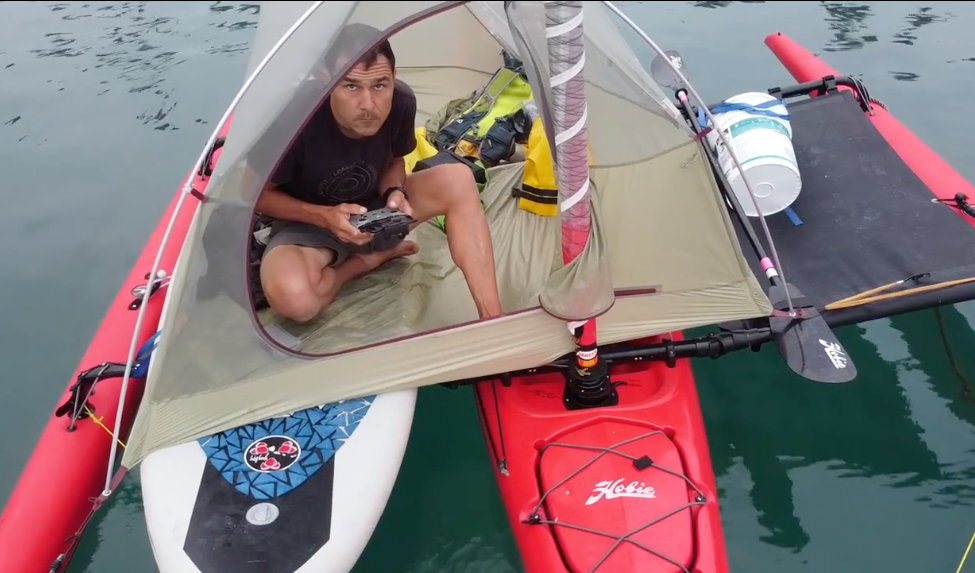 Sleeping aboard the Hobie Tandem Island. Yes, it can be done! I slept here 3 nights in a row.
I tend to be very picky about sleeping – and I also get seasick easily, so it was with great joy that I discovered I had above average sleep in the harbor in spite of bobbing around gently in every direction! This setup definitely works for me. As a result, I purchased a new paddle board that is 5 inches wider and 6 inches longer than the one in the photos (new board is 34″ wide and 10’6″ long). One could certainly come up with more elaborate sleeping platforms – including capacity for two people, but this 3 night test was enough to prove to me that it definitely works.
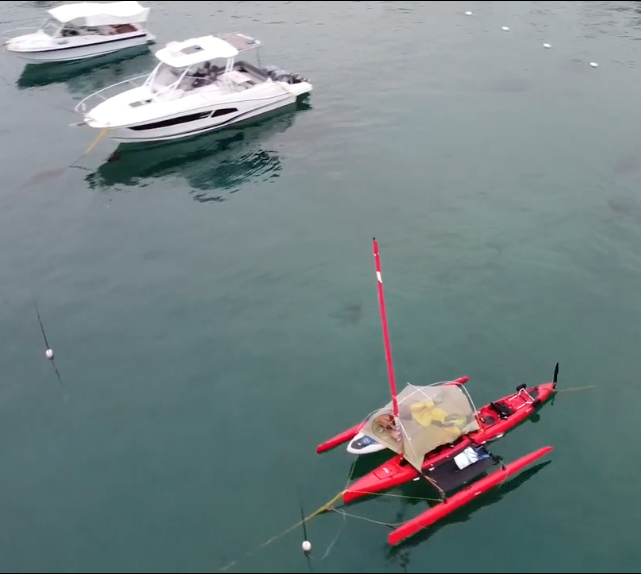 Here is an aerial view of the tent where I slept aboard the Hobie Tandem Island for 3 nights.
I came to the realization that if I were to fall off the boat in the night, that would be a deadly disaster – so I left the tent door open and the fly open (and attached to the mast) all night long. This was great for the Catalina Island climate, but it might not be suitable in locations where you’re trying to evade bugs or precipitation.
Long Distances on Hobie Tandem Island
The other thing I wanted to learn was how far can I go on the Hobie Tandem Island. Obviously, this is very dependent on winds, currents, and weather, but I found that at my “all day pace” I could average 3.5mph quite easily. The crossing to Catalina took about 7 hours each way, and both times I was happy to be done – but could have gone longer. I was able to sail the last hour or so of both crossings – dramatically increasing the speeds to about 5mph. Based on this experience, I would say that I’d be OK with doing ~25 miles in a day… but it would definitely be possible to do 30 or more – especially if you had good wind conditions. My ideal wind would be a steady 10mph wind on a “Broad Reach”. Although a Beam Reach is going to be faster, it is not quite as comfortable wave-wise as the Broad Reach. Also, once winds exceed 15mph, the sea state becomes uncomfortable in open water with a long fetch.
In the future, I hope to produce more content about things I’ve learned about this amazing craft… but for now, here you can find individual accounts for each day:
Day 1
Day 2
Day 3
Day 4
Day 6
Day 7
Day 9
Day 1:
[activity id=”12495855807″]
Day 2:
[activity id=”12505633064″]
Day 3:
[activity id=”12513368097″]
Day 4:
[activity id=”12525858670″]
Day 6:
[activity id=”12536628752″]
Day 7:
[activity id=”12548163849″]
Day 9:
[activity id=”12560330390″]
Thanks for reading!








Awesome trip. We’re planning to do Catalina this winter so fun to read your adventures.